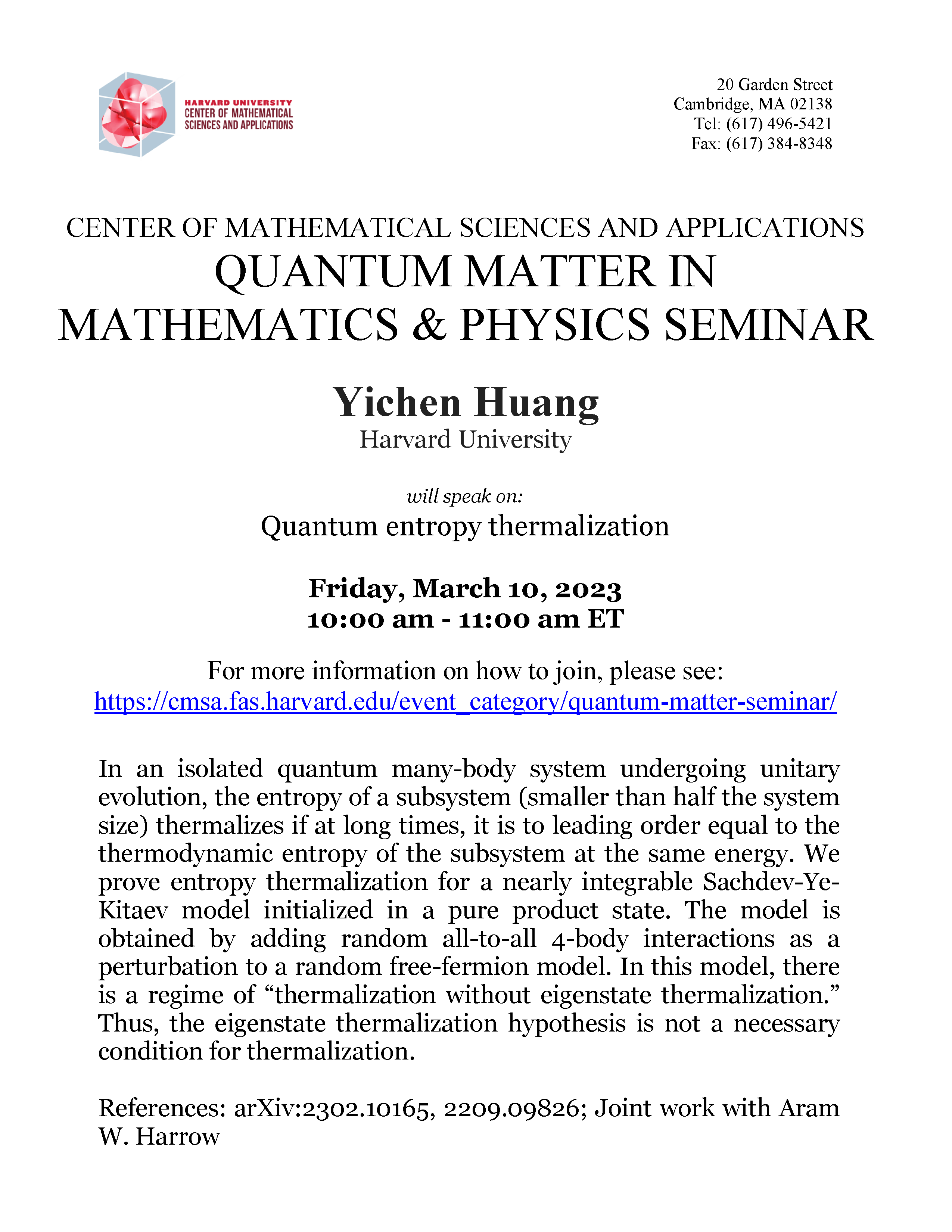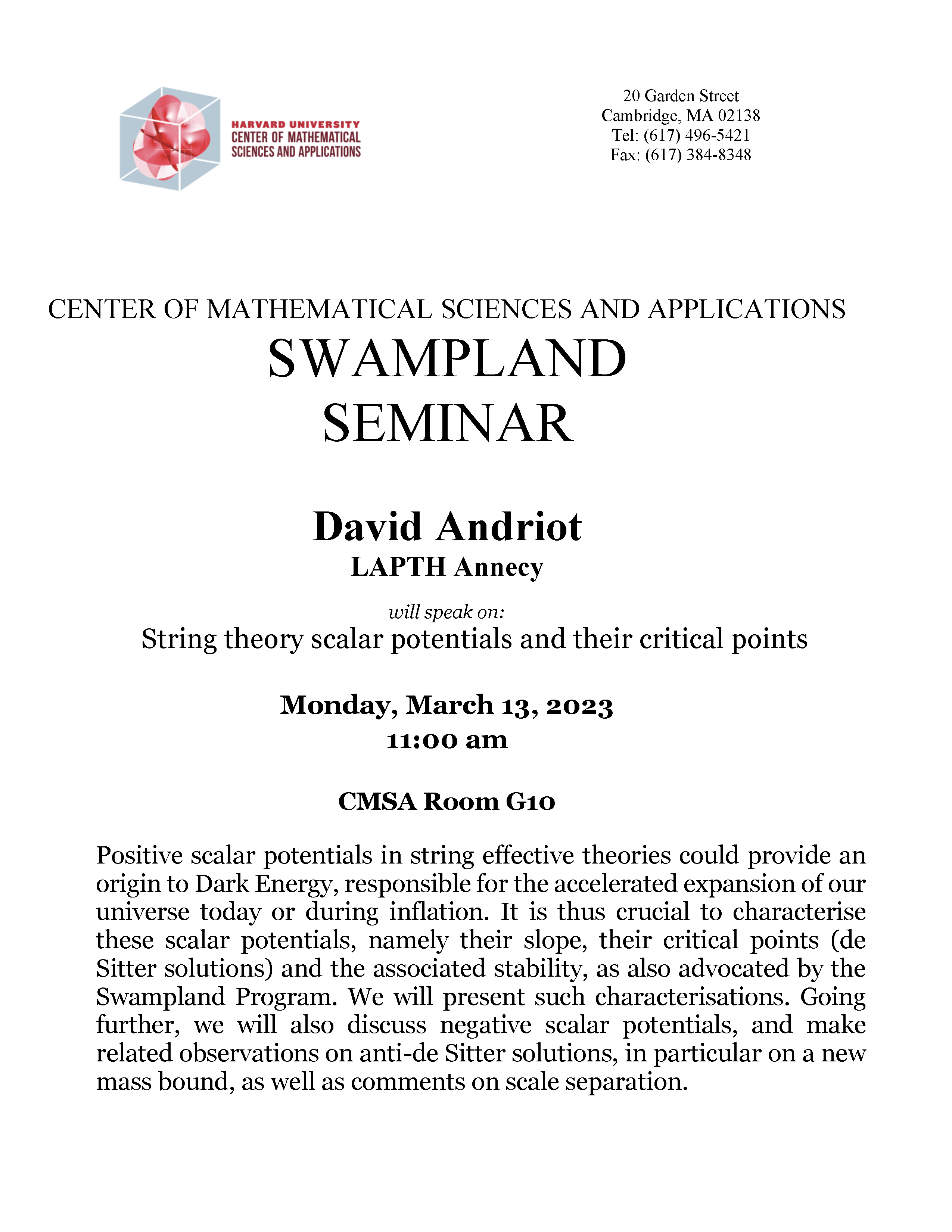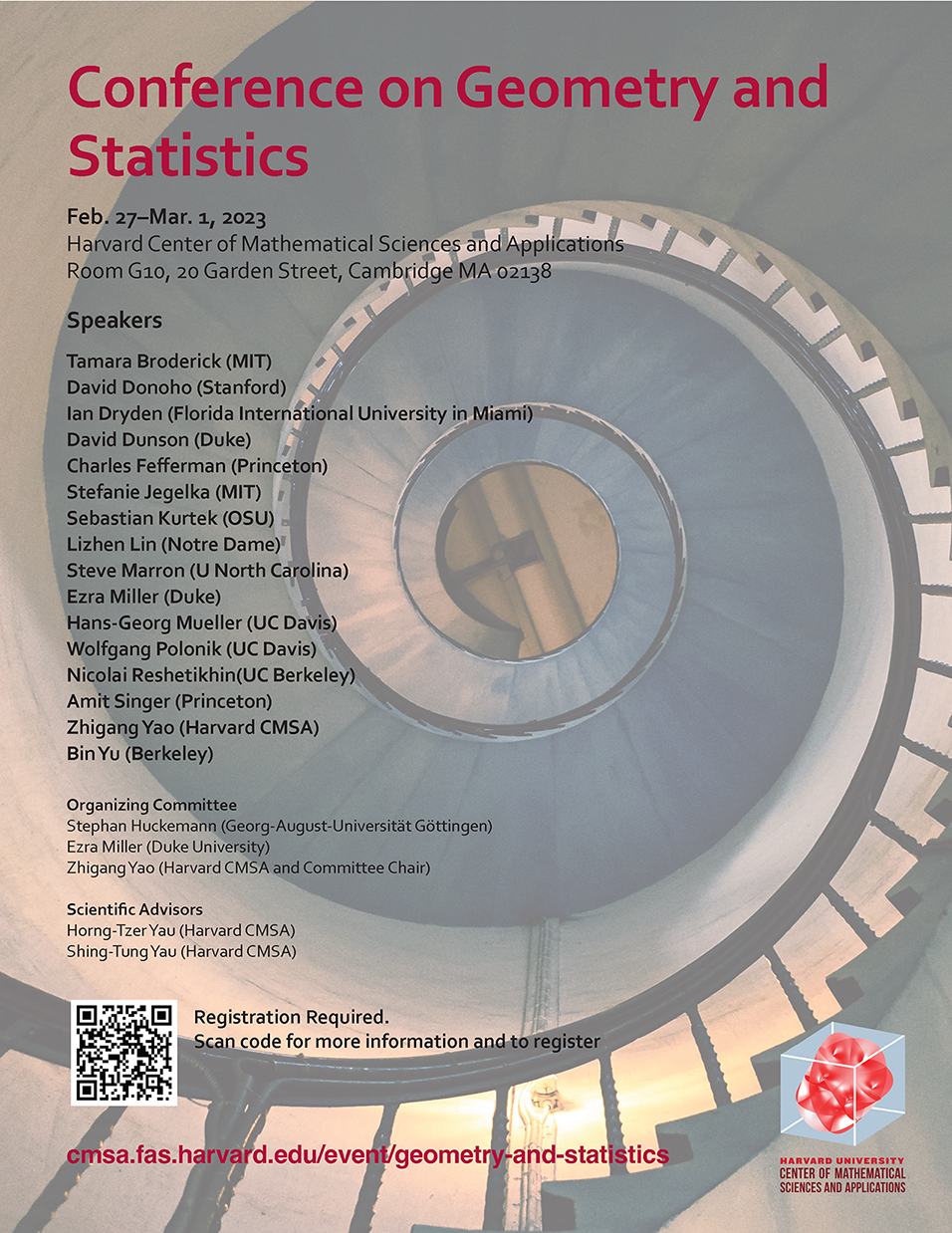
• Conference on Geometry and Statistics

    CMSA Room G10 CMSA, 20 Garden Street, Cambridge, MA, United States

    On Feb 27-March 1, 2023 the CMSA will host a Conference on Geometry and Statistics. Location: G10, CMSA, 20 Garden Street, Cambridge MA 02138 Organizing Committee: Stephan Huckemann (Georg-August-Universität Göttingen) Ezra Miller (Duke University) Zhigang Yao (Harvard CMSA and Committee Chair) Scientific Advisors: Horng-Tzer Yau (Harvard CMSA) Shing-Tung Yau (Harvard CMSA) Speakers: Tamara Broderick (MIT) […]
  • New bounds on lattice covering volumes, and nearly uniform covers

    CMSA Room G10 CMSA, 20 Garden Street, Cambridge, MA, United States

    Member Seminar Speaker: Barak Weiss   Title: New bounds on lattice covering volumes, and nearly uniform covers Abstract: Let L be a lattice in R^n and let K be a convex body. The covering volume of L with respect to K is the minimal volume of a dilate rK, such that L+rK = R^n, normalized by the […]

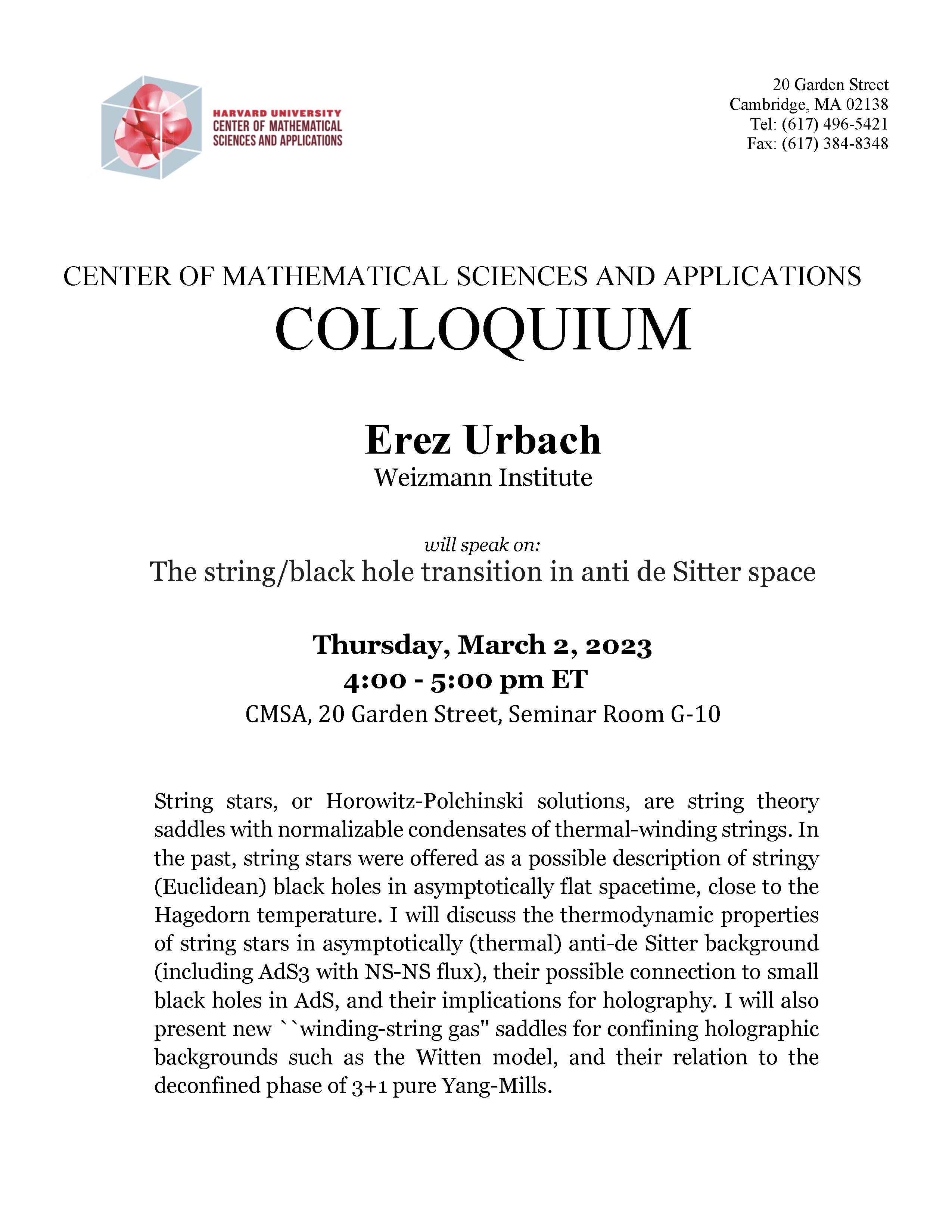
  • The string/black hole transition in anti de Sitter space

    CMSA Room G10 CMSA, 20 Garden Street, Cambridge, MA, United States

    Speaker: Erez Urbach, Weizmann Institute of Science Title: The string/black hole transition in anti de Sitter space Abstract: String stars, or Horowitz-Polchinski solutions, are string theory saddles with normalizable condensates of thermal-winding strings. In the past, string stars were offered as a possible description of stringy (Euclidean) black holes in asymptotically flat spacetime, close to the […]

  • Strongly coupled ultraviolet fixed point and symmetric mass generation in four dimensions with 8 Kähler-Dirac fermions

    Virtual

    Quantum Matter Seminar Speaker: Anna Hasenfratz (University of Colorado) Title: Strongly coupled ultraviolet fixed point and symmetric mass generation in four dimensions with 8 Kähler-Dirac fermions Abstract: 4-dimensional gauge-fermion systems exhibit a quantum phase transition from a confining, chirally broken phase to a conformal phase as the number of fermions is increased. While the existence of the conformal […]

  • Categorical Symmetry of the Standard Model from Gravitational Anomaly 

    CMSA Room G10 CMSA, 20 Garden Street, Cambridge, MA, United States

    Member Seminar Speaker: Juven Wang Title: Categorical Symmetry of the Standard Model from Gravitational Anomaly Abstract: In the Standard Model, the total "sterile right-handed" neutrino number n_{νR} is not equal to the family number Nf. The anomaly index (-Nf+n_{νR}) had been advocated to play an important role in our previous work on Cobordism and Deformation Class of […]

  • Conformal symmetry, Optimization algorithms and the Critical Phenomena

    CMSA Room G10 CMSA, 20 Garden Street, Cambridge, MA, United States

    Speaker: Ning Su, University of Pisa Title: Conformal symmetry, Optimization algorithms and the Critical Phenomena Abstract: In the phase diagram of many substances, the critical points have emergent conformal symmetry and are described by conformal field theories. Traditionally, physical quantities near the critical point can be computed by perturbative field theory method, where conformal symmetry […]

  • How to steer foundation models?

    CMSA Room G10 CMSA, 20 Garden Street, Cambridge, MA, United States

    https://youtu.be/ztk5TPYTKZA New Technologies in Mathematics Seminar Speaker: Jimmy Ba, University of Toronto Title: How to steer foundation models? Abstract: By conditioning on natural language instructions, foundation models and large language models (LLMs) have displayed impressive capabilities as general-purpose computers. However, task performance depends significantly on the quality of the prompt used to steer the model. […]

  • Pseudospectrum and black hole quasinormal mode instability: An ultraviolet universality conjecture

    CMSA Room G10 CMSA, 20 Garden Street, Cambridge, MA, United States

    https://youtu.be/teqIIXRJXd4 General Relativity Seminar Speaker: Jose Luis Jaramillo (Bourgogne U.) Title: Pseudospectrum and black hole quasinormal mode instability: an ultraviolet universality conjecture Abstract: Can we measure the ‘effective regularity’ of spacetime from the perturbation of quasi-normal mode (QNM) overtones? Black hole (BH) QNMs encode the resonant response of black holes under linear perturbations, their associated […]

  • On the free energy of spin glasses with multiple types

    Virtual

    Probability Seminar Speaker: Jean-Christophe Mourrat (ENS Lyon) Title: On the free energy of spin glasses with multiple types Abstract: In the simplest spin-glass model, due to Sherrington and Kirkpatrick, the energy function involves interaction terms between all pairs of spins. A bipartite version of this model can be obtained by splitting the spins into two […]

  • Quantum entropy thermalization

    Virtual

    Quantum Matter Seminar Speaker: Yichen Huang (Harvard) Title: Quantum entropy thermalization Abstract: In an isolated quantum many-body system undergoing unitary evolution, the entropy of a subsystem (smaller than half the system size) thermalizes if at long times, it is to leading order equal to the thermodynamic entropy of the subsystem at the same energy. We […]

  • String theory scalar potentials and their critical points

    CMSA Room G10 CMSA, 20 Garden Street, Cambridge, MA, United States

    Swampland Seminar Speaker: David Andriot (Annecy, LAPTH) Title: String theory scalar potentials and their critical points Abstract: Positive scalar potentials in string effective theories could provide an origin to Dark Energy, responsible for the accelerated expansion of our universe today or during inflation. It is thus crucial to characterize these scalar potentials, namely their slope, […]

  • Randomized algorithms in combinatorics

    CMSA Room G10 CMSA, 20 Garden Street, Cambridge, MA, United States

    Member Seminar Speaker: Michael Simkin Title: Randomized algorithms in combinatorics Abstract: Randomized algorithms have been a computational workhorse for almost as long as there have been computers. Surprisingly, such algorithms can also be used to attack problems that are neither algorithmic nor probabilistic. Time permitting I will discuss the following combintorial examples: Enumerative combinatorics and the […]