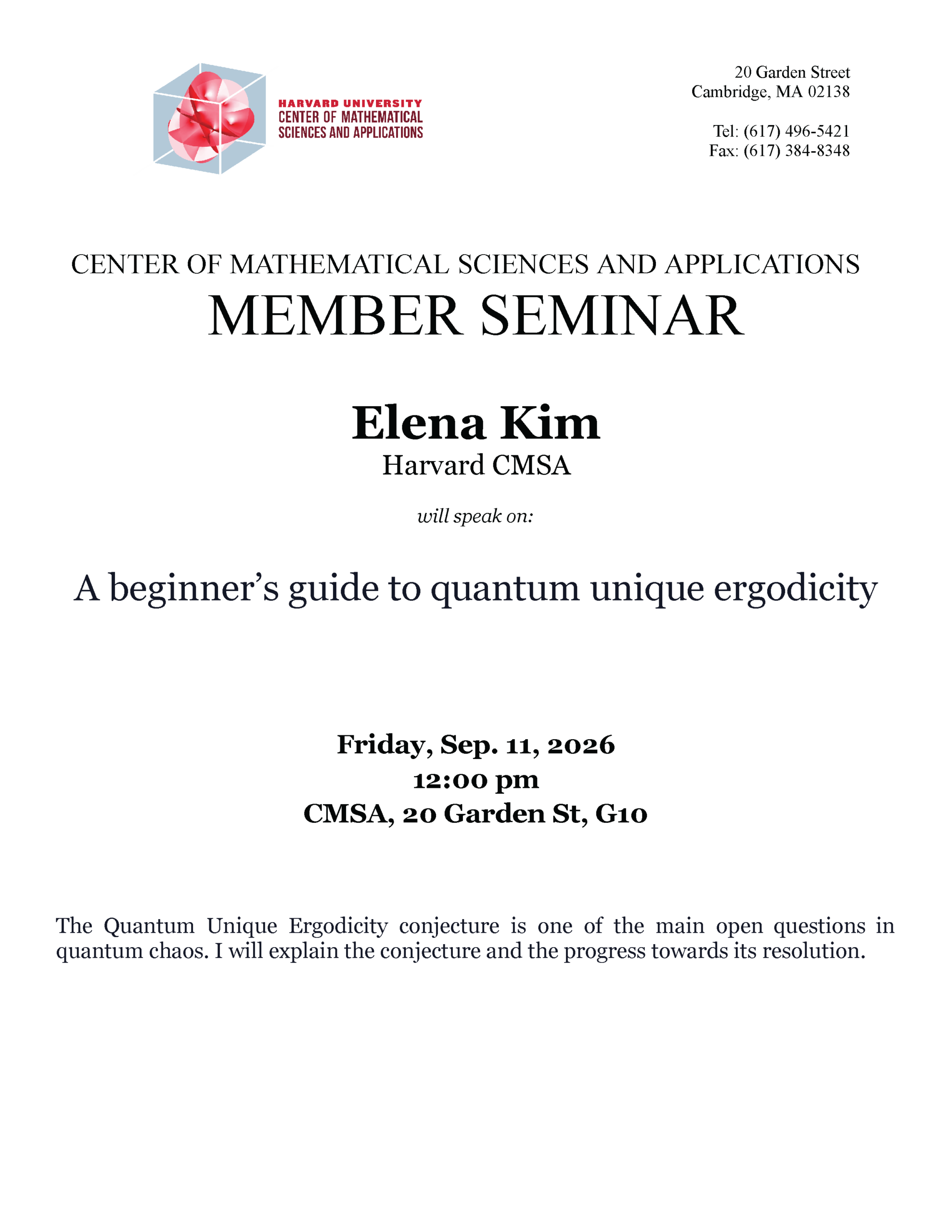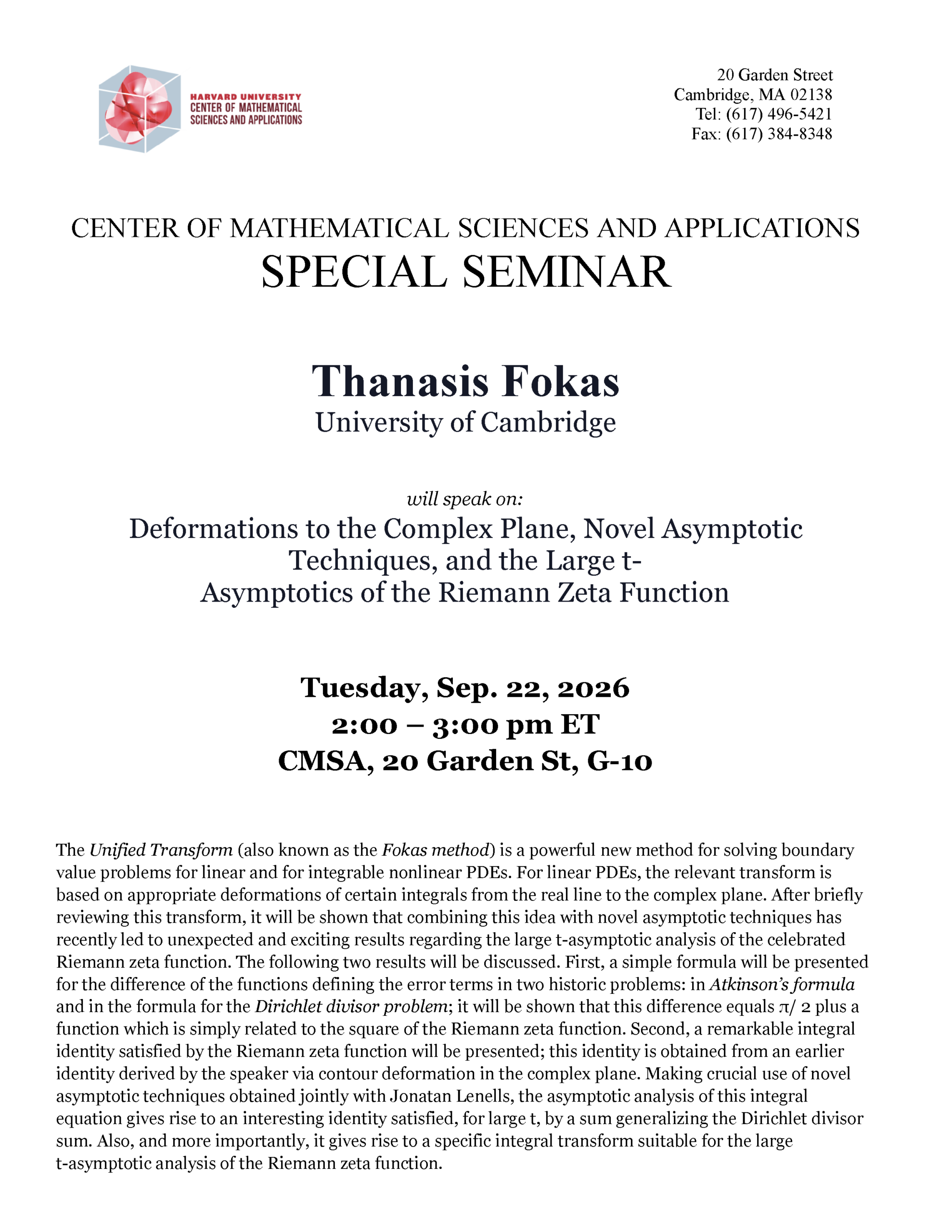
• Dynamics as intersection problem

    CMSA Room G10 CMSA, 20 Garden Street, Cambridge, MA, United States

    Colloquium Speaker: Nikita Nekrasov, Simons Center Title: Dynamics as intersection problem Abstract: Most classical and quantum field theories are based on an action principle. However, there are important exceptions to this --- hydrodynamics and the theory of self-dual fields. In this talk we formulate the covariant relativistic fluid dynamics, with or without magnetic fields, as […]

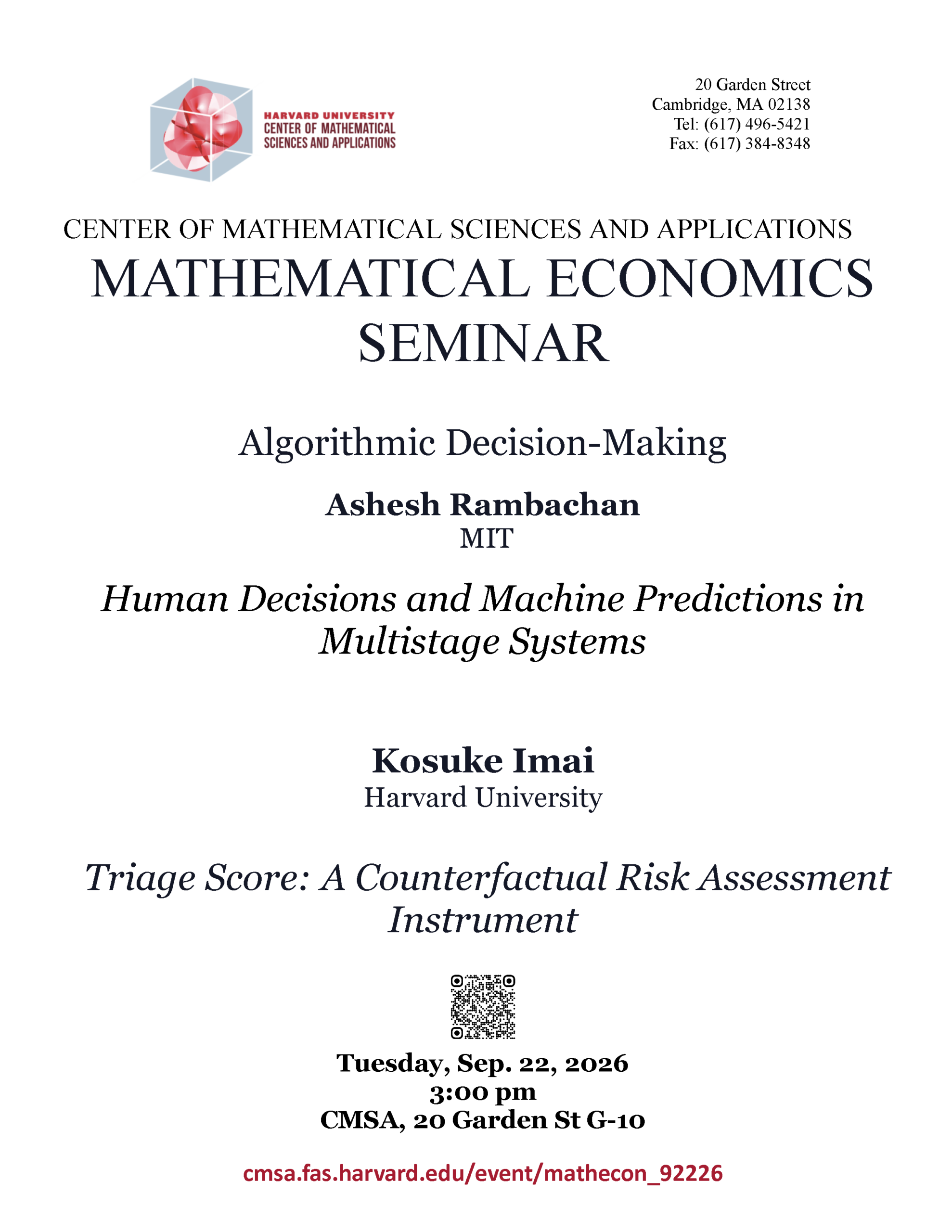
  • New directions in synthetic data

    Virtual
    Virtual Event

    New Technologies in Mathematics Seminar Speaker: Tatsunori Hashimoto, Stanford Title: New directions in synthetic data Abstract: Synthetic data has been an effective, if boring set of techniques: prompt some language model to restructure your corpus to match some downstream task, with occasionally some distillation. In this talk, we will take a more expansive view of […]

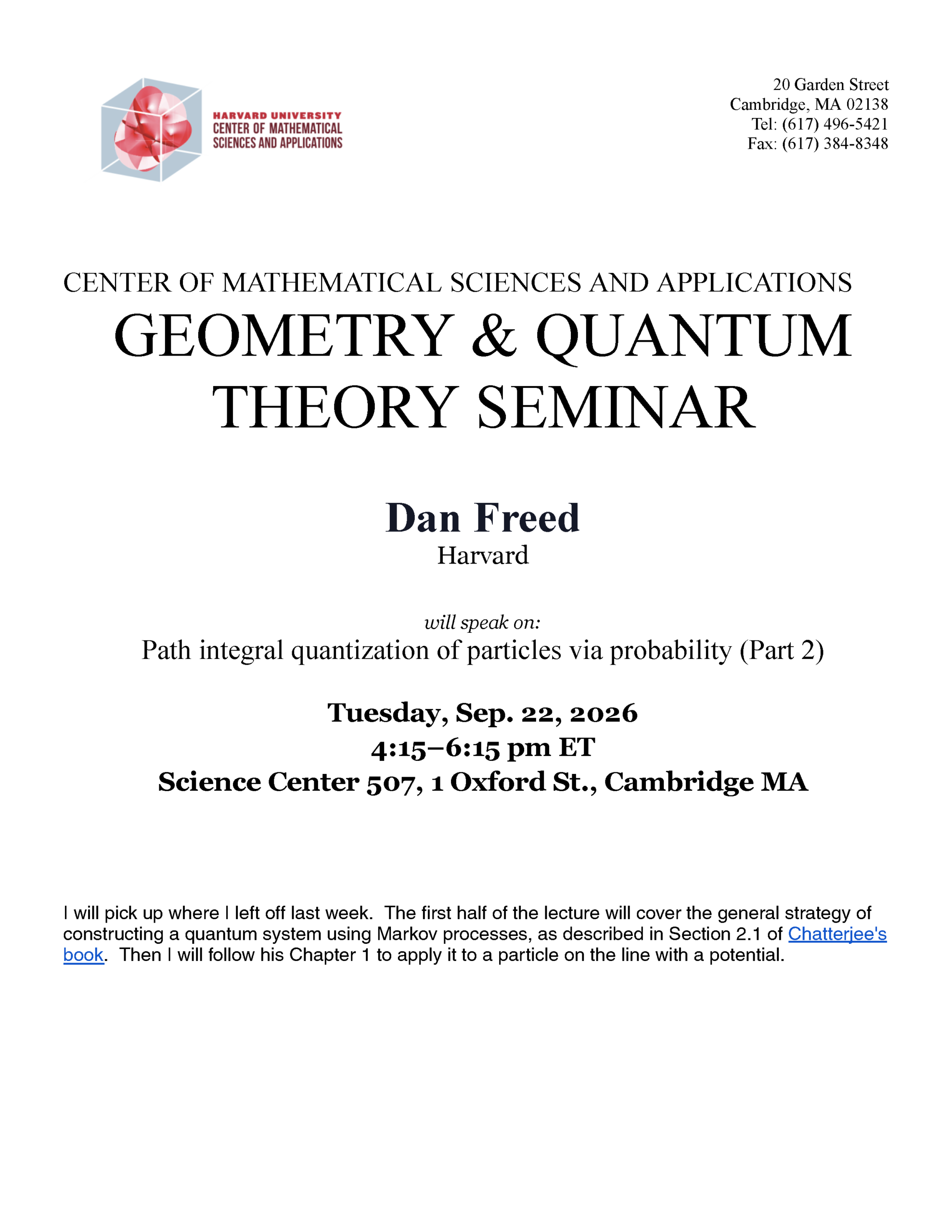
  • Statistical Shape Analysis of Complex Natural Structures

    CMSA Room G10 CMSA, 20 Garden Street, Cambridge, MA, United States

    Colloquium Speaker: Anuj Srivastava, Johns Hopkins University Title: Statistical Shape Analysis of Complex Natural Structures Abstract: Statistical modeling and analysis of structured data is a fast-growing field in Statistics and Data Science. Rapid advances in imaging techniques have led to tremendous amounts of data for analyzing imaged objects across several scientific disciplines. Examples include shapes […]

  • Polynomial invariants of conjugation over finite fields

    CMSA Room G10 CMSA, 20 Garden Street, Cambridge, MA, United States

    Algebra Seminar Speaker: Aryaman Maithani, University of Utah Title: Polynomial invariants of conjugation over finite fields Abstract: Consider the conjugation action of GL₂(K) on the polynomial ring K. When K is an infinite field, the ring of invariants is a polynomial ring generated by the trace and the determinant. We describe the ring of invariants when K is a finite field, and show that it is a hypersurface.    

  • Separation of timescales controls feature learning and overfitting in large neural networks

    Virtual
    Virtual Event

    New Technologies in Mathematics Seminar Speaker: Pierfrancesco Urbani, Universite Paris-Saclay, CNRS, CEA, Institut de physique theorique Title: Separation of timescales controls feature learning and overfitting in large neural networks Abstract: To understand the inductive bias and generalization capabilities of large, overparameterized machine learning models, it is essential to analyze the dynamics of their training algorithms. […]

  • Big Data Conference 2026

    CMSA Room G10 CMSA, 20 Garden Street, Cambridge, MA, United States

    Big Data Conference 2026 Dates: Sep. 3–4, 2026 Location: Harvard University CMSA, 20 Garden Street, Cambridge & via Zoom The Big Data Conference features speakers from the Harvard community as well as scholars from across the globe, with talks focusing on computer science, statistics, math and physics, and economics. Details TBA  

  • The Geometry of Machine Learning 2026

    CMSA 20 Garden Street Cambridge, Massachusetts 02138 United States

    The Geometry of Machine Learning 2026 Dates: September 8–11, 2026 Location: Harvard CMSA, Room G10, 20 Garden Street, Cambridge MA 02138 Organizers: Michael R. Douglas (CMSA) and Mike Freedman (CMSA)   Details TBA   Support provided by Logical Intelligence.    

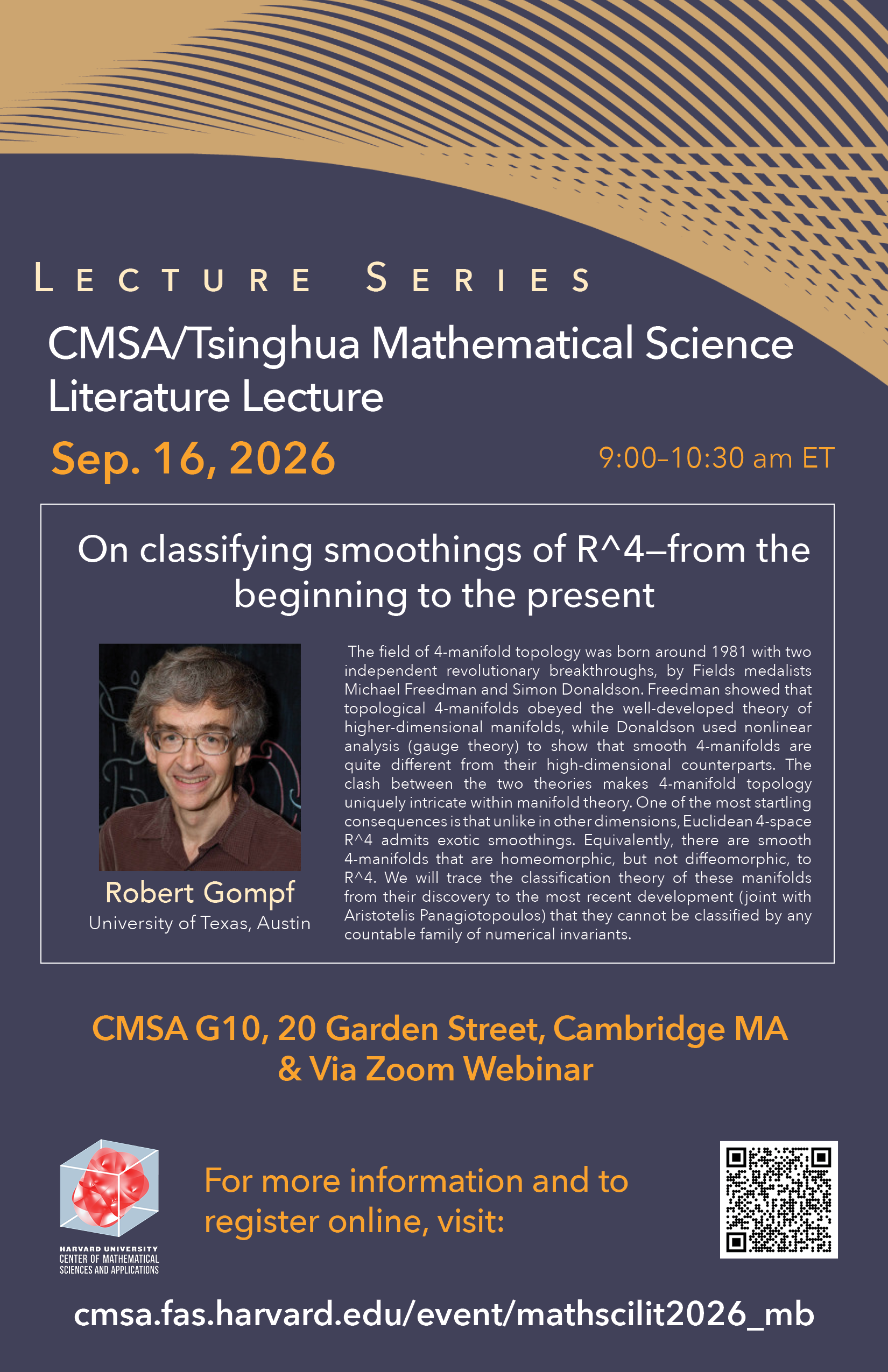
  • CMSA/Tsinghua Math-Science Literature Lecture: Robert Gompf

    CMSA Room G10 CMSA, 20 Garden Street, Cambridge, MA, United States

    CMSA/Tsinghua Math-Science Literature Lecture Date: September 16, 2026 Time: 9:00 - 10:30 am ET Location: CMSA G10, 20 Garden Street & via Zoom Webinar Speaker: Robert E. Gompf, University of Texas, Austin   Beginning in Spring 2020, the CMSA began hosting a lecture series on literature in the mathematical sciences, with a focus on significant […]