• Holography and Regge Phases at Large U(1) Charge

    CMSA Room G10 CMSA, 20 Garden Street, Cambridge, MA, United States

    Quantum Field Theory and Physical Mathematics Seminar Speaker: Giulia Fardelli, Boston University Title: Holography and Regge Phases at Large U(1) Charge Abstract: A single Conformal Field Theory (CFT) can have a rich phase diagram with qualitatively different emergent behaviors in a range of different regimes parameterized by the conserved charges of the theory. In this […]

  • Dolbeault Virasoro algebra and M5 branes

    CMSA Room G10 CMSA, 20 Garden Street, Cambridge, MA, United States

    Quantum Field Theory and Physical Mathematics Seminar Speaker: Brian Williams, Boston University Title: Dolbeault Virasoro algebra and M5 branes Abstract: The worldvolume theory on a stack of M5 branes in M-theory is superconformal. We propose a conjecture that in the holomorphic twist of the theory on a stack of M5 branes an infinite-dimensional enhancement of […]

  • Bosonic and fermionic 1-form symmetries and anomaly matching

    CMSA Room G10 CMSA, 20 Garden Street, Cambridge, MA, United States

    Quantum Field Theory and Physical Mathematics Seminar *via Zoom only* Speaker: Rajath Radhakrishnan (ICTP, Trieste) Title: Bosonic and fermionic 1-form symmetries and anomaly matching Abstract: In this talk, I will consider bosonic and fermionic (non-invertible) 1-form symmetries in 2+1d QFTs. These are 1-form symmetries implemented by topological line operators with real spins. I will present a classification […]

  • The spin-statistics theorem for TFTs

    CMSA Room G10 CMSA, 20 Garden Street, Cambridge, MA, United States

    Quantum Field Theory and Physical Mathematics Seminar Speaker: Luuk Stehouwer, Dalhousie University Title: The spin-statistics theorem for TFTs Abstract: In quantum field theory (QFT) the spin-statistics theorem says that in a unitary QFT, a particle has half-integer spin if and only if it is a fermion. I show how to phrase this statement in the […]

  • Representations of minimal W-algebras: unitarity and modular invariance

    Virtual

    Quantum Field Theory and Physical Mathematics Seminar Speaker: Victor Kac (MIT) Title: Representations of minimal W-algebras: unitarity and modular invariance Abstract: The minimal W-algebras, obtained by quantum Hamiltonian reduction from affina vertex algebras, form the most interesting class of vertex algebras, which includes all superconformal algebras: Virasoro, Neveu-Scharz, N=2, 3, 4, and big N=4. I will […]

  • Emergent Non-Invertible Symmetries —The Adjoint QCD Example

    CMSA Room G10 CMSA, 20 Garden Street, Cambridge, MA, United States

    Quantum Field Theory and Physical Mathematics Seminar Speaker: Shani Nadir Meynet (Uppsala) Title: Emergent Non-Invertible Symmetries — The Adjoint QCD Example Abstract: After reviewing some general properties of generalized symmetries and the renormalization group (RG) flow for quantum field theories (QFT), I'll describe how the recently discovered non-invertible symmetries can be used to study theories […]
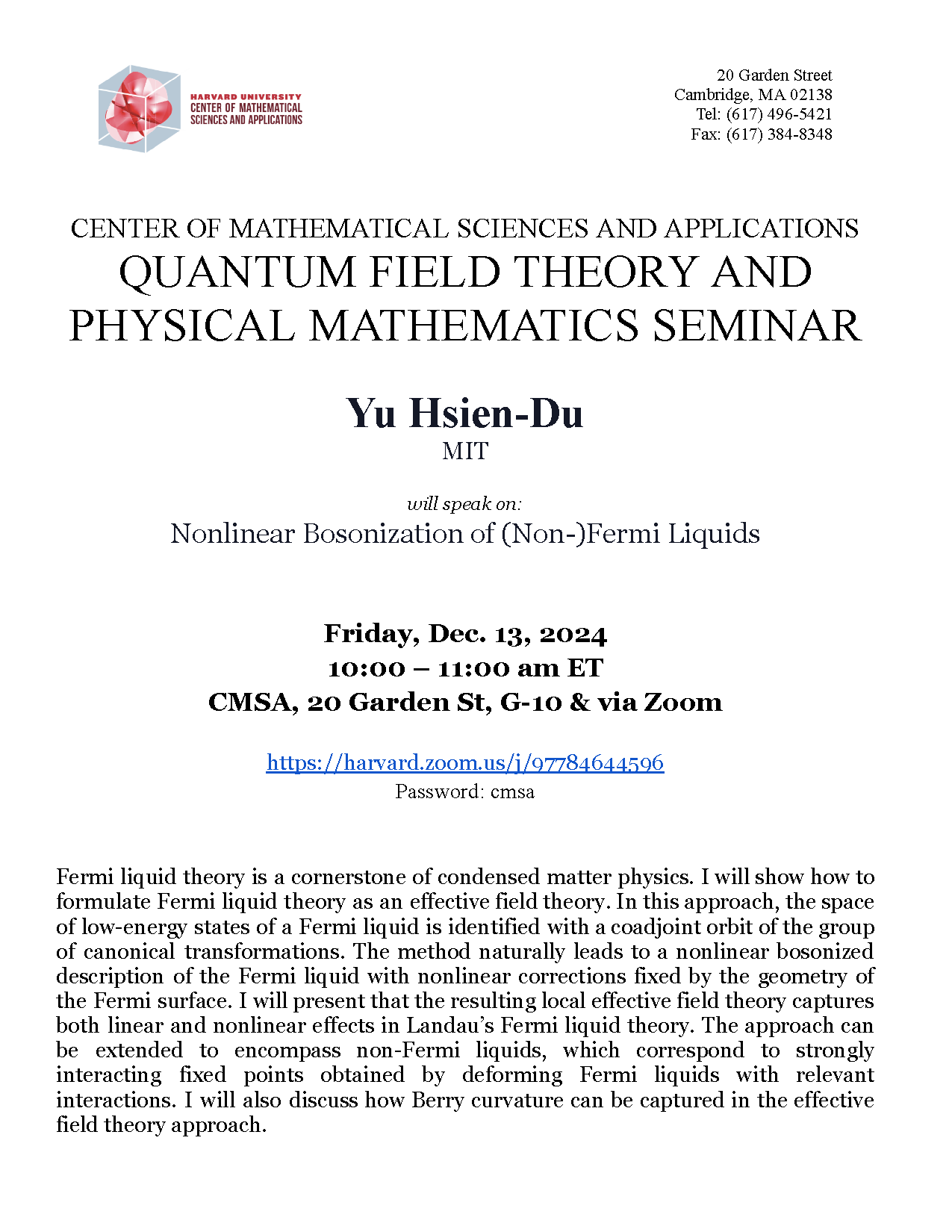
  • Nonlinear Bosonization of (Non-)Fermi Liquids

    CMSA Room G10 CMSA, 20 Garden Street, Cambridge, MA, United States

    Quantum Field Theory and Physical Mathematics Seminar Speaker: Yi-Hsien Du (MIT) Title: Nonlinear Bosonization of (Non-)Fermi Liquids Abstract: Fermi liquid theory is a cornerstone of condensed matter physics. I will show how to formulate Fermi liquid theory as an effective field theory. In this approach, the space of low-energy states of a Fermi liquid is identified with a […]

  • A homotopy of 2d SCFTs and an implication for Topological Modular Forms

    CMSA Room G10 CMSA, 20 Garden Street, Cambridge, MA, United States

    Quantum Field Theory and Physical Mathematics Seminar Speaker: Vivek Saxena (YITP Stony Brook and NHETC Rutgers) Title: A homotopy of 2d SCFTs and an implication for Topological Modular Forms Abstract: The Segal-Stolz-Teichner conjecture states that there exists an isomorphism between deformation classes of two-dimensional N=(0,1) superconformal field theories (SCFTs) and generalized cohomology classes known as […]

  • Topological to Gravitational Leptogenesis, via Ultra Unification 

    CMSA Room G10 CMSA, 20 Garden Street, Cambridge, MA, United States

    Quantum Field Theory and Physical Mathematics Seminar Speaker: Juven Wang (LIMS, Royal Institution) Title: Topological to Gravitational Leptogenesis, via Ultra Unification Abstract: We propose a new mechanism for leptogenesis, named Topological Leptogenesis, in which dark matter consists of topological order, so gapped anyon excitations decay to generate the Standard Model lepton asymmetry. Topological Leptogenesis is in […]

  • On 5d conformal matter

    Virtual

    Quantum Field Theory and Physical Mathematics Seminar Speaker: Mario De Marco (UL Brussels) Title: On 5d conformal matter Abstract: SCFTs with 8 supercharges lie at the sweet spot of the classification program of susy scale-invariant theories: with this amount of susy, the classification is in principle achievable, despite being non-trivial. In this talk, I will present […]

  • Toward constructing a large-scale quantum computer based on TQFT

    CMSA Room G10 CMSA, 20 Garden Street, Cambridge, MA, United States

    Quantum Field Theory and Physical Mathematics Seminar Speaker: Liyuan Chen ( Harvard) Title: Toward constructing a large-scale quantum computer based on TQFT Abstract: Topological quantum computation, motivated by topological quantum field theory (TQFT), offers a promising path toward fault-tolerant universal quantum computation. However, the practical realization of such a system remains challenging due to the […]

  • Quantum Field Theory and Physical Mathematics

    CMSA Room G10 CMSA, 20 Garden Street, Cambridge, MA, United States

    Quantum Field Theory and Physical Mathematics Seminar Speaker: Kai Xu, Harvard Title: Finite Landscape of 6d N=(1,0) Supergravity Abstract: We present a bottom-up argument showing that the number of massless fields in six-dimensional quantum gravitational theories with eight supercharges is uniformly bounded. Specifically, we show that the number of tensor multiplets is bounded by T≤193, and the […]