• Local Donaldson-Scaduto conjecture

    Common Room, CMSA 20 Garden Street, Cambridge, MA, United States

    Member Seminar Speaker: Saman Habibi Esfahani Title: Local Donaldson-Scaduto conjecture Abstract: This talk is based on joint works with Gora Bera and Yang Li. Motivated by collapsing Calabi-Yau 3-folds and G2-manifolds with Lefschetz K3 fibrations in the adiabatic setting, Donaldson and Scaduto conjectured the existence and uniqueness of a special Lagrangian pair-of-pants in the Calabi-Yau […]
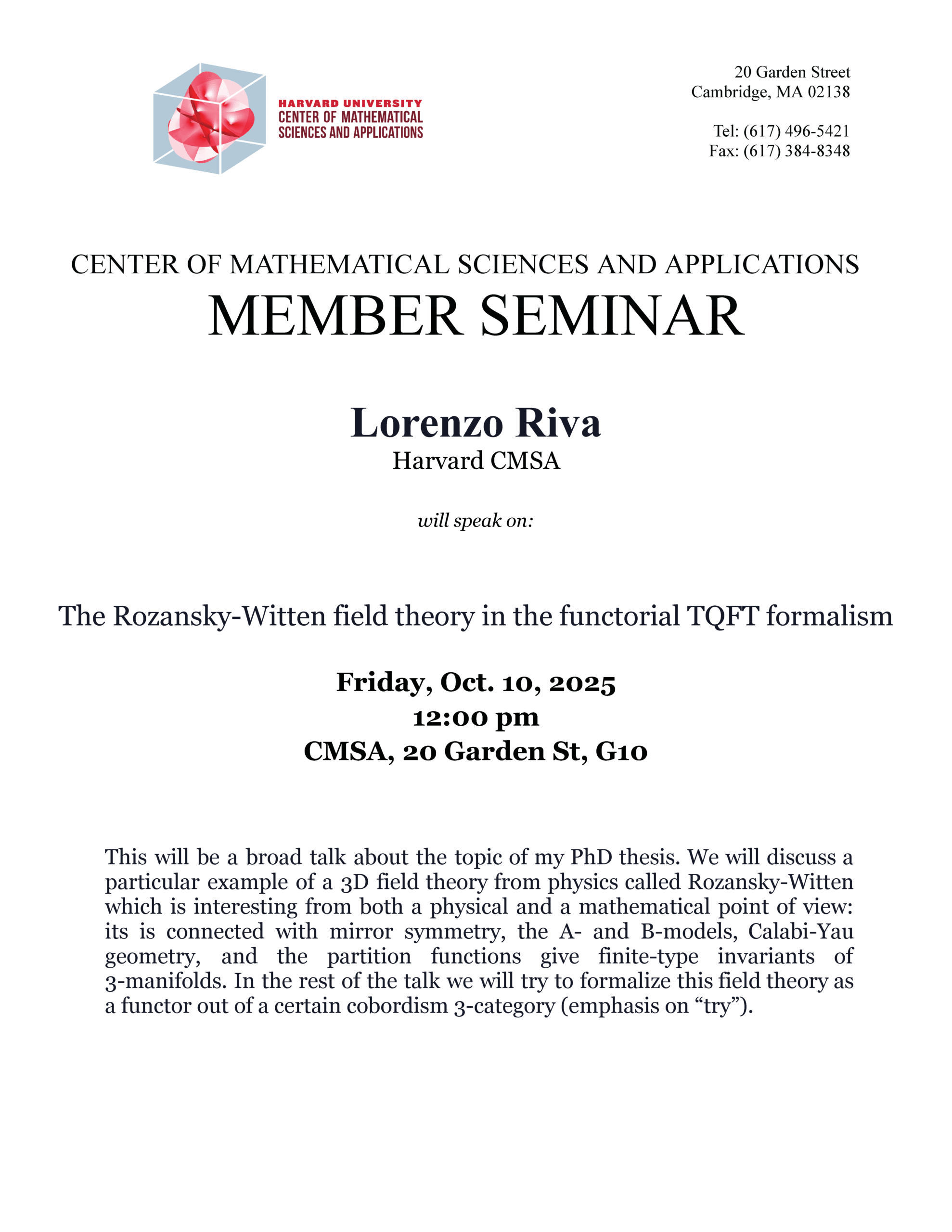
  • The Rozansky-Witten field theory in the functorial TQFT formalism

    Common Room, CMSA 20 Garden Street, Cambridge, MA, United States

    Member Seminar Speaker: Lorenzo Riva Title: The Rozansky-Witten field theory in the functorial TQFT formalism Abstract: This will be a broad talk about the topic of my PhD thesis. We will discuss a particular example of a 3D field theory from physics called Rozansky-Witten which is interesting from both a physical and a mathematical point […]

  • DMFT, Two Point Correlations of Resolvents, and Applications to Machine Learning Theory

    Common Room, CMSA 20 Garden Street, Cambridge, MA, United States

    Member Seminar Speaker: Blake Bordelon Title: DMFT, Two Point Correlations of Resolvents, and Applications to Machine Learning Theory Abstract: Machine learning algorithms evolve the parameters of a model in a high dimensional and disordered loss landscape. To characterize the effects of random initialization of model parameters, randomly sampled training data, and the effect of SGD noise, it […]

  • Analytic Spread of Binomial Edge Ideals

    Common Room, CMSA 20 Garden Street, Cambridge, MA, United States

    Member Seminar Speaker: Stephen Landsittel, CMSA Title: Analytic Spread of Binomial Edge Ideals Abstract: To an ideal J in a polynomial ring R over a field K we associate its analytic spread \ell(J), which is the dimension of the fiber cone F(J) of J. When J is graded and generated in a single degree d, then […]

  • Skein remain the same

    Common Room, CMSA 20 Garden Street, Cambridge, MA, United States

    Member Seminar Speaker: Sunghyuk Park, CMSA Title: Skein remain the same Abstract: The count of holomorphic curves in a Calabi-Yau 3-fold ending on a Lagrangian is famously not deformation invariant, but Ekholm and Shende have shown that it can be made invariant by counting in the skein. Given a 3-manifold M and a branched cover arising from […]

  • Classification of 2D Stabilizer States

    Common Room, CMSA 20 Garden Street, Cambridge, MA, United States

    Member Seminar Speaker: Bowen Yang Title: Classification of 2D Stabilizer States Abstract: I will explain how translation-invariant two-dimensional stabilizer states are completely classified by finite abelian groups with nondegenerate quadratic forms—that is, by abelian anyon theories. The proof uses the algebraic structure of stabilizer codes as modules over Laurent polynomial rings, revealing how their physical […]

  • Optimal learning protocols via statistical physics and control theory

    Common Room, CMSA 20 Garden Street, Cambridge, MA, United States

    Member Seminar Speaker: Francesco Mori, CMSA Title: Optimal learning protocols via statistical physics and control theory Abstract: Behind the impressive performance of modern machine learning lies a toolkit of training tricks, from tuning learning rates to curating training data. These heuristics are powerful but hard to interpret and possibly suboptimal, leaving open the challenge of finding general […]

  • A combinatorial formula for interpolation Macdonald polynomials

    Common Room, CMSA 20 Garden Street, Cambridge, MA, United States

    Member Seminar Speaker: Houcine Ben Dali, Harvard CMSA Title: A combinatorial formula for interpolation Macdonald polynomials Abstract: In 1996, Knop and Sahi introduced a remarkable family of inhomogeneous symmetric polynomials, defined via vanishing conditions, whose top homogeneous parts are exactly the Macdonald polynomials. Like the Macdonald polynomials, these interpolation Macdonald polynomials are closely connected to […]

  • Some results about saturation

    Common Room, CMSA 20 Garden Street, Cambridge, MA, United States

    Member Seminar Speaker: Stephen Landsittel Title: Some results about saturation Abstract: Given a local ring R we can ask when saturation of ideals in R commutes with other operations on ideals (such as extension to a ring containing R). We show that the condition that extension of ideals along a ring map R \to S […]

  • A beginner’s guide to quantum unique ergodicity

    CMSA Room G10 CMSA, 20 Garden Street, Cambridge, MA, United States

    Member Seminar Speaker: Elena Kim Title: A beginner's guide to quantum unique ergodicity Abstract: The Quantum Unique Ergodicity conjecture is one of the main open questions in quantum chaos. I will explain the conjecture and the progress towards its resolution.

  • Member Seminar

    CMSA Room G10 CMSA, 20 Garden Street, Cambridge, MA, United States

    Member Seminar Speaker: Lorenzo Riva, CMSA Title: Un-extending extended TQFTs Abstract: An ordinary topological quantum field theory (TQFT) assigns invariants to manifolds of dimensions n in a way that is compatible with cutting-and-gluing along submanifolds of dimension n-1. An extended TQFT assigns invariants that are also compatible with cutting along submanifolds of all codimensions. One way to […]

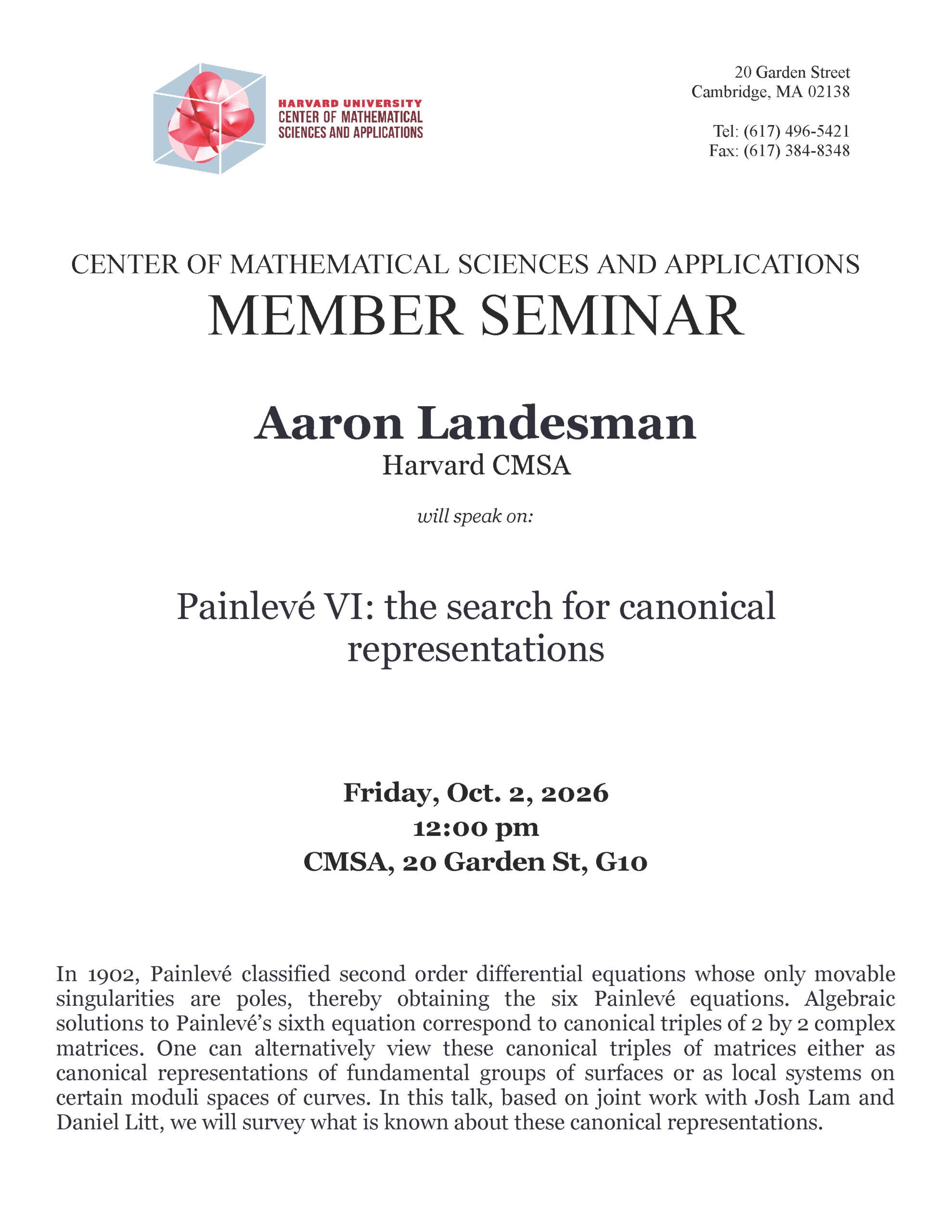
  • Painlevé VI: the search for canonical representations

    CMSA Room G10 CMSA, 20 Garden Street, Cambridge, MA, United States

    Member Seminar Speaker: Aaron Landesman Title: Painlevé VI: the search for canonical representations Abstract: In 1902, Painlevé classified second order differential equations whose only movable singularities are poles, thereby obtaining the six Painlevé equations. Algebraic solutions to Painlevé's sixth equation correspond to canonical triples of 2 by 2 complex matrices. One can alternatively view these […]