• SYZ Conjecture beyond Mirror Symmetry

    Virtual

    Abstract: Strominger-Yau-Zaslow conjecture is one of the guiding principles in mirror symmetry, which not only predicts the geometric structures of Calabi-Yau manifolds but also provides a recipe for mirror construction. Besides mirror symmetry, the SYZ conjecture itself is the holy grail in geometrical analysis and closely related to the behavior of the Ricci-flat metrics. In this talk, […]
  • Quantum Oscillations of Electrical Resistivity in an Insulator

    Virtual

    Speaker: Lu Li (U Michigan) Title: Quantum Oscillations of Electrical Resistivity in an Insulator Abstract: In metals, orbital motions of conduction electrons are quantized in magnetic fields, which is manifested by quantum oscillations in electrical resistivity. This Landau quantization is generally absent in insulators, in which all the electrons are localized. Here we report a notable exception […]

  • Learning and inference from sensitive data

    Virtual

    Speaker: Adam Smith (Boston University) Title: Learning and inference from sensitive data Abstract: Consider an agency holding a large database of sensitive personal information—say,  medical records, census survey answers, web searches, or genetic data. The agency would like to discover and publicly release global characteristics of the data while protecting the privacy of individuals’ records. I will discuss recent (and not-so-recent) results on this problem with […]

  • Curve-counting with fixed domain (“Tevelev degrees”)

    Virtual

    Abstract: We will consider the following problem: if (C,x_1,…,x_n) is a fixed general pointed curve, and X is a fixed target variety with general points y_1,…,y_n, then how many maps f:C -> X in a given homology class are there, such that f(x_i)=y_i? When considered virtually in Gromov-Witten theory, the answer may be expressed in terms of […]

  • The smooth closing lemma for area-preserving surface diffeomorphisms

    Virtual

    Speaker: Boyu Zhang, Princeton University Title: The smooth closing lemma for area-preserving surface diffeomorphisms Abstract: In this talk, I will introduce the smooth closing lemma for area-preserving diffeomorphisms on surfaces. The proof is based on a Weyl formula for PFH spectral invariants and a non-vanishing result of twisted Seiberg- Witten Floer homology. This is joint work […]

  • Unreasonable effectiveness of the quantum complexity view on quantum many-body physics

    Virtual

    https://youtu.be/wKCgR3aFpnc Speaker: Anurag Anshu, Department of EECS & Challenge Institute for Quantum Computation, UC Berkeley Title: Unreasonable effectiveness of the quantum complexity view on quantum many-body physics Abstract: A central challenge in quantum many-body physics is to estimate the properties of natural quantum states, such as the quantum ground states and Gibbs states. Quantum Hamiltonian complexity […]

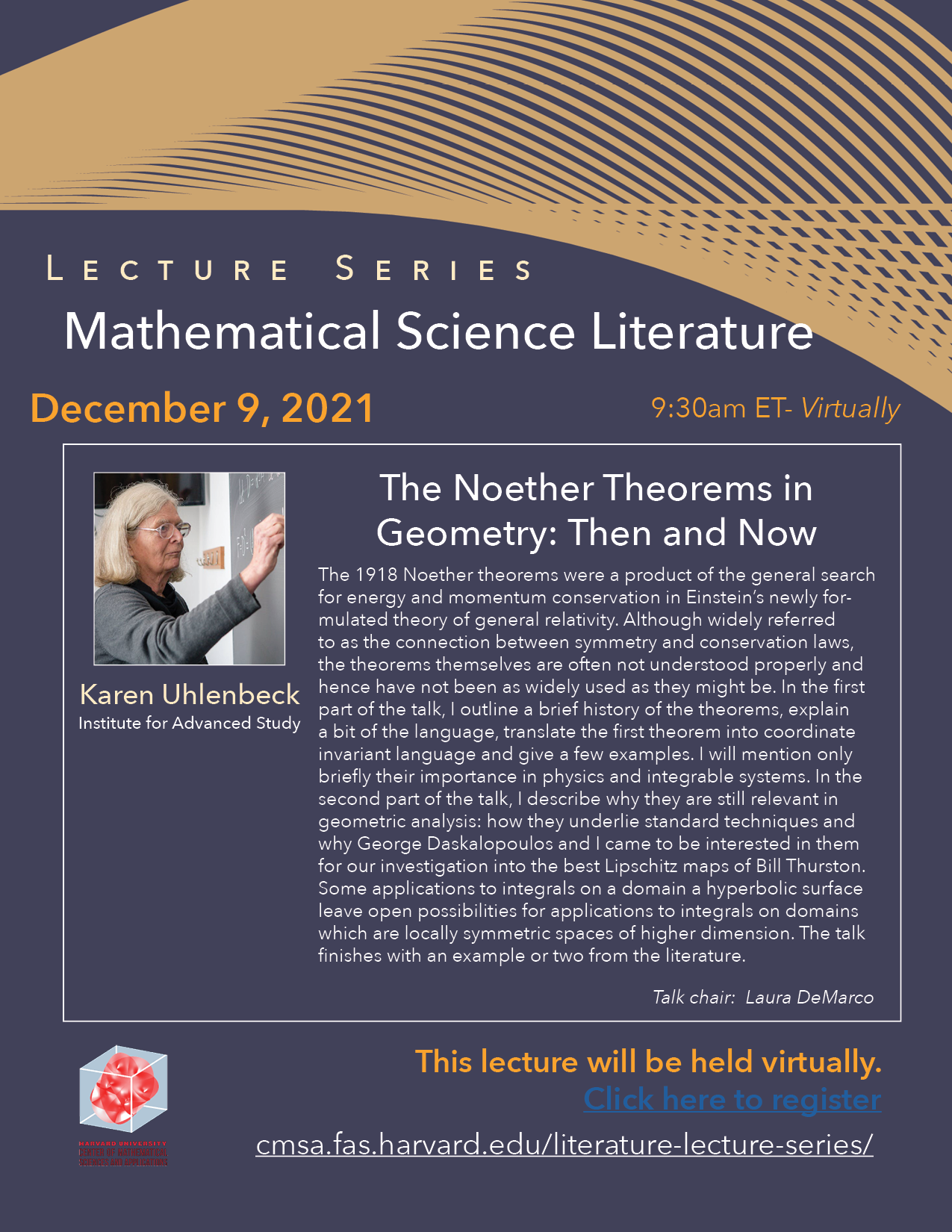
  • CMSA Math-Science Literature Lecture – Karen Uhlenbeck

    Virtual

    Karen Uhlenbeck (Institute for Advanced Study) Title: The Noether Theorems in Geometry: Then and Now Abstract: The 1918 Noether theorems were a product of the general search for energy and momentum conservation in Einstein’s newly formulated theory of general relativity. Although widely referred to as the connection between symmetry and conservation laws, the theorems themselves […]

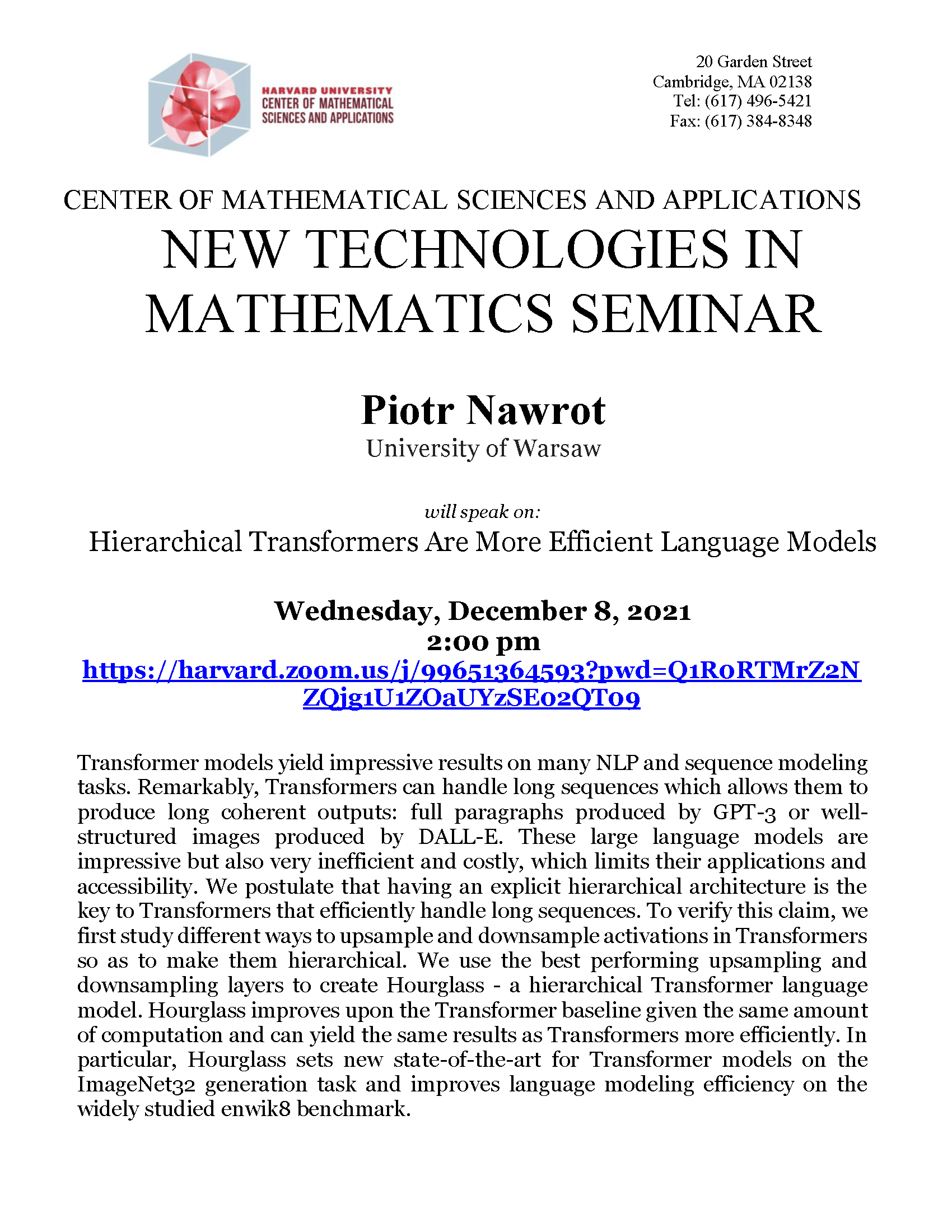
  • Hierarchical Transformers are More Efficient Language Models

    Virtual

    https://youtu.be/soqWNyrdjkw Speaker: Piotr Nawrot, University of Warsaw Title: Hierarchical Transformers are More Efficient Language Models Abstract: Transformer models yield impressive results on many NLP and sequence modeling tasks. Remarkably, Transformers can handle long sequences which allows them to produce long coherent outputs: full paragraphs produced by GPT-3 or well-structured images produced by DALL-E. These large language […]

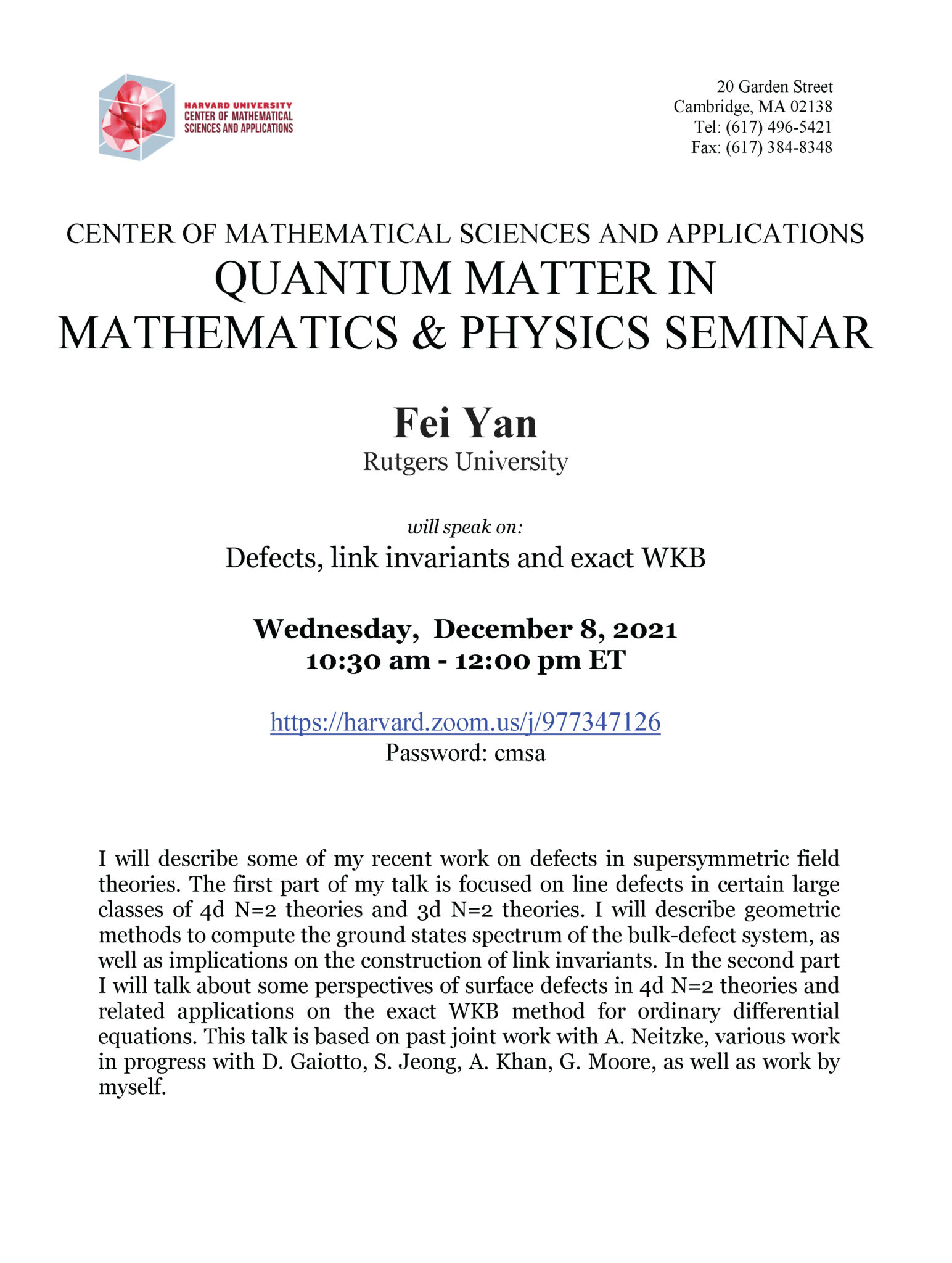
  • Defects, link invariants and exact WKB

    Virtual

    Speaker: Fei Yan (Rutgers) Title: Defects, link invariants and exact WKB Abstract: I will describe some of my recent work on defects in supersymmetric field theories. The first part of my talk is focused on line defects in certain large classes of 4d N=2 theories and 3d N=2 theories. I will describe geometric methods to compute the […]

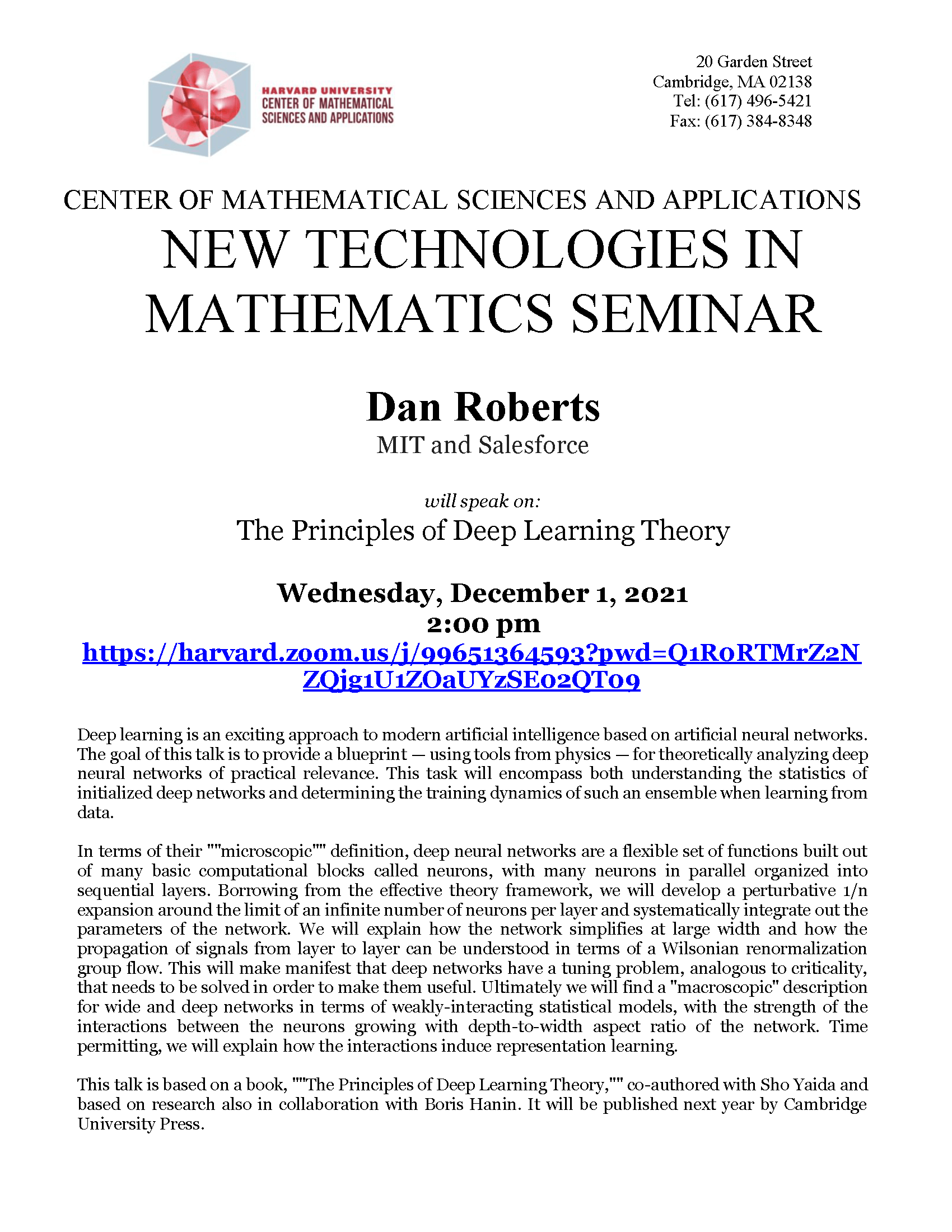
  • The Principles of Deep Learning Theory

    Virtual

    https://youtu.be/wXZKoHEzASg Speaker: Dan Roberts, MIT & Salesforce Title: The Principles of Deep Learning Theory Abstract: Deep learning is an exciting approach to modern artificial intelligence based on artificial neural networks. The goal of this talk is to provide a blueprint — using tools from physics — for theoretically analyzing deep neural networks of practical relevance. This […]