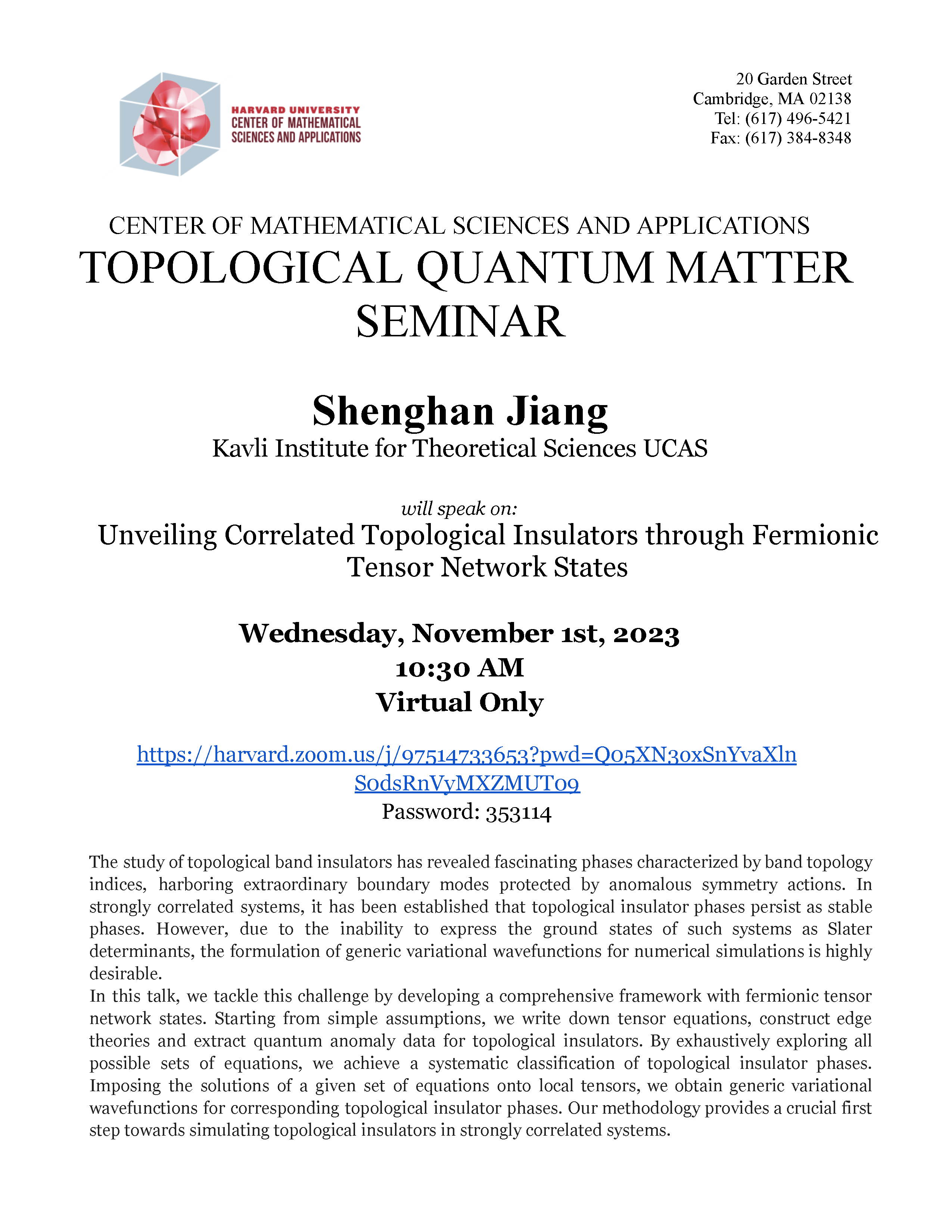
• Classification of Self-Dual Vertex Operator Superalgebras of Central Charge at Most 24

    Virtual

    Quantum Matter Seminar Speakers: Gerald Höhn (Kansas State University) & Sven Möller (University of Hamburg) Title: Classification of Self-Dual Vertex Operator Superalgebras of Central Charge at Most 24 Abstract: We discuss the classfication of self-dual vertex operator superalgebras (SVOAs) of central charge 24, or in physics parlance the purely chiral 2-dimensional fermionic conformal field theories […]

  • Anomalies of (1+1)D categorical symmetries

    Virtual

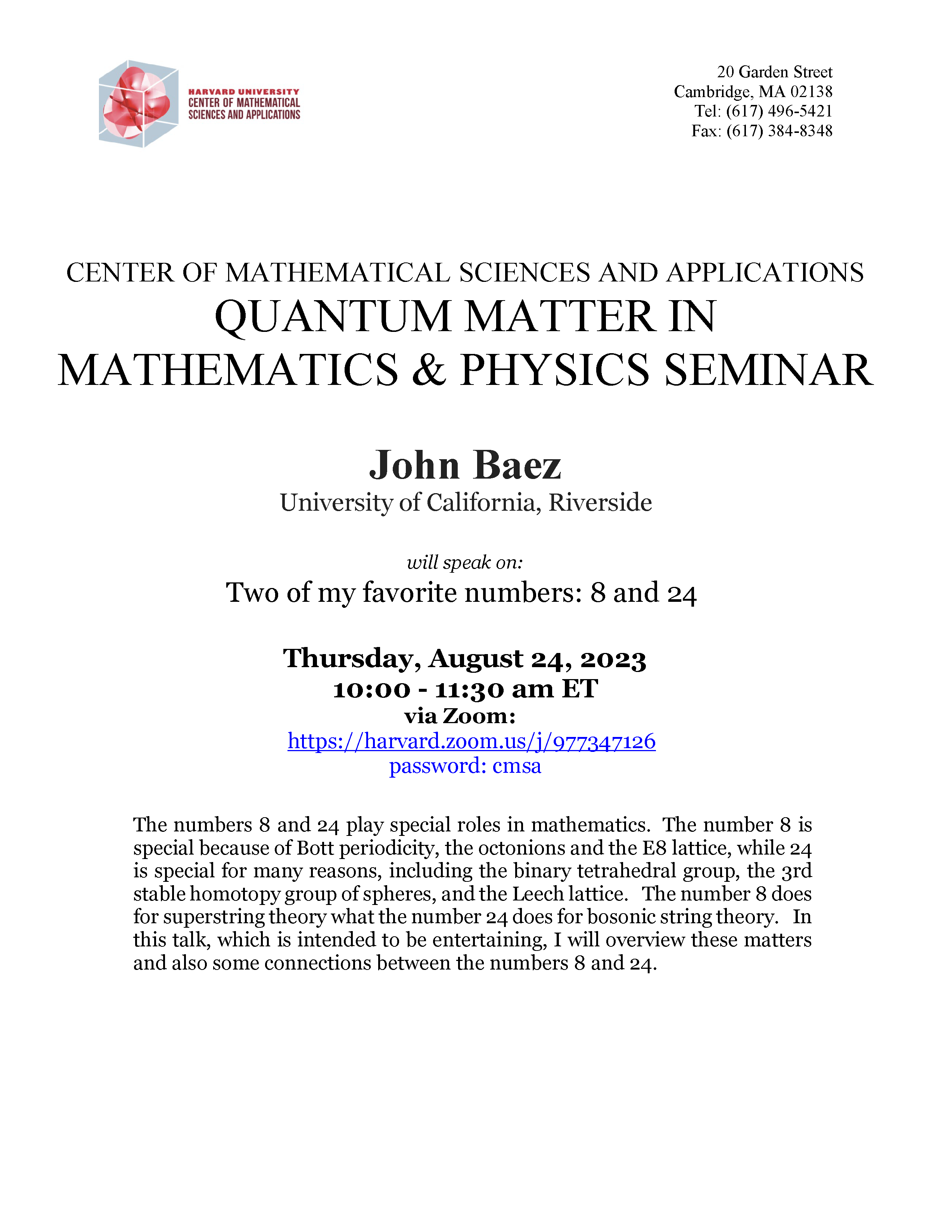
    Quantum Matter Seminar Speaker: Carolyn Zhang (U Chicago) Title: Anomalies of (1+1)D categorical symmetries Abstract: We present a general approach for detecting when a fusion category symmetry is anomalous, based on the existence of a special kind of Lagrangian algebra of the corresponding Drinfeld center. The Drinfeld center of a fusion category $A$ describes a […]

  • Positivity of Static quasi-local Mass in general relativity

    Virtual

    https://youtu.be/b4vyZvml0aw General Relativity Seminar Speaker: Aghil Alaee, Clark University Title: Positivity of Static quasi-local Mass in general relativity Abstract: In this talk, we review results on the PMT of quasi-local masses and prove the positivity of static quasi-local masses with respect to the AdS and AdS Schwarzschild spacetimes.

  • Modern Hopfield Networks for Novel Transformer Architectures

    Virtual

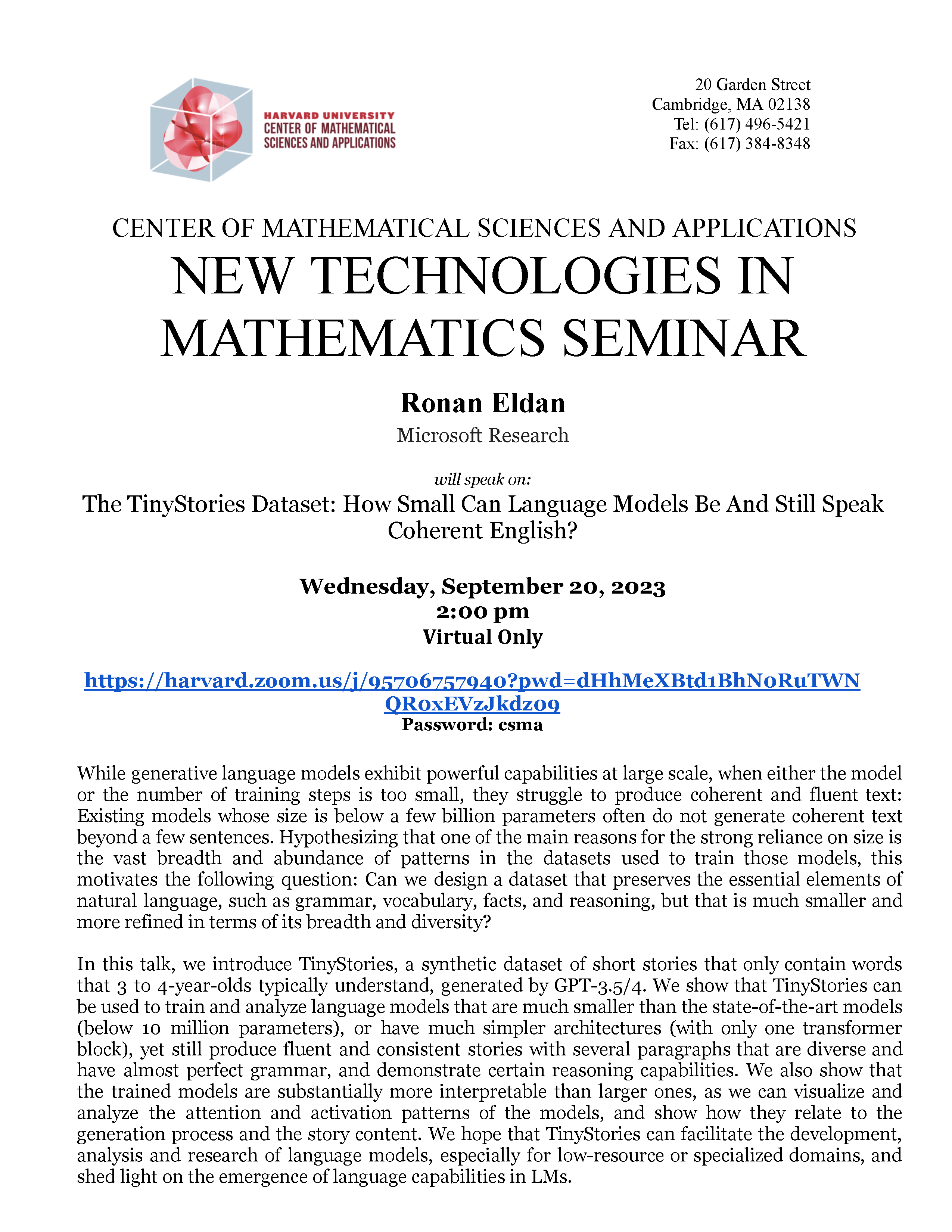
    https://youtu.be/5LXiQUsnHrI New Technologies in Mathematics Seminar Speaker: Dmitry Krotov, IBM Research - Cambridge Title: Modern Hopfield Networks for Novel Transformer Architectures Abstract: Modern Hopfield Networks or Dense Associative Memories are recurrent neural networks with fixed point attractor states that are described by an energy function. In contrast to conventional Hopfield Networks, which were popular in […]

  • Fracton Self-Statistics

    Virtual

    Quantum Matter Seminar Title: Fracton Self-Statistics Speaker: Hao Song (ITP-CAS) Abstract: Fracton order describes novel quantum phases of matter that host quasiparticles with restricted mobility, and thus lies beyond the existing paradigm of topological order. In particular, excitations that cannot move without creating other excitations are called fractons. Here we address a fundamental open question […]

  • The localized seed-to-solution method for the Einstein constraints

    Virtual

    https://youtu.be/eGU1AQBcxNw General Relativity Seminar Speaker: Philippe G. LeFloch, Sorbonne University and CNRS Title: The localized seed-to-solution method for the Einstein constraints Abstract: I will discuss advances on asymptotically Euclidian initial data sets and the variational method introduced by J. Corvino and R. Schoen. This talk is based on joint papers with The-Cang Nguyen (Montpellier) and Bruno […]

  • Toolformer: Language Models Can Teach Themselves to Use Tools

    Virtual

    https://youtu.be/UID_oXuN-0Y New Technologies in Mathematics Seminar Speaker: Timo Schick, Meta AI Title: Toolformer: Language Models Can Teach Themselves to Use Tools Abstract: Language models exhibit remarkable abilities to solve new tasks from just a few examples or textual instructions, especially at scale. They also, paradoxically, struggle with basic functionality, such as arithmetic or factual lookup, where […]

  • Kähler-Einstein metrics on families of Fano varieties

    Virtual

    Algebraic Geometry in String Theory Seminar Speaker: Chung-Ming Pan, Institut de Mathématiques de Toulouse Title: Kähler-Einstein metrics on families of Fano varieties Abstract: This talk aims to introduce a pluripotential approach to study uniform a priori estimates of Kähler-Einstein (KE) metrics on families of Fano varieties. I will first recall basic tools in the pluripotential theory […]

  • Some rigorous results on the Lévy spin glass model

    Virtual

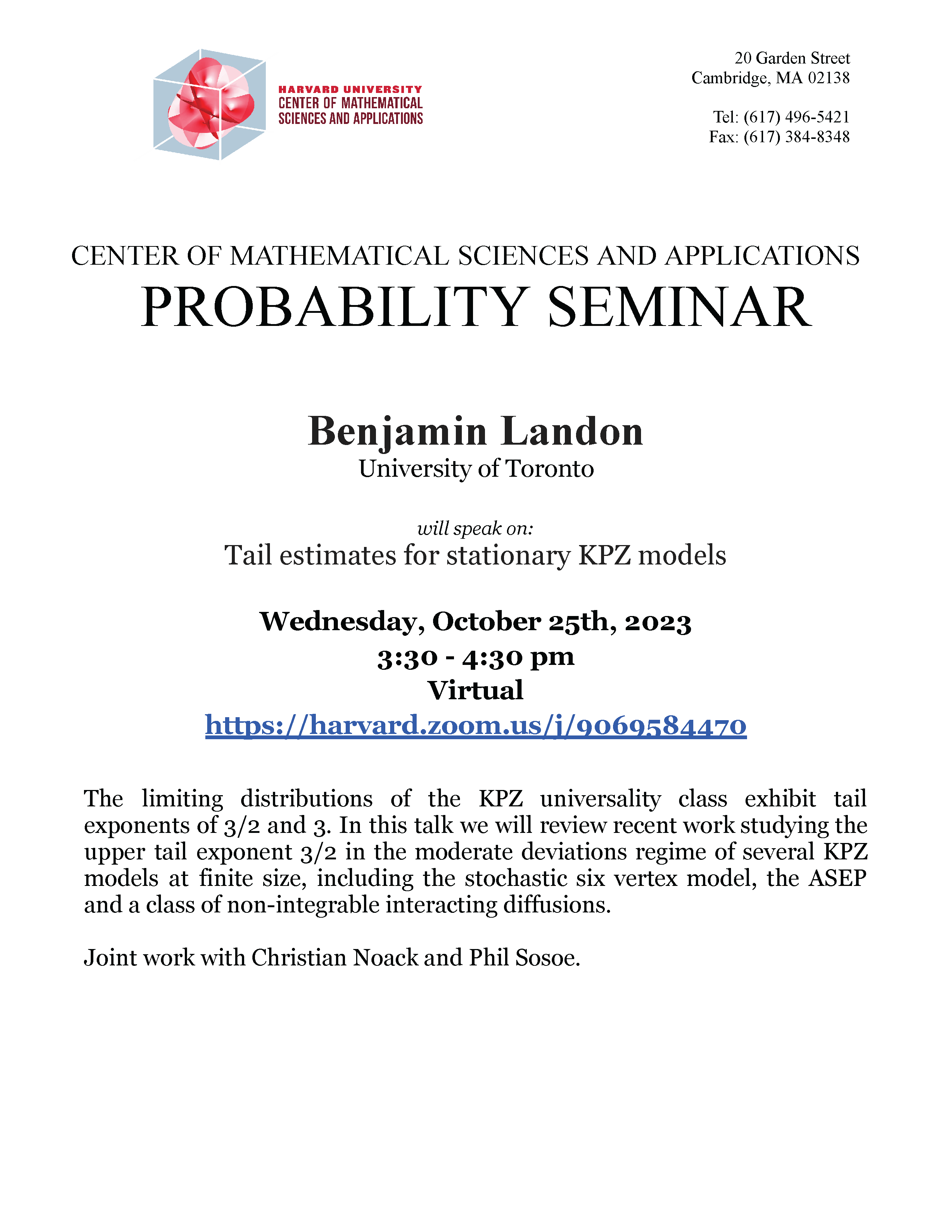
    Probability Seminar Speaker: Wei-Kuo Chen (Minnesota) Title: Some rigorous results on the Lévy spin glass model Abstract: The Lévy spin glass model, proposed by Cizeau-Bouchaud, is a mean-field model defined on a fully connected graph, where the spin interactions are formulated through a power-law distribution. This model is well-motivated from the study of the experimental metallic spin […]

  • Active chemical reactions in phase-separating systems

    Virtual

    Active Matter Seminar   Speaker:  Jonathan Bauermann, Max Planck Institute for the Physics of Complex Systems Title: Active chemical reactions in phase-separating systems Abstract: Motivated by the existence of membrane-less compartments in the chemically active environment of living cells, I will discuss the dynamics of droplets in the presence of active chemical reactions. Therefore, I […]

  • Quantum entropy thermalization

    Virtual

    Quantum Matter Seminar Speaker: Yichen Huang (Harvard) Title: Quantum entropy thermalization Abstract: In an isolated quantum many-body system undergoing unitary evolution, the entropy of a subsystem (smaller than half the system size) thermalizes if at long times, it is to leading order equal to the thermodynamic entropy of the subsystem at the same energy. We […]

  • On the free energy of spin glasses with multiple types

    Virtual

    Probability Seminar Speaker: Jean-Christophe Mourrat (ENS Lyon) Title: On the free energy of spin glasses with multiple types Abstract: In the simplest spin-glass model, due to Sherrington and Kirkpatrick, the energy function involves interaction terms between all pairs of spins. A bipartite version of this model can be obtained by splitting the spins into two […]