During the 2025–26 academic year, the CMSA will be hosting a Colloquium series, organized by Tomer Ezra, Houcine Ben Dali, Francesco Mori, and Sunghyuk Park.

It will take place on Mondays from 4:30 – 5:30 pm (Eastern Time) in Room G10, CMSA, 20 Garden Street. All CMSA postdocs/members are required to attend the weekly CMSA Colloquium series as well as the weekly CMSA Members’ Seminars.

To subscribe to the CMSA Colloquium Mailing list, please visit this link.

The schedule will be updated as talks are confirmed.

  • A Mean Field View of the Landscape of Two-Layers Neural Networks

    CMSA 20 Garden Street, Cambridge, MA, United States

    Speaker: Andrea Montanari (Stanford) Title: A Mean Field View of the Landscape of Two-Layers Neural Networks Abstract: Multi-layer neural networks are among the most powerful models in machine learning and yet, the fundamental reasons for this success defy mathematical understanding. Learning a neural network requires to optimize a highly non-convex and high-dimensional objective (risk function), a problem which […]
  • Black Holes and Naked Singularities

    CMSA 20 Garden Street, Cambridge, MA, United States

    Speaker: Ramesh Narayan, Department of Astronomy, Harvard University Title: Black Holes and Naked Singularities Abstract: Black Hole solutions in General Relativity contain Event Horizons and Singularities. Astrophysicists have discovered two populations of black hole candidates in the Universe: stellar-mass objects with masses in the range 5 to 30 solar masses, and supermassive objects with masses […]

  • Graph Structure in Polynomial Systems: Chordal Networks

    CMSA 20 Garden Street, Cambridge, MA, United States

    Speaker: Pablo Parillo (MIT) Title: Graph Structure in Polynomial Systems: Chordal Networks Abstract: The sparsity structure of a system of polynomial equations or an optimization problem can be naturally described by a graph summarizing the interactions among the decision variables. It is natural to wonder whether the structure of this graph might help in computational algebraic geometry […]

  • On the fibration structure of known Calabi-Yau threefolds

    CMSA 20 Garden Street, Cambridge, MA, United States

    Speaker: Washington Tayor (MIT) Title: On the fibration structure of known Calabi-Yau threefolds Abstract: In recent years, there is increasing evidence from a variety of directions, including the physics of F-theory and new generalized CICY constructions, that a large fraction of known Calabi-Yau manifolds have a genus one or elliptic fibration. In this talk I will describe […]

  • Exploring the (massive) space of graph partitions

    CMSA 20 Garden Street, Cambridge, MA, United States

    Speaker: Moon Duchin (Tufts) Title: Exploring the (massive) space of graph partitions Abstract: The problem of electoral redistricting can be set up as a search of the space of partitions of a graph (representing the units of a state or other jurisdiction) subject to constraints (state and federal rules about the properties of districts).  I'll survey the problem and some […]

  • The virtual fundamental class in symplectic geometry

    CMSA 20 Garden Street, Cambridge, MA, United States

    Speaker: Dusa McDuff (Columbia University)  Title: The virtual fundamental class in symplectic geometry Abstract: Essential to many constructions and applications of symplectic geometry is the ability to count J-holomorphic curves. The moduli spaces of such curves have well understood compactifications, and if cut out transversally are oriented manifolds of dimension equal to the index of the problem, so […]

  • Computational Principles of Auditory Cortex

    CMSA 20 Garden Street, Cambridge, MA, United States

    Speaker: Xiaoqin Wang (Johns Hopkins University) Title: Computational Principles of Auditory Cortex Abstract: Auditory cortex is located at the top of a hierarchical processing pathway in the brain that encodes acoustic information. This brain region is crucial for speech and music perception and vocal production. Auditory cortex has long been considered a difficult brain region to study and remained one of less […]

  • Recent progress on mean curvature flow

    CMSA 20 Garden Street, Cambridge, MA, United States

    Speaker: Robert Haslhofer (University of Toronto) Title: Recent progress on mean curvature flow Abstract: A family of surfaces moves by mean curvature flow if the velocity at each point is given by the mean curvature vector. Mean curvature flow is the most natural evolution in extrinsic geometry and shares many features with Hamilton’s Ricci flow from intrinsic geometry. In the […]

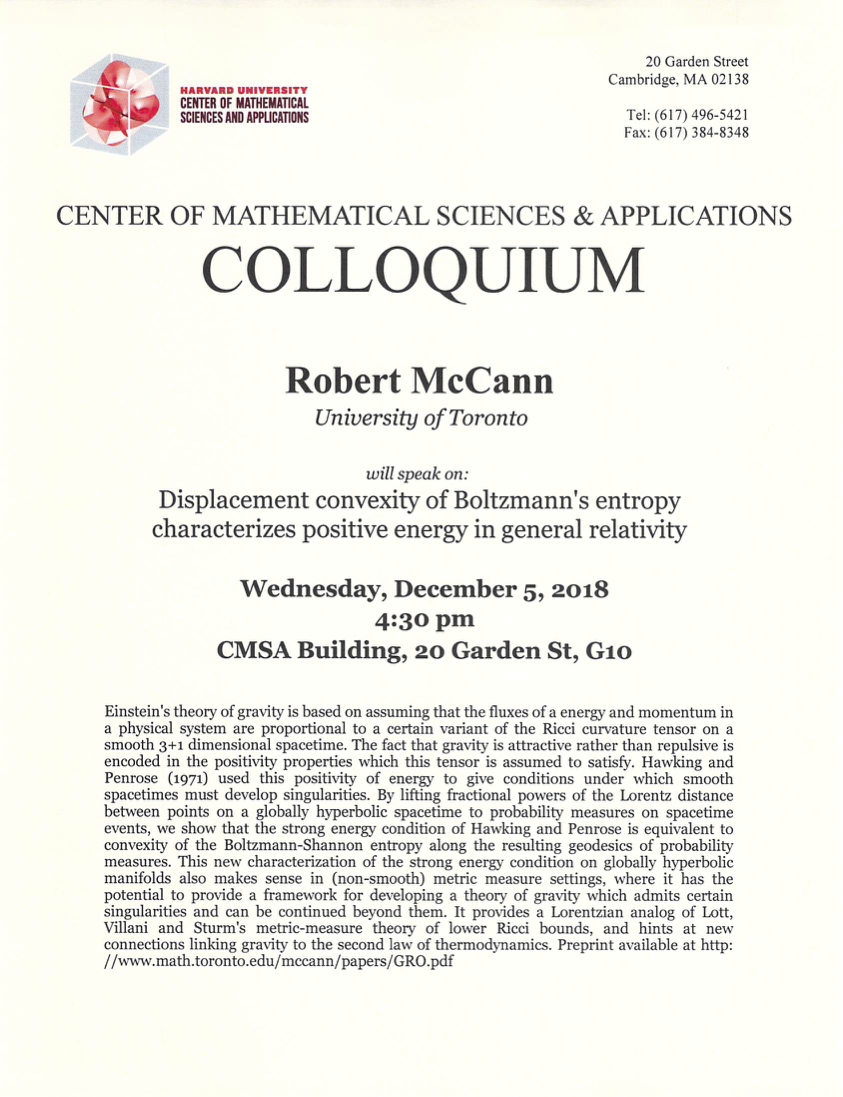
  • Displacement convexity of Boltzmann’s entropy characterizes positive energy in general relativity

    CMSA 20 Garden Street, Cambridge, MA, United States

    Speaker: Robert McCann (University of Toronto) Title: Displacement convexity of Boltzmann's entropy characterizes positive energy in general relativity Abstract: Einstein's theory of gravity is based on assuming that the fluxes of a energy and momentum in a physical system are proportional to a certain variant of the Ricci curvature tensor on a smooth 3+1 dimensional spacetime. The fact that […]

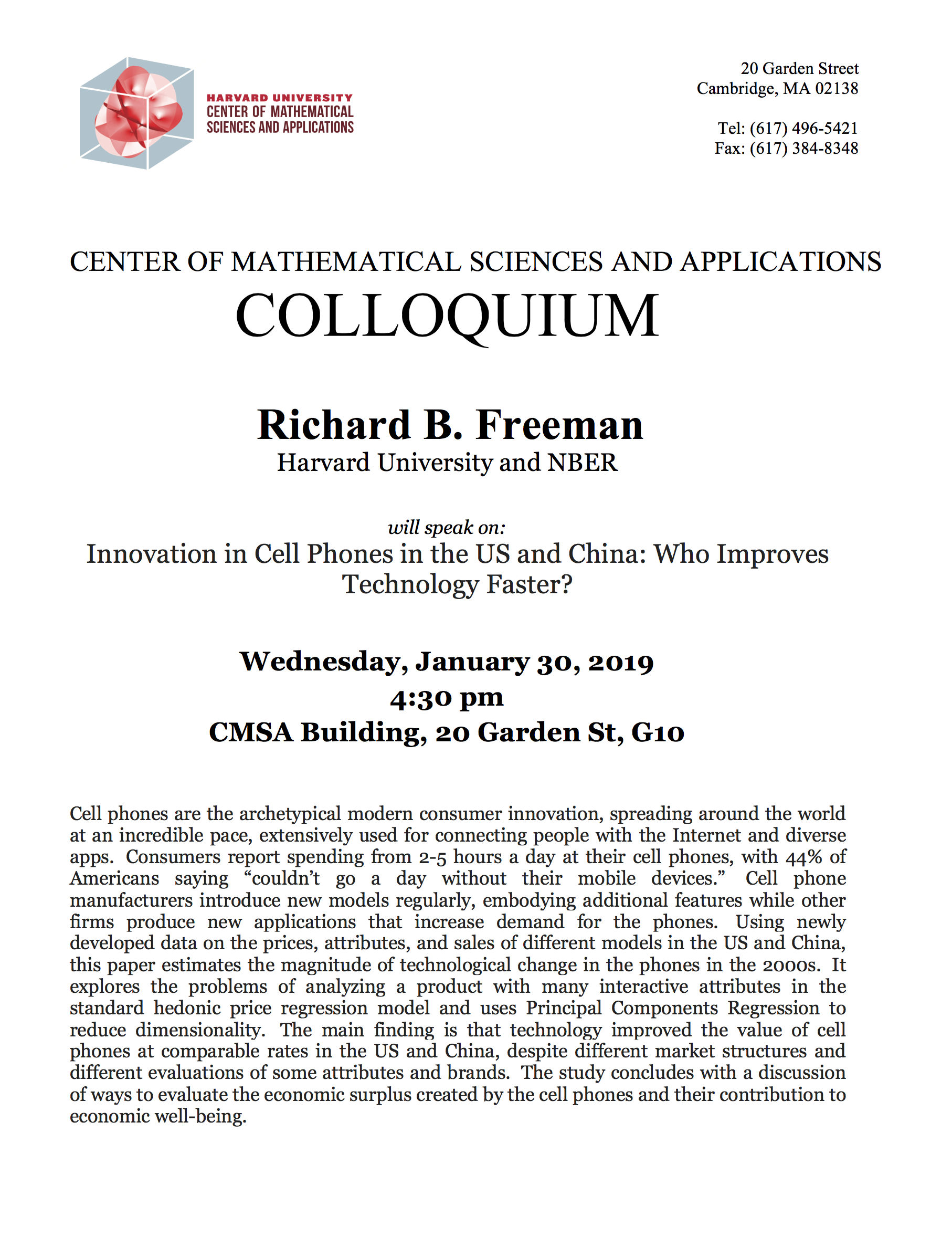
  • Innovation in Cell Phones in the US and China: Who Improves Technology Faster?

    CMSA 20 Garden Street, Cambridge, MA, United States

    Speaker: Richard B. Freeman (Harvard University and NBER) Title: Innovation in Cell Phones in the US and China: Who Improves Technology Faster? Abstract: Cell phones are the archetypical modern consumer innovation, spreading around the world at an incredible pace, extensively used for connecting people with the Internet and diverse apps. Consumers report spending from 2-5 hours a day […]

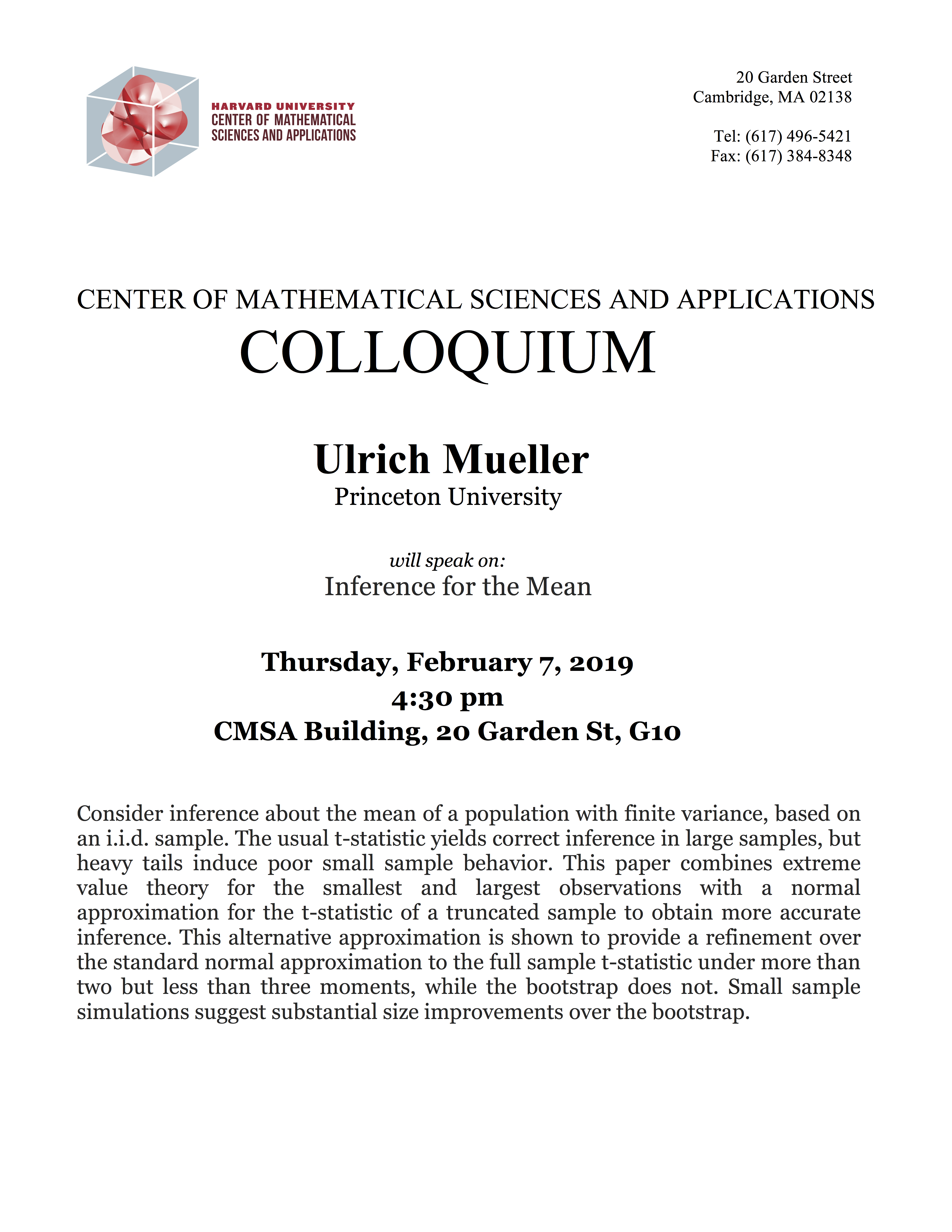
  • Inference for the Mean

    CMSA 20 Garden Street, Cambridge, MA, United States

    Speaker: Ulrich Mueller (Princeton) Title: Inference for the Mean Abstract: Consider inference about the mean of a population with finite variance, based on an i.i.d. sample. The usual t-statistic yields correct inference in large samples, but heavy tails induce poor small sample behavior. This paper combines extreme value theory for the smallest and largest observations with a normal approximation for […]

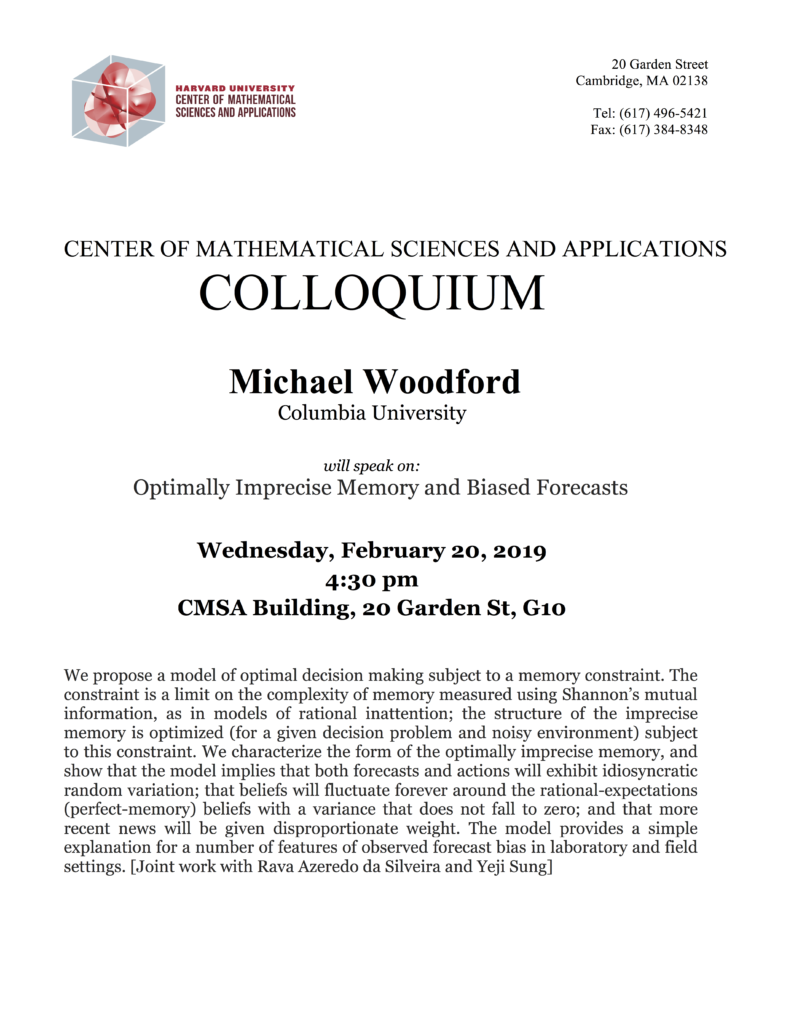
  • Optimally Imprecise Memory and Biased Forecasts

    CMSA 20 Garden Street, Cambridge, MA, United States

    Speaker: Michael Woodford (Columbia) Title: Optimally Imprecise Memory and Biased Forecasts Abstract: We propose a model of optimal decision making subject to a memory constraint. The constraint is a limit on the complexity of memory measured using Shannon’s mutual information, as in models of rational inattention; the structure of the imprecise memory is optimized (for a given decision problem and […]