During the 2025–26 academic year, the CMSA will be hosting a Colloquium series, organized by Tomer Ezra, Houcine Ben Dali, Francesco Mori, and Sunghyuk Park.

It will take place on Mondays from 4:30 – 5:30 pm (Eastern Time) in Room G10, CMSA, 20 Garden Street. All CMSA postdocs/members are required to attend the weekly CMSA Colloquium series as well as the weekly CMSA Members’ Seminars.

To subscribe to the CMSA Colloquium Mailing list, please visit this link.

The schedule will be updated as talks are confirmed.

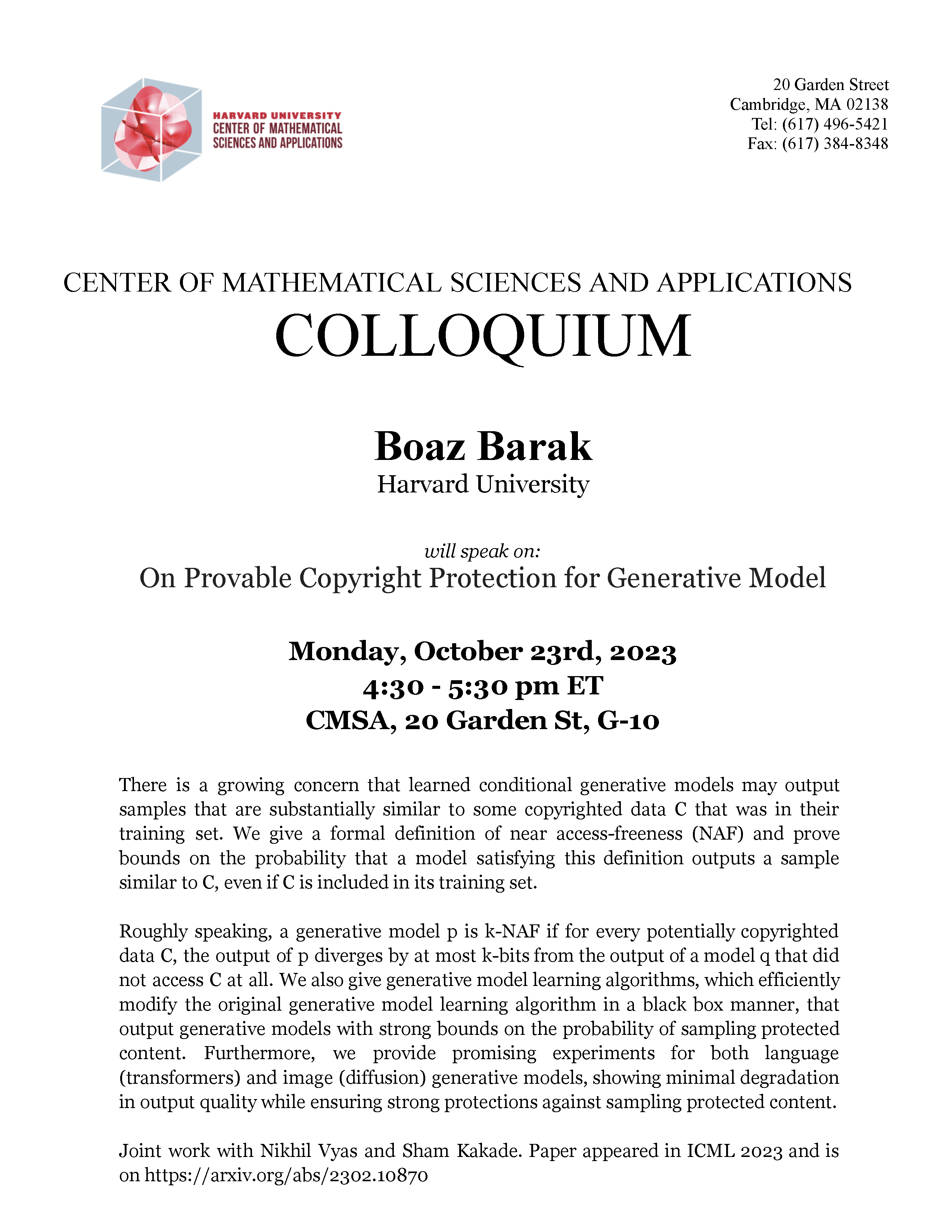
  • Complete disorder is impossible: Some topics in Ramsey theory

    CMSA Room G10 CMSA, 20 Garden Street, Cambridge, MA, United States

    Colloquium Speaker: James Cummings,Carnegie Mellon University Title: Complete disorder is impossible: Some topics in Ramsey theory Abstract: The classical infinite Ramsey theorem states that if we colour pairs of natural numbers using two colours, there is an infinite set all of whose pairs get the same colour. This is the beginning of a rich theory, […]

  • The Mobility Edge of Lévy Matrices

    CMSA Room G10 CMSA, 20 Garden Street, Cambridge, MA, United States

    Colloquium Speaker: Patrick Lopatto (Brown) Title: The Mobility Edge of Lévy Matrices Abstract: Lévy matrices are symmetric random matrices whose entry distributions lie in the domain of attraction of an alpha-stable law; such distributions have infinite variance when alpha is less than 2. Due to the ubiquity of heavy-tailed randomness, these models have been broadly […]

  • Clique listing algorithms

    CMSA Room G10 CMSA, 20 Garden Street, Cambridge, MA, United States

    Speaker: Virginia Vassilevska Williams (MIT) Title: Clique listing algorithms Abstract: A k-clique in a graph G is a subgraph of G on k vertices in which every pair of vertices is linked by an edge. Cliques are a natural notion of social network cohesiveness with a long history. A fundamental question, with many applications, is […]

  • Doping and inverting Mott insulators on semiconductor moire superlattices

    CMSA Room G10 CMSA, 20 Garden Street, Cambridge, MA, United States

    https://youtu.be/-NisBM-2a2I Speaker: Liang Fu (MIT) Title: Doping and inverting Mott insulators on semiconductor moire superlattices Abstract: Semiconductor bilayer heterostructures provide a remarkable platform for simulating Hubbard models on an emergent lattice defined by moire potential minima. As a hallmark of Hubbard model physics, the Mott insulator state with local magnetic moments has been observed at […]

  • Noether’s Learning Dynamics: Role of Symmetry Breaking in Neural Networks

    CMSA Room G10 CMSA, 20 Garden Street, Cambridge, MA, United States

    Colloquium Speaker: Hidenori Tanaka (NTT Research at Harvard) Title: Noether’s Learning Dynamics: Role of Symmetry Breaking in Neural Networks Abstract: In nature, symmetry governs regularities, while symmetry breaking brings texture. In artificial neural networks, symmetry has been a central design principle, but the role of symmetry breaking is not well understood. Here, we develop a […]

  • Neural Optimal Stopping Boundary

    CMSA Room G10 CMSA, 20 Garden Street, Cambridge, MA, United States

    Speaker: Max Reppen (Boston University) Title: Neural Optimal Stopping Boundary Abstract:  A method based on deep artificial neural networks and empirical risk minimization is developed to calculate the boundary separating the stopping and continuation regions in optimal stopping. The algorithm parameterizes the stopping boundary as the graph of a function and introduces relaxed stopping rules based on fuzzy […]

  • From spin glasses to Boolean circuits lower bounds – Algorithmic barriers from the overlap gap property

    CMSA Room G10 CMSA, 20 Garden Street, Cambridge, MA, United States

    Speaker: David Gamarnik (MIT) Title: From spin glasses to Boolean circuits lower bounds. Algorithmic barriers from the overlap gap property Abstract: Many decision and optimization problems over random structures exhibit an apparent gap between the existentially optimal values and algorithmically achievable values. Examples include the problem of finding a largest independent set in a random graph, the problem […]

  • Complete Calabi-Yau metrics: Recent progress and open problems

    CMSA Room G10 CMSA, 20 Garden Street, Cambridge, MA, United States

    Speaker: Tristan Collins, MIT Title: Complete Calabi-Yau metrics: Recent progress and open problems Abstract: Complete Calabi-Yau metrics are fundamental objects in Kahler geometry arising as singularity models or "bubbles" in degenerations of compact Calabi-Yau manifolds.  The existence of these metrics and their relationship with algebraic geometry are the subjects of several long standing conjectures due […]

  • The Black Hole Information Paradox: A Resolution on the Horizon?

    CMSA Room G10 CMSA, 20 Garden Street, Cambridge, MA, United States

    Speaker: Netta Engelhardt (MIT) Title: The Black Hole Information Paradox: A Resolution on the Horizon? Abstract: The black hole information paradox — whether information escapes an evaporating black hole or not — remains one of the most longstanding mysteries of theoretical physics. The apparent conflict between validity of semiclassical gravity at low energies and unitarity […]

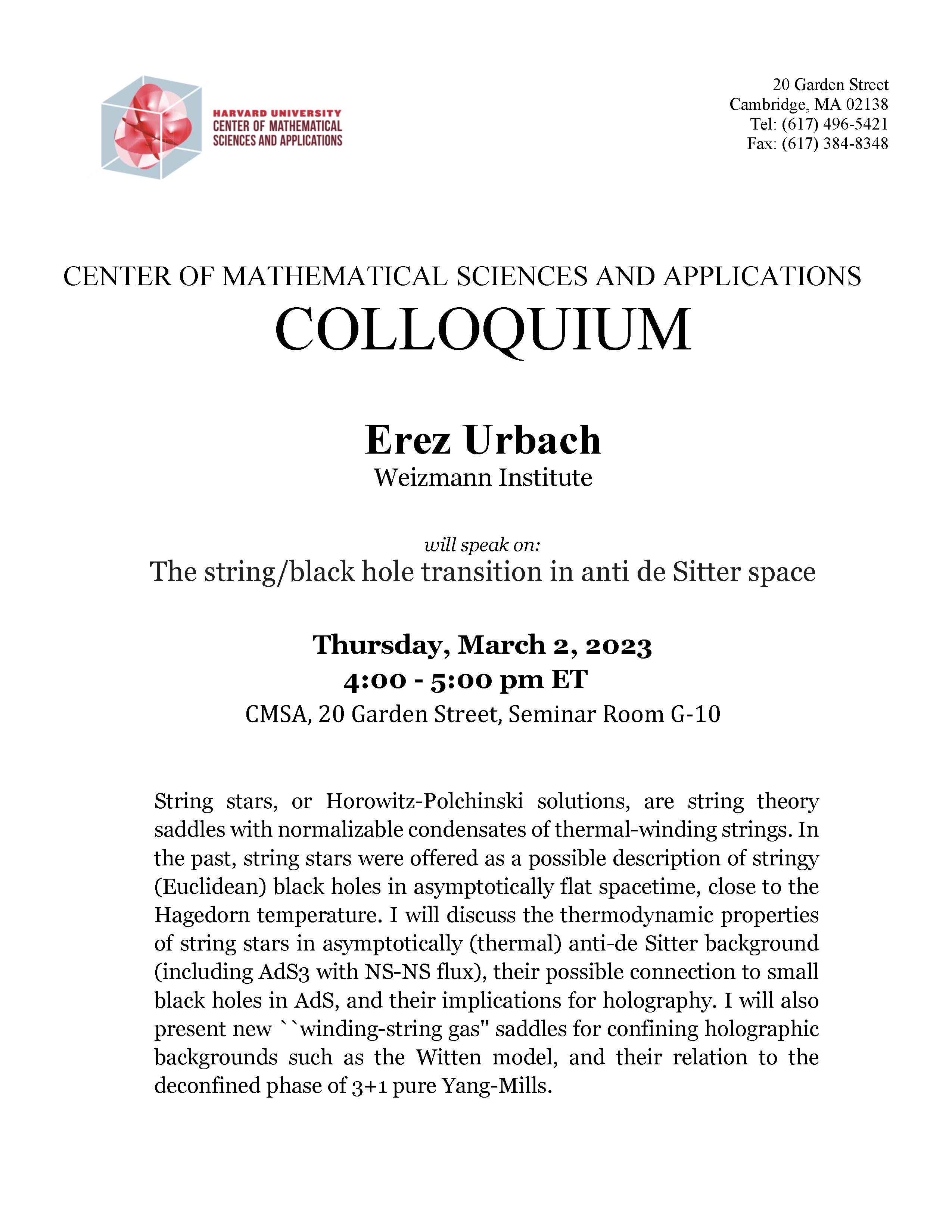
  • The string/black hole transition in anti de Sitter space

    CMSA Room G10 CMSA, 20 Garden Street, Cambridge, MA, United States

    Speaker: Erez Urbach, Weizmann Institute of Science Title: The string/black hole transition in anti de Sitter space Abstract: String stars, or Horowitz-Polchinski solutions, are string theory saddles with normalizable condensates of thermal-winding strings. In the past, string stars were offered as a possible description of stringy (Euclidean) black holes in asymptotically flat spacetime, close to the […]
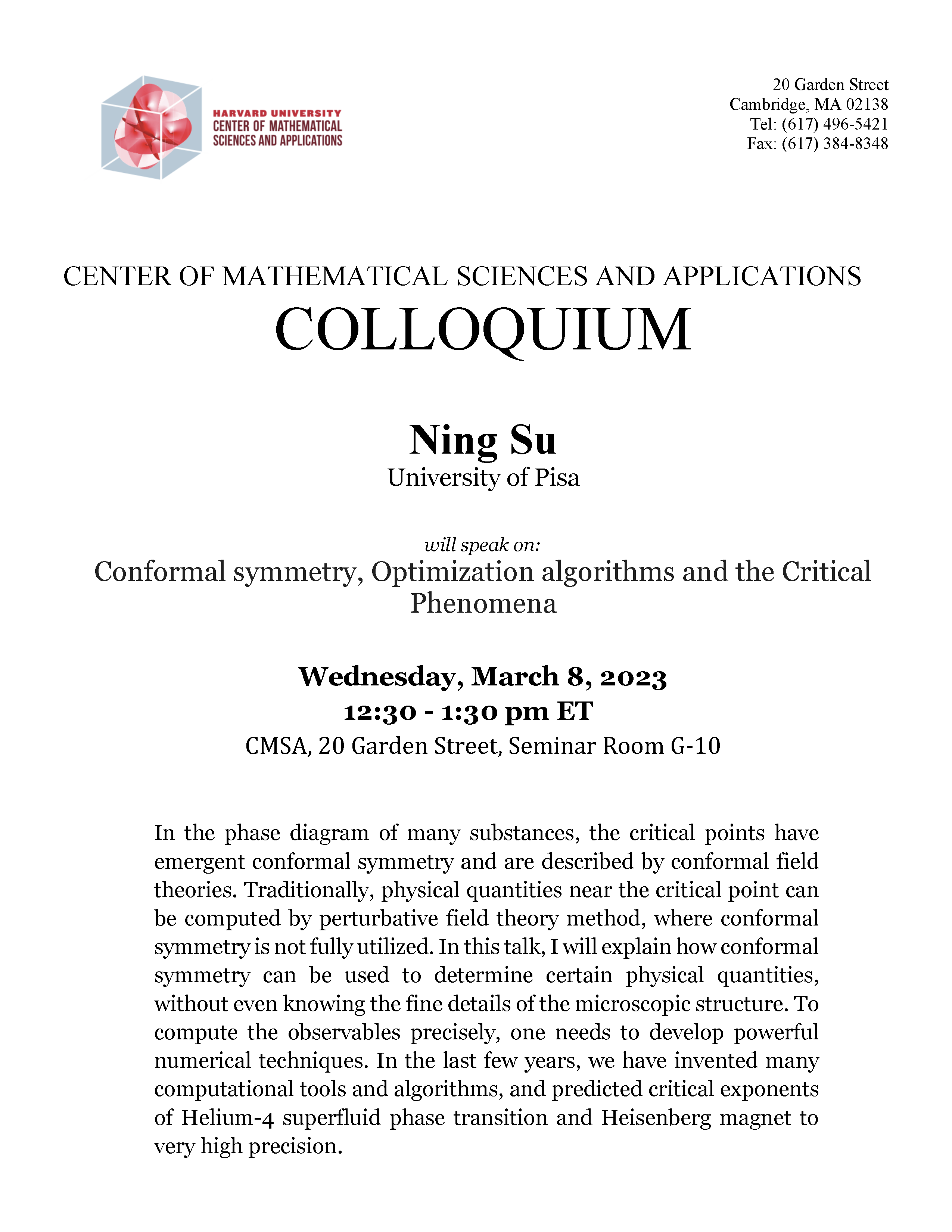
  • Conformal symmetry, Optimization algorithms and the Critical Phenomena

    CMSA Room G10 CMSA, 20 Garden Street, Cambridge, MA, United States

    Speaker: Ning Su, University of Pisa Title: Conformal symmetry, Optimization algorithms and the Critical Phenomena Abstract: In the phase diagram of many substances, the critical points have emergent conformal symmetry and are described by conformal field theories. Traditionally, physical quantities near the critical point can be computed by perturbative field theory method, where conformal symmetry […]

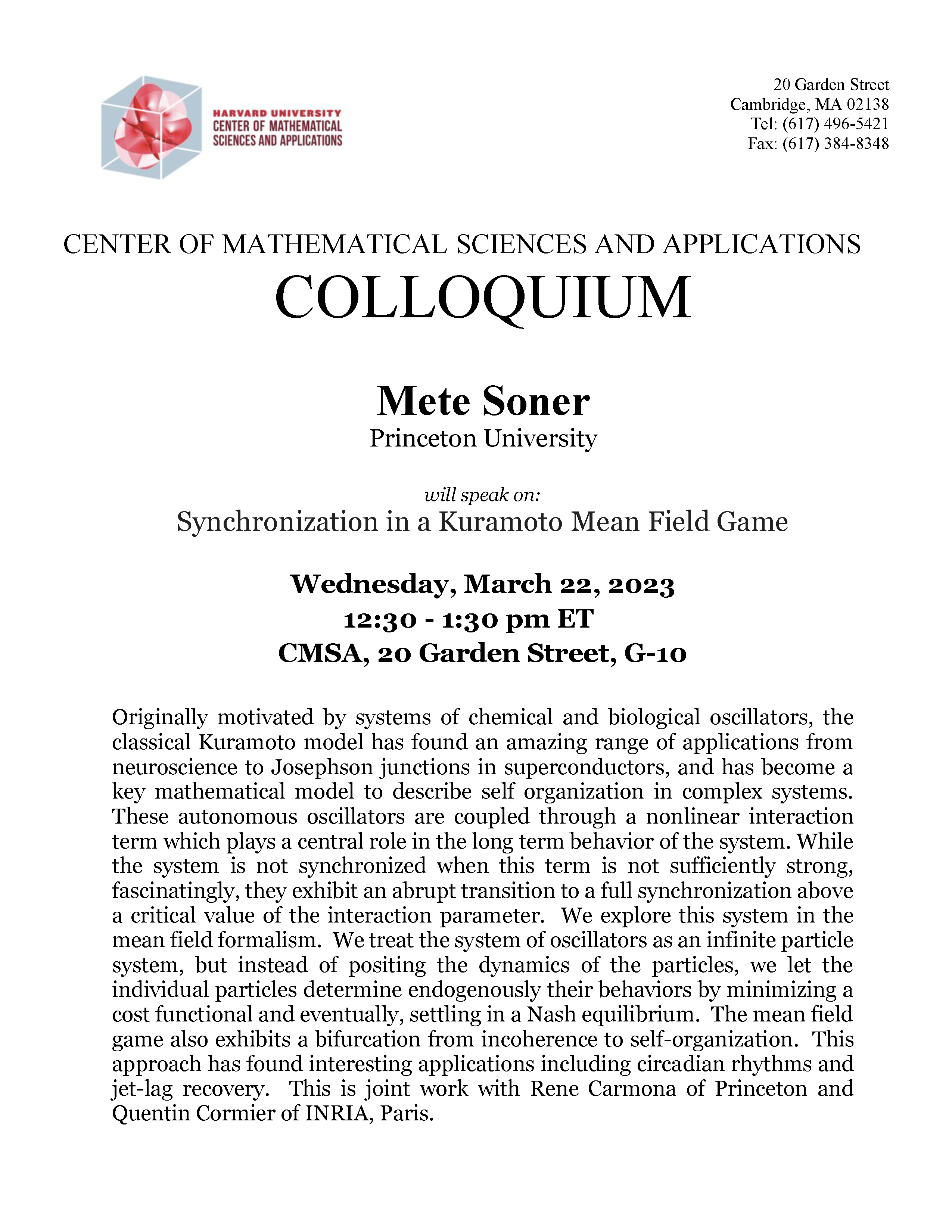
  • Synchronization in a Kuramoto Mean Field Game

    CMSA Room G10 CMSA, 20 Garden Street, Cambridge, MA, United States

    Speaker: Mete Soner (Princeton University) Title: Synchronization in a Kuramoto Mean Field Game Abstract:  Originally motivated by systems of chemical and biological oscillators, the classical Kuramoto model has found an amazing range of applications from neuroscience to Josephson junctions in superconductors, and has become a  key mathematical model to describe self organization in complex systems. These autonomous oscillators are […]