During the 2026–27 academic year, the CMSA will be hosting a Member Seminar, organized by Elena Kim and Lorenzo Riva.

This seminar will take place weekly on Fridays from 12:00–1:00 pm Eastern Time.

The schedule will be updated as talks are confirmed.

  • A leisurely stroll through the theory of adjunctions

    CMSA Room G10 CMSA, 20 Garden Street, Cambridge, MA, United States

    Member Seminar Speaker: Lorenzo Riva, Harvard CMSA Title: A leisurely stroll through the theory of adjunctions Abstract: Adjoint functors (and, more generally, adjunctions in a 2-category) are ubiquitous in algebra and topology. In this talk I will give an overview of the basics of adjunctions, with the ultimate goal being understanding the statement of the […]
  • Theory of Task-Adapted Dynamics in Large Recurrent Neural Networks

    CMSA Room G10 CMSA, 20 Garden Street, Cambridge, MA, United States

    Member Seminar Speaker: Blake Bordelon, CMSA Title: Theory of Task-Adapted Dynamics in Large Recurrent Neural Networks Abstract: Recurrent neural networks (RNNs) encode expressive and flexible dynamical systems which can adapt to perform tasks by modifying the internal connections between neurons. In this work we analyze the structure of the dynamical systems encoded in RNNs after […]

  • Gauge theory, from low dimensions to higher dimensions and back

    CMSA Room G10 CMSA, 20 Garden Street, Cambridge, MA, United States

    Member Seminar Speaker: Saman Habibi Esfahani, CMSA Title: Gauge theory, from low dimensions to higher dimensions and back Abstract: Almost thirty years ago, Donaldson and Thomas proposed extending powerful ideas from gauge theory, which had transformed the study of three- and four-dimensional manifolds, to higher dimensions, with the goal of defining new invariants of special […]

  • Failures of Holographic Emergence

    CMSA Room G10 CMSA, 20 Garden Street, Cambridge, MA, United States

    Member Seminar Speaker: Elliott Gesteau, CMSA Title: Failures of Holographic Emergence Abstract: Recent developments have taught us that some semiclassical spacetimes, in particular those containing closed universe components, cannot emerge from a holographic correspondence. In this talk, I will explain how one can get to this conclusion by using either quantum information theory or properties of the large N limit of […]

  • Quantum topology from dynamics

    CMSA Room G10 CMSA, 20 Garden Street, Cambridge, MA, United States

    Member Seminar Speaker: Sunghyuk Park, CMSA Title: Quantum topology from dynamics Abstract: Dynamics studies the long-term behavior of systems that evolve over time, such as the famous Lorenz system. Quantum topology, by contrast, studies knots and low-dimensional manifolds through invariants that are usually constructed using representation-theoretic tools. In this talk, I will explain how quantum invariants of […]

  • Higgs and Coulomb branches: Geometry and Representation Theory

    CMSA Room G10 CMSA, 20 Garden Street, Cambridge, MA, United States

    Member Seminar Speaker: Vasily Krylov Title: Higgs and Coulomb branches: Geometry and Representation Theory Abstract: Higgs and Coulomb branches of quiver gauge theories form two important families of Poisson varieties that are expected to be exchanged under so-called 3D mirror symmetry. Quantized Coulomb branches are associative algebras deforming the algebras of functions on Coulomb branches. They are […]

  • The Intermingling of Symmetry and Parametrization in Matrix Product States

    CMSA Room G10 CMSA, 20 Garden Street, Cambridge, MA, United States

    Member Seminar Speaker: Daniel Spiegel Title: The Intermingling of Symmetry and Parametrization in Matrix Product States Abstract: In the study of quantum spin systems, it is by now well-known that interesting phases of quantum matter can arise from gapped ground states when the system is invariant under a symmetry group G or when the system varies continuously […]

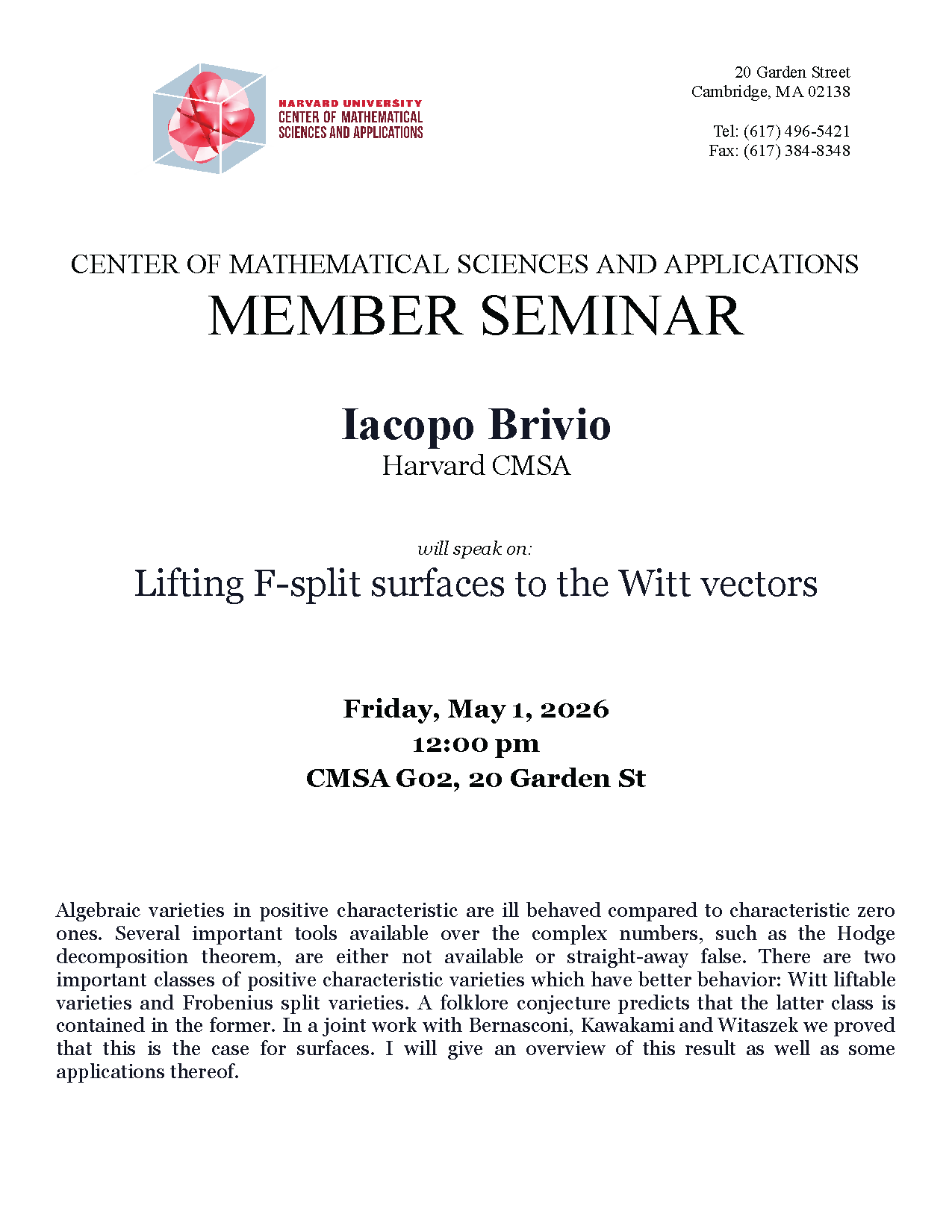
  • Lifting F-split surfaces to the Witt vectors

    CMSA Room G10 CMSA, 20 Garden Street, Cambridge, MA, United States

    Member Seminar Speaker: Iacopo Brivio, CMSA Title: Lifting F-split surfaces to the Witt vectors Abstract: Algebraic varieties in positive characteristic are ill behaved compared to characteristic zero ones. Several important tools available over the complex numbers, such as the Hodge decomposition theorem, are either not available or straight-away false. There are two important classes of […]

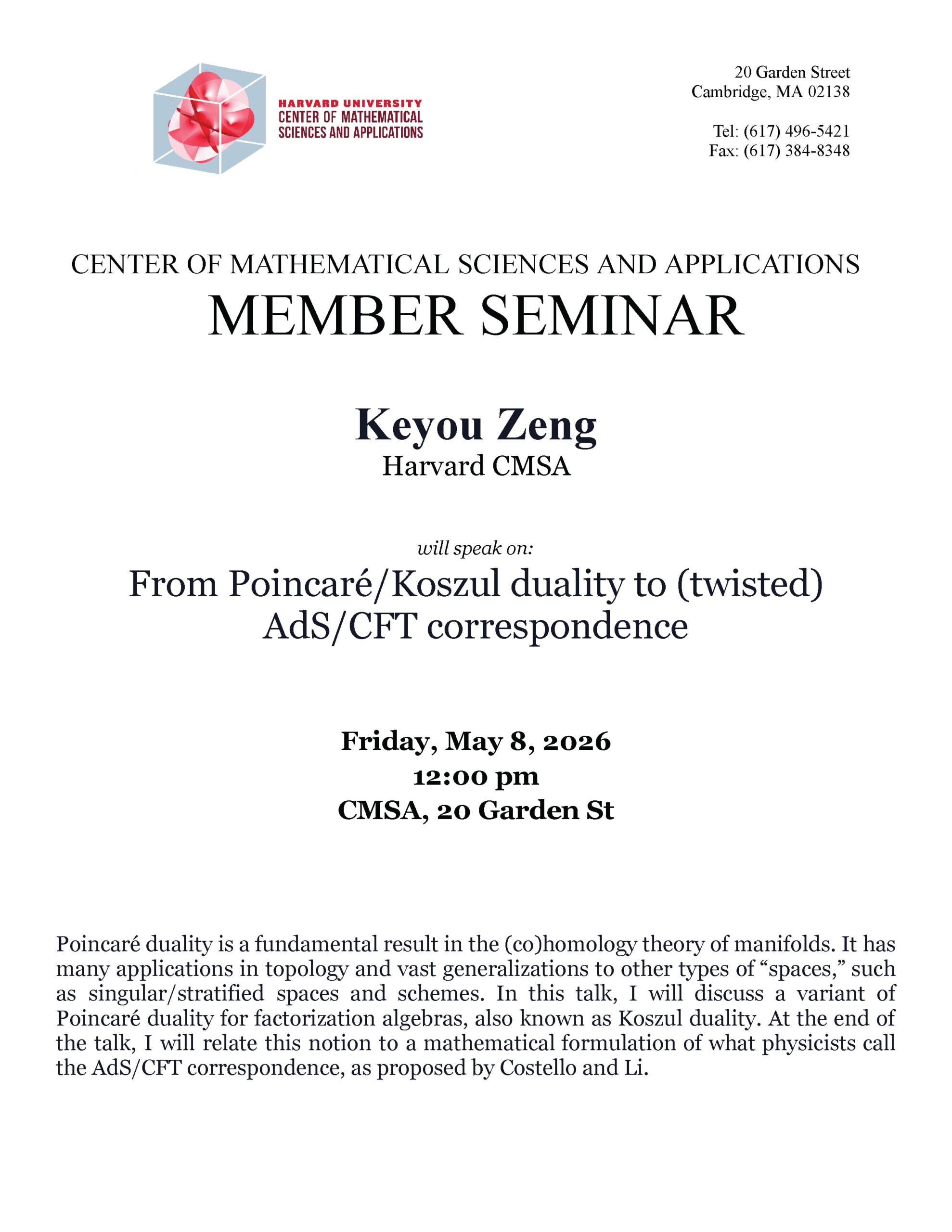
  • From Poincaré/Koszul duality to (twisted) AdS/CFT correspondence

    CMSA Room G10 CMSA, 20 Garden Street, Cambridge, MA, United States

    Member Seminar Speaker: Keyou Zeng Title: From Poincaré/Koszul duality to (twisted) AdS/CFT correspondence Abstract: Poincaré duality is a fundamental result in the (co)homology theory of manifolds. It has many applications in topology and vast generalizations to other types of “spaces,” such as singular/stratified spaces and schemes. In this talk, I will discuss a variant of Poincaré duality […]

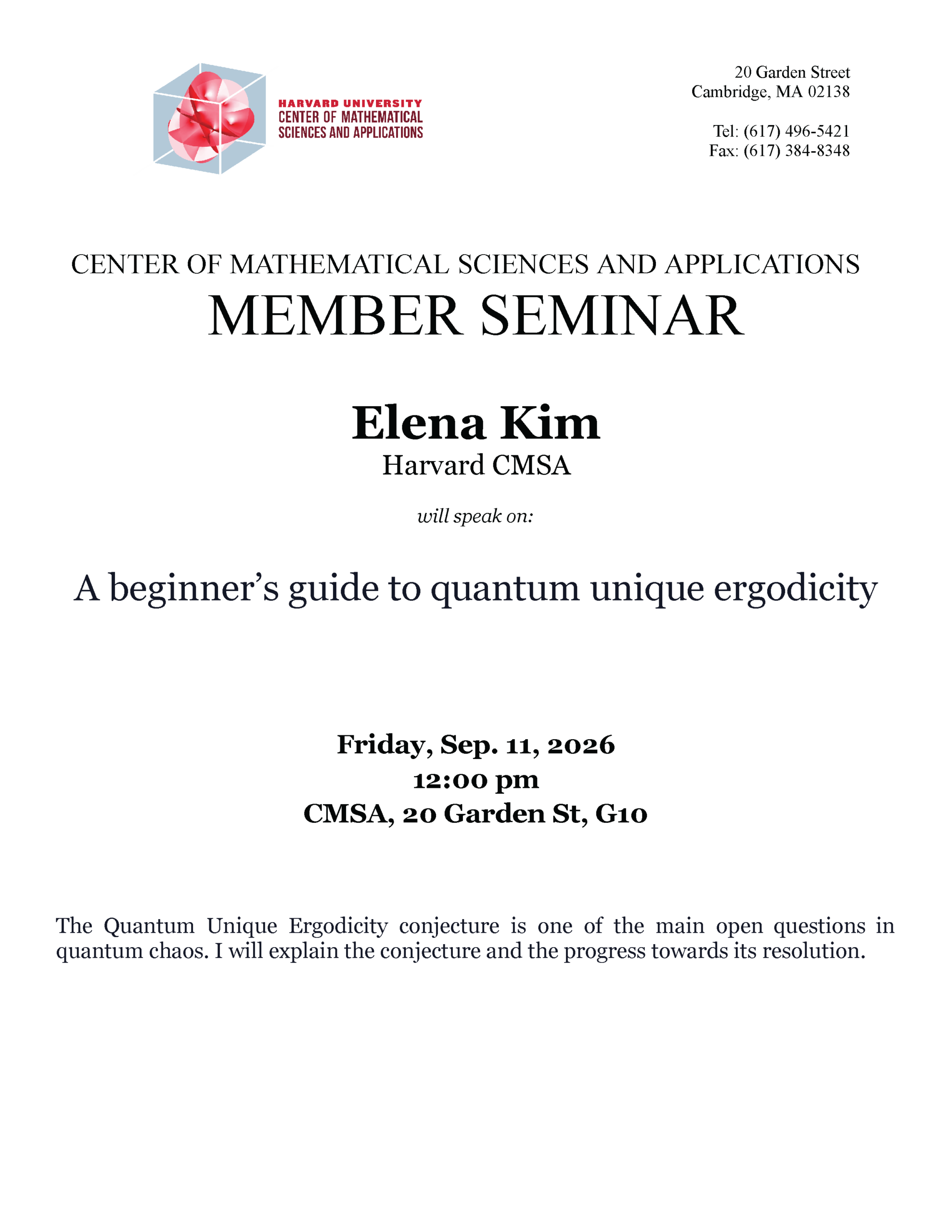
  • A beginner’s guide to quantum unique ergodicity

    CMSA Room G10 CMSA, 20 Garden Street, Cambridge, MA, United States

    Member Seminar Speaker: Elena Kim Title: A beginner's guide to quantum unique ergodicity Abstract: The Quantum Unique Ergodicity conjecture is one of the main open questions in quantum chaos. I will explain the conjecture and the progress towards its resolution.

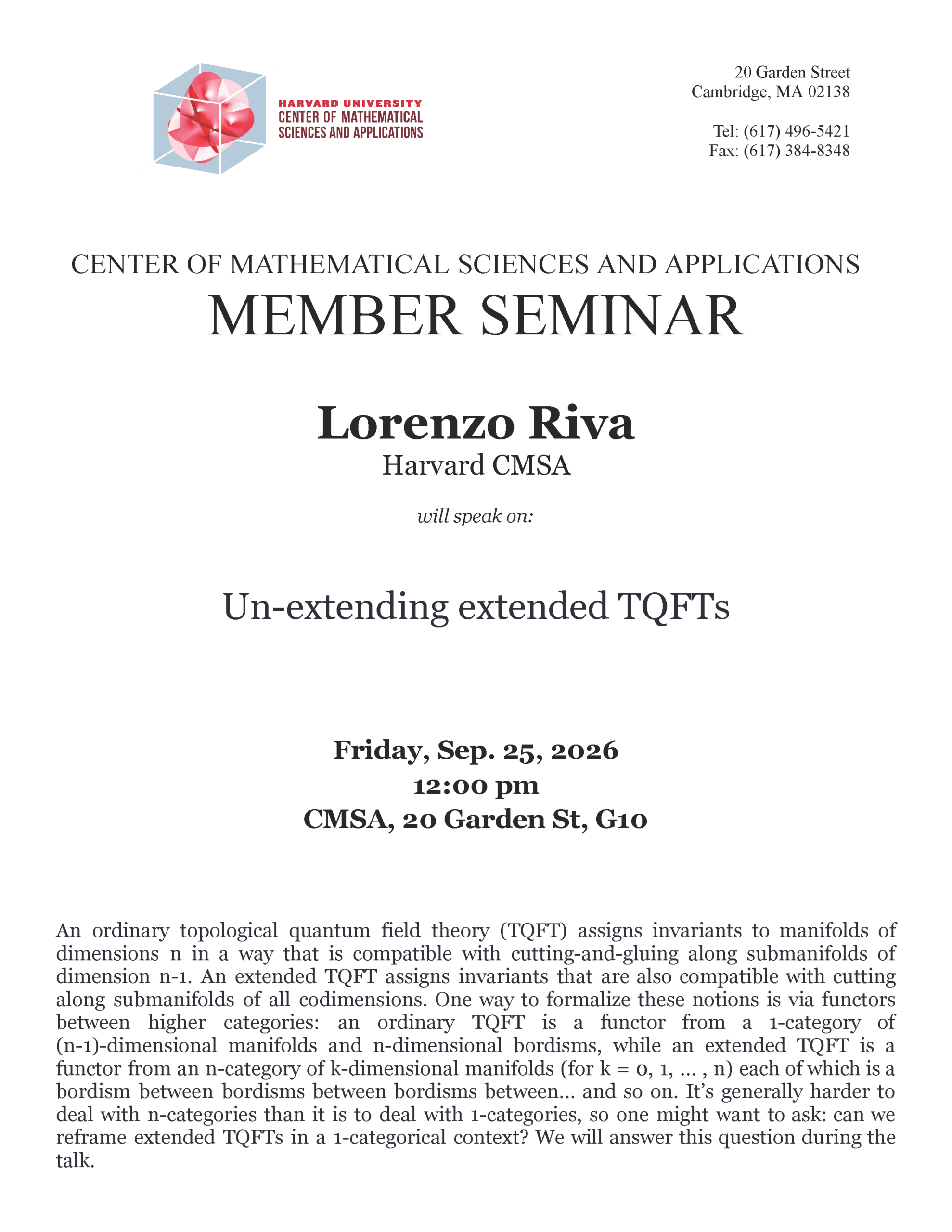
  • Member Seminar

    CMSA Room G10 CMSA, 20 Garden Street, Cambridge, MA, United States

    Member Seminar Speaker: Lorenzo Riva, CMSA Title: Un-extending extended TQFTs Abstract: An ordinary topological quantum field theory (TQFT) assigns invariants to manifolds of dimensions n in a way that is compatible with cutting-and-gluing along submanifolds of dimension n-1. An extended TQFT assigns invariants that are also compatible with cutting along submanifolds of all codimensions. One way to […]

  • Painlevé VI: the search for canonical representations

    CMSA Room G10 CMSA, 20 Garden Street, Cambridge, MA, United States

    Member Seminar Speaker: Aaron Landesman Title: Painlevé VI: the search for canonical representations Abstract: In 1902, Painlevé classified second order differential equations whose only movable singularities are poles, thereby obtaining the six Painlevé equations. Algebraic solutions to Painlevé's sixth equation correspond to canonical triples of 2 by 2 complex matrices. One can alternatively view these […]