During 2025–26, the CMSA will host a seminar on Quantum Field Theory and Physical Mathematics, organized by Robert Moscrop, Ahsan Khan, Chuck Doran, and Keyou Zeng.

This seminar series, a successor to the Quantum Matter Seminar, focuses on all aspects of quantum field theory and its associated mathematics.

The seminar will take place on Mondays from 3:00–4:00 pm.

To receive seminar announcements, please subscribe to the mailing list.

The schedule will be updated as talks are confirmed.

  • de Rham Theory in Derived Differential Geometry

    CMSA Room G10 CMSA, 20 Garden Street, Cambridge, MA, United States

    Quantum Field Theory and Physical Mathematics Seminar Speaker: Grigorii Taroian, U Toronto Title: de Rham Theory in Derived Differential Geometry Abstract: In the talk, I will describe recent progress in building a version of de Rham theory for derived manifolds and derived differentiable stacks. Derived differential geometry is a nascent field applying techniques from derived algebraic […]

  • The Moyal bracket and the BV cohomology of the spinning particle

    CMSA Room G10 CMSA, 20 Garden Street, Cambridge, MA, United States

    Quantum Field Theory and Physical Mathematics Seminar Speaker: Ezra Getzler, Northwestern Title: The Moyal bracket and the BV cohomology of the spinning particle Abstract: The spinning particle is the one-dimensional reduction of the Neveu-Schwartz-Ramond superstring. It consists of a supersymmetric particle moving in a one-dimensional supergravity background, and its quantization is the Hilbert superspace of […]

  • BV and the ThimTFT

    CMSA Room G02 20 Garden Street, Cambridge, MA

    Quantum Field Theory and Physical Mathematics Seminar Speaker: Justin Kulp, Stony Brook Title: BV and the ThimTFT Abstract: The SymTFT (or “quiche”) construction relates different global forms of d-dimensional QFTs with discrete symmetry: realizing different global forms as a (d+1)-dimensional TFT on an interval, with a common "physical" boundary condition on one side, and different […]

  • Computing WKB periods 

    CMSA Room G02 20 Garden Street, Cambridge, MA

    Quantum Field Theory and Physical Mathematics Seminar Speaker: Max Meynig, University of Connecticut Title: Computing WKB periods Abstract:  In one dimensional quantum mechanics, the all-orders WKB method leads to ‘quantum periods’ which are formal power series in \hbar whose coefficients are certain period integrals. These periods, which limelight in supersymmetric/string theories, have rich structure and can be […]

  • Reflexive Polytopes and the Convergence of Feynman Integrals

    CMSA Room G10 CMSA, 20 Garden Street, Cambridge, MA, United States

    Quantum Field Theory and Physical Mathematics Seminar Speaker: Pierre Vanhove (Institute of Theoretical Physics - Saclay) Title: Reflexive Polytopes and the Convergence of Feynman Integrals Abstract: In the parametric representation, Feynman integrals can be viewed as Euler integrals defined by the Symanzik polynomials of a graph. The convergence properties of these integrals are intimately tied […]

  • On the p-curvature of quantum connections of CY threefolds

    CMSA Room G10 CMSA, 20 Garden Street, Cambridge, MA, United States

    Quantum Field Theory and Physical Mathematics Seminar Speaker: Shaoyun Bai (MIT) Title: On the p-curvature of quantum connections of CY threefolds Abstract: The small quantum connection of Calabi-Yau varieties has integral coefficients, thus admits reduction mod a prime number p. A fundamental invariant associated with flat connections over characteristic p is the p-curvature, which lies […]

  • Quantum Field Theory and Physical Mathematics

    CMSA Room G10 CMSA, 20 Garden Street, Cambridge, MA, United States

    Quantum Field Theory and Physical Mathematics Seminar Speaker: Davide Gaiotto (Perimeter Institute)

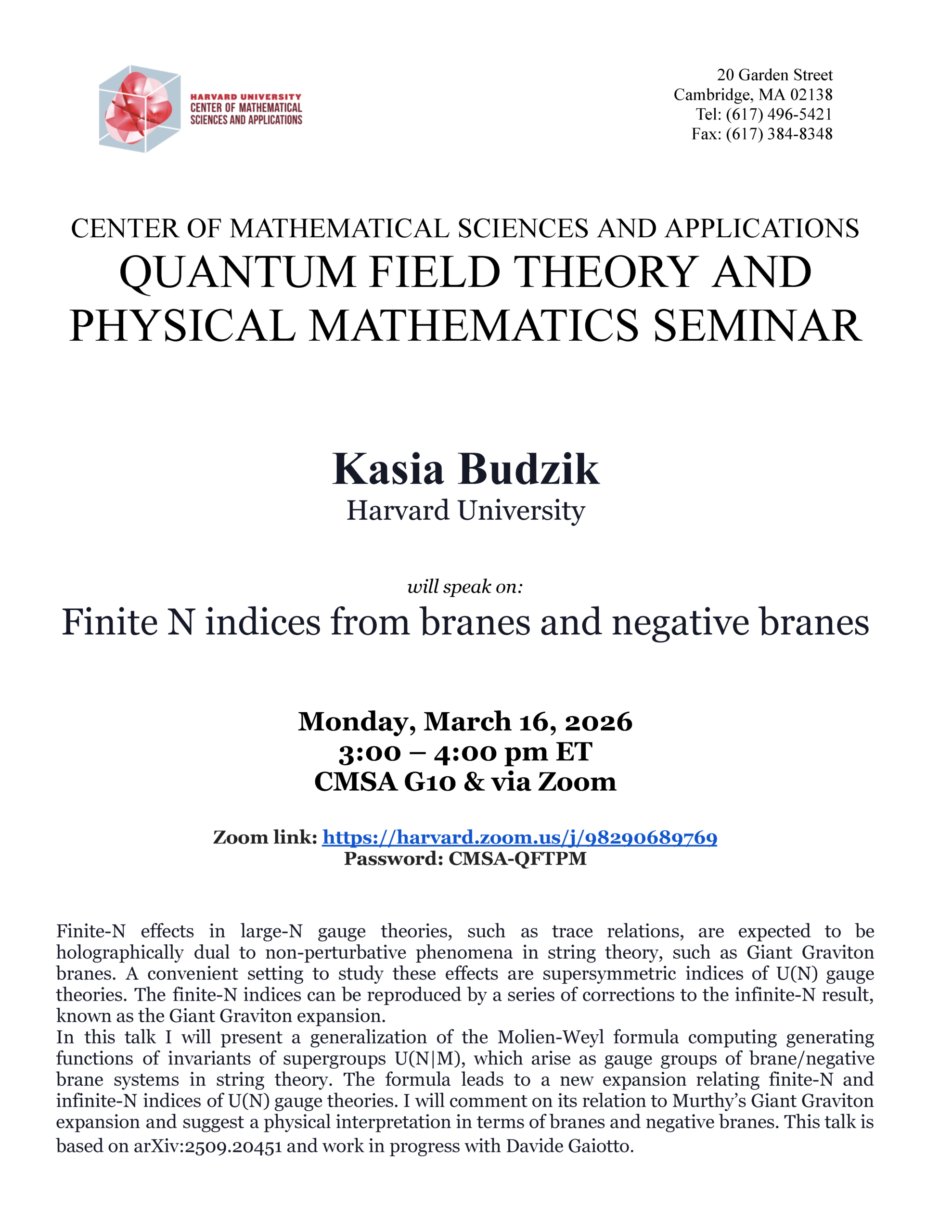
  • Finite N indices from branes and negative branes

    CMSA Room G10 CMSA, 20 Garden Street, Cambridge, MA, United States

    Quantum Field Theory and Physical Mathematics Seminar Speaker: Kasia Budzik (Harvard University) Title: Finite N indices from branes and negative branes Abstract: Finite-N effects in large-N gauge theories, such as trace relations, are expected to be holographically dual to non-perturbative phenomena in string theory, such as Giant Graviton branes. A convenient setting to study these […]

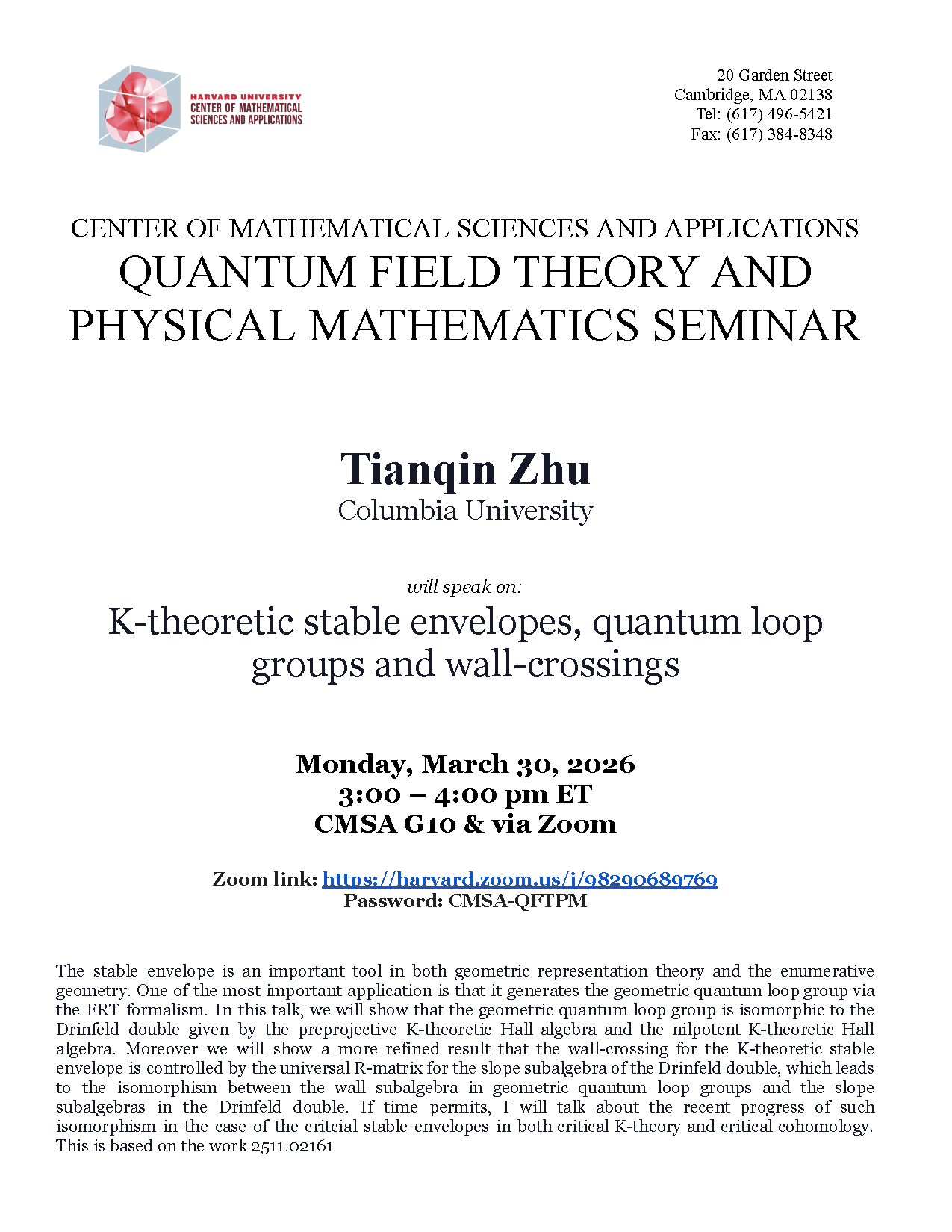
  • K-theoretic stable envelopes, quantum loop groups and wall-crossings

    CMSA Room G10 CMSA, 20 Garden Street, Cambridge, MA, United States

    Quantum Field Theory and Physical Mathematics Seminar Speaker: Tianqin Zhu, Columbia University Title: K-theoretic stable envelopes, quantum loop groups and wall-crossings Abstract: The stable envelope is an important tool in both geometric representation theory and the enumerative geometry. One of the most important application is that it generates the geometric quantum loop group via the FRT […]

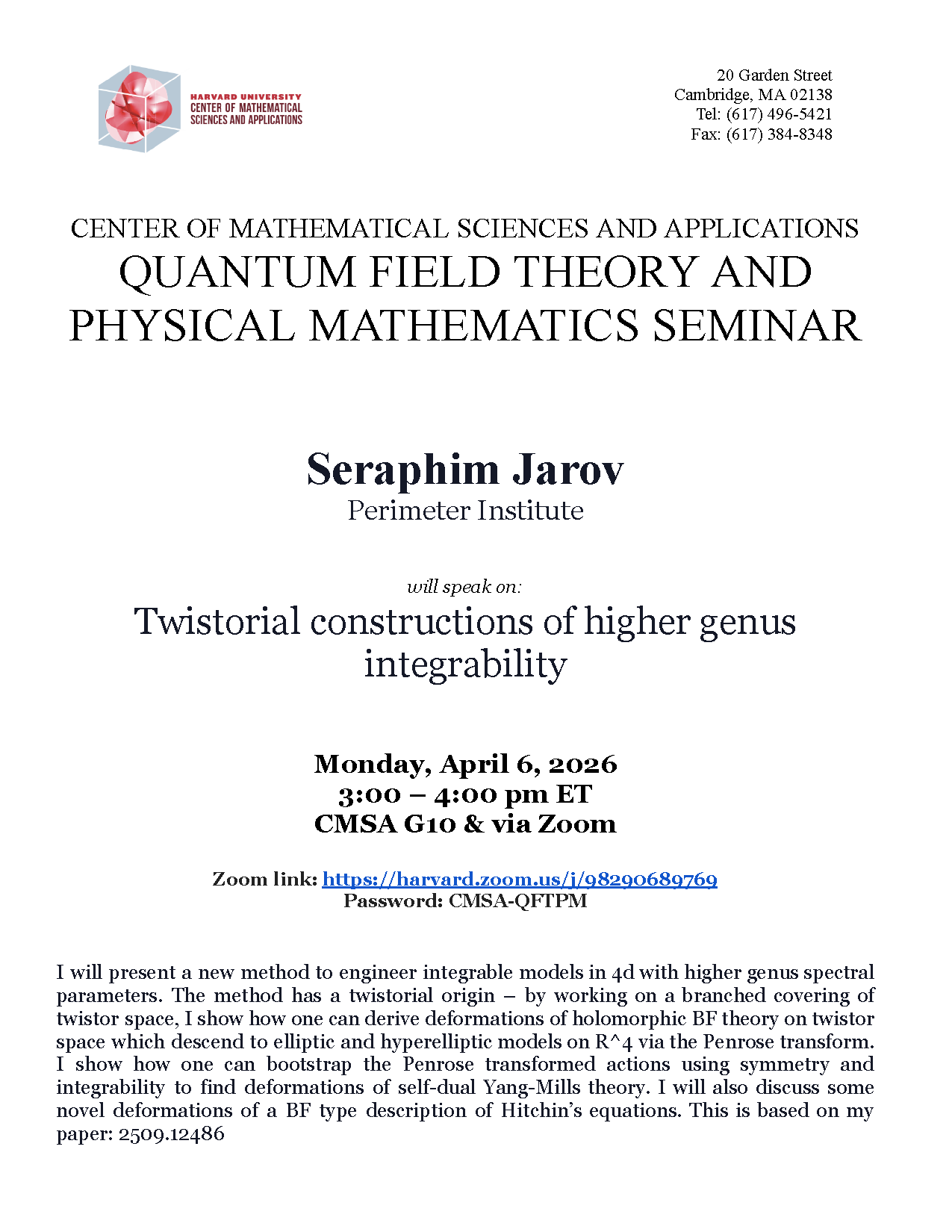
  • Twistorial constructions of higher genus integrability

    CMSA Room G10 CMSA, 20 Garden Street, Cambridge, MA, United States

    Quantum Field Theory and Physical Mathematics Seminar Speaker: Seraphim Jarov, Perimeter Institute Title: Twistorial constructions of higher genus integrability Abstract: I will present a new method to engineer integrable models in 4d with higher genus spectral parameters. The method has a twistorial origin – by working on a branched covering of twistor space, I show […]

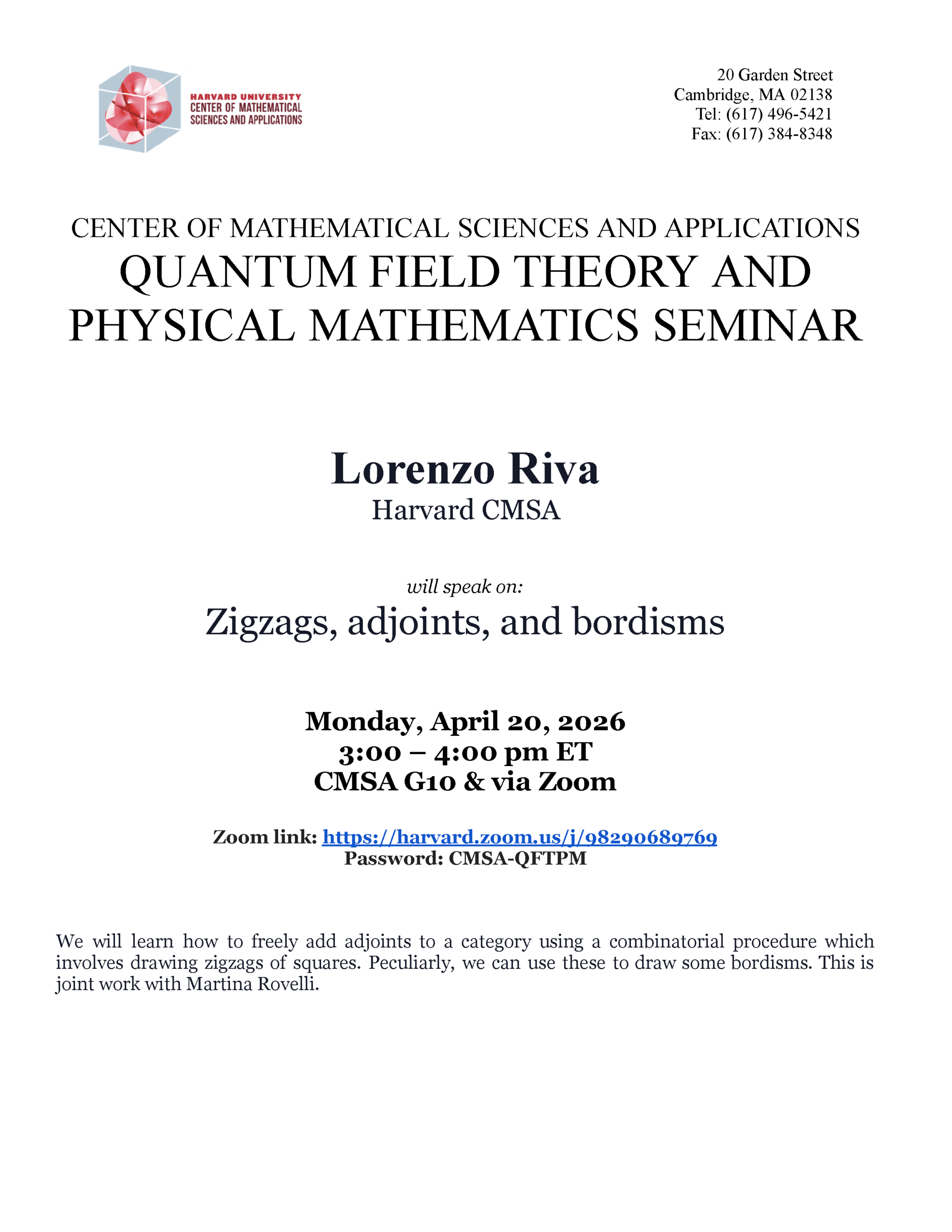
  • Zigzags, adjoints, and bordisms

    CMSA Room G10 CMSA, 20 Garden Street, Cambridge, MA, United States

    Quantum Field Theory and Physical Mathematics Seminar Speaker: Lorenzo Riva (Harvard CMSA) Title: Zigzags, adjoints, and bordisms Abstract: We will learn how to freely add adjoints to a category using a combinatorial procedure which involves drawing zigzags of squares. Peculiarly, we can use these to draw some bordisms. This is joint work with Martina Rovelli.

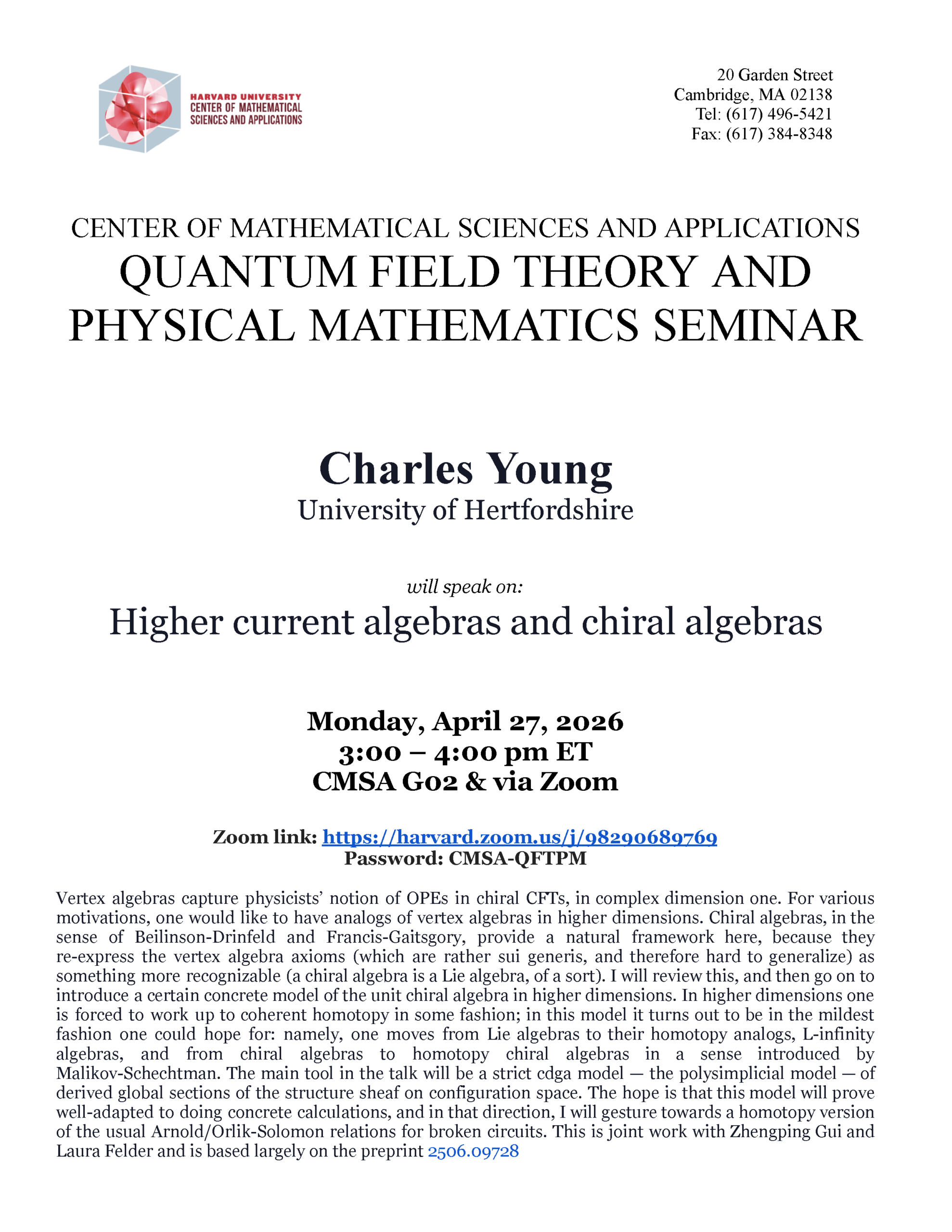
  • Higher current algebras and chiral algebras

    CMSA G102 20 Garden Street, Cambridge, MA

    Quantum Field Theory and Physical Mathematics Seminar Speaker: Charles Young (University of Hertfordshire) Title: Higher current algebras and chiral algebras Abstract: Vertex algebras capture physicists' notion of OPEs in chiral CFTs, in complex dimension one. For various motivations, one would like to have analogs of vertex algebras in higher dimensions. Chiral algebras, in the sense of Beilinson-Drinfeld and Francis-Gaitsgory, provide a natural framework here, […]