During the 2025–26 academic year, the Harvard Mathematics Department and CMSA will jointly host a seminar on Geometry and Quantum Theory, organized by Dan Freed and Vasily Krylov. The seminar will meet on Tuesdays from 4:15–6:30 pm (Eastern Time).

The seminar will take place in Science Center 507, 1 Oxford Street, Cambridge MA.

  • The Quasi-Adiabatic Theorem and All That

    Science Center 507 1 Oxford Street, Cambridge

    Geometry and Quantum Theory Seminar Speaker: Daniel Spiegel, Harvard Title: The Quasi-Adiabatic Theorem and All That Abstract: Yosuke Kubota has recently made progress on understanding Kitaev's conjecture by constructing a loop spectrum consisting of spaces of quantum spin systems, indexed by spatial dimension of the lattice (arXiv: 2503.12618). After a brief reminder on the C*-algebraic […]

  • More on Kubota’s spectrum of invertible states

    Science Center 507 1 Oxford Street, Cambridge

    Geometry and Quantum Theory Seminar Speakers: Dan Freed and Bowen Yang, Harvard CMSA Title: More on Kubota's spectrum of invertible states Abstract: Bowen will explain a construction aptly dubbed “Kitaev’s pump” in Kubota’s paper. Time permitting, Bowen will demonstrate its ubiquity throughout the study of topological phases, where it appears under various guises. In the second hour, […]

  • Geometric structures on gauge theoretic moduli spaces

    Science Center 507 1 Oxford Street, Cambridge

    Geometry and Quantum Theory Seminar Speaker: Saman Habibi Esfahani (CMSA) Title: Geometric structures on gauge theoretic moduli spaces Abstract: Motivated by Witten’s study of instantons on S3 x S1, we survey some classical and recent results, programs, and conjectures on geometric structures, such as symplectic and hyperkahler, on moduli spaces of instantons and monopoles on various […]
  • Constructing oriented TQFTs from twisted pivotal tensor categories

    CMSA Room G10 CMSA, 20 Garden Street, Cambridge, MA, United States

    Geometry and Quantum Theory Seminar Speaker: William Stewart Title: Constructing oriented TQFTs from twisted pivotal tensor categories Abstract: The cobordism hypothesis classifies n-dimensional oriented TQFTs in terms of SO(n) homotopy fixed point data. An SO(2) homotopy fixed point structure on a finite tensor category gives rise to a twisted pivotal structure (a more general notion […]

  • Bi-HKT Manifolds, Sigma Models, Large N=4 and their String Constructions

    Science Center 507 1 Oxford Street, Cambridge

    Geometry and Quantum Theory Seminar Speakers: Max Hübner, CMSA Title: Bi-HKT Manifolds, Sigma Models, Large N=4 and their String Constructions Abstract: We continue our review of Witten's paper "Instantons and the Large N=4 Algebra". We discuss the realization of large N=4 supersymmetry in the context of supersymmetric sigma-models, and discuss and motivate string theoretic duals […]

  • Solitonic Symmetry: Cohomology with TFT Coefficients

    Science Center 507 1 Oxford Street, Cambridge

    Geometry and Quantum Theory Seminar Speaker: Sanjay Raman, Harvard Title: Solitonic Symmetry: Cohomology with TFT Coefficients Abstract: We review the formalism of https://arxiv.org/pdf/2307.00939, which develops the theory of solitonic symmetry in quantum field theory. The algebraic structure of solitonic symmetry is determined by the fusion of topological functionals in a given path-integral formulation of topological field theory, and […]

  • TQFTs do not detect the Milnor sphere

    Science Center 507 1 Oxford Street, Cambridge

    Joint Math/CMSA Geometry and Quantum Theory Seminar Speaker: Lorenzo Riva, Harvard CMSA Title: TQFTs do not detect the Milnor sphere Abstract: I will talk about the recent paper of Gripaios and Randall-Williams with that title, where they prove that a functorial TQFT (i.e. a symmetric monoidal functor from the n-dimensional bordism category into a suitably […]

  • Line operators in holomorphic QFT

    Science Center 507 1 Oxford Street, Cambridge

    Joint Math/CMSA Geometry and Quantum Theory Seminar Speaker: Keyou Zeng (CMSA) Title: Line operators in holomorphic QFT Abstract: We will discuss the recent work (arxiv:2508.11749), which defines the so called dg shifted Yangian. I will discuss their origin from the study of 3d holomorphic topological field theories, a variant of 3d TQFT. A dg shifted Yangian […]

  • 1-shifted Yangians from 1-shifted Lie bialgebras

    Science Center 507 1 Oxford Street, Cambridge

    Joint Math/CMSA Geometry and Quantum Theory Seminar Speaker: Vasily Krylov, Harvard Title: 1-shifted Yangians from 1-shifted Lie bialgebras Abstract: In the previous talk, Keyou explained that the fusion of line defects in 3d holomorphic–topological field theories is expected to be governed by so-called DG-shifted Yangians. Following arXiv:2503.08770, I will present examples of such DG-shifted Yangians arising from […]

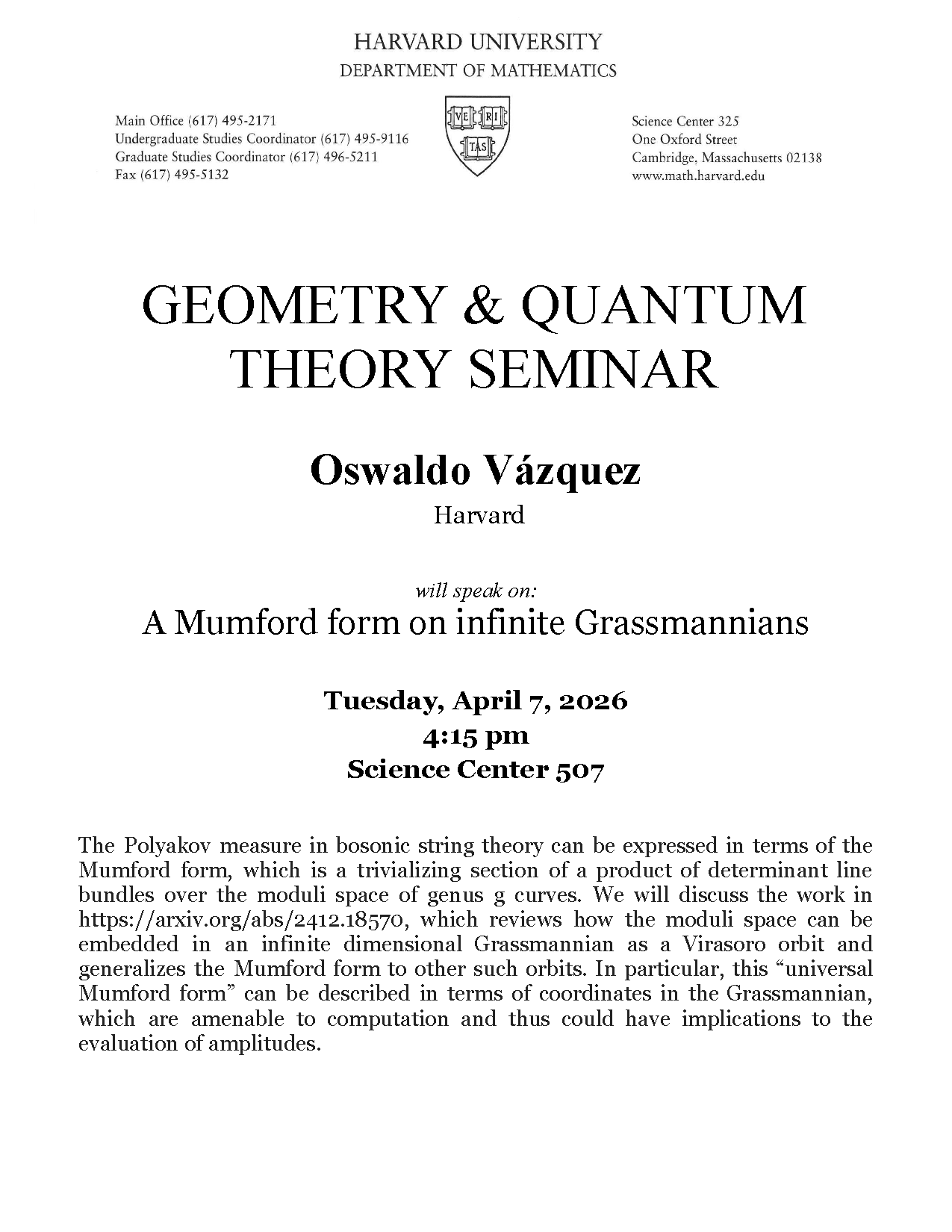
  • A Mumford form on infinite Grassmannians

    Science Center 507 1 Oxford Street, Cambridge

    Joint Math/CMSA Geometry and Quantum Theory Seminar Speaker: Oswaldo Vázquez (Harvard) Title: A Mumford form on infinite Grassmannians Abstract: The Polyakov measure in bosonic string theory can be expressed in terms of the Mumford form, which is a trivializing section of a product of determinant line bundles over the moduli space of genus g curves. We […]

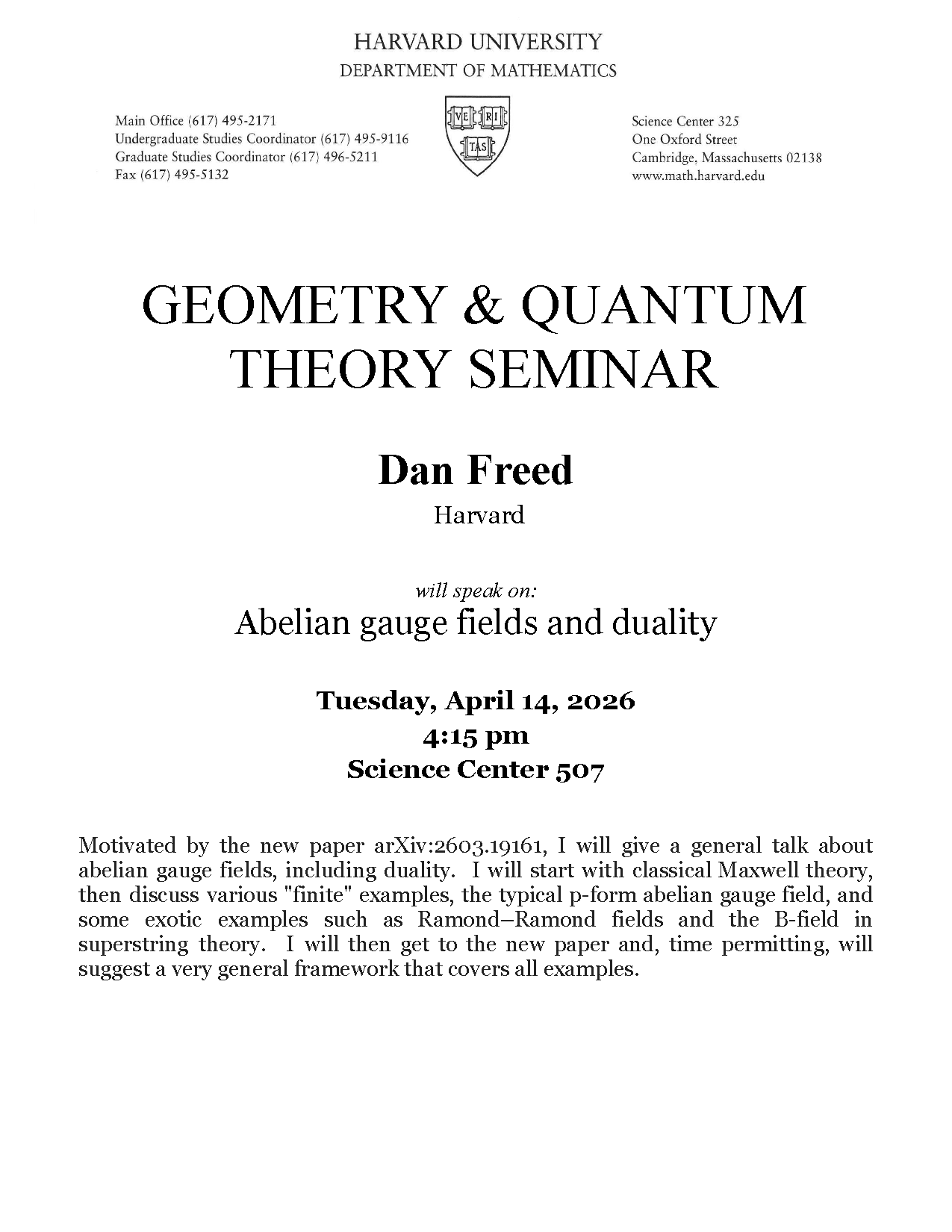
  • Abelian gauge fields and duality

    Science Center 507 1 Oxford Street, Cambridge

    Joint Math/CMSA Geometry and Quantum Theory Seminar Speaker: Dan Freed, Harvard Math & CMSA Title: Abelian gauge fields and duality Abstract: Motivated by the new paper arXiv:2603.19161, I will give a general talk about abelian gauge fields, including duality. I will start with classical Maxwell theory, then discuss various “finite” examples, the typical p-form abelian […]