During 2024–25, the CMSA will host a seminar on Quantum Matter in Mathematics and Physics, organized by Ahsan Khan, Robert Moscrop, and Sunghyuk Park.

This seminar will take place on Fridays at 9:00–10:30 am (Eastern Time) through October. In November, seminars will be held from 10:00–11:30 am. To learn how to attend this seminar, please fill out this form.

The schedule will be updated as talks are confirmed.

Videos are available at the Quantum Matter in Mathematics and Physics Youtube Playlist

  • 3D gravity and gravitational entanglement entropy

    Virtual

    Quantum Matter Seminar Speaker: Gabriel Wong (Harvard CMSA) Title: 3D gravity and gravitational entanglement entropy Abstract: Recent progress in AdS/CFT has provided a good understanding of how the bulk spacetime is encoded in the entanglement structure of the boundary CFT. However, little is known about how spacetime emerges directly from the bulk quantum theory. We […]
  • Symmetry in quantum field theory and quantum gravity 1

    Speaker: Daniel Harlow (MIT) Title: Symmetry in quantum field theory and quantum gravity 1 Abstract: In this talk I will give an overview of semi-recent work with Hirosi Ooguri arguing that three old conjectures about symmetry in quantum gravity are true in the AdS/CFT correspondence.  These conjectures are 1) that there are no global symmetries in […]

  • Exact Many-Body Ground States from Decomposition of Ideal Higher Chern Bands: Applications to Chirally Twisted Graphene Multilayers

    Virtual

    Quantum Matter Seminar Speaker: Junkai Dong (Harvard University) Title: Exact Many-Body Ground States from Decomposition of Ideal Higher Chern Bands: Applications to Chirally Twisted Graphene Multilayers Abstract: Motivated by the higher Chern bands of twisted graphene multilayers, we consider flat bands with arbitrary Chern number C with ideal quantum geometry. While C>1 bands differ from […]

  • Neutrino Masses from Generalized Symmetry Breaking

    Virtual

    Quantum Matter Seminar Speaker: Sungwoo Hong (U Chicago & KAIST) Title: Neutrino Masses from Generalized Symmetry Breaking Abstract: We explore generalized global symmetries in theories of physics beyond the Standard Model. Theories of Z′ bosons generically contain 'non-invertible' chiral symmetries, whose presence indicates a natural paradigm to break this symmetry by an exponentially small amount […]

  • Non-Invertible Symmetries from Holography and Branes

    Virtual

    Quantum Matter Seminar Speaker: Federico Bonetti (Oxford) Title: Non-Invertible Symmetries from Holography and Branes Abstract:  The notion of global symmetry in quantum field theory (QFT) has witnessed dramatic generalizations in the past few years. One of the most exciting developments has been the identification of 4d QFTs possessing non-invertible symmetries, i.e. global symmetries whose generators […]

  • Phase Fluctuations in Two-Dimensional Superconductors and Pseudogap Phenomenon

    Virtual

    Quantum Matter Seminar Speaker: Yang Qi (Fudan) Title: Phase Fluctuations in Two-Dimensional Superconductors and Pseudogap Phenomenon Abstract: We study the phase fluctuations in the normal state of a general two-dimensional (2d) superconducting system with s-wave pairing. The effect of phase fluctuations of the pairing fields can be dealt with perturbatively using disorder averaging, after we […]

  • Reflections on Parity Breaking

    Virtual

    Quantum Matter Seminar Speakers: Jacob McNamara (Caltech) and Matthew Reece (Harvard) Title: Reflections on Parity Breaking Abstract: One approach to the Strong CP Problem (known as Nelson-Barr models) is to assume that parity is a gauge symmetry, which is spontaneously broken in the world around us. In this talk, we will describe the formal meaning […]

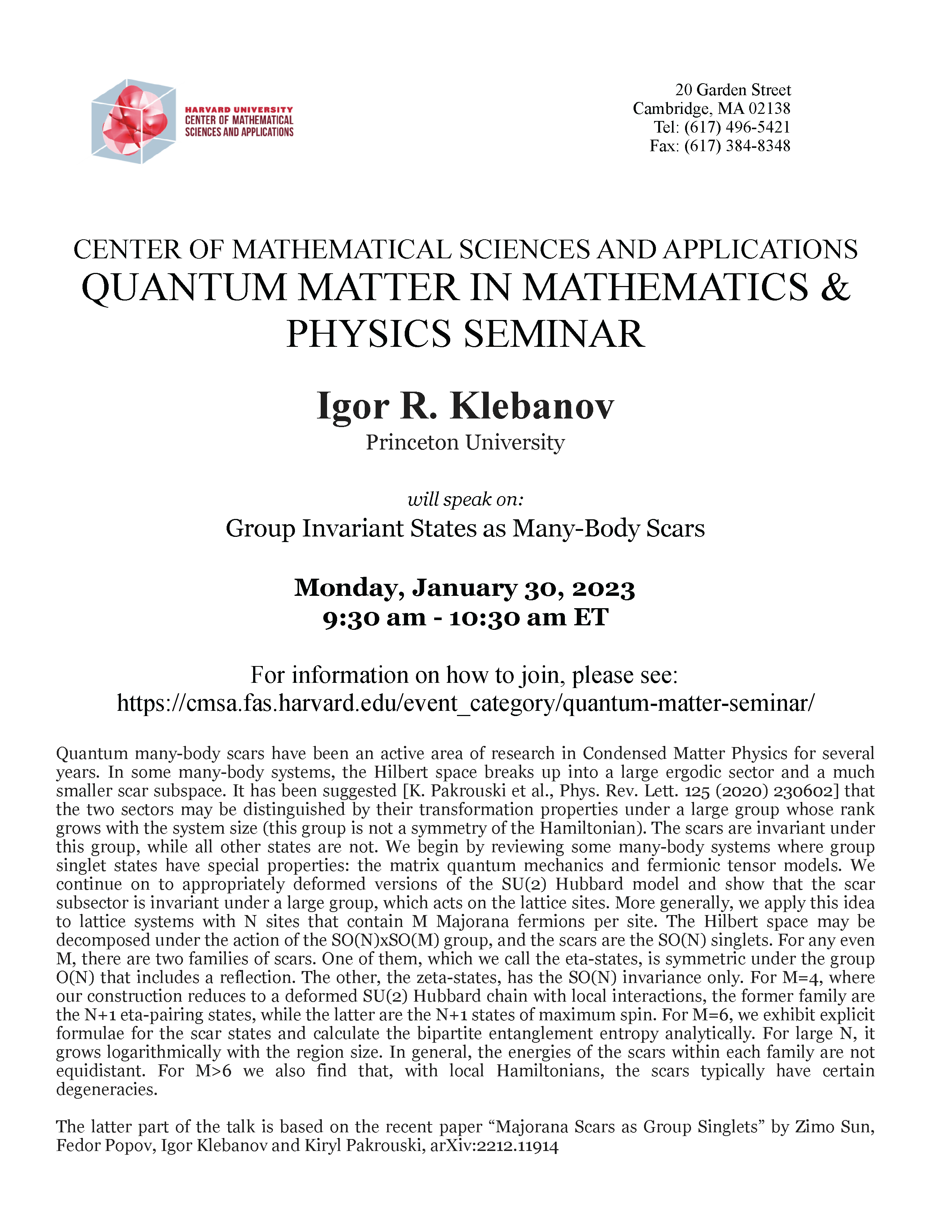
  • Group Invariant States as Many-Body Scars

    Virtual

    Quantum Matter Seminar Title: Group Invariant States as Many-Body Scars Speaker: Igor R. Klebanov (Princeton University) Abstract: Quantum many-body scars have been an active area of research in Condensed Matter Physics for several years. In some many-body systems, the Hilbert space breaks up into a large ergodic sector and a much smaller scar subspace. It […]

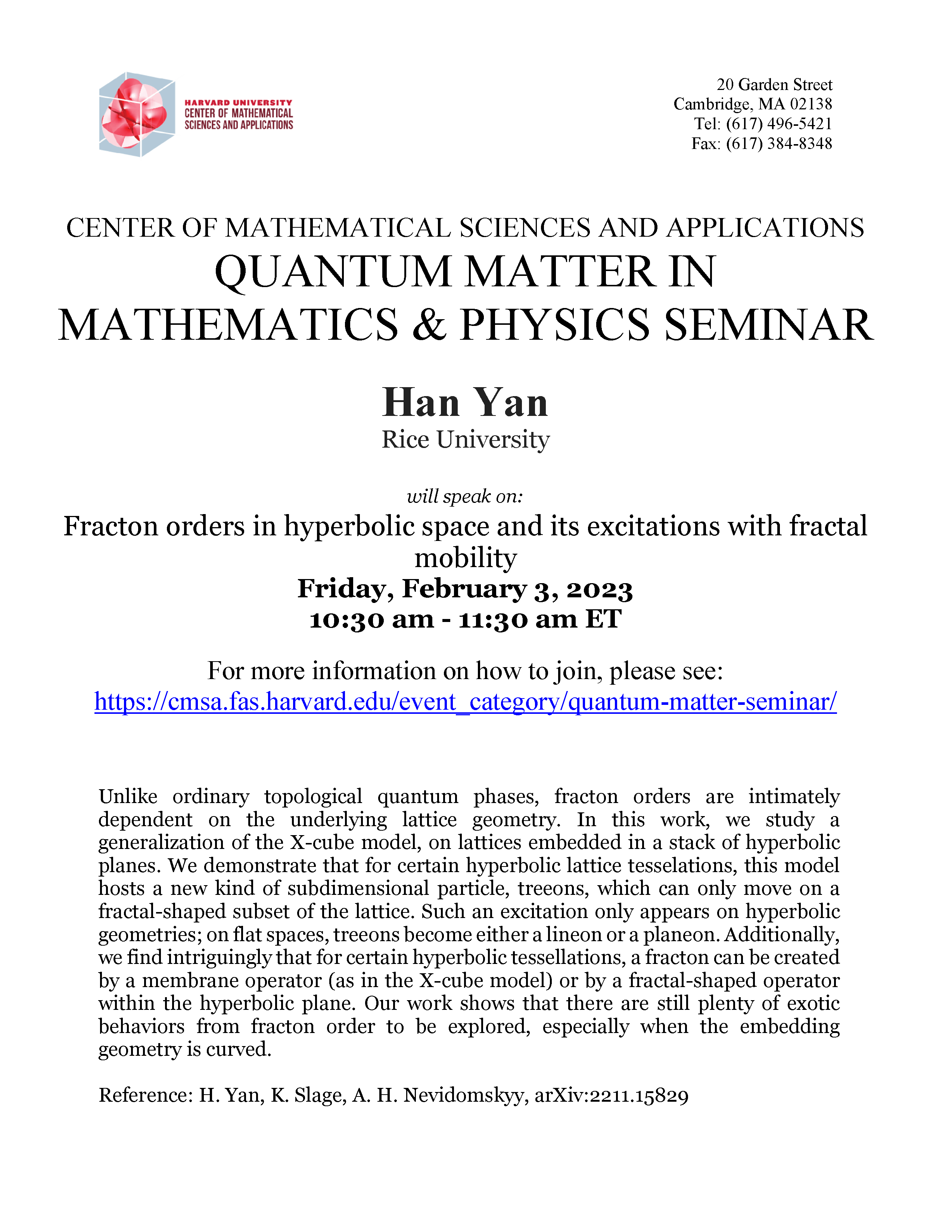
  • Fracton orders in hyperbolic space and its excitations with fractal mobility

    Virtual

    Quantum Matter Seminar Speaker: Han Yan (Rice U) Title: Fracton orders in hyperbolic space and its excitations with fractal mobility Abstract: Unlike ordinary topological quantum phases, fracton orders are intimately dependent on the underlying lattice geometry. In this work, we study a generalization of the X-cube model, on lattices embedded in a stack of hyperbolic […]

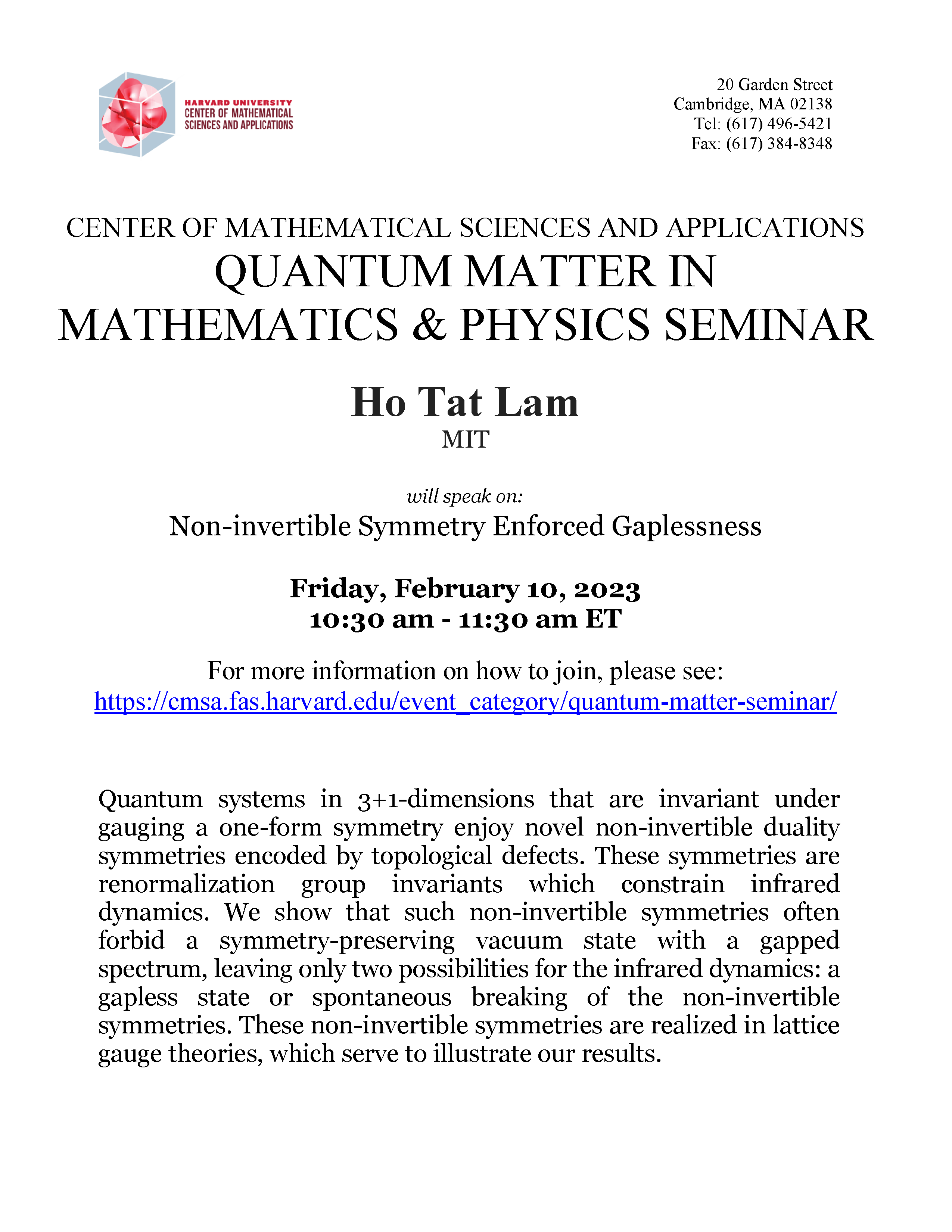
  • Non-invertible Symmetry Enforced Gaplessness

    Virtual

    Quantum Matter Seminar Speaker: Ho Tat Lam (MIT) Title: Non-invertible Symmetry Enforced Gaplessness Abstract: Quantum systems in 3+1-dimensions that are invariant under gauging a one-form symmetry enjoy novel non-invertible duality symmetries encoded by topological defects. These symmetries are renormalization group invariants which constrain infrared dynamics. We show that such non-invertible symmetries often forbid a symmetry-preserving vacuum state […]

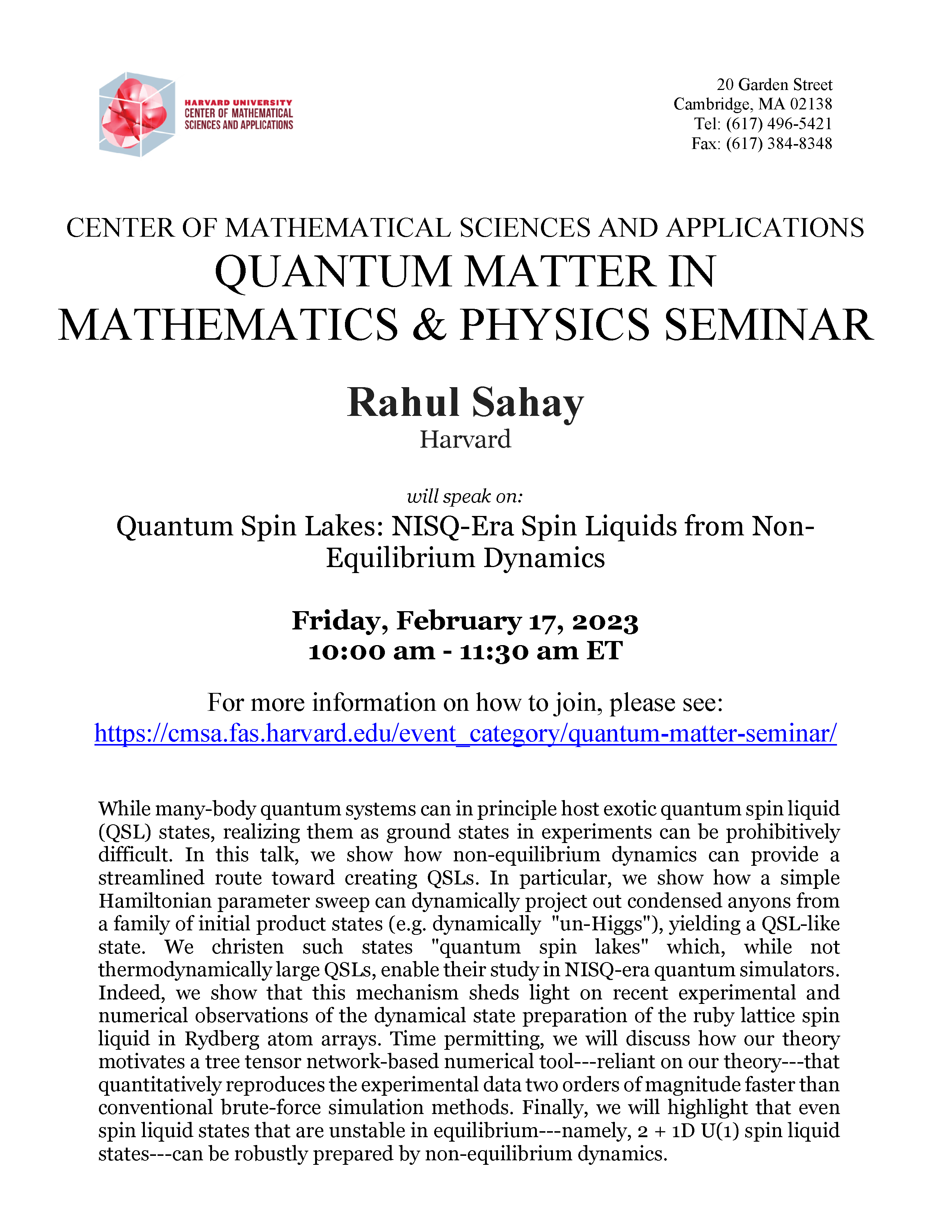
  • Quantum Spin Lakes: NISQ-Era Spin Liquids from Non-Equilibrium Dynamics

    Virtual

    Quantum Matter Seminar Speaker: Rahul Sahay (Harvard) Title: Quantum Spin Lakes: NISQ-Era Spin Liquids from Non-Equilibrium Dynamics Abstract: While many-body quantum systems can in principle host exotic quantum spin liquid (QSL) states, realizing them as ground states in experiments can be prohibitively difficult. In this talk, we show how non-equilibrium dynamics can provide a streamlined […]

  • Strongly coupled ultraviolet fixed point and symmetric mass generation in four dimensions with 8 Kähler-Dirac fermions

    Virtual

    Quantum Matter Seminar Speaker: Anna Hasenfratz (University of Colorado) Title: Strongly coupled ultraviolet fixed point and symmetric mass generation in four dimensions with 8 Kähler-Dirac fermions Abstract: 4-dimensional gauge-fermion systems exhibit a quantum phase transition from a confining, chirally broken phase to a conformal phase as the number of fermions is increased. While the existence of the conformal […]