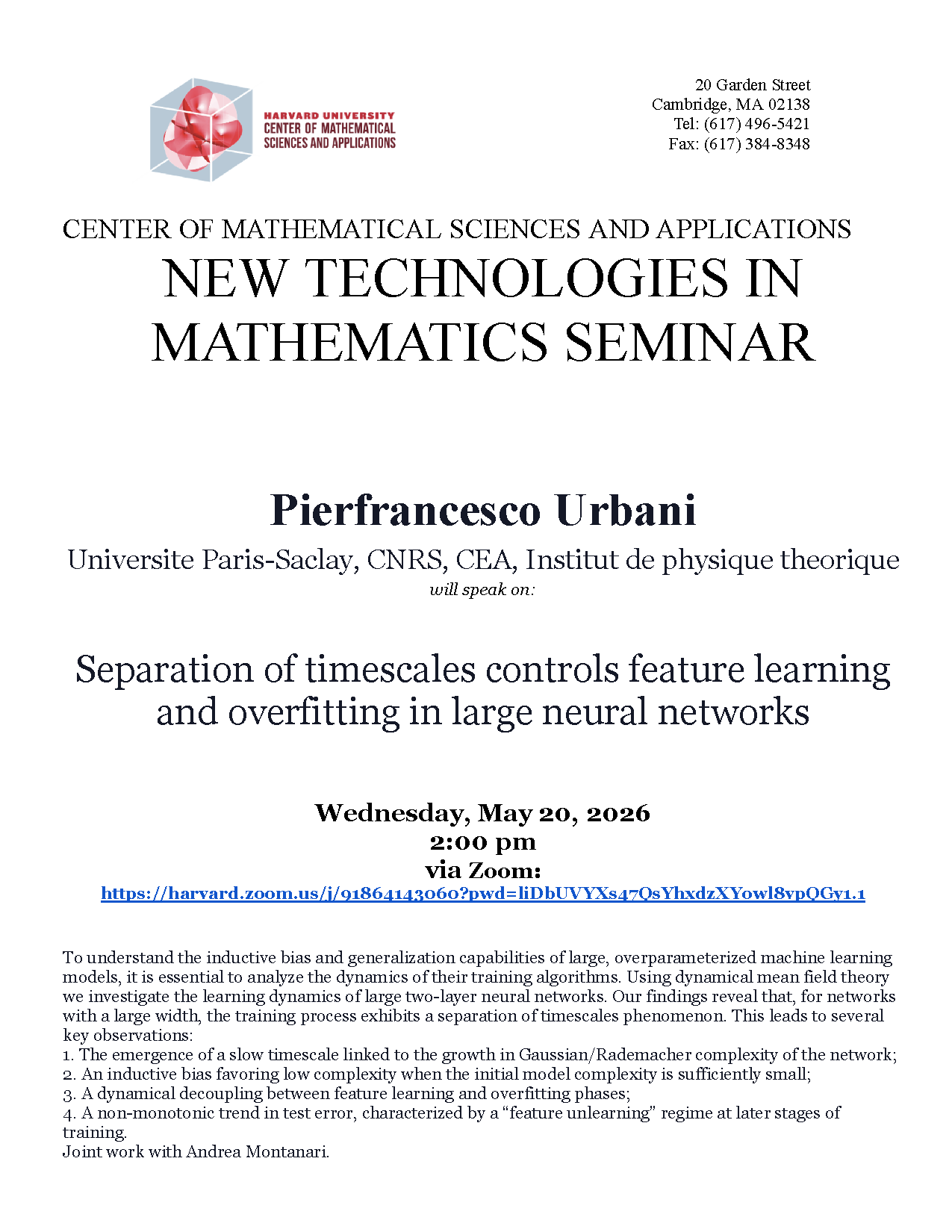
• Machine learning tools for mathematical discovery

    Virtual

    New Technologies in Mathematics Seminar Speaker: Adam Zsolt Wagner, Google DeepMind Title: Machine learning tools for mathematical discovery Abstract: I will discuss various ML tools we can use today to try to find interesting constructions to various mathematical problems. I will briefly mention simple reinforcement learning setups and PatternBoost, but the talk will mainly focus […]

  • Towards a Dolbeault AGT correspondence

    CMSA Room G10 CMSA, 20 Garden Street, Cambridge, MA, United States

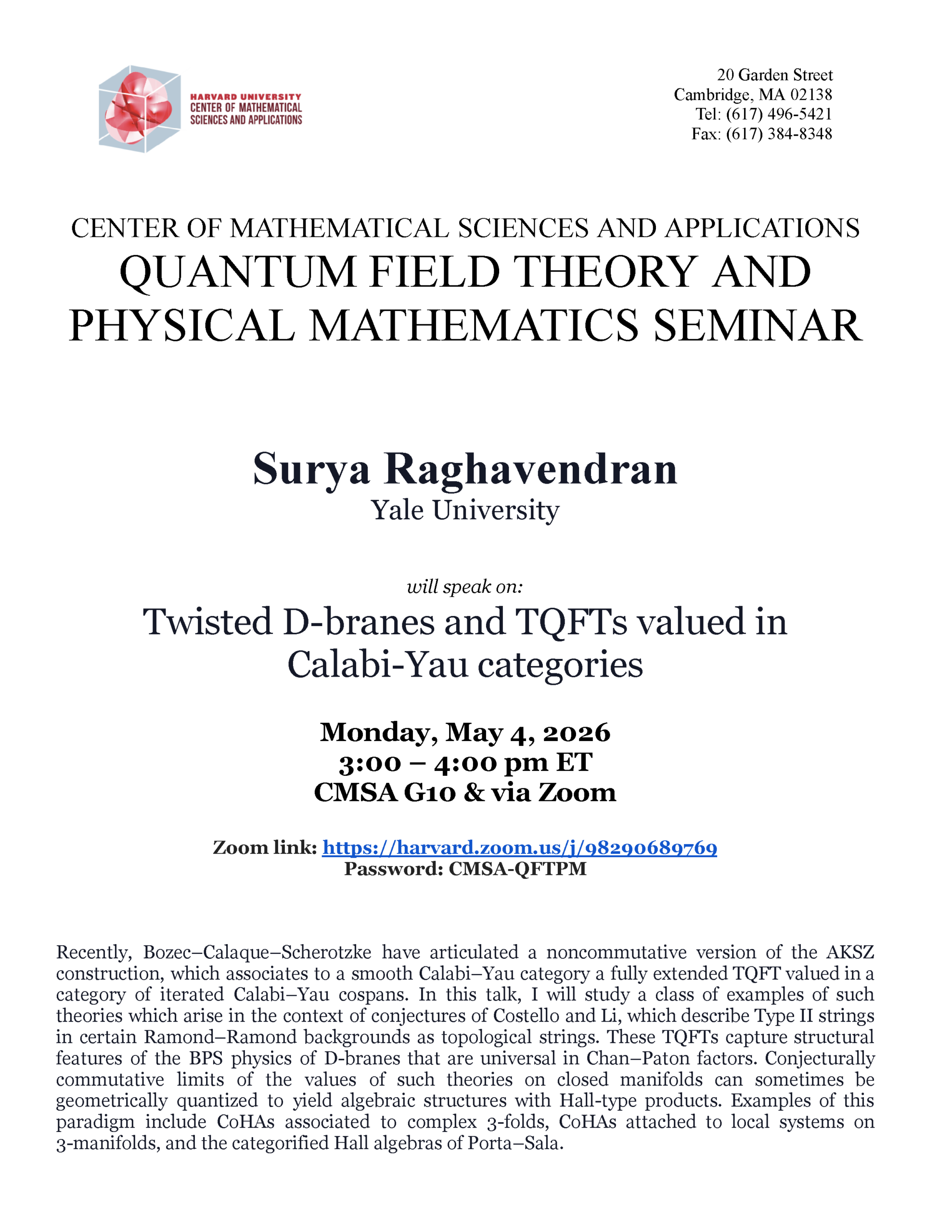
    Differential Geometry and Physics Seminar Speaker: Surya Raghavendran, Yale Title: Towards a Dolbeault AGT correspondence Abstract: The AGT correspondence and its extensions propose geometric constructions of vertex algebras and their modules from the cohomology of various moduli spaces of sheaves on surfaces. Physically, the correspondence is illuminated throgh the holomorphic–topological twist of the six-dimensional N=(2,0) superconformal field […]

  • A combinatorial formula for interpolation Macdonald polynomials

    Common Room, CMSA 20 Garden Street, Cambridge, MA, United States

    Member Seminar Speaker: Houcine Ben Dali, Harvard CMSA Title: A combinatorial formula for interpolation Macdonald polynomials Abstract: In 1996, Knop and Sahi introduced a remarkable family of inhomogeneous symmetric polynomials, defined via vanishing conditions, whose top homogeneous parts are exactly the Macdonald polynomials. Like the Macdonald polynomials, these interpolation Macdonald polynomials are closely connected to […]

  • Computing WKB periods 

    CMSA Room G02 20 Garden Street, Cambridge, MA

    Quantum Field Theory and Physical Mathematics Seminar Speaker: Max Meynig, University of Connecticut Title: Computing WKB periods Abstract:  In one dimensional quantum mechanics, the all-orders WKB method leads to ‘quantum periods’ which are formal power series in \hbar whose coefficients are certain period integrals. These periods, which limelight in supersymmetric/string theories, have rich structure and can be […]

  • Recent Advances in Probabilistically Checkable Proofs

    CMSA Room G10 CMSA, 20 Garden Street, Cambridge, MA, United States

    Colloquium Speaker: Dor Minzer (MIT) Title: Recent Advances in Probabilistically Checkable Proofs Abstract: The PCP Theorem is a cornerstone of computer science, with applications to hardness of approximation, verification, interactive protocols and more. It asserts a witness for the satisfiability of a given 3CNF formula can be encoded in a robust way that allows local checking.In this […]

  • Geometry and Quantum Theory Seminar

    Science Center 507 1 Oxford Street, Cambridge

    Geometry and Quantum Theory Seminar Speaker: Lorenzo Riva, CMSA Title: Aganagic’s invariant is Khovanov homology Abstract: Webster computed the Khovanov homology of (the closure of) a braid in terms of the action of that braid on a certain KLRW category. Aganagic proposed that the same computation could be done in the Fukaya-Seidel category of the multiplicative Coulomb […]

  • Covers of curves, Ceresa cycles, and unlikely intersections

    CMSA Room G10 CMSA, 20 Garden Street, Cambridge, MA, United States

    Algebra Seminar Speaker: Padamavathi Srinivasan, Boston University Title: Covers of curves, Ceresa cycles, and unlikely intersections Abstract: The Ceresa cycle is a canonical homologically trivial algebraic cycle associated to a curve in its Jacobian. In his 1983 thesis, Ceresa showed that this cycle is algebraically nontrivial for a very general complex curve of genus at least […]

  • The active Young-Dupré equation

    CMSA Room G10 CMSA, 20 Garden Street, Cambridge, MA, United States

    Colloquium Speaker: Julien Tailleur, MIT Title: The active Young-Dupré equation Abstract: The Young-Dupré equation is a cornerstone of the equilibrium theory of capillary and wetting phenomena. In the biological world, interfacial phenomena are ubiquitous, from the spreading of bacterial colonies to tissue growth and flocking of birds, but the description of such active systems escapes […]

  • Electrical networks, Grassmannians, and cluster algebras

    CMSA Room G10 CMSA, 20 Garden Street, Cambridge, MA, United States

    Algebra Seminar Speaker: Lazar Guterman, Hebrew University of Jerusalem Title: Electrical networks, Grassmannians, and cluster algebras Abstract: An electrical network with $n$ boundary vertices induces a matrix called the response matrix which measures the electrical properties of the network. The set of response matrices of all electrical networks has a characterization in terms of positivity of […]