• The classifying space of a Morse flow category

    Science Center 507 1 Oxford Street, Cambridge

    Joint Math/CMSA Geometry and Quantum Theory Seminar Speaker: Lorenzo Riva, Harvard CMSA Title: The classifying space of a Morse flow category Abstract: Following a paper of Calle and Liu we show that, under suitable tameness assumptions, the classifying space of the Morse category associated to a manifold M with a Morse function recovers the homotopy […]

  • Transcendental Epsilon Multiplicity via Divisor Volumes

    CMSA Room G02 20 Garden Street, Cambridge, MA

    Algebra Seminar Speaker: Sudipta Das, Tata Institute of Fundamental Research Title: Transcendental Epsilon Multiplicity via Divisor Volumes Abstract:  In this talk, our goal is to establish a structural bridge between asymptotic commutative algebra and transcendence theory to show that there exists an ideal in a Noetherian local ring whose epsilon multiplicity is transcendental. By equating the […]

  • Lifting F-split surfaces to the Witt vectors

    CMSA Room G10 CMSA, 20 Garden Street, Cambridge, MA, United States

    Member Seminar Speaker: Iacopo Brivio, CMSA Title: Lifting F-split surfaces to the Witt vectors Abstract: Algebraic varieties in positive characteristic are ill behaved compared to characteristic zero ones. Several important tools available over the complex numbers, such as the Hodge decomposition theorem, are either not available or straight-away false. There are two important classes of […]

  • Twisted D-branes and TQFTs valued in Calabi-Yau categories

    CMSA Room G10 CMSA, 20 Garden Street, Cambridge, MA, United States

    Quantum Field Theory and Physical Mathematics Seminar Speaker: Surya Raghavendran, Yale University Title: Twisted D-branes and TQFTs valued in Calabi-Yau categories Abstract: Recently, Bozec–Calaque–Scherotzke have articulated a noncommutative version of the AKSZ construction, which associates to a smooth Calabi–Yau category a fully extended TQFT valued in a category of iterated Calabi–Yau cospans. In this talk, […]

  • Dynamics as intersection problem

    CMSA Room G10 CMSA, 20 Garden Street, Cambridge, MA, United States

    Colloquium Speaker: Nikita Nekrasov, Simons Center Title: Dynamics as intersection problem Abstract: Most classical and quantum field theories are based on an action principle. However, there are important exceptions to this --- hydrodynamics and the theory of self-dual fields. In this talk we formulate the covariant relativistic fluid dynamics, with or without magnetic fields, as […]
  • New directions in synthetic data

    Virtual
    Virtual Event

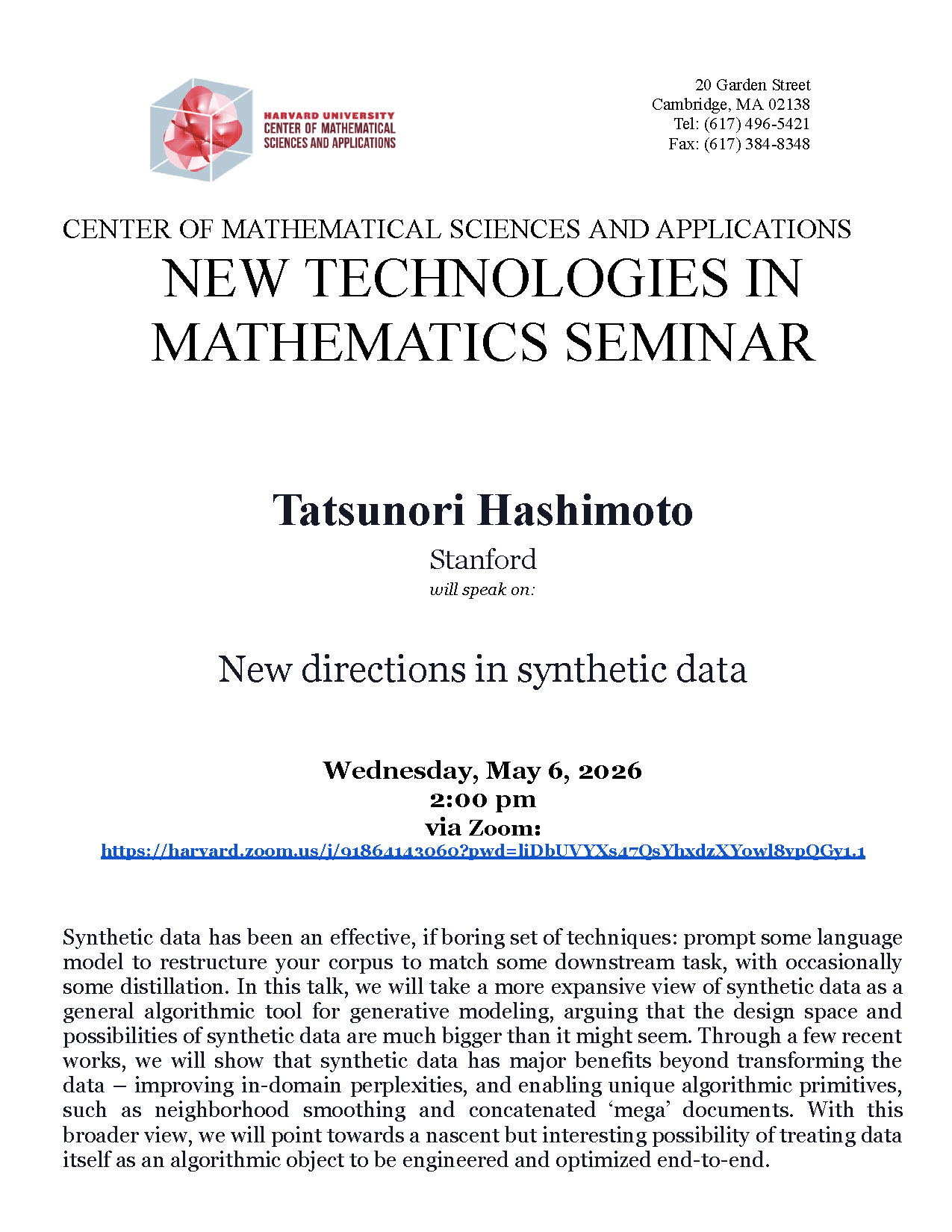
    New Technologies in Mathematics Seminar Speaker: Tatsunori Hashimoto, Stanford Title: New directions in synthetic data Abstract: Synthetic data has been an effective, if boring set of techniques: prompt some language model to restructure your corpus to match some downstream task, with occasionally some distillation. In this talk, we will take a more expansive view of […]

  • Statistical Shape Analysis of Complex Natural Structures

    CMSA Room G10 CMSA, 20 Garden Street, Cambridge, MA, United States

    Colloquium Speaker: Anuj Srivastava, Johns Hopkins University Title: Statistical Shape Analysis of Complex Natural Structures Abstract: Statistical modeling and analysis of structured data is a fast-growing field in Statistics and Data Science. Rapid advances in imaging techniques have led to tremendous amounts of data for analyzing imaged objects across several scientific disciplines. Examples include shapes […]

  • Polynomial invariants of conjugation over finite fields

    CMSA Room G10 CMSA, 20 Garden Street, Cambridge, MA, United States

    Algebra Seminar Speaker: Aryaman Maithani, University of Utah Title: Polynomial invariants of conjugation over finite fields Abstract: Consider the conjugation action of GL₂(K) on the polynomial ring K. When K is an infinite field, the ring of invariants is a polynomial ring generated by the trace and the determinant. We describe the ring of invariants when K is a finite field, and show that it is a hypersurface.    

  • Separation of timescales controls feature learning and overfitting in large neural networks

    Virtual
    Virtual Event

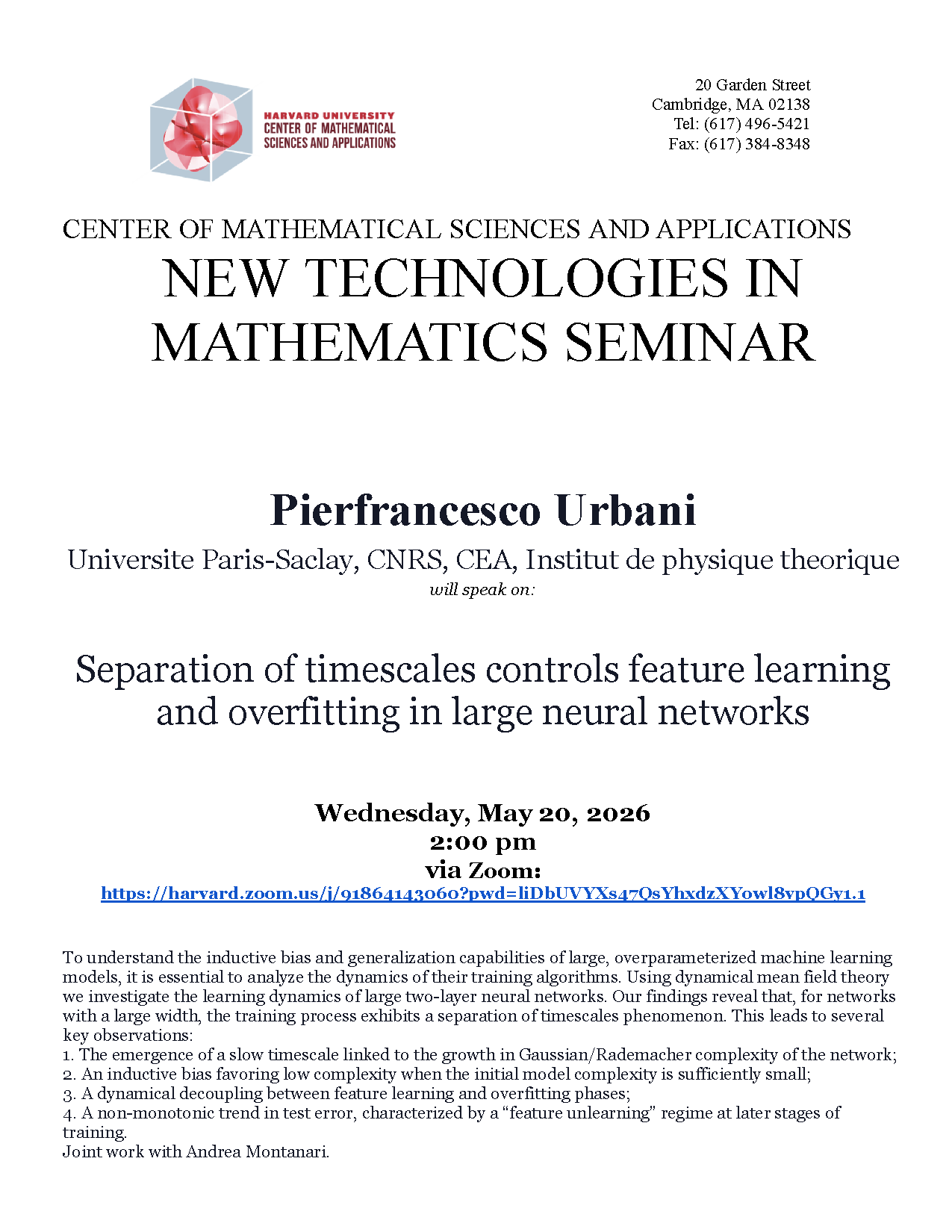
    New Technologies in Mathematics Seminar Speaker: Pierfrancesco Urbani, Universite Paris-Saclay, CNRS, CEA, Institut de physique theorique Title: Separation of timescales controls feature learning and overfitting in large neural networks Abstract: To understand the inductive bias and generalization capabilities of large, overparameterized machine learning models, it is essential to analyze the dynamics of their training algorithms. […]