

- This event has passed.
Workshop on Calabi-Yau metrics and optimal transport
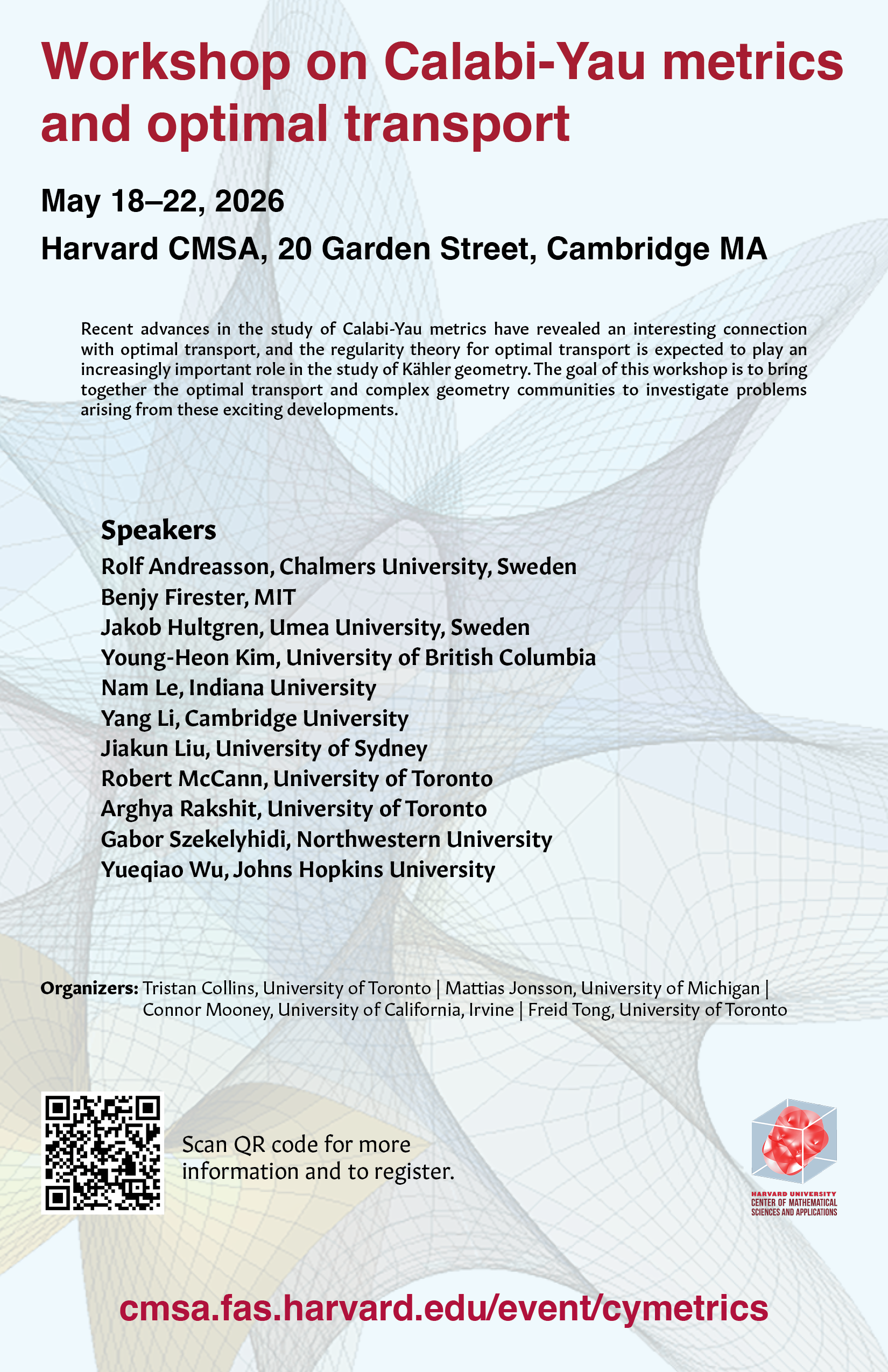
Workshop on Calabi-Yau metrics and optimal transport
Dates: May 18–22, 2026
Location: Harvard CMSA, 20 Garden Street, Cambridge MA
Recent advances in the study of Calabi-Yau metrics have revealed an interesting connection with optimal transport, and the regularity theory for optimal transport is expected to play an increasingly important role in the study of Kähler geometry. The goal of this workshop is to bring together the optimal transport and complex geometry communities to investigate problems arising from these exciting developments.
Videos of selected talks are now available on the Youtube Playlist
Minicourse Speakers
- Robert McCann, University of Toronto
- Yang Li, Cambridge University
Workshop Speakers
- Rolf Andreasson, Chalmers University, Sweden
- Benjy Firester, MIT
- Jakob Hultgren, Umea University, Sweden
- Young-Heon Kim, University of British Columbia
- Nam Le, Indiana University
- Jiakun Liu, University of Sydney
- Arghya Rakshit, University of Toronto
- Gabor Szekelyhidi, Northwestern University
- Yueqiao Wu, Johns Hopkins University
Organizers:
- Tristan Collins, University of Toronto
- Mattias Jonsson, University of Michigan
- Connor Mooney, University of California, Irvine
- Freid Tong, University of Toronto
Schedule (pdf)
Monday, May 18, 2026
9:00–9:30 am
Breakfast
9:30–10:45 am
Tutorial: Yang Li, Cambridge University (via Zoom Webinar)
Title: On the metric SYZ conjecture
Abstract: For a polarised degeneration family of Calabi-Yau manifolds near the large complex structure limit, the metric SYZ conjecture asks for a special Lagrangian torus fibration on the generic region of the Calabi-Yau manifolds. I will summarize the progress on the metric SYZ conjecture so far, emphasizing on some more recent progress.
10:45–11:15 am
Break
11:15 am–12:30 pm
Tutorial: Robert McCann, University of Toronto
Title: A geometric approach to apriori estimates for optimal transport maps
Abstract: A key inequality which underpins the regularity theory of optimal transport for costs satisfying the Ma-Trudinger-Wang condition is the Pogorelov second derivative bound. This translates to an a priori interior modulus of the differential estimate for smooth optimal maps. We describe a new derivation of this estimate with Brendle, Leger and Rankin which relies in part on Kim, McCann, and Warren’s observation that the graph of an optimal map becomes a volume maximizing non-timelike submanifold when the product of the source and target domains is endowed with a suitable pseudo-Riemannian geometry that combines both the marginal densities and the cost. This unexpected links optimal transport to the plateau problem in geometry with split signature, and shows the key difficulty is showing the maximizing non-timelike submanifold is in fact (uniformly) spacelike. J. Reine Angew. Math. 817 (2024) 251-266 doi.org/10.1515/crelle-2024-0071 arXiv 2311.10208
12:30–2:00 pm
Lunch (catered)
2:00–3:15 pm
Talk: Nam Le, Indiana University
Title: Variational approach to degenerate Monge-Ampère equations with mixed measures and monotonicity
Abstract: In this talk, we will discuss the solvability and uniqueness for several degenerate Monge-Ampère equations including the Monge-Ampère eigenvalue problem in real Euclidean spaces that involve singular Borel measures. Our approach systematically analyzes the Monge-Ampère energy from the variational point of view and appropriately exploits monotonicity arguments. We will examine several essential tools: the mixed Monge-Ampère measure, Aleksandrov-Blocki-Jerison type maximum principles, convex envelope, comparison principles for subcritical equations, and integration by parts whose failure leads to symmetry breaking and nonuniqueness phenomena.
3:15–3:45 pm
Break
3:45–5:00 pm
Talk: Yueqiao Wu, Johns Hopkins University
Title: Valuative aspects of complete Calabi-Yau metrics of Euclidean volume growth
Abstract: The search of a complete Calabi-Yau metric on an affine variety X amounts to solving a complex Monge-Ampère equation subject to nice “boundary conditions” at infinity. In the case where X is the complement of an SNC anticanonical divisor on a Fano manifold, generalizing the work of Tian-Yau, Collins-Li showed that such boundary data can be extracted from solutions to certain real Monge-Ampère equations. If we require the metric to have Euclidean volume growth, however, it is understood that the boundary conditions should come from prescribing a Calabi-Yau asymptotic cone at infinity. This is the same as giving the algebro-geometric data of a valuation which induces a degeneration of X to a K-stable affine cone. In this talk, we will explain that such valuations in fact always come from Fano type compactifications of X, similar to the ones considered by Tian-Yau and Collins-Li. In addition, K-semistability of the affine cone can be characterized intrinsically by a valuative criterion on X. Based on joint work with Mattias Jonsson.
Tuesday, May 19, 2026
9:00–9:30 am
Breakfast
9:30–10:45 am
Tutorial: Robert McCann, University of Toronto
Title: Trading linearity for ellipticity: A low regularity Lorentzian splitting theorem
Abstract: While Einstein’s theory of gravity is formulated in a smooth setting, the celebrated singularity theorems of Hawking and Penrose describe many physical situations in which this smoothness must eventually breakdown. It is thus of great interest to study the theory in low regularity settings. In the lecture, we establish a low regularity splitting theorem by sacrificing linearity of the d’Alembertian to recover ellipticity. We exploit a negative homogeneity $p$-d’Alembert operator for this purpose. The same technique yields a simplified proof of Eschenberg (1988) Galloway (1989) and Newman’s (1990) confirmation of Yau’s (1982) conjecture, bringing all three Lorentzian splitting results into a framework closer to the Cheeger-Gromoll splitting theorem from Riemannian geometry. Based on joint work with Mathias Braun, Nicola Gigli, Argam Ohanyan, and Clemens Saemann: 1) arXiv 2501.00702 2) arXiv 2408.15968 3) arXiv 2410.12632 4) arXiv 2507.06836
10:45–11:15 am
Break
11:15 am–12:30 pm
Tutorial: Yang Li, Cambridge University (via Zoom Webinar)
Title: On the metric SYZ conjecture
Abstract: For a polarised degeneration family of Calabi-Yau manifolds near the large complex structure limit, the metric SYZ conjecture asks for a special Lagrangian torus fibration on the generic region of the Calabi-Yau manifolds. I will summarize the progress on the metric SYZ conjecture so far, emphasizing on some more recent progress.
12:30–2:00 pm
Lunch Break
2:00–3:15 pm
Talk: Young-Heon Kim, University of British Columbia
Title: Trajectory Inference via Multi-marginal Schrödinger Bridges
Abstract: Trajectory inference arises in important scientific problems. In particular, biological development can be interpreted as a curve in the space of gene-expression distributions, and the goal is to infer this trajectory from observed data. There has been progress by using optimal transport (OT) as a way to interpolate between distributions. More recently, Schrödinger bridges, a stochastic generalization of OT, have been considered. In this talk, we discuss stability of such OT-based methods. This is joint work with Geoffrey Schiebinger and Rentian Yao.
3:15
Break
6:30 pm
Dinner
Wednesday, May 20, 2026
9:00–9:30 am
Breakfast
9:30–10:45 am
Tutorial: Yang Li, Cambridge University (via Zoom Webinar)
Title: On the metric SYZ conjecture
Abstract: For a polarised degeneration family of Calabi-Yau manifolds near the large complex structure limit, the metric SYZ conjecture asks for a special Lagrangian torus fibration on the generic region of the Calabi-Yau manifolds. I will summarize the progress on the metric SYZ conjecture so far, emphasizing on some more recent progress.
10:45–11:15 am
Break
11:15 am–12:30 pm
Tutorial: Robert McCann, University of Toronto
Title: The monopolist’s free boundary problem in the plane: an excursion into the economic value of private information
Abstract: The principal-agent problem is an important paradigm in economic theory for studying the value of private information: the nonlinear pricing problem faced by a monopolist is one example; others include optimal taxation and auction design. For multidimensional spaces of consumers (i.e. agents) and products, Rochet and Chone (1998) reformulated this problem as a concave maximization over the set of convex functions, by assuming agent preferences are bilinear in the product and agent parameters. This optimization corresponds mathematically to a convexity-constrained obstacle problem. The solution is divided into multiple regions, according to the rank of the Hessian of the optimizer.
If the monopolists costs grow quadratically with the product type we show that a partially smooth free boundary delineates the region where it becomes efficient to customize products for individual buyers. We give the first complete solution of the problem on square domains, and discover new transitions from unbunched to targeted and from targeted to blunt bunching as market conditions become more and more favorable to the seller.
Based on works with Kelvin Shuangjian Zhang, Cale Rankin, and Lucas O’Brien in various combinations:
1) Math. Models Methods Appl. Sci. 34 (2024) 2351-2394; 2) J. Convex Anal. (Rockafellar 90 Issue), 32 (2) (2025) 579-584; 3) arXiv 2303.04937; 4) arxiv 2412.15505; 5) arXiv 2603.14100.
Thursday, May 21, 2026
9:00–9:30 am
Breakfast
9:30–10:45 am
Talk: Gabor Szekelyhidi, Northwestern University
Title: Nondegenerate Neck Pinches along the 2d Lagrangian mean curvature flow
Abstract: The Thomas-Yau-Joyce conjecture predicts that the mean curvature flow can be used to decompose Lagrangian submanifolds in Calabi-Yau manifolds into special Lagrangian building blocks. The basic mechanism for this decomposition is given by neck pinches. I will discuss work on the behavior of such neck-pinch singularities, in particular the class of nondegenerate neck pinches, which satisfy certain properties conjectured by Joyce. The construction also relates to work of Neves on finite time singularity formation.
10:45–11:15 am
Break
11:15 am–12:30 pm
Talk: Rolf Andreasson, Chalmers University, Sweden
Title: Optimal transport between boundaries of dual reflexive polytope
Abstract: I will present an optimal transport problem between the boundaries of a pair of reflexive polytopes. Under a certain structural condition on its solution, this problem is related the study of metric degenerations of families of Calabi–Yau hypersurfaces in the corresponding toric Fano variety. A better understanding of such solutions and their regularity would shed light on several aspects of the degeneration and conjectural Gromov–Hausdorff limit, and I will present some open directions of research. This is based on joint work with Jakob Hultgren, Mattias Jonsson, Enrica Mazzon and Nicholas McCleerey.
12:30–2:00 pm
Lunch Break
2:00–3:15 pm
Talk: Jakob Hultgren, Umea University, Sweden
Title: Affine mondoromy, cost functions and real Monge-Ampère equations
Abstract: Recent results of Blum-Liu and Y. Li show that the metric SYZ conjecture holds. The solution hinges on the existence of valuatively independent bases for spaces of sections of the polarising bundle. These bases induce a cost function, providing a link between the non-Archimedean Monge-Ampère equation and optimal transport. The resulting SYZ-fibration is constructed on a large but non-explicit set. In order to better understand this set, more information about the cost function is arguably needed. We propose a cost function explicitly computable from the monodromy of an affine structure on the essential skeleton. In the case of the Fermat family of cubic curves, this cost function (as opposed to the one attained from the ambient projective space) can be shown to agree with the one attained from a valuatively independent basis. We conjecture that this equality of cost functions holds in general, and demonstrate in examples how the explicit cost function can be used to directly produce solutions to real Monge-Ampère equations on the essential skeleton. Joint work with Sohaib Khalid.
3:15–3:45 pm
Break
3:45–5:00 pm
Talk: Benjy Firester, MIT
Title: Free boundary Monge-Ampere equations with applications to optimal transport and Calabi-Yau geometry
Abstract: I will present a variational framework to solve a general class of free-boundary Monge-Ampère equations. This approach combines the classical first and second boundary value problems by imposing both the boundary data and the gradient image of the solution. I will explore applications to the Monge-Ampère eigenvalue problem, convex reconstruction theorems, and geometric problems including a hemispherical Minkowski problem, Calabi-Yau metrics, and free boundary toric Kähler–Einstein/Kähler-Ricci soliton metrics. I will also discuss the connection to the boundary regularity of optimal transport.
Friday, May 22, 2026
9:00–9:30 am
Breakfast
9:30–10:45 am
Talk: Jiakun Liu, University of Sydney
Title: Free boundary problems in optimal transportation
Abstract: In this talk, I will present some recent results on the regularity of free boundaries in optimal transportation, including higher-order regularity, global regularity, and a model case involving multiple targets. These results are based on a series of joint works with Shibing Chen, Xianduo Wang, and Xu-Jia Wang.
10:45–11:15 am
Break
11:15 am–12:30 pm
Talk: Arghya Rakshit, University of Toronto
Title: Solutions to the Monge–Ampère equation with singular structures
Abstract: We construct examples of solutions to the Monge–Ampère equation with point masses exhibiting polyhedral singular structures. We further analyze the stability of these singular sets under small perturbations of the data. In addition, we construct solutions whose Monge–Ampère measure contains a singular component supported on lower-dimensional sets and we study the regularity of such solutions.