Algebra Seminar
Algebra Seminar

Algebra Seminar
Member Seminar Speaker: Stephen Landsittel Title: Some results about saturation Abstract: Given a local ring R we can ask when saturation of ideals in R commutes with other operations on ideals (such as extension to a ring containing R). We show that the condition that extension of ideals along a ring map R \to S […]
Freedman Seminar Speakers: Michael Freedman, CMSA and Slava Krushkal, University of Virginia (2-3 pm and 3:15-4:15 pm) Title: Formulating 4D surgery for AI agents Abstract: The topological category surgery exact sequence is still open for free groups (and most groups of exponential growth). The lack of knowledge is about both surgery and s-cobordism; and the […]

Quantum Field Theory and Physical Mathematics Seminar Speaker: Pierre Vanhove (Institute of Theoretical Physics - Saclay) Title: Reflexive Polytopes and the Convergence of Feynman Integrals Abstract: In the parametric representation, Feynman integrals can be viewed as Euler integrals defined by the Symanzik polynomials of a graph. The convergence properties of these integrals are intimately tied […]
Colloquium Speaker: Olivier Bernardi, Brandeis University Title: Bijections for hyperplane arrangements of Coxeter type Abstract: This talk is about real hyperplane arrangements whose hyperplanes are of the form {xi −xj = s} or {xi +xj = s}. We describe a bijective framework for a large family of such arrangements which we call transitive. For each transitive arrangement A, […]
Geometry and Quantum Theory Seminar Speakers: Dan Freed and Bowen Yang, Harvard CMSA Title: More on Kubota's spectrum of invertible states Abstract: Bowen will explain a construction aptly dubbed “Kitaev’s pump” in Kubota’s paper. Time permitting, Bowen will demonstrate its ubiquity throughout the study of topological phases, where it appears under various guises. In the second hour, […]
CMSA Q&A Seminar Speaker: Ludmil Katzarkov, University of Miami Title: New Birational Invariants Abstract: We will introduce the origins of the main ideas of the theory of atoms. Applications follow. Equivariant and mixed atoms will be considered.
New Technologies in Mathematics Seminar Speaker: George Tsoukalas, UT Austin Dept. of Computer Science and Google DeepMind. Title: Automated Theory Formation and Interestingness in Mathematics Abstract: Advances in modern learning systems are beginning to demonstrate utility for select problems in research mathematics. A broader challenge is that of developing new theories automatically. This area has a rich […]
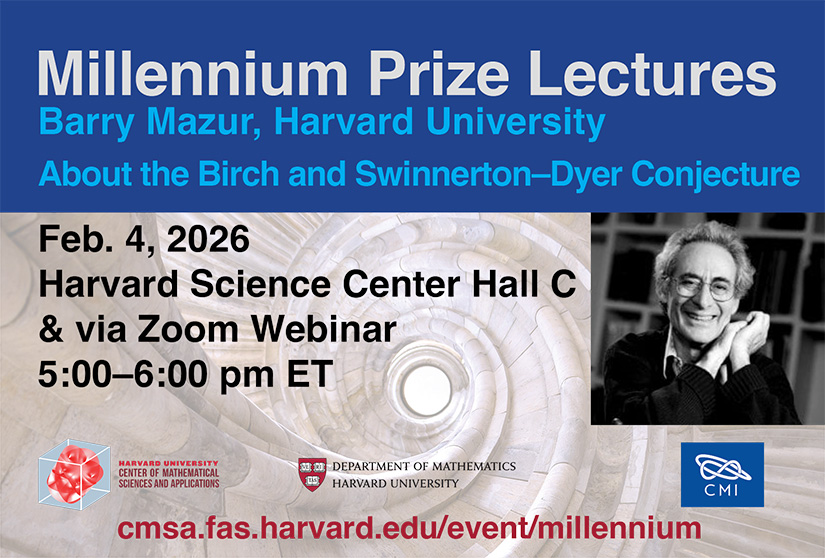
https://youtu.be/14-9iCoclFE Date: February 4, 2026 Time: 5:00–6:00 pm Location: Harvard Science Center Hall C, 1 Oxford St., Cambridge MA Speaker: Barry Mazur, Harvard University Title: About the Birch and Swinnerton–Dyer Conjecture Abstract: In the 1950s Bryan Birch and Peter Swinnerton–Dyer made computations that suggested a striking connection between a basic global invariant of an elliptic […]
Differential Geometry and Physics Seminar Speaker: Monica Jinwoo Kang, Texas A&M University Title: Index from a point Abstract: We argue that protected data of 4d N=2 SCFTs admits a purely algebro-geometric characterization. We conjecture that both the Macdonald index (and hence the Schur index) and the Higgs branch are encoded by a bifiltered affine scheme determined by […]
Differential Geometry and Physics Seminar Speaker: Yinan Wang, Peking University Title: On E7+1/2 gauge theory Abstract: We propose that an exotic gauge theory based on the intermediate Lie algebra E7+1/2 naturally appears in the landscape of 6d F-theory. We give strong evidence of this proposal with 6d anomaly cancellation, dual M-theory geometry and elliptic genus of the single-string […]
Algebra Seminar