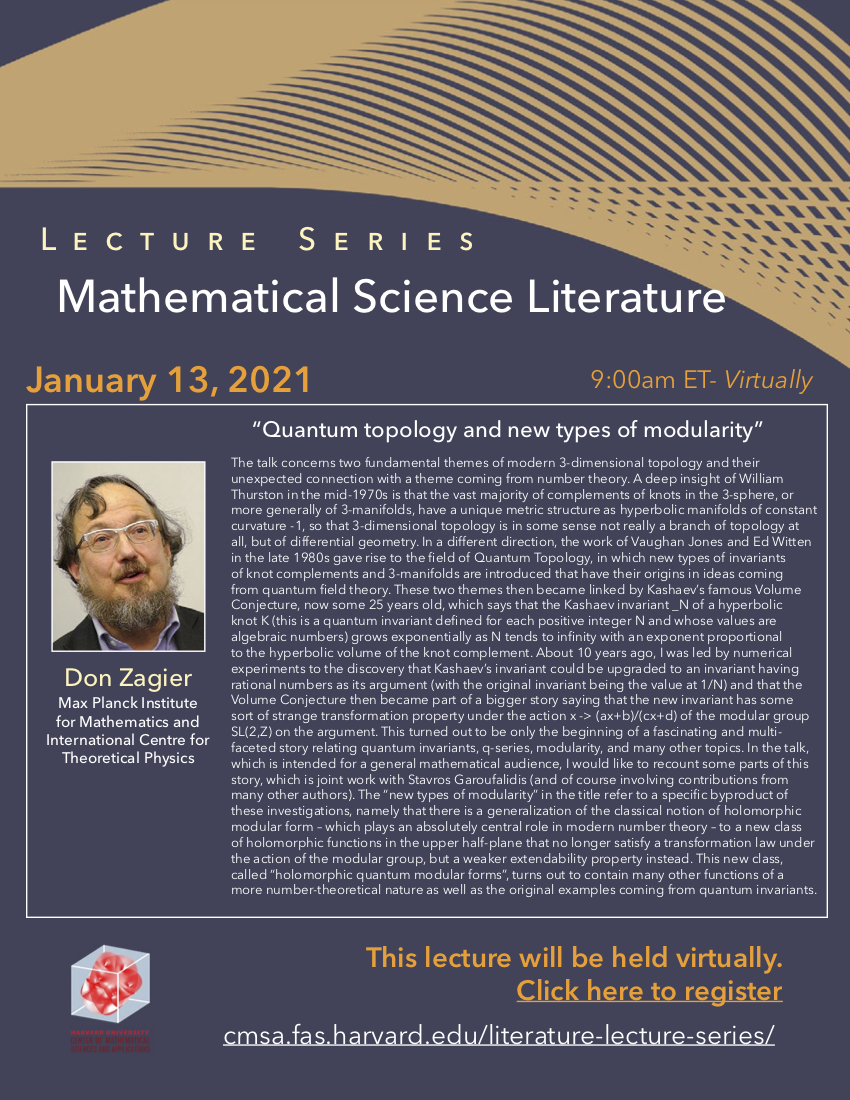
• CMSA Math-Science Literature Lecture: Quantum topology and new types of modularity

    Virtual

    Don Zagier (Max Planck Institute for Mathematics and International Centre for Theoretical Physics) Title: Quantum topology and new types of modularity Abstract: The talk concerns two fundamental themes of modern 3-dimensional topology and their unexpected connection with a theme coming from number theory. A deep insight of William Thurston in the mid-1970s is that the […]
  • AI and Theorem Proving

    Virtual

    https://youtu.be/UnYrWuOzOlc Speaker: Josef Urban, Czech Technical University Title: AI and Theorem Proving Abstract: The talk will discuss the main approaches that combine machine learning with automated theorem proving and automated formalization. This includes learning to choose relevant facts for “hammer” systems, guiding the proof search of tableaux and superposition automated provers by interleaving learning and […]

  • Language Modeling for Mathematical Reasoning

    Virtual

    Speaker: Christian Szegedy Title: Language Modeling for Mathematical Reasoning Abstract: In this talk, I will summarize the current state of the art of transformer based language models and give examples on non-trivial reasoning task language models can solve in higher order logic reasoning. I will also discuss how to inject injective bias into transformer networks via pretraining on […]

  • Gromov-Witten/Donaldson Thomas theory and Birational/Symplectic invariants for algebraic surfaces

    Virtual

    During the Spring 2021 Semester Artan Sheshmani (CMSA/ I.M. A.U.) will be teaching a CMSA special lecture series on Gromov-Witten/Donaldson Thomas theory and Birational/Symplectic invariants for algebraic surfaces. In order to attend this series, please fill out this form. The lectures will be held Mondays from 8:00 – 9:30 AM ET and Wednesdays from 8:00 – 9:00 AM ET beginning January 25 on […]

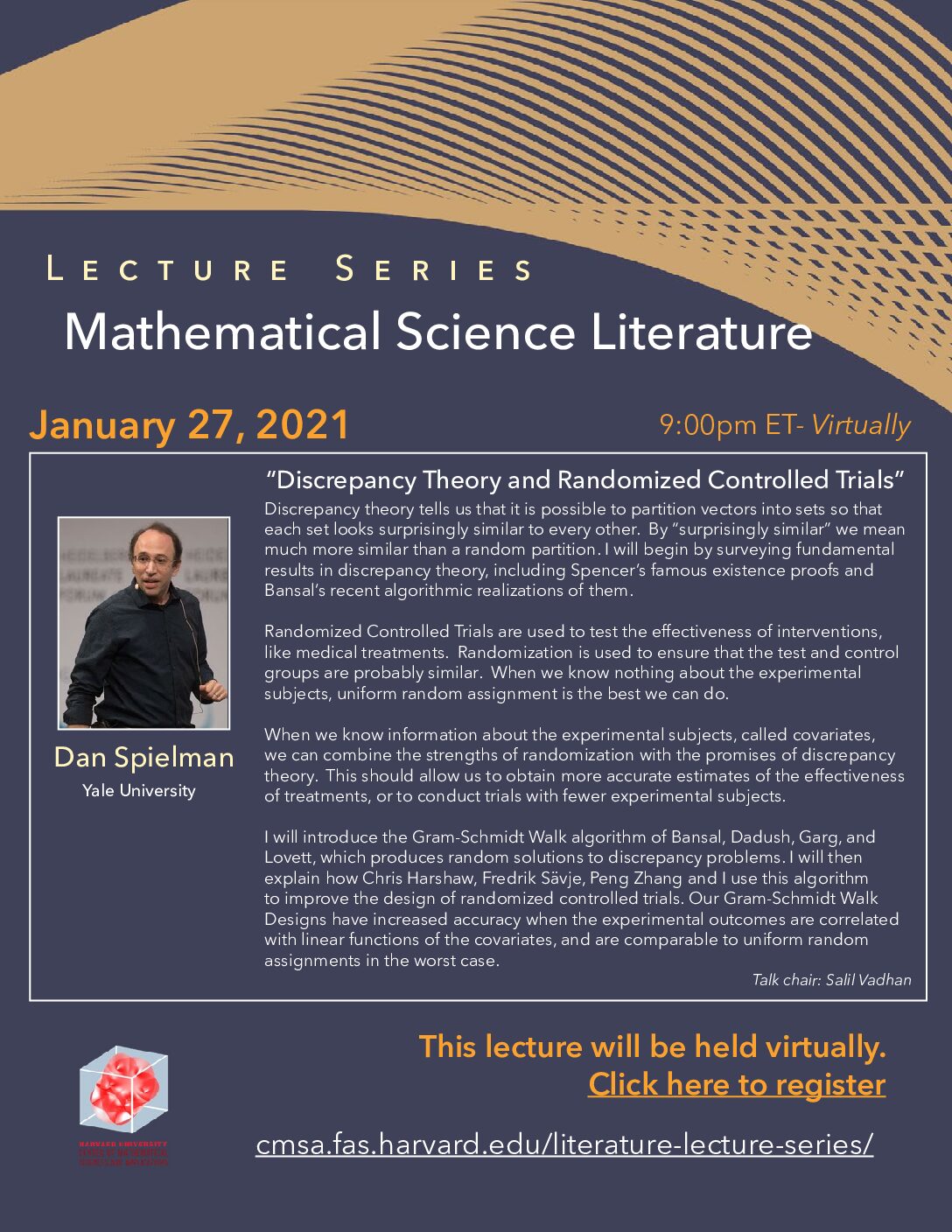
  • CMSA Math-Science Literature Lecture: Discrepancy Theory and Randomized Controlled Trials

    Virtual

    Dan Spielman (Yale University) Title: Discrepancy Theory and Randomized Controlled Trials Abstract: Discrepancy theory tells us that it is possible to partition vectors into sets so that each set looks surprisingly similar to every other.  By “surprisingly similar” we mean much more similar than a random partition. I will begin by surveying fundamental results in […]

  • Knowledge graph representation: From recent models towards a theoretical understanding

    Speaker: Carl Allen and Ivana Balažević - University of Edinburgh School of Informatics Title: Knowledge graph representation: From recent models towards a theoretical understanding Abstract: Knowledge graphs (KGs), or knowledge bases, are large repositories of facts in the form of triples (subject, relation, object), e.g. (Edinburgh, capital_of, Scotland). Many models have been developed to succinctly represent KGs […]