
3-5-2018 Mathematical Physics Seminar
CMSA Room G10 CMSA, 20 Garden Street, Cambridge, MA, United States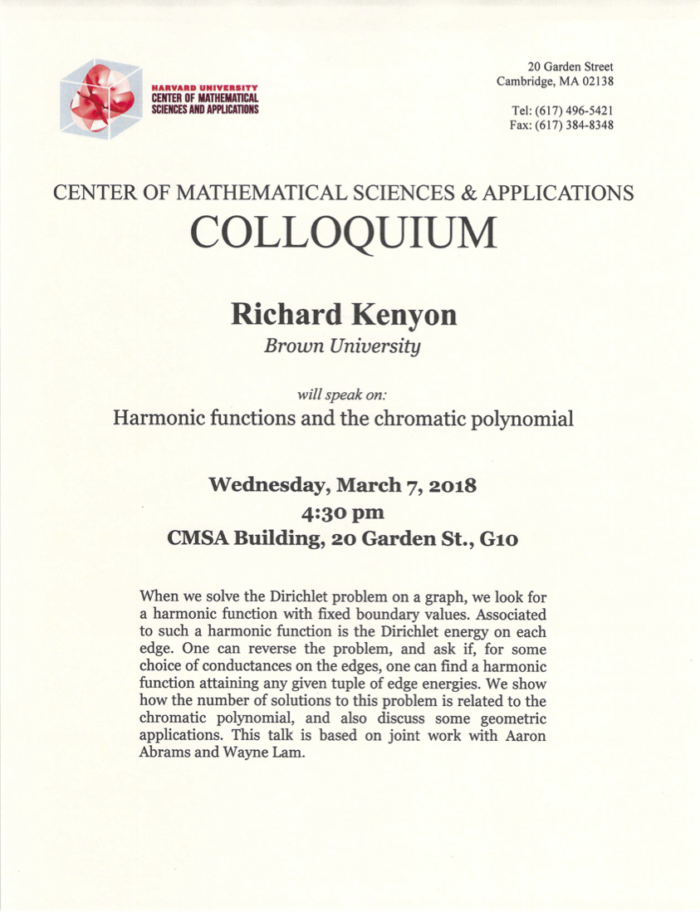
Harmonic functions and the chromatic polynomial
Speaker: Richard Kenyon, Brown Title: Harmonic functions and the chromatic polynomial
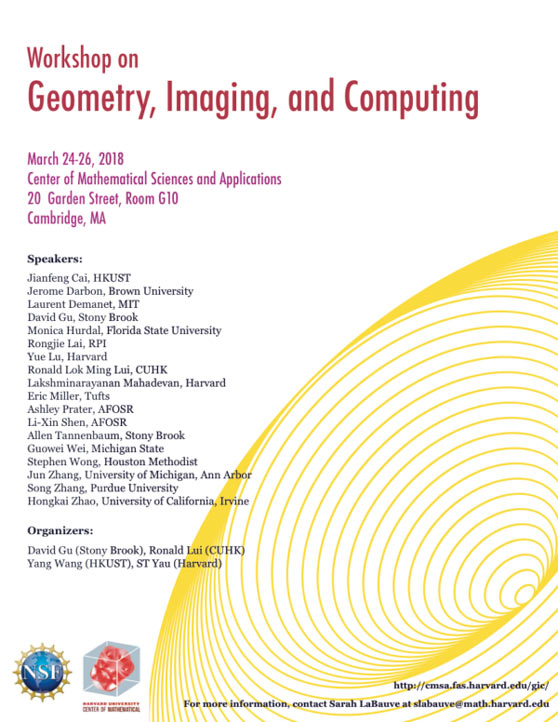
Workshop on Geometry, Imaging, and Computing
CMSA 20 Garden Street, Cambridge, MA, United StatesOn March 24-26, The Center of Mathematical Sciences and Applications will be hosting a workshop on Geometry, Imaging, and Computing, based off the journal of the same name. The workshop will take place in CMSA building, G10. The organizing committee consists of Yang Wang (HKUST), Ronald Lui (CUHK), David Gu (Stony Brook), and Shing-Tung Yau (Harvard). Confirmed Speakers: Jianfeng Cai (HKUST) Shikui Chen (Stony Brook) Jerome Darbon (Brown University) Laurent Demanet (MIT) David […]
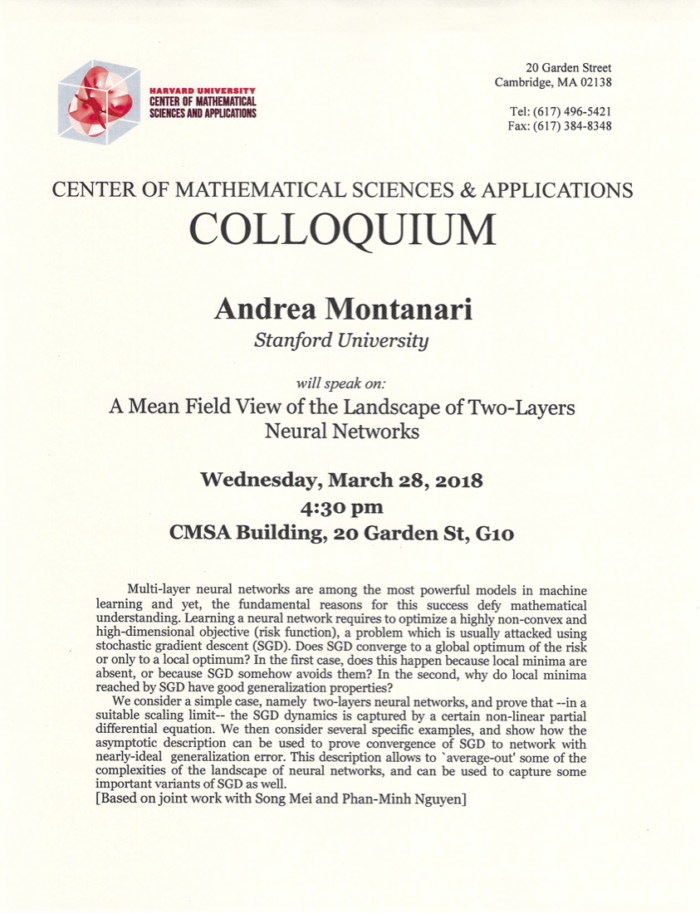
A Mean Field View of the Landscape of Two-Layers Neural Networks
CMSA 20 Garden Street, Cambridge, MA, United StatesSpeaker: Andrea Montanari (Stanford) Title: A Mean Field View of the Landscape of Two-Layers Neural Networks Abstract: Multi-layer neural networks are among the most powerful models in machine learning and yet, the fundamental reasons for this success defy mathematical understanding. Learning a neural network requires to optimize a highly non-convex and high-dimensional objective (risk function), a problem which […]

Math Science Lectures in Honor of Raoul Bott, April 2-3
Harvard Science Center 1 Oxford Street, Cambridge, MAOn April 2-3, the CMSA will be hosting two lectures by Freddy Cachazo (Perimeter Institute) on “Geometry and Combinatorics in Particle Interactions.” This will be the first of the new annual Bott Math Science Lecture Series hosted by the CMSA. The lectures will take place from 4:30-5:30pm in Science Center, Hall D.
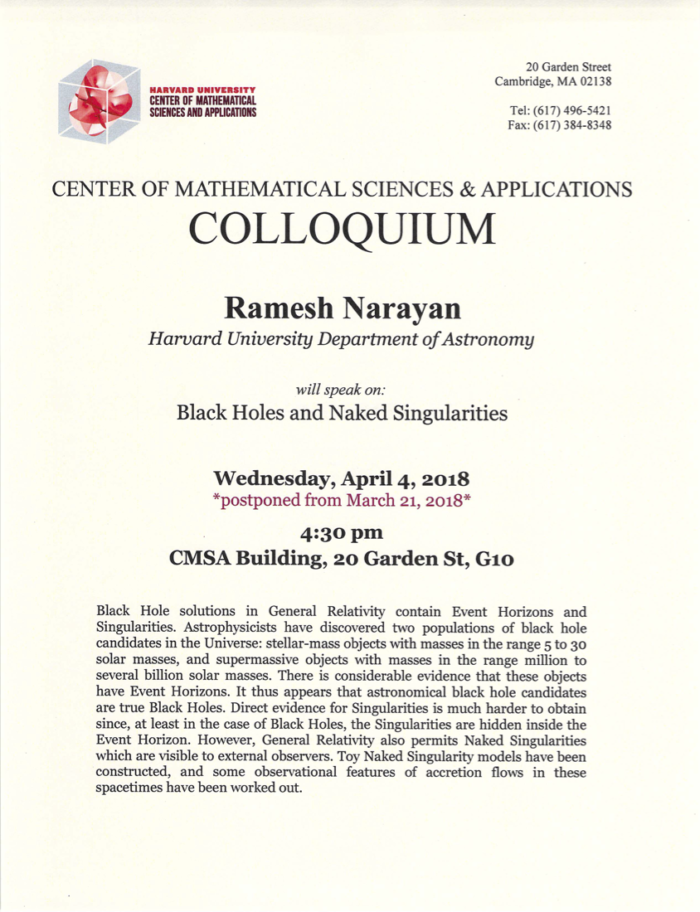
Black Holes and Naked Singularities
CMSA 20 Garden Street, Cambridge, MA, United StatesSpeaker: Ramesh Narayan, Department of Astronomy, Harvard University Title: Black Holes and Naked Singularities Abstract: Black Hole solutions in General Relativity contain Event Horizons and Singularities. Astrophysicists have discovered two populations of black hole candidates in the Universe: stellar-mass objects with masses in the range 5 to 30 solar masses, and supermassive objects with masses […]