
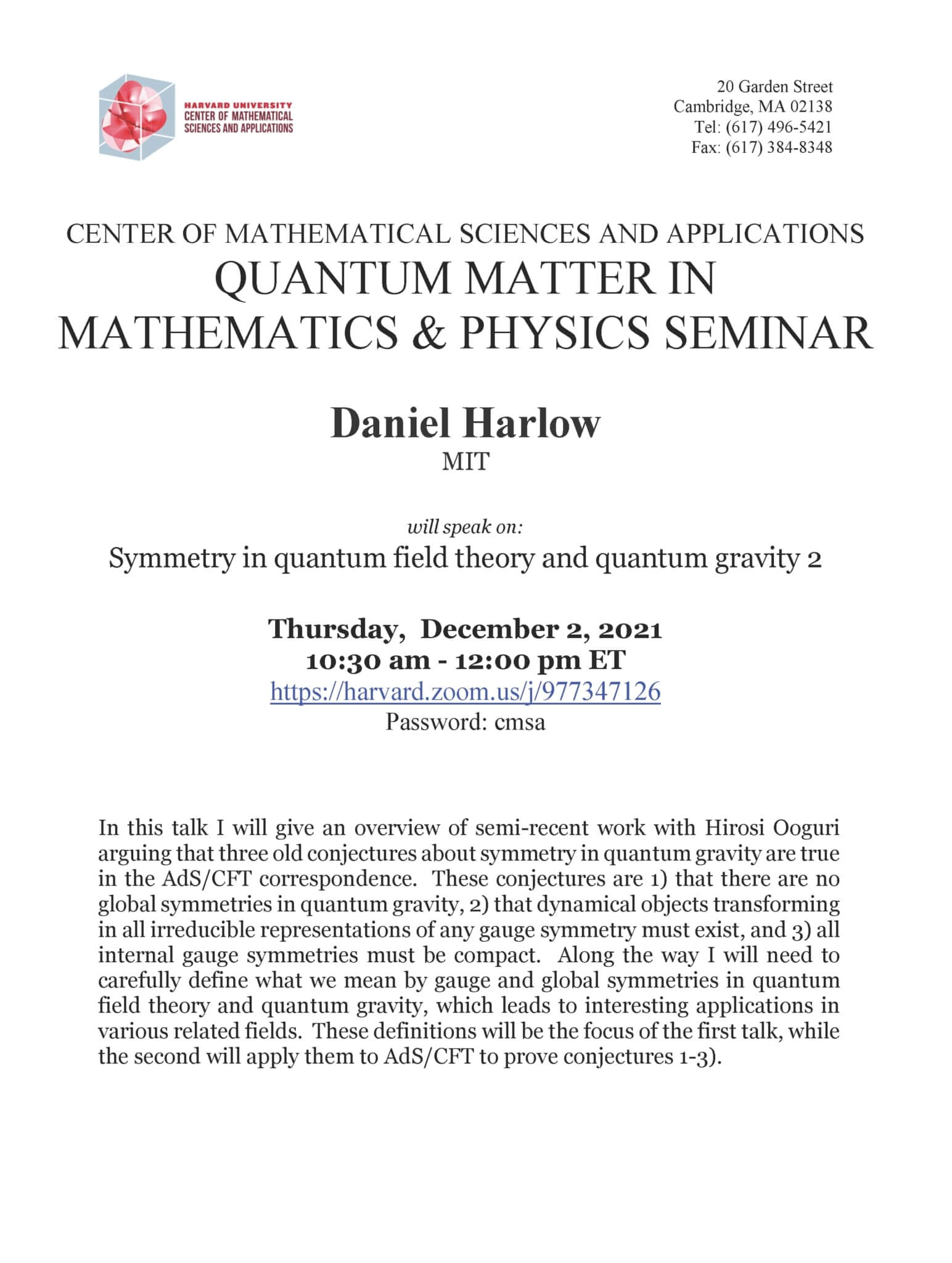
Symmetry in quantum field theory and quantum gravity 2
Speaker: Daniel Harlow (MIT) Title: Symmetry in quantum field theory and quantum gravity 2 Abstract: In this talk I will give an overview of semi-recent work with Hirosi Ooguri arguing that three old conjectures about symmetry in quantum gravity are true in the AdS/CFT correspondence. These conjectures are 1) that there are no global symmetries […]
Kerr Geodesics and Self-consistent match between Inspiral and Transition-to-merger
Abstract: The two-body motion in General Relativity can be solved perturbatively in the small mass ratio expansion. Kerr geodesics describe the leading order motion. After a short summary of the classification of polar and radial Kerr geodesic motion, I will consider the inspiral motion of a point particle around the Kerr black hole subjected to the […]
Hydrodynamics and multi-scale order in confluent epithelia
Abstract: In this talk I will review our ongoing theoretical and experimental efforts toward deciphering the hydrodynamic behavior of confluent epithelia. The ability of epithelial cells to collectively flow lies at the heart of a myriad of processes that are instrumental for life, such as embryonic morphogenesis and wound healing, but also of life-threatening conditions, such […]
12/2/2021 Interdisciplinary Science Seminar
Title: Polyhomogeneous expansions and Z/2-harmonic spinors branching along graphs Abstract: In this talk, we will first reformulate the linearization of the moduli space of Z/2-harmonic spinorsv branching along a knot. This formula tells us that the kernel and cokernel of the linearization are isomorphic to the kernel and cokernel of the Dirac equation with a polyhomogeneous boundary […]
Black Holes, 2D Gravity, and Random Matrices
Member Seminar Speaker: Dan Kapec Title: Black Holes, 2D Gravity, and Random Matrices Abstract: I will discuss old and new connections between black hole physics, 2D quantum gravity, and random matrix theory. Black holes are believed to be very complicated, strongly interacting quantum mechanical systems, and certain aspects of their Hamiltonians should be well approximated by random […]
Extremal Black Hole Corrections from Iyer-Wald
Abstract: Extremal black holes play a key role in our understanding of various swampland conjectures and in particular the WGC. The mild form of the WGC states that higher-derivative corrections should decrease the mass of extremal black holes at fixed charge. Whether or not this conjecture is satisfied depends on the sign of the combination […]
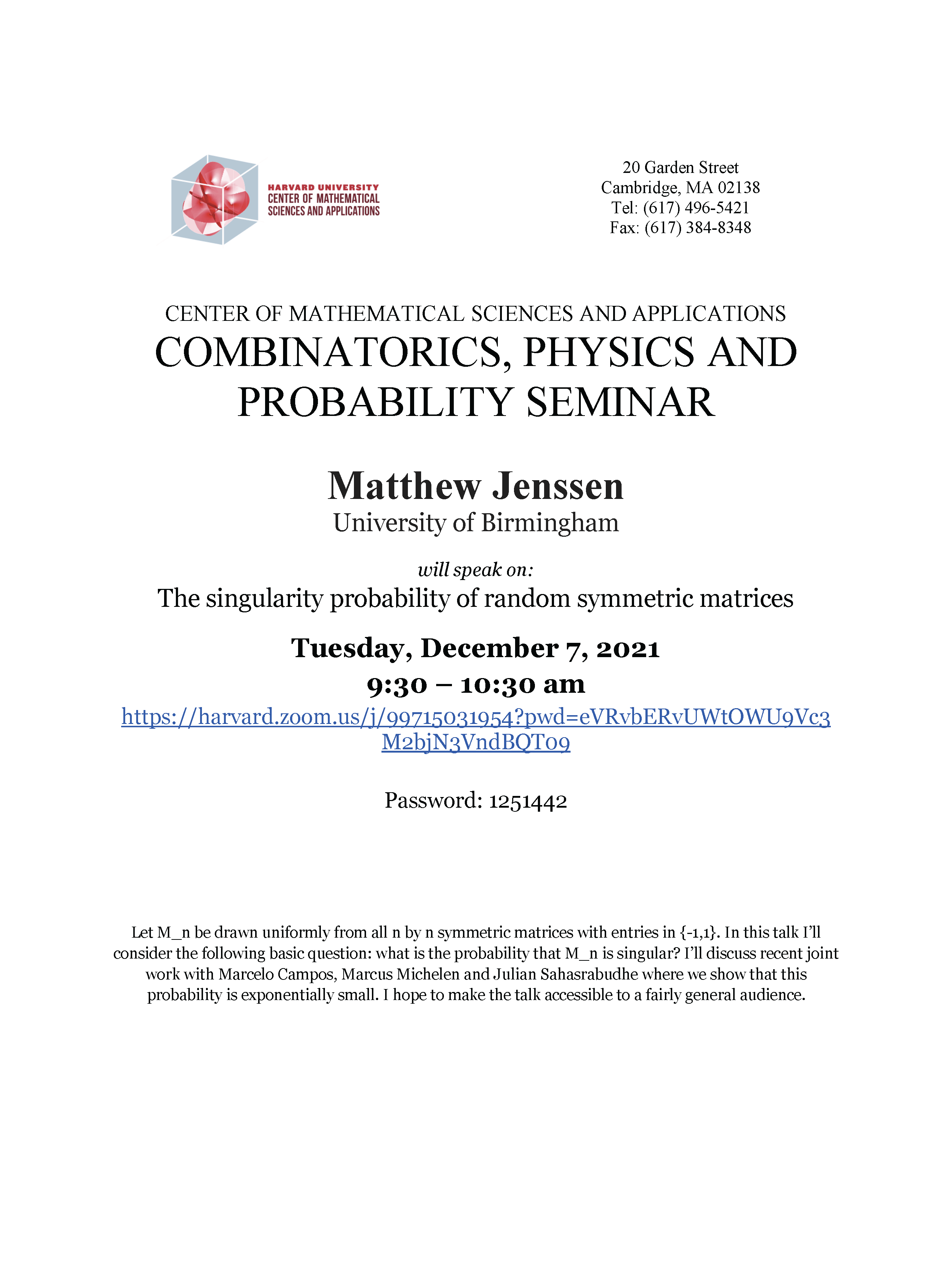
The singularity probability of random symmetric matrices
Abstract: Let M_n be drawn uniformly from all n by n symmetric matrices with entries in {-1,1}. In this talk I’ll consider the following basic question: what is the probability that M_n is singular? I’ll discuss recent joint work with Marcelo Campos, Marcus Michelen and Julian Sahasrabudhe where we show that this probability is exponentially small. […]
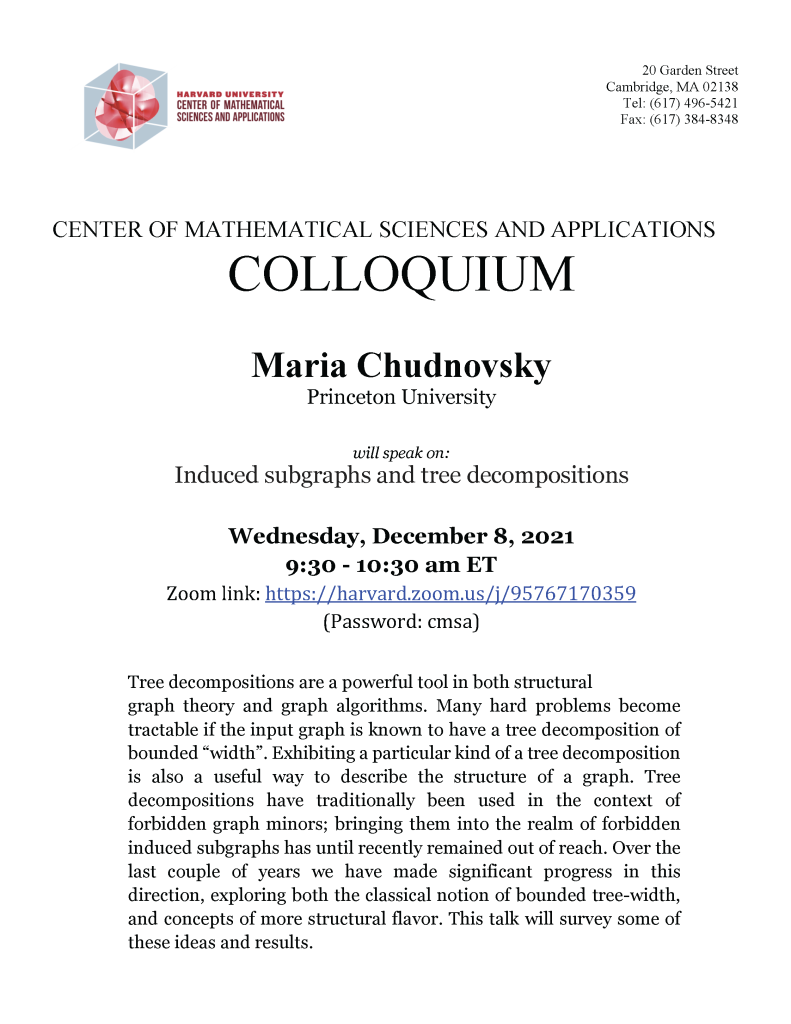
Induced subgraphs and tree decompositions
Speaker: Maria Chudnovsky, Princeton Title: Induced subgraphs and tree decompositions Abstract: Tree decompositions are a powerful tool in both structural graph theory and graph algorithms. Many hard problems become tractable if the input graph is known to have a tree decomposition of bounded “width”. Exhibiting a particular kind of a tree decomposition is also a useful way […]
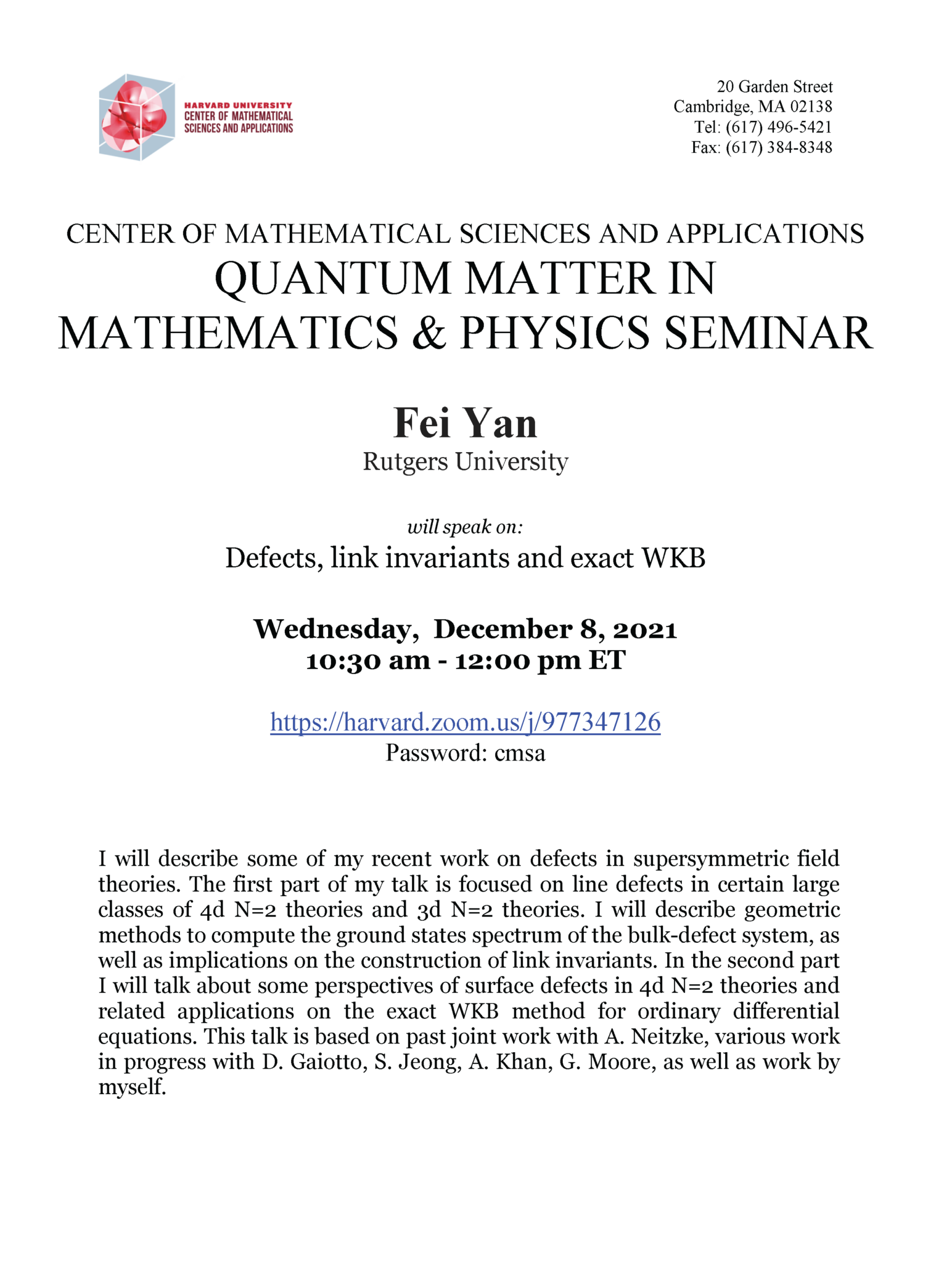
Defects, link invariants and exact WKB
VirtualSpeaker: Fei Yan (Rutgers) Title: Defects, link invariants and exact WKB Abstract: I will describe some of my recent work on defects in supersymmetric field theories. The first part of my talk is focused on line defects in certain large classes of 4d N=2 theories and 3d N=2 theories. I will describe geometric methods to compute the […]
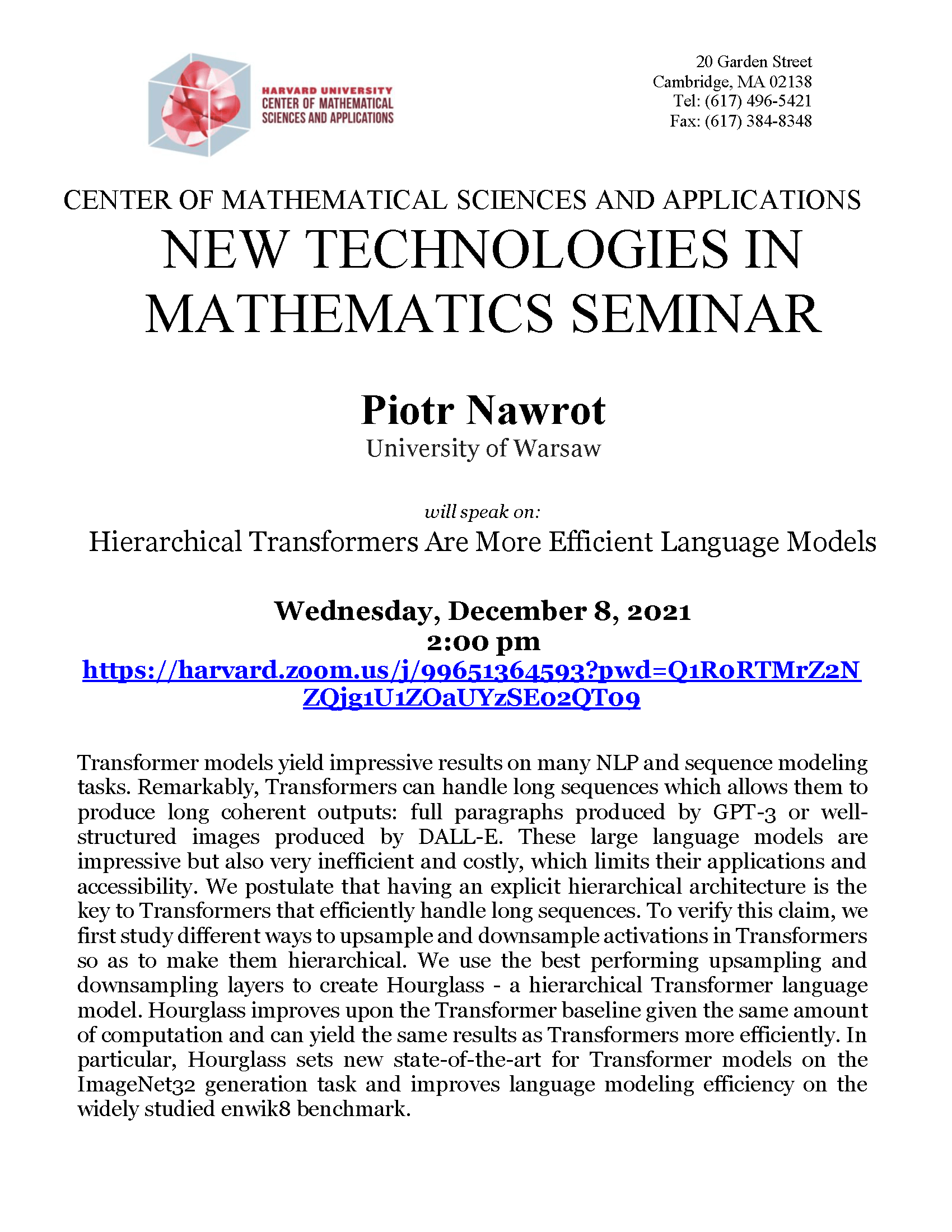
Hierarchical Transformers are More Efficient Language Models
Virtualhttps://youtu.be/soqWNyrdjkw Speaker: Piotr Nawrot, University of Warsaw Title: Hierarchical Transformers are More Efficient Language Models Abstract: Transformer models yield impressive results on many NLP and sequence modeling tasks. Remarkably, Transformers can handle long sequences which allows them to produce long coherent outputs: full paragraphs produced by GPT-3 or well-structured images produced by DALL-E. These large language […]