• When does a three-dimensions Chern-Simons theory have a time reversal symmetry?

    Virtual

    Speaker: Roman Geiko (UCLA) Title: When does a three-dimensions Chern-Simons theory have a time reversal symmetry? In this talk, I will discuss the time reversal invariance of (spin-) Chern-Simons theory in 3 dimensions at both classical and quantum levels. I will show how to obtain a complete classification of Abelian anyons with the time reversal […]
  • Exact lattice chiral symmetry in 2d gauge theory

    Virtual

    Quantum Matter Seminar Speaker: Aleksey Cherman (UMN) Title: Exact lattice chiral symmetry in 2d gauge theory Abstract: Preserving the symmetries of massless fermions is a well-known challenge in lattice field theory.  I'll discuss symmetry-preserving lattice regularizations of 2d QED with one and two flavors of Dirac fermions, as well as the `3450' chiral gauge theory. […]

  • On compactness phenomena

    CMSA Room G10 CMSA, 20 Garden Street, Cambridge, MA, United States

    Member Seminar Speaker: Alejandro Poveda Title: On compactness phenomena Abstract: In this presentation I shall be preoccupied with compactness phenomena in set theory. Compactness is the phenomenon by which the local properties of a mathematical structure determine its global behavior. This phenomenon is intrinsic to the very architecture of the mathematical universe and manifests to us in a […]

  • Approaches to the formalization of differential geometry

    CMSA Room G10 CMSA, 20 Garden Street, Cambridge, MA, United States

    https://youtu.be/oiOpudgC0J4 New Technologies in Mathematics Seminar Speaker: Heather Macbeth, Fordham University Title: Approaches to the formalization of differential geometry Abstract: In the last five years, there has been early work on the computer formalization of differential geometry. I will survey the projects I am aware of. I will also describe two projects of my own, […]

  • Quantum Matter in Mathematics and Physics Seminar

    Gauging spacetime inversions

    CMSA Room G10 CMSA, 20 Garden Street, Cambridge, MA, United States

    Quantum Matter in Mathematics and Physics Seminar Speaker: Daniel Harlow (MIT) Title: Gauging spacetime inversions Abstract: Spacetime inversion symmetries such as parity and time reversal play a central role in physics, but they are usually treated as global symmetries. In quantum gravity there are no global symmetries, so any spacetime inversion symmetries must be gauge […]

  • Member Seminar

    Anti-Iitaka conjecture in positive characteristic

    CMSA Room G10 CMSA, 20 Garden Street, Cambridge, MA, United States

    CMSA Member Seminar Speaker: Iacopo Brivio (Harvard) Title: Anti-Iitaka conjecture in positive characteristic Abstract: Given a smooth projective variety, its Kodaira dimension kappa(K_X) is an important invariant that measures the rate of growth of m-pluricanonical forms as a function of m. It serves as an higher-dimensional generalization of the genus of a Riemann surface. If f : X […]

  • CMSA/MATH Bi-Annual Gathering

    Common Room, CMSA 20 Garden Street, Cambridge, MA, United States

    On Friday, Jan. 26, 2024 the CMSA will host the CMSA/MATH Bi-Annual Gathering for Harvard CMSA and Math affiliates in the CMSA Common Room at 20 Garden Street, Cambridge MA 02138.

  • General Relativity Seminar

    A quasi-local mass in general relativity

    CMSA Room G10 CMSA, 20 Garden Street, Cambridge, MA, United States

    https://youtu.be/hmRFX1Js6IA General Relativity Seminar Speaker: Aghil Alaee, Clark University Title: A quasi-local mass in general relativity Abstract: In this talk, we define a new gauge-independent quasi-local mass and energy with respect to the Minkowski spacetime. In contrast to other quasi-local masses, this new quasi-local mass/energy has a quasi-local proof of positivity. This positivity property is for spacelike surfaces with any topology.  Moreover, we show […]

  • Algebraic Geometry in String Theory Seminar

    Algebraic billiards and dynamical degrees

    CMSA Room G10 CMSA, 20 Garden Street, Cambridge, MA, United States

    Algebraic Geometry in String Theory Seminar Speaker: Max Weinreich (Harvard) Title: Algebraic billiards and dynamical degrees Abstract: Billiards is one of the most-studied dynamical systems, modeling the behavior of a point particle bouncing around some space. If the space is a plane region bounded by an algebraic curve, then we may use techniques from algebraic geometry […]

  • Quantum Matter in Mathematics and Physics Seminar

    Quantum Circuits to local Hamiltonian: role in quantum complexity and new constructions 

    CMSA Room G10 CMSA, 20 Garden Street, Cambridge, MA, United States

    Quantum Matter in Mathematics and Physics Seminar Speaker: Anurag Anshu (Harvard) Title: Quantum Circuits to local Hamiltonian: role in quantum complexity and new constructions Abstract: At the heart of the theory of NP completeness lies a mapping from classical circuits to constraint satisfaction problems (classical local Hamiltonians). The quantum analogue of this is the remarkable history […]

  • Member Seminar

    On complete Calabi-Yau metrics and Monge-Ampere equations

    CMSA Room G10 CMSA, 20 Garden Street, Cambridge, MA, United States

    CMSA Member Seminar Speaker: Freid Tong (Harvard CMSA) Title: On complete Calabi-Yau metrics and Monge-Ampere equations Abstract: Calabi-Yau metrics are central objects in K\"ahler geometry and also string theory. The existence of Calabi-Yau metrics on compact manifolds was answered by Yau in his solution of the Calabi conjecture, but the situation in the non-compact setting is much more delicate, and many questions related to the existence […]

  • AQFT Lecture Series | Minhyong Kim

    CMSA Room G10 CMSA, 20 Garden Street, Cambridge, MA, United States

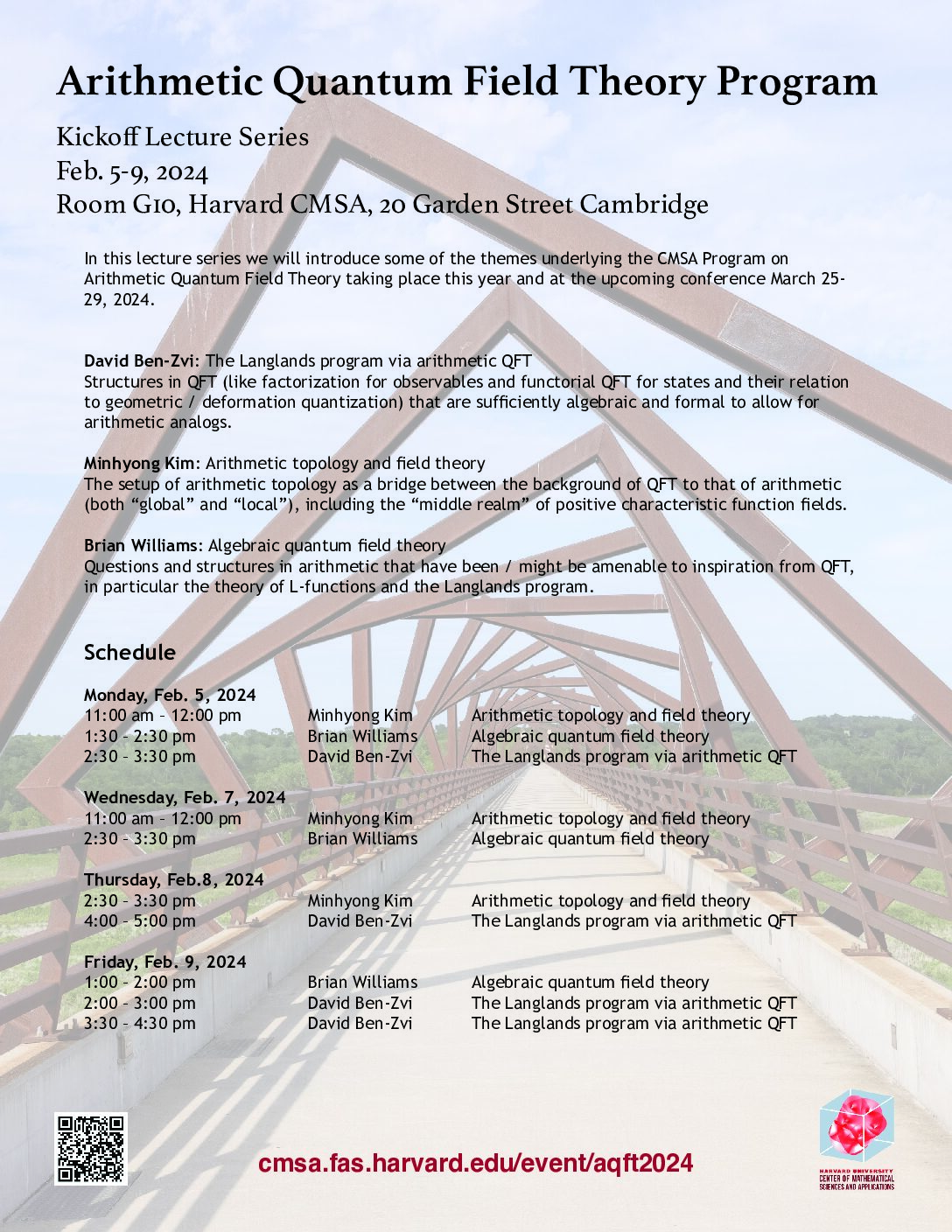
    Arithmetic Quantum Field Theory Program Lecture Series Speaker: Minhyong Kim, University of Edinburgh Topic: Arithmetic topology and field theory Abstract: The setup of arithmetic topology as a bridge between the background of QFT to that of arithmetic (both “global” and “local”), including the “middle realm” of positive characteristic function fields. Slides (pdf)