• The Rozansky-Witten field theory in the functorial TQFT formalism

    Common Room, CMSA 20 Garden Street, Cambridge, MA, United States

    Member Seminar Speaker: Lorenzo Riva Title: The Rozansky-Witten field theory in the functorial TQFT formalism Abstract: This will be a broad talk about the topic of my PhD thesis. We will discuss a particular example of a 3D field theory from physics called Rozansky-Witten which is interesting from both a physical and a mathematical point […]

  • Geometry and Quantum Theory Seminar

    Science Center 507 1 Oxford Street, Cambridge

    Geometry and Quantum Theory Seminar Speaker: Dylan Galt, Harvard (60 minute talk) Title: What is a "nonlinear" near-symplectic form? Abstract: In this talk, I will explain how one might understand this question and why a possible answer can be found in the geometry of coassociative 4-folds, a special class of minimal submanifolds discovered by Harvey and Lawson.   […]

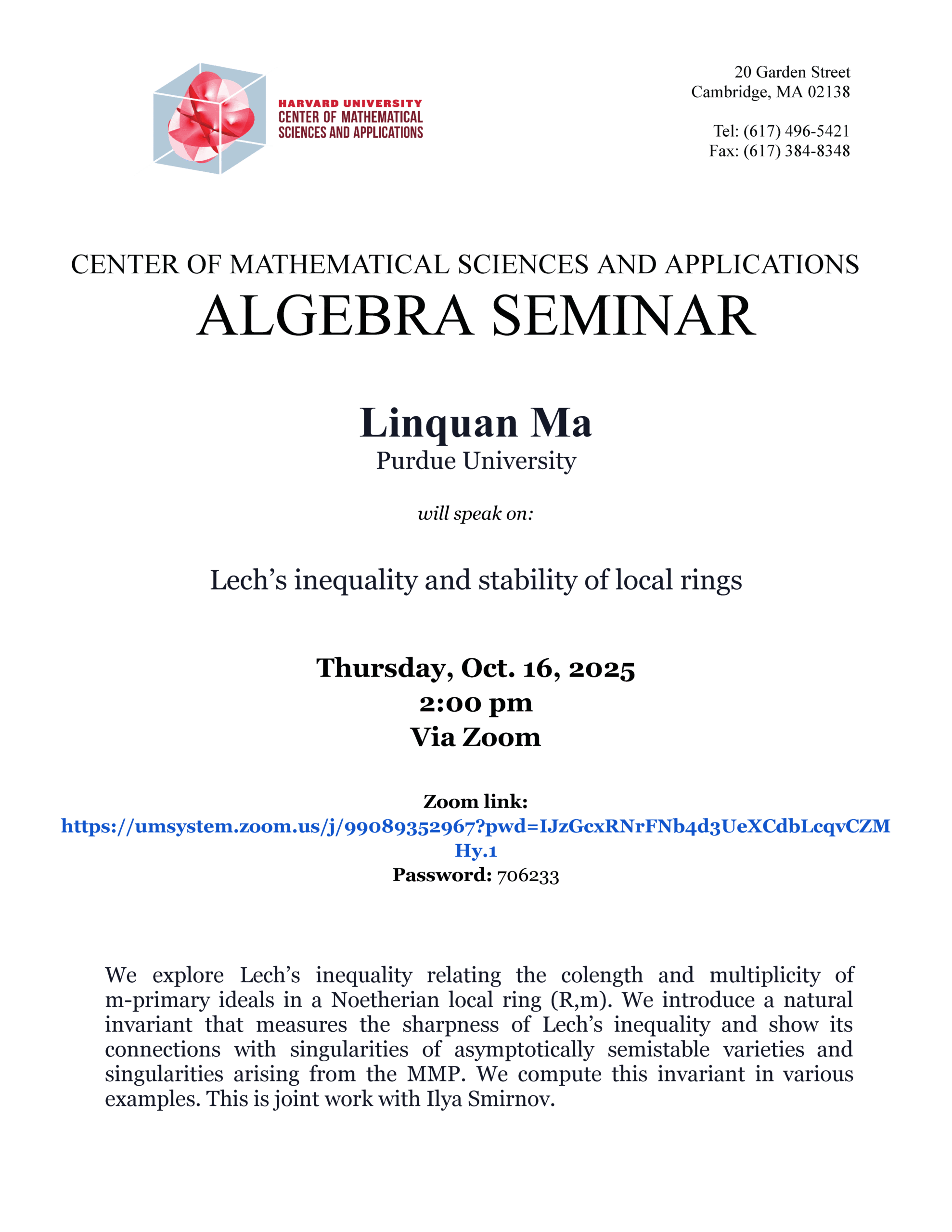
  • Lech’s inequality and stability of local rings

    Virtual

    Algebra Seminar Speaker: Linquan Ma (Purdue University) Title: Lech's inequality and stability of local rings Abstract: We explore Lech's inequality relating the colength and multiplicity of m-primary ideals in a Noetherian local ring (R,m). We introduce a natural invariant that measures the sharpness of Lech's inequality and show its connections with singularities of asymptotically semistable varieties […]

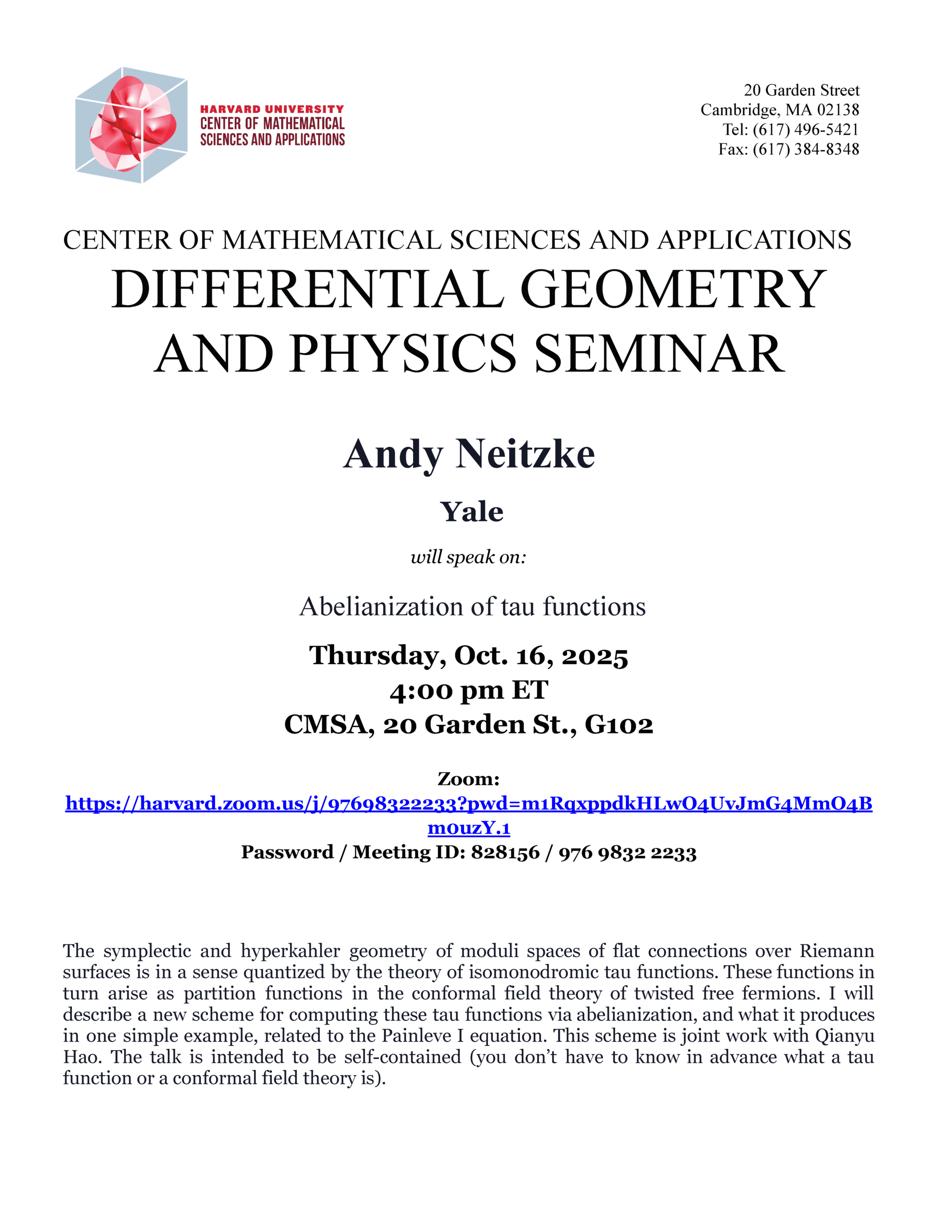
  • Differential Geometry and Physics Seminar

    CMSA Room G10 CMSA, 20 Garden Street, Cambridge, MA, United States

    Differential Geometry and Physics Seminar Speaker: Andy Neitzke, Yale Title: Abelianization of tau functions Abstract: The symplectic and hyperkahler geometry of moduli spaces of flat connections over Riemann surfaces is in a sense quantized by the theory of isomonodromic tau functions. These functions in turn arise as partition functions in the conformal field theory of […]

  • DMFT, Two Point Correlations of Resolvents, and Applications to Machine Learning Theory

    Common Room, CMSA 20 Garden Street, Cambridge, MA, United States

    Member Seminar Speaker: Blake Bordelon Title: DMFT, Two Point Correlations of Resolvents, and Applications to Machine Learning Theory Abstract: Machine learning algorithms evolve the parameters of a model in a high dimensional and disordered loss landscape. To characterize the effects of random initialization of model parameters, randomly sampled training data, and the effect of SGD noise, it […]

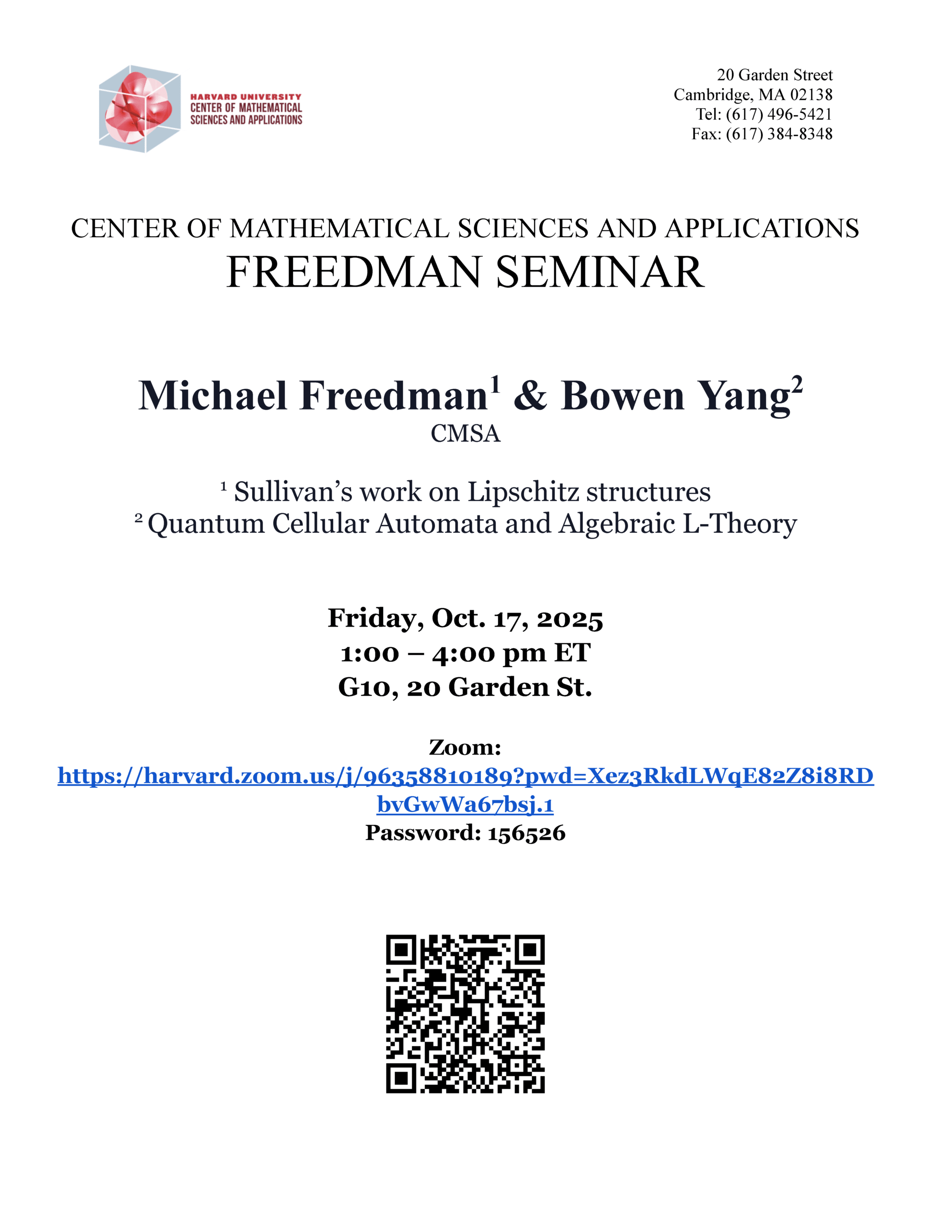
  • Freedman Seminar: Michael Freedman, CMSA & Bowen Yang, CMSA

    Virtual

    Freedman Seminar Speaker: Michael Freedman, Harvard CMSA Title: Sullivan's work on Lipschitz structures Abstract: I'll begin with an elementary, but now little known, piece of PL topology: engulfing. John Stalling used it to give an alternative proof of the high dimensional Poincare conjecture. Then I'll explain Dennis Sullivan's enhancement of Kirby's torus trick (which relies […]

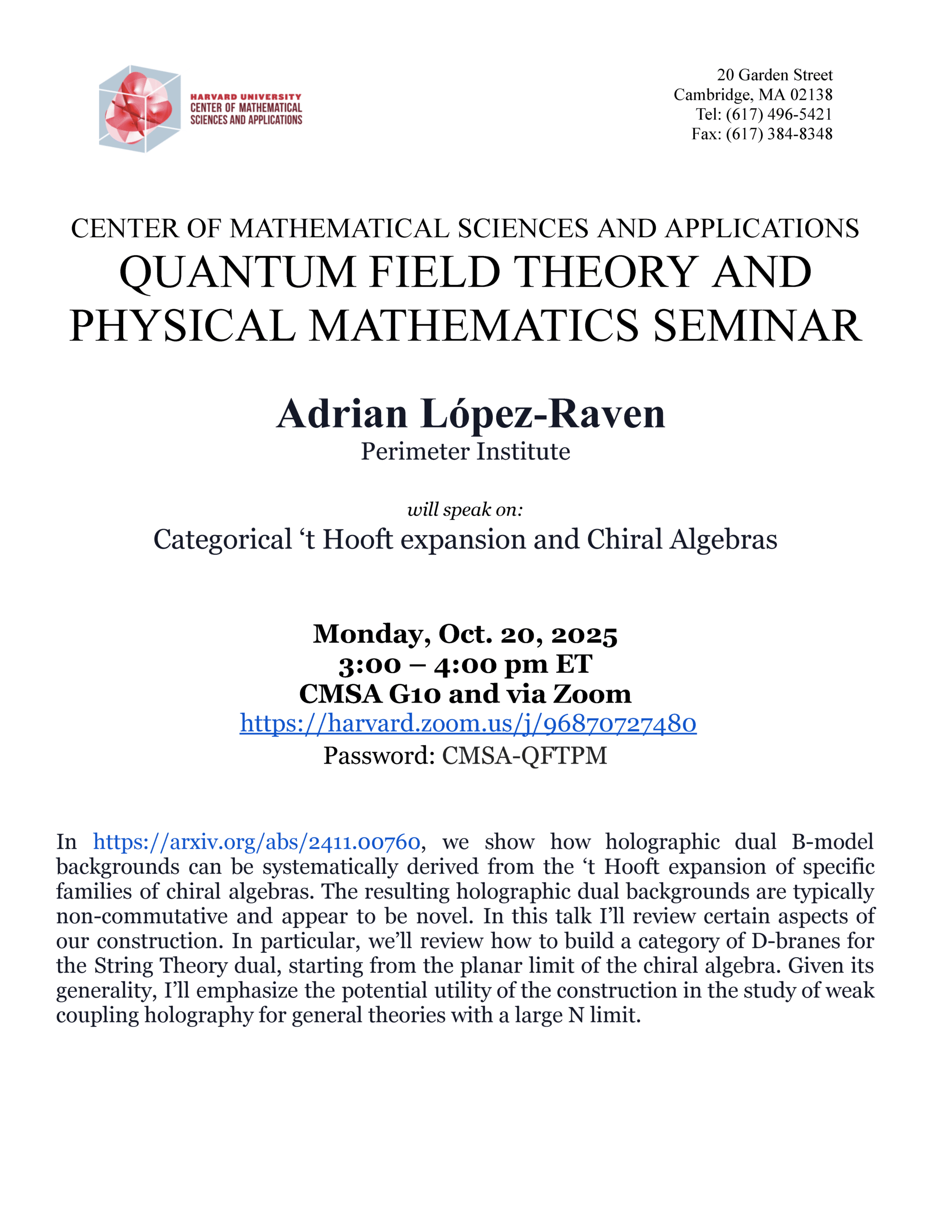
  • Categorical ‘t Hooft expansion and Chiral Algebras

    CMSA Room G10 CMSA, 20 Garden Street, Cambridge, MA, United States

    Quantum Field Theory and Physical Mathematics Seminar Speaker: Adrian López-Raven, Perimeter Title: Categorical 't Hooft expansion and Chiral Algebras Abstract: In https://arxiv.org/abs/2411.00760, we show how holographic dual B-model backgrounds can be systematically derived from the 't Hooft expansion of specific families of chiral algebras. The resulting holographic dual backgrounds are typically non-commutative and appear to be […]

  • CMSA Q&A Seminar

    CMSA Q&A Seminar: Thomas Grimm

    Common Room, CMSA 20 Garden Street, Cambridge, MA, United States

    CMSA Q&A Seminar Speaker: Thomas Grimm, Utrecht & CMSA Topic: What is o-minimality and what is it good for?

  • The Carleson project: A collaborative formalization

    Virtual

    New Technologies in Mathematics Seminar Speaker: María Inés de Frutos Fernández, Mathematical Institute, University of Bonn Title: The Carleson project: A collaborative formalization Abstract: A well-known result in Fourier analysis establishes that the partial Fourier sums of a smooth periodic function $f$ converge uniformly to $f$, but the situation is a lot more subtle for […]