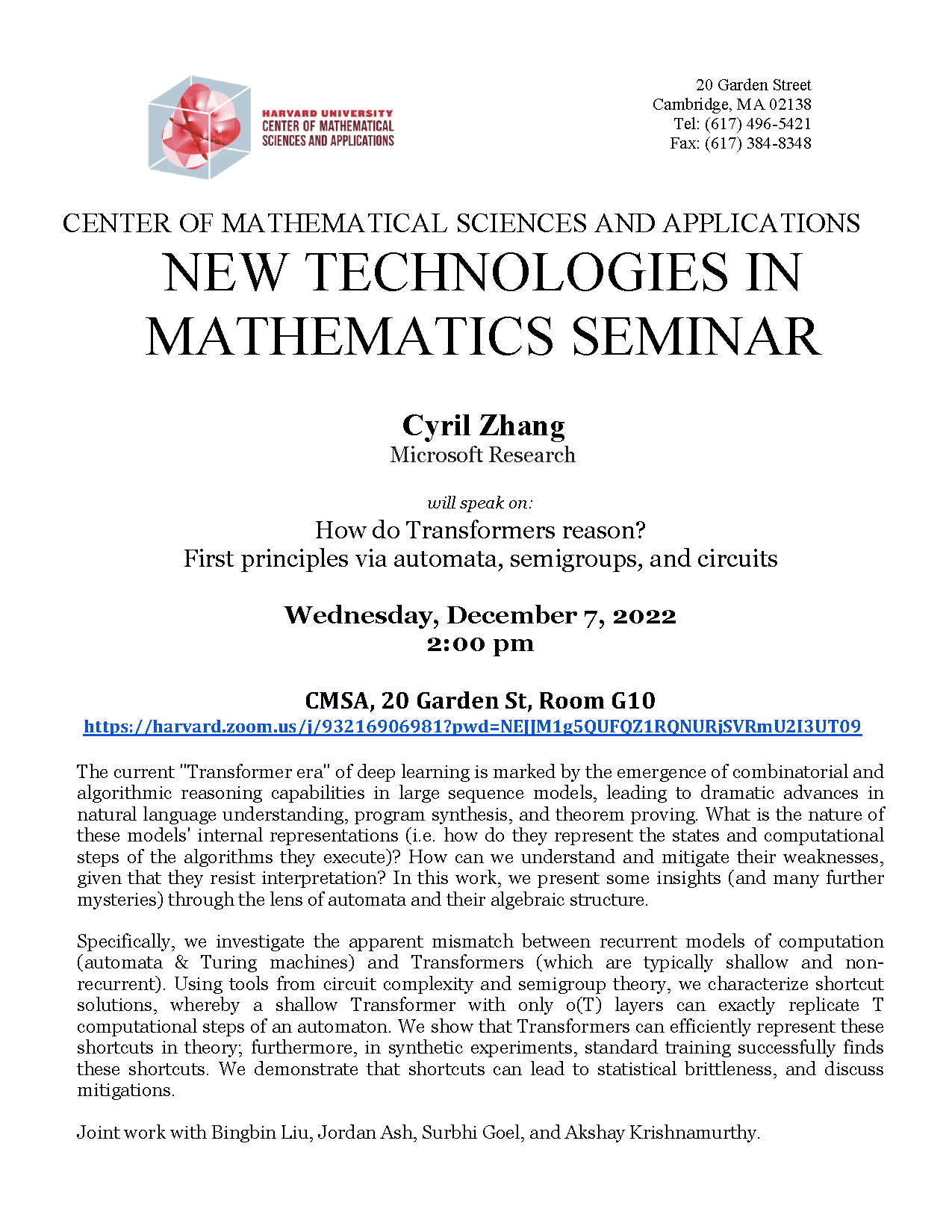
• How do Transformers reason? First principles via automata, semigroups, and circuits

    CMSA Room G10 CMSA, 20 Garden Street, Cambridge, MA, United States

    https://youtu.be/g8zdumOAWzw New Technologies in Mathematics Seminar Speaker: Cyril Zhang, Microsoft Research Title: How do Transformers reason? First principles via automata, semigroups, and circuits Abstract: The current "Transformer era" of deep learning is marked by the emergence of combinatorial and algorithmic reasoning capabilities in large sequence models, leading to dramatic advances in natural language understanding, program synthesis, […]
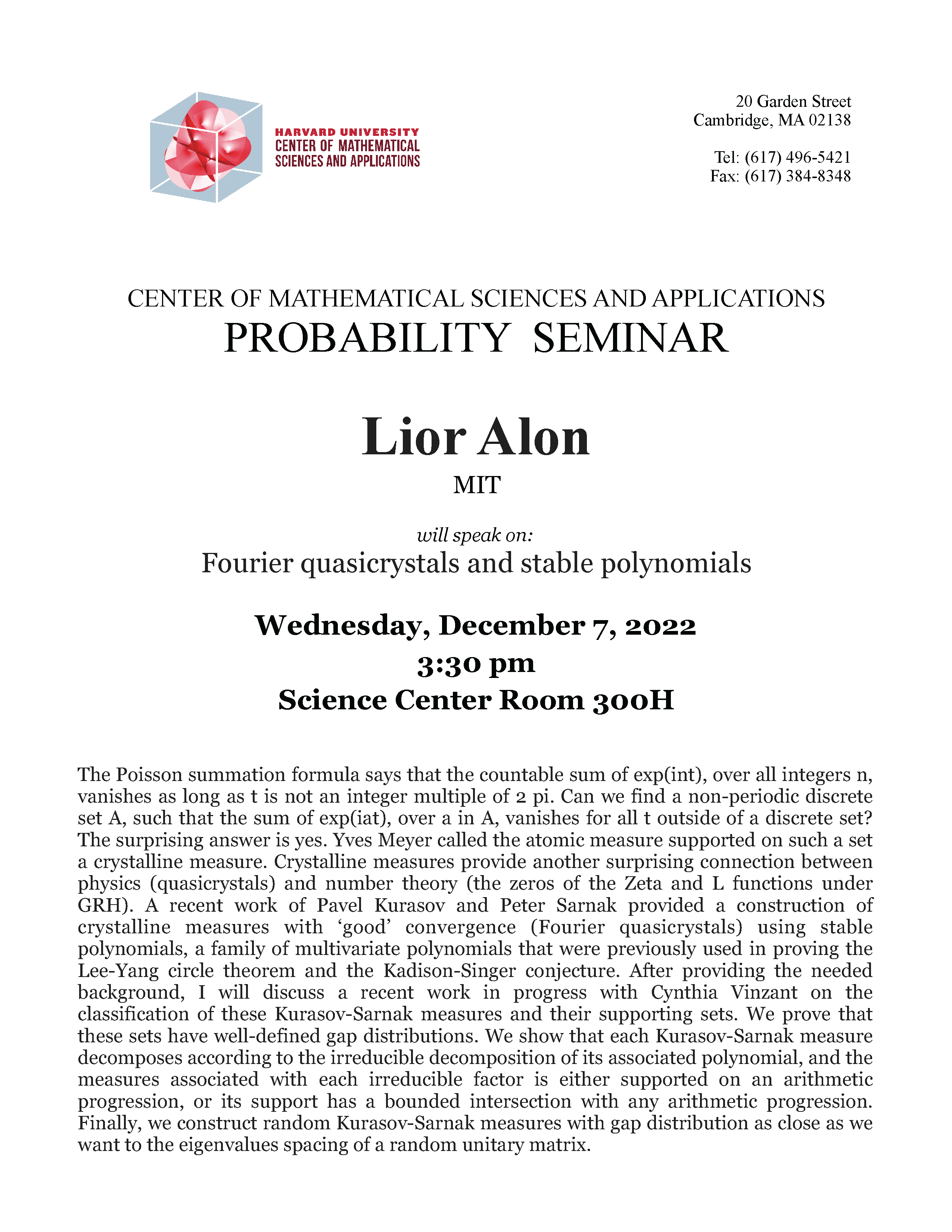
  • Fourier quasicrystals and stable polynomials

    Harvard Science Center 1 Oxford Street, Cambridge, MA

    Probability Seminar Note location change: Science Center Room 300H Speaker: Lior Alon (MIT) Title: Fourier quasicrystals and stable polynomials Abstract: The Poisson summation formula says that the countable sum of exp(int), over all integers n, vanishes as long as t is not an integer multiple of 2 pi. Can we find a non-periodic discrete set A, such […]

  • A new proof for the nonlinear stability of slowly-rotating Kerr-de Sitter

    Virtual

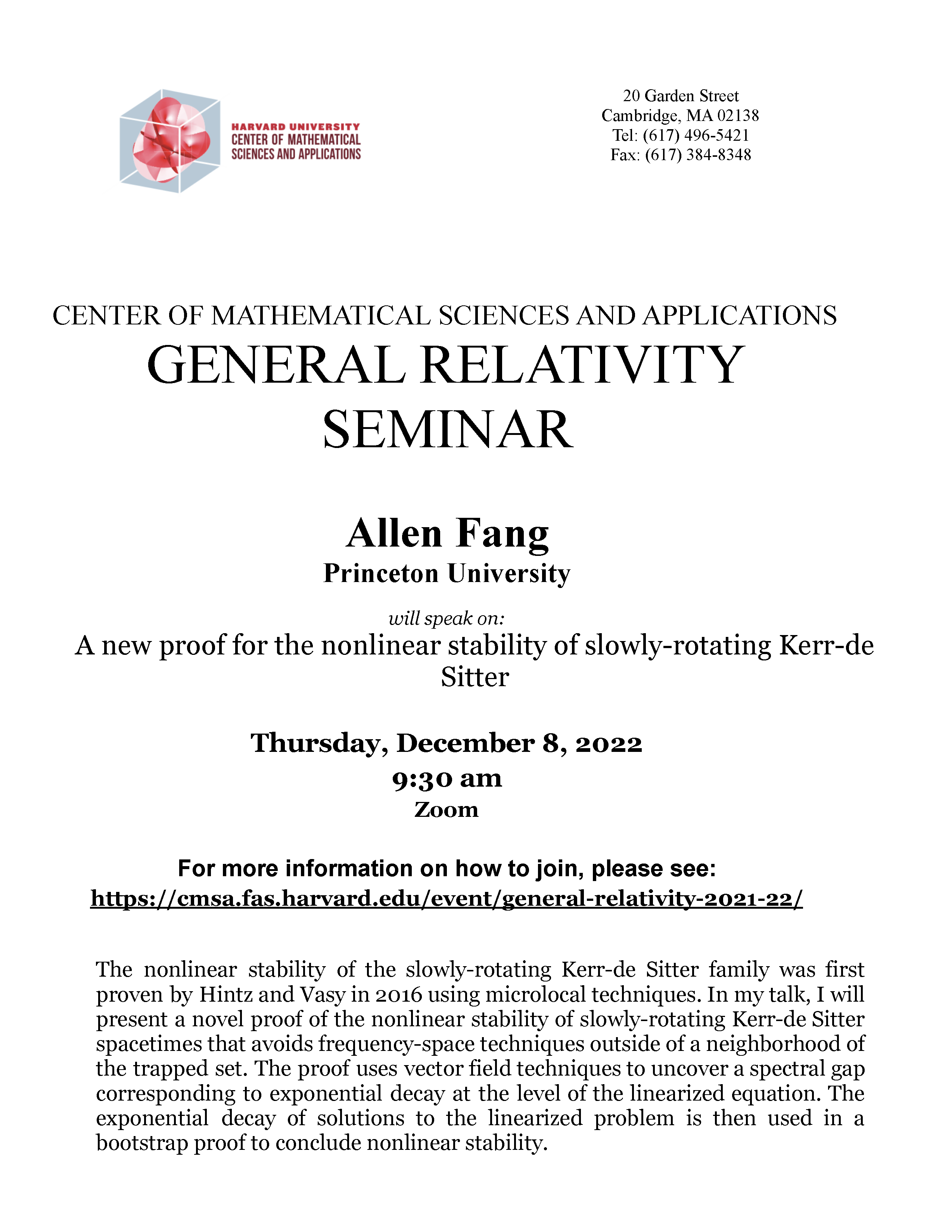
    https://youtu.be/jwvkS2A2dL8 General Relativity Seminar Speaker: Allen Fang (Princeton) Title: A new proof for the nonlinear stability of slowly-rotating Kerr-de Sitter Abstract: The nonlinear stability of the slowly-rotating Kerr-de Sitter family was first proven by Hintz and Vasy in 2016 using microlocal techniques. In my talk, I will present a novel proof of the nonlinear stability […]

  • Self-organization of motile cells by quorum-sensing or chemotactic interactions

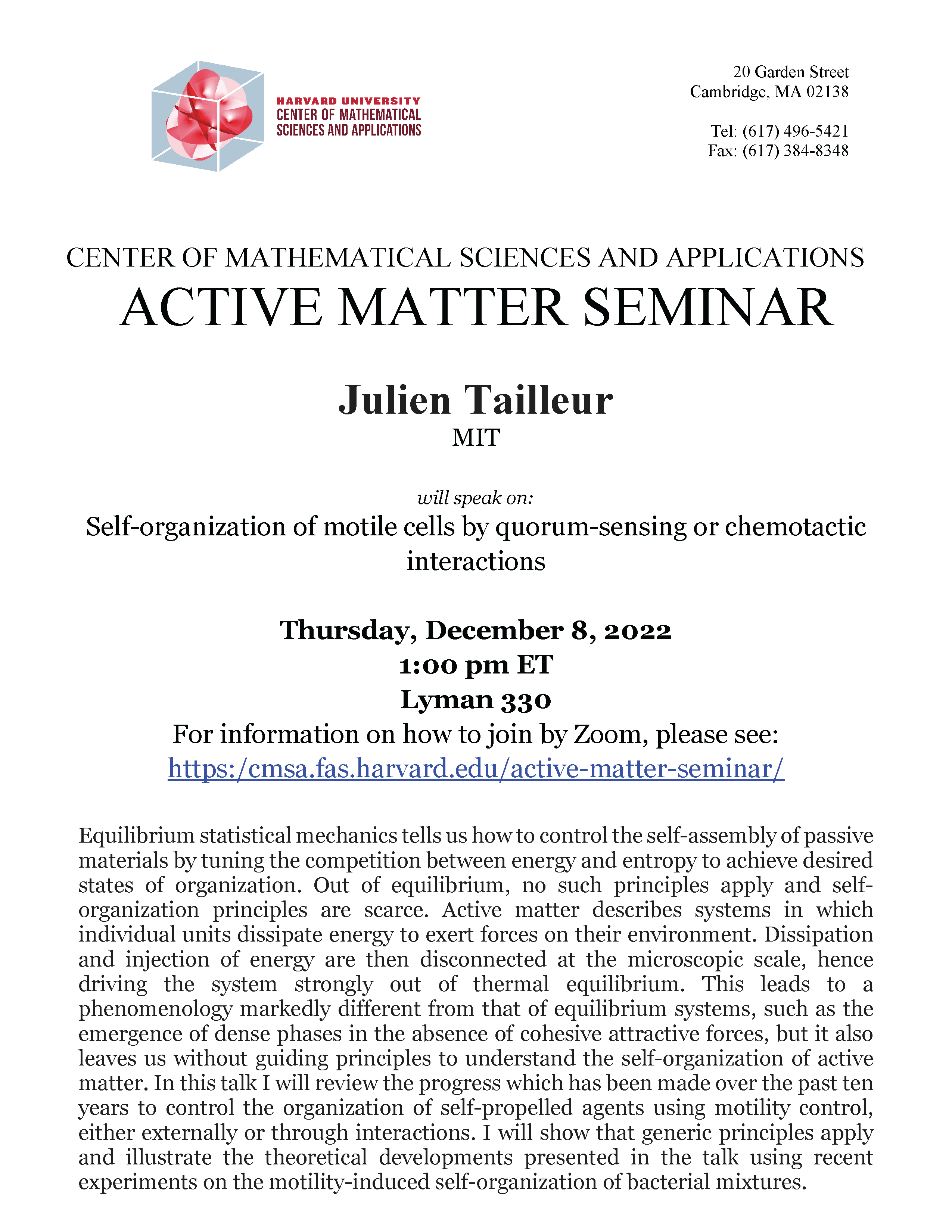
    Active Matter Seminar Speaker: Julien Tailleur (MIT) Title: Self-organization of motile cells by quorum-sensing or chemotactic interactions Abstract: Equilibrium statistical mechanics tells us how to control the self-assembly of passive materials by tuning the competition between energy and entropy to achieve desired states of organization. Out of equilibrium, no such principles apply and self-organization principles are […]

  • Non-Invertible Symmetries from Holography and Branes

    Virtual

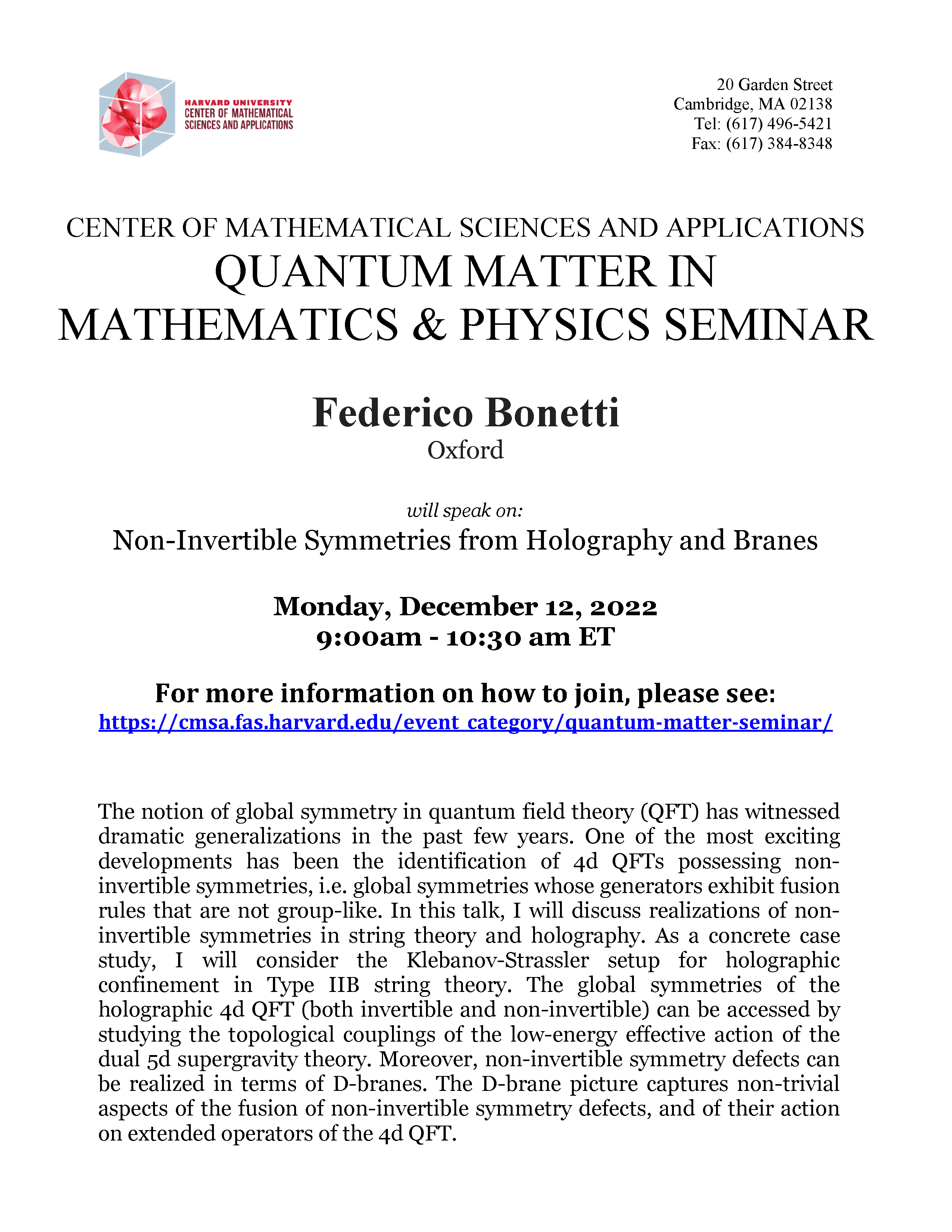
    Quantum Matter Seminar Speaker: Federico Bonetti (Oxford) Title: Non-Invertible Symmetries from Holography and Branes Abstract:  The notion of global symmetry in quantum field theory (QFT) has witnessed dramatic generalizations in the past few years. One of the most exciting developments has been the identification of 4d QFTs possessing non-invertible symmetries, i.e. global symmetries whose generators […]

  • Phase Fluctuations in Two-Dimensional Superconductors and Pseudogap Phenomenon

    Virtual

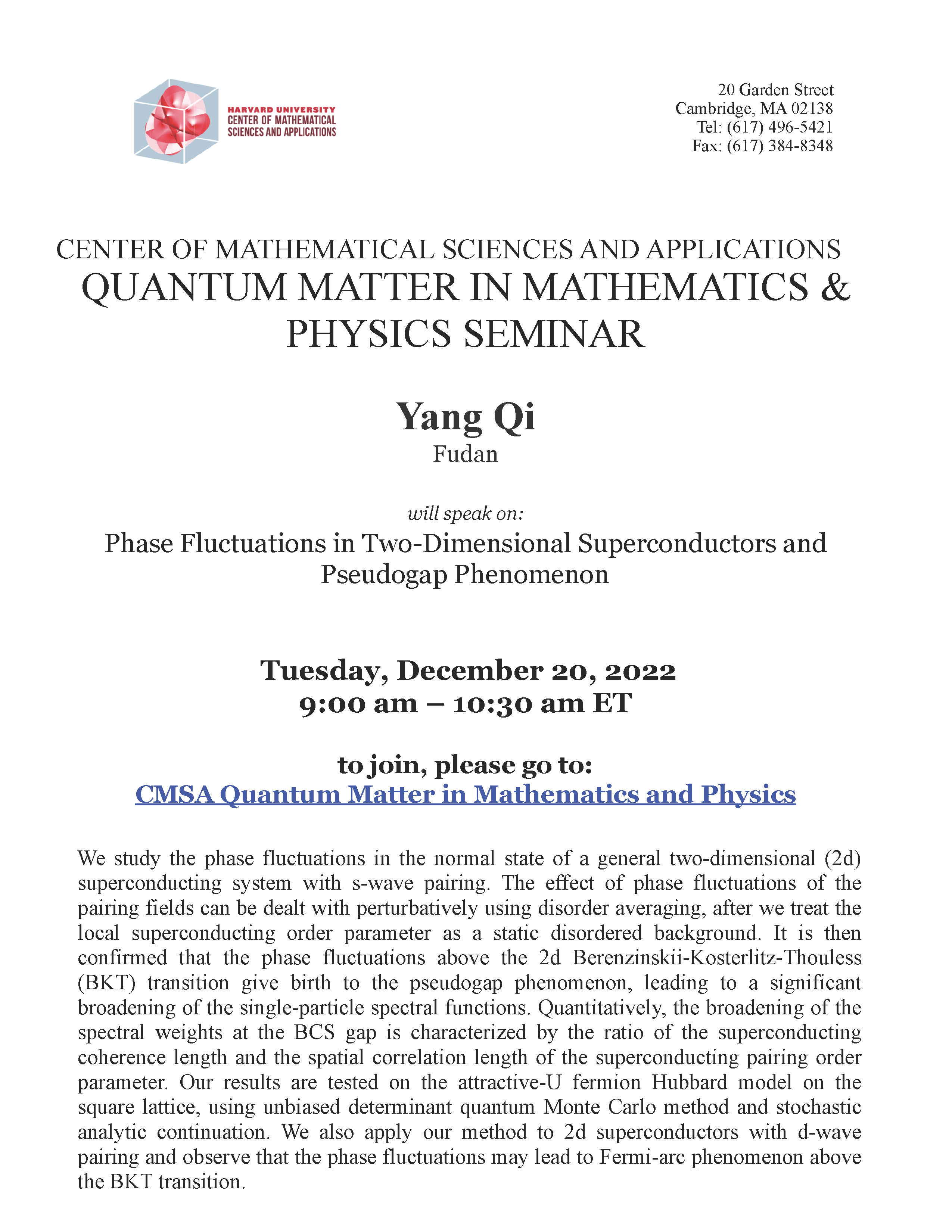
    Quantum Matter Seminar Speaker: Yang Qi (Fudan) Title: Phase Fluctuations in Two-Dimensional Superconductors and Pseudogap Phenomenon Abstract: We study the phase fluctuations in the normal state of a general two-dimensional (2d) superconducting system with s-wave pairing. The effect of phase fluctuations of the pairing fields can be dealt with perturbatively using disorder averaging, after we […]

  • Reflections on Parity Breaking

    Virtual

    Quantum Matter Seminar Speakers: Jacob McNamara (Caltech) and Matthew Reece (Harvard) Title: Reflections on Parity Breaking Abstract: One approach to the Strong CP Problem (known as Nelson-Barr models) is to assume that parity is a gauge symmetry, which is spontaneously broken in the world around us. In this talk, we will describe the formal meaning […]

  • Testing spacetime geometry with images of supermassive compact objects: Current status and the future

    Virtual

    https://youtu.be/ParxdL5gREI General Relativity Seminar Speaker: Prashant Kocherlakota (BHI) Title: Testing spacetime geometry with images of supermassive compact objects: Current status and the future Abstract: Astrophysical black holes (BHs) are expected to be described by the Kerr solution of the Einstein equations. Several frameworks have recently been developed to parametrically deform the Kerr metric in significantly […]

  • Group Invariant States as Many-Body Scars

    Virtual

    Quantum Matter Seminar Title: Group Invariant States as Many-Body Scars Speaker: Igor R. Klebanov (Princeton University) Abstract: Quantum many-body scars have been an active area of research in Condensed Matter Physics for several years. In some many-body systems, the Hilbert space breaks up into a large ergodic sector and a much smaller scar subspace. It […]

  • Swampland program, extra dimensions and supersymmetry breaking

    CMSA Room G10 CMSA, 20 Garden Street, Cambridge, MA, United States

    Swampland Seminar Speaker: Ignatios Antoniadis (LPTHE Paris) Title: Swampland program, extra dimensions and supersymmetry breaking Abstract: I will argue on the possibility that the smallness of some physical parameters signal a universe corresponding to a large distance corner in the string landscape of vacua. Such parameters can be the scales of dark energy and supersymmetry breaking, leading to […]

  • AI and Theorem Proving

    CMSA Room G10 CMSA, 20 Garden Street, Cambridge, MA, United States

    Member Seminar Speaker: Mike Douglas Title: AI and Theorem Proving Abstract: We survey interactive theorem proving and the Lean theorem prover, and the use of AI and large language models to improve this technology. We hope to start a discussion on projects we can do at the CMSA.

  • Near extremal de Sitter black holes and JT gravity

    Virtual

    https://youtu.be/0gWCm0wmgOY General Relativity Seminar Speaker: Chiara Toldo (Harvard) Title: Near extremal de Sitter black holes and JT gravity Abstract: In this talk I will explore the thermodynamic response near extremality of charged black holes in four-dimensional Einstein-Maxwell theory with a positive cosmological constant. The latter exhibit three different extremal limits, dubbed cold, Nariai and ultracold configurations, with […]