• Hints of Flat Space Holography

    CMSA Room G10 CMSA, 20 Garden Street, Cambridge, MA, United States

    Member Seminar Speaker: Dan Kapec Title: Hints of Flat Space Holography Abstract: Despite our detailed understanding of holography in Anti-de Sitter space, flat space holography remains somewhat mysterious. “Celestial CFT” is a formalism which attempts to recast quantum gravity in (d+2)-dimensional asymptotically flat spacetimes in terms of a d-dimensional Euclidean conformal field theory residing at the conformal […]
  • The Black Hole Information Paradox: A Resolution on the Horizon?

    CMSA Room G10 CMSA, 20 Garden Street, Cambridge, MA, United States

    Speaker: Netta Engelhardt (MIT) Title: The Black Hole Information Paradox: A Resolution on the Horizon? Abstract: The black hole information paradox — whether information escapes an evaporating black hole or not — remains one of the most longstanding mysteries of theoretical physics. The apparent conflict between validity of semiclassical gravity at low energies and unitarity […]

  • Thresholds for edge colorings

    Virtual

    Probability Seminar Speaker: Vishesh Jain (University of Illinois Chicago) Title: Thresholds for edge colorings Abstract: We show that if each edge of the complete bipartite graph K_{n,n} is given a random list of C(\log n) colors from , then with high probability, there is a proper edge coloring where the color of each edge comes […]

  • Formation of trapped surfaces in the Einstein-Yang-Mills system

    Virtual

    https://youtu.be/z7q0LGNVPII General Relativity Seminar Speaker: Nikolaos Athanasiou (University of Crete, Greece) Title: Formation of trapped surfaces in the Einstein-Yang-Mills system Abstract: The purpose of this talk is to give an overview of a semi-global existence result and a trapped surface formation results in the context of the Einstein-Yang-Mills system. Adopting a “signature for decay rates” […]

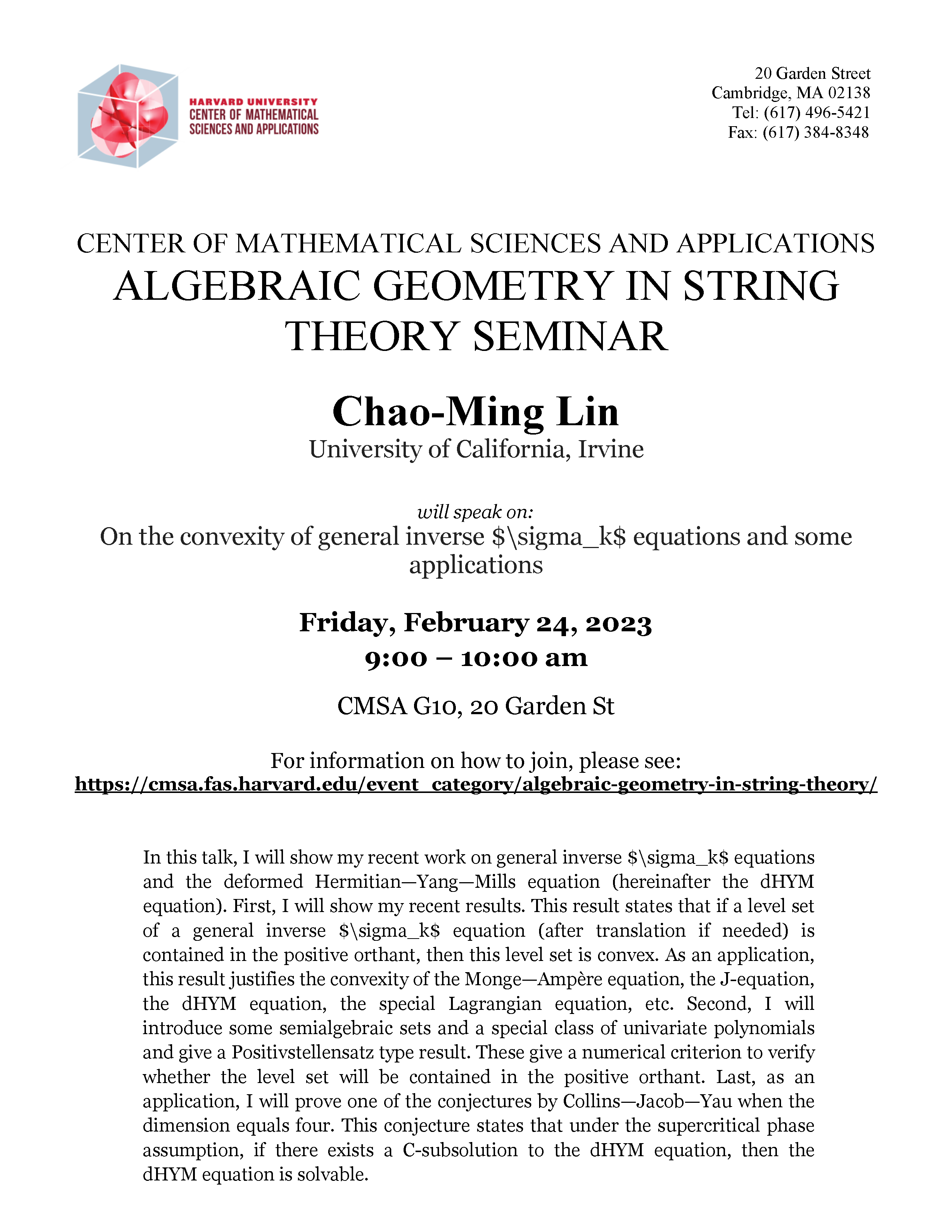
  • On the convexity of general inverse $\sigma_k$ equations and some applications

    CMSA Room G10 CMSA, 20 Garden Street, Cambridge, MA, United States

    Algebraic Geometry in String Theory Seminar Speaker: Chao-Ming Lin (University of California, Irvine) Title: On the convexity of general inverse $\sigma_k$ equations and some applications Abstract: In this talk, I will show my recent work on general inverse $\sigma_k$ equations and the deformed Hermitian-Yang-Mills equation (hereinafter the dHYM equation). First, I will show my recent […]

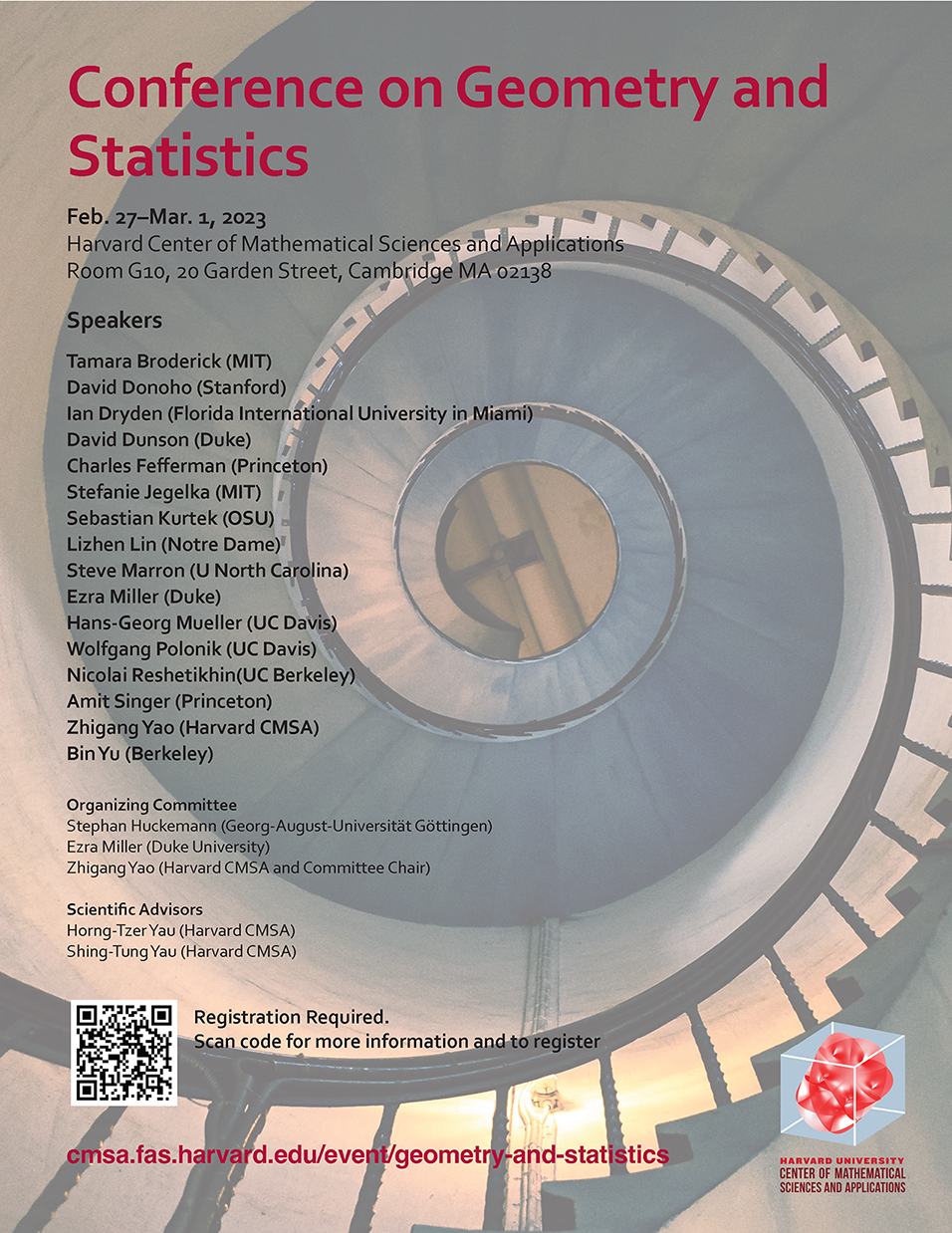
  • Conference on Geometry and Statistics

    CMSA Room G10 CMSA, 20 Garden Street, Cambridge, MA, United States

    On Feb 27-March 1, 2023 the CMSA will host a Conference on Geometry and Statistics. Location: G10, CMSA, 20 Garden Street, Cambridge MA 02138 Organizing Committee: Stephan Huckemann (Georg-August-Universität Göttingen) Ezra Miller (Duke University) Zhigang Yao (Harvard CMSA and Committee Chair) Scientific Advisors: Horng-Tzer Yau (Harvard CMSA) Shing-Tung Yau (Harvard CMSA) Speakers: Tamara Broderick (MIT) […]

  • New bounds on lattice covering volumes, and nearly uniform covers

    CMSA Room G10 CMSA, 20 Garden Street, Cambridge, MA, United States

    Member Seminar Speaker: Barak Weiss   Title: New bounds on lattice covering volumes, and nearly uniform covers Abstract: Let L be a lattice in R^n and let K be a convex body. The covering volume of L with respect to K is the minimal volume of a dilate rK, such that L+rK = R^n, normalized by the […]

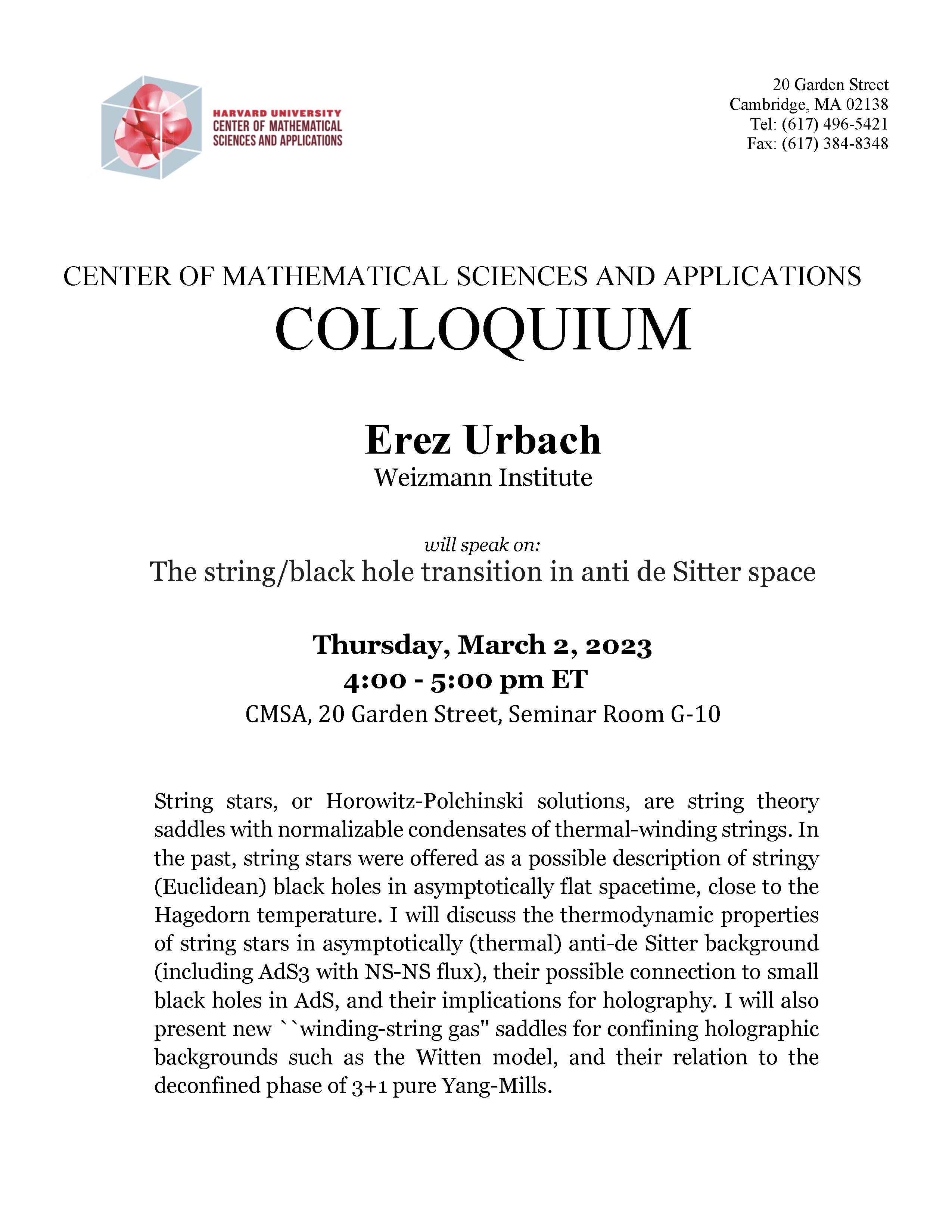
  • The string/black hole transition in anti de Sitter space

    CMSA Room G10 CMSA, 20 Garden Street, Cambridge, MA, United States

    Speaker: Erez Urbach, Weizmann Institute of Science Title: The string/black hole transition in anti de Sitter space Abstract: String stars, or Horowitz-Polchinski solutions, are string theory saddles with normalizable condensates of thermal-winding strings. In the past, string stars were offered as a possible description of stringy (Euclidean) black holes in asymptotically flat spacetime, close to the […]

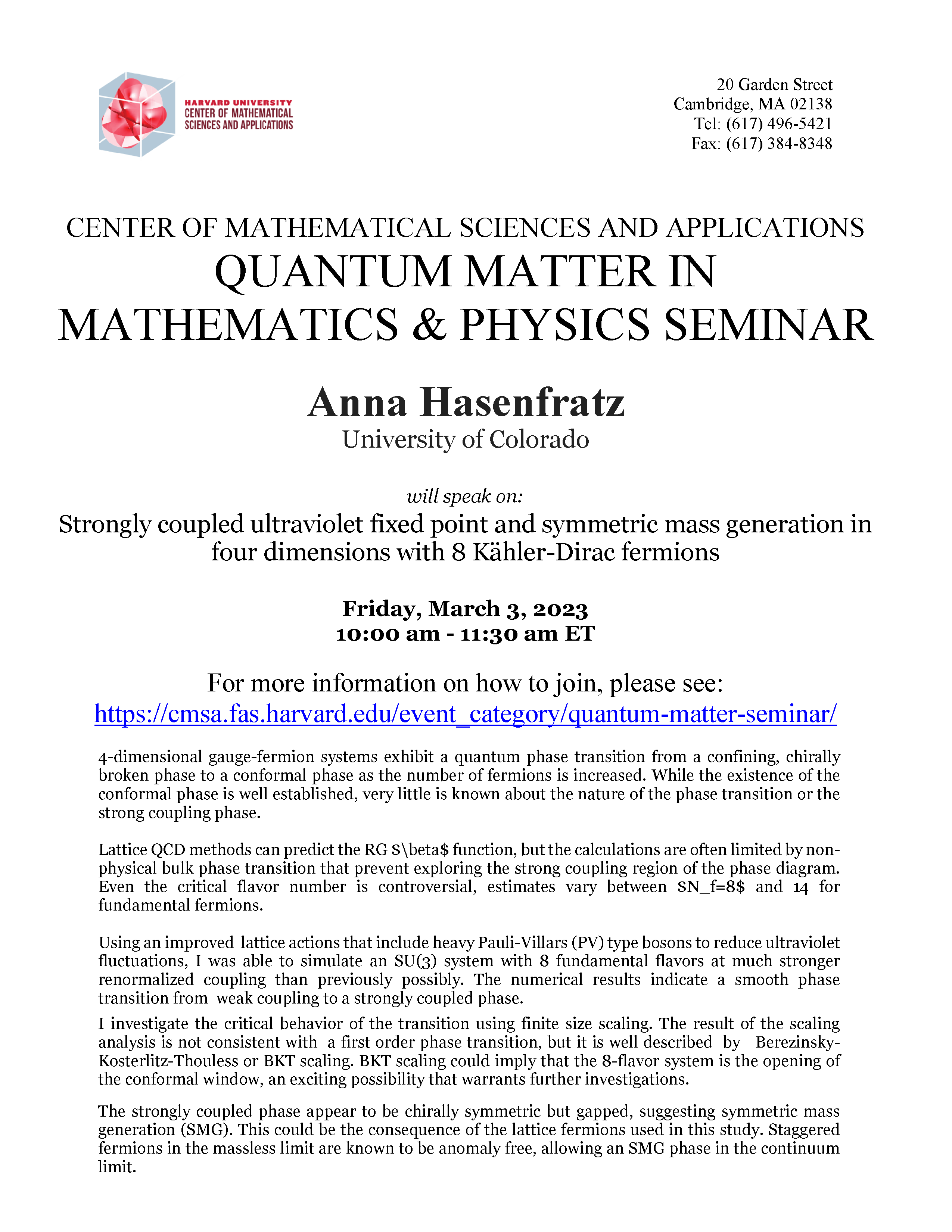
  • Strongly coupled ultraviolet fixed point and symmetric mass generation in four dimensions with 8 Kähler-Dirac fermions

    Virtual

    Quantum Matter Seminar Speaker: Anna Hasenfratz (University of Colorado) Title: Strongly coupled ultraviolet fixed point and symmetric mass generation in four dimensions with 8 Kähler-Dirac fermions Abstract: 4-dimensional gauge-fermion systems exhibit a quantum phase transition from a confining, chirally broken phase to a conformal phase as the number of fermions is increased. While the existence of the conformal […]

  • Categorical Symmetry of the Standard Model from Gravitational Anomaly 

    CMSA Room G10 CMSA, 20 Garden Street, Cambridge, MA, United States

    Member Seminar Speaker: Juven Wang Title: Categorical Symmetry of the Standard Model from Gravitational Anomaly Abstract: In the Standard Model, the total "sterile right-handed" neutrino number n_{νR} is not equal to the family number Nf. The anomaly index (-Nf+n_{νR}) had been advocated to play an important role in our previous work on Cobordism and Deformation Class of […]

  • Conformal symmetry, Optimization algorithms and the Critical Phenomena

    CMSA Room G10 CMSA, 20 Garden Street, Cambridge, MA, United States

    Speaker: Ning Su, University of Pisa Title: Conformal symmetry, Optimization algorithms and the Critical Phenomena Abstract: In the phase diagram of many substances, the critical points have emergent conformal symmetry and are described by conformal field theories. Traditionally, physical quantities near the critical point can be computed by perturbative field theory method, where conformal symmetry […]

  • How to steer foundation models?

    CMSA Room G10 CMSA, 20 Garden Street, Cambridge, MA, United States

    https://youtu.be/ztk5TPYTKZA New Technologies in Mathematics Seminar Speaker: Jimmy Ba, University of Toronto Title: How to steer foundation models? Abstract: By conditioning on natural language instructions, foundation models and large language models (LLMs) have displayed impressive capabilities as general-purpose computers. However, task performance depends significantly on the quality of the prompt used to steer the model. […]