• From spin glasses to Boolean circuits lower bounds – Algorithmic barriers from the overlap gap property

    CMSA Room G10 CMSA, 20 Garden Street, Cambridge, MA, United States

    Speaker: David Gamarnik (MIT) Title: From spin glasses to Boolean circuits lower bounds. Algorithmic barriers from the overlap gap property Abstract: Many decision and optimization problems over random structures exhibit an apparent gap between the existentially optimal values and algorithmically achievable values. Examples include the problem of finding a largest independent set in a random graph, the problem […]
  • Bakry-Emery theory and renormalisation

    Hybrid

    Probability Seminar Speaker: Roland Bauerschmidt (Cambridge) Title: Bakry-Emery theory and renormalisation Abstract: I will discuss an approach to log-Sobolev inequalities that combines the Bakry-Emery theory with renormalisation and present several applications. These include log-Sobolev inequalities with polynomial dependence for critical Ising models on Z^d when d>4 and singular SPDEs with uniform dependence of the log-Sobolev […]

  • Quasinormal modes and Ruelle resonances: mathematician’s perspective

    CMSA Room G10 CMSA, 20 Garden Street, Cambridge, MA, United States

    https://youtu.be/FyJ6TieNQBc General Relativity Seminar Speaker: Maciej Zworski, UC Berkeley Title: Quasinormal modes and Ruelle resonances: mathematician's perspective Abstract: Quasinormal modes of gravitational waves and Ruelle resonances in hyperbolic classical dynamics share many general properties and can be considered "scattering resonances": they appear in expansions of correlations, as poles of Green functions and are associated to […]

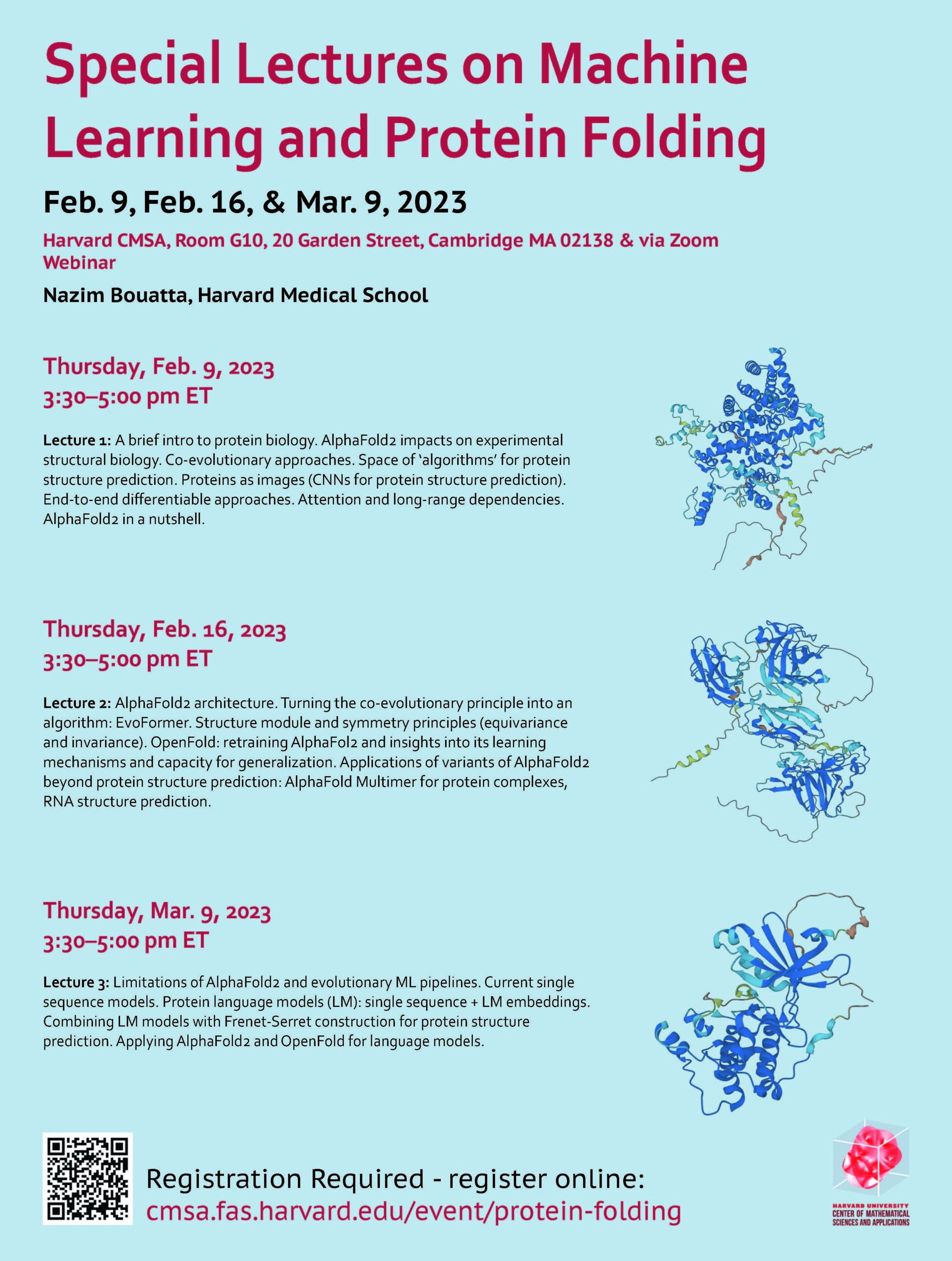
  • Special Lectures on Machine Learning and Protein Folding

    CMSA Room G10 CMSA, 20 Garden Street, Cambridge, MA, United States

    The CMSA hosted a series of three 90-minute lectures on the subject of machine learning for protein folding. Thursday Feb. 9, Thursday Feb. 16, & Thursday March 9, 2023, 3:30-5:00 pm ET Location: G10, CMSA, 20 Garden Street, Cambridge MA 02138 & via Zoom     Speaker: Nazim Bouatta, Harvard Medical School Abstract: AlphaFold2, a […]

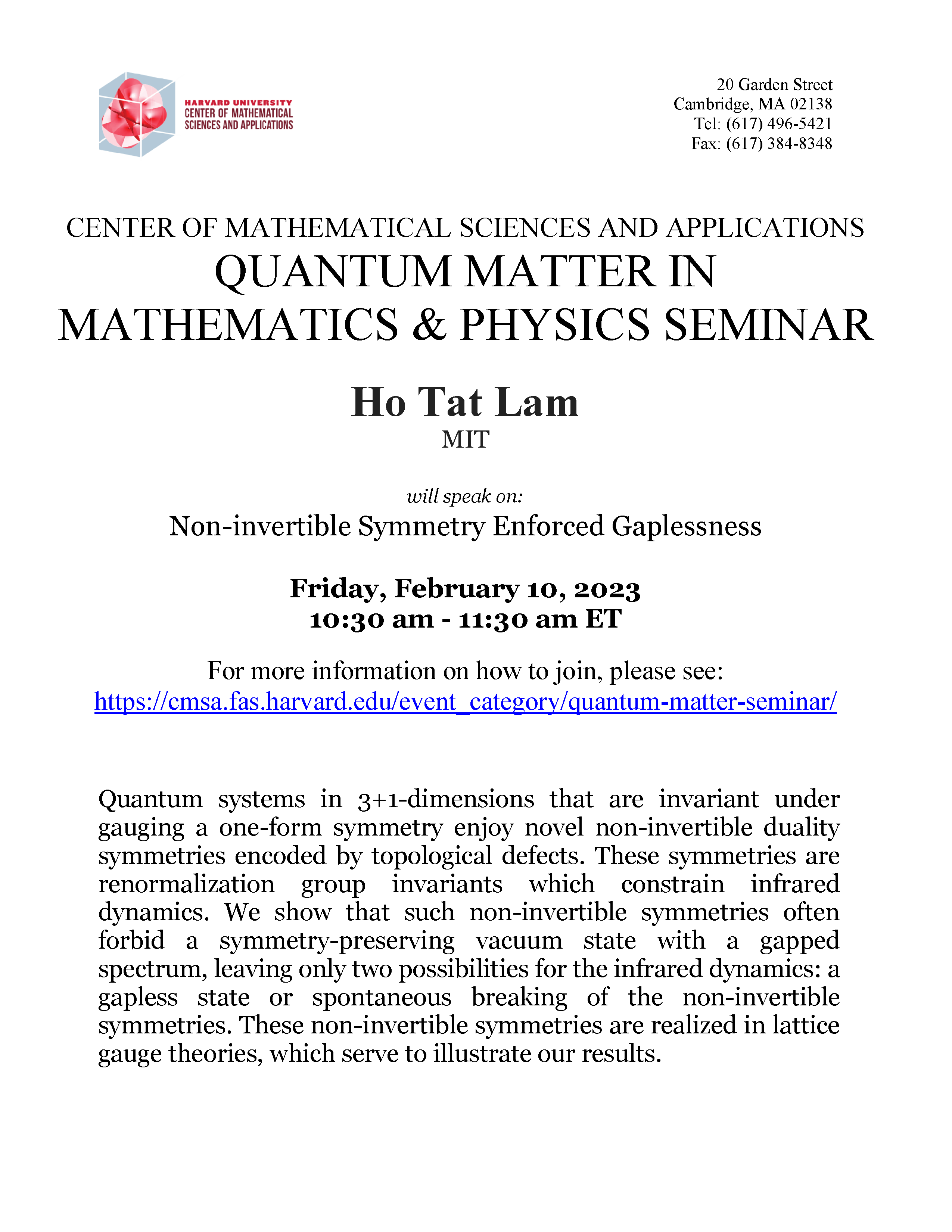
  • Non-invertible Symmetry Enforced Gaplessness

    Virtual

    Quantum Matter Seminar Speaker: Ho Tat Lam (MIT) Title: Non-invertible Symmetry Enforced Gaplessness Abstract: Quantum systems in 3+1-dimensions that are invariant under gauging a one-form symmetry enjoy novel non-invertible duality symmetries encoded by topological defects. These symmetries are renormalization group invariants which constrain infrared dynamics. We show that such non-invertible symmetries often forbid a symmetry-preserving vacuum state […]

  • Parity and Cobordism

    CMSA Room G10 CMSA, 20 Garden Street, Cambridge, MA, United States

    Swampland Seminar Speaker: Jake McNamara (Caltech) Title: Parity and Cobordism Abstract: The swampland cobordism conjecture provides a convenient way to discuss conserved charges associated with the topology of spacetime. However, much of the power of the cobordism conjecture comes from a mathematical black box: the Adams spectral sequence. In this talk, I will give physical meaning to […]

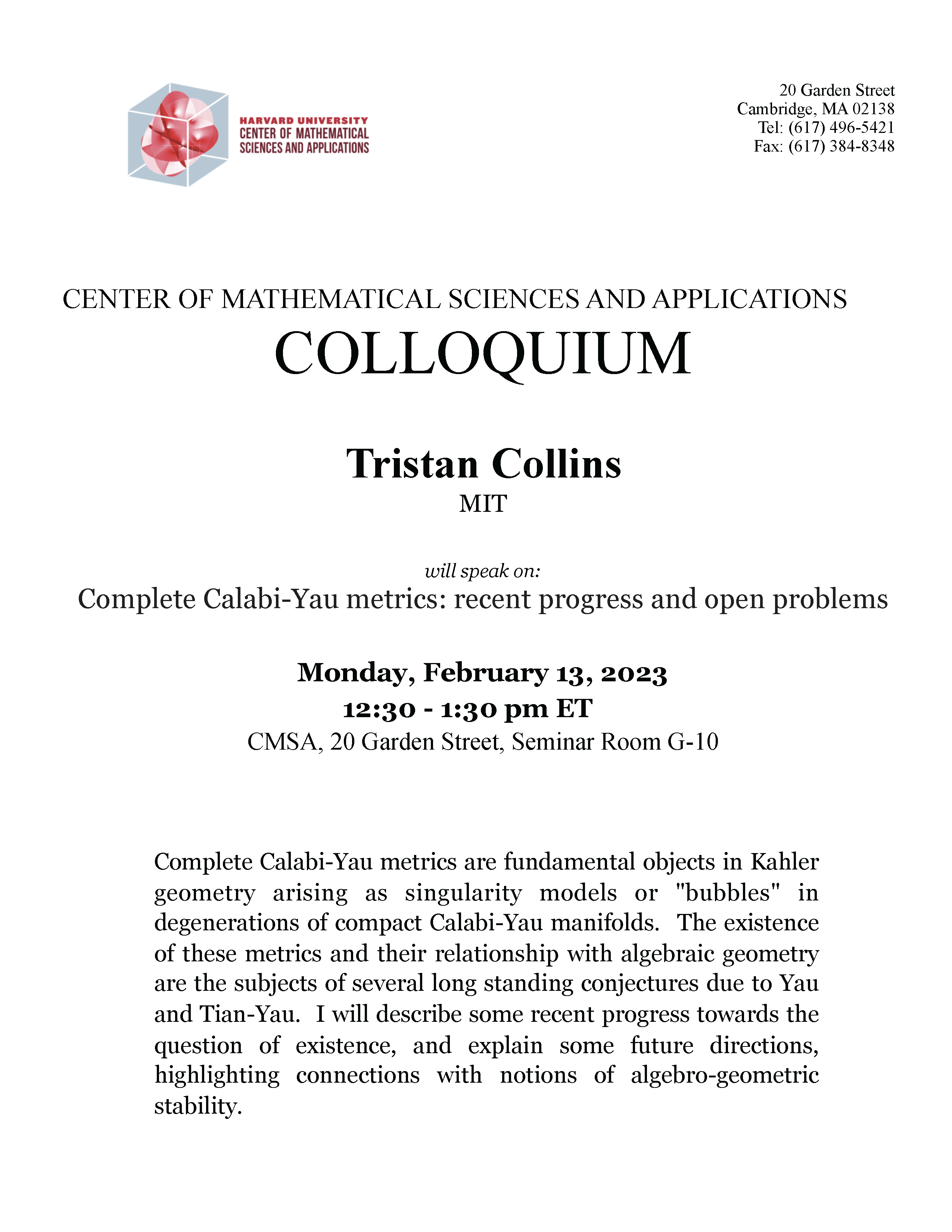
  • Complete Calabi-Yau metrics: Recent progress and open problems

    CMSA Room G10 CMSA, 20 Garden Street, Cambridge, MA, United States

    Speaker: Tristan Collins, MIT Title: Complete Calabi-Yau metrics: Recent progress and open problems Abstract: Complete Calabi-Yau metrics are fundamental objects in Kahler geometry arising as singularity models or "bubbles" in degenerations of compact Calabi-Yau manifolds.  The existence of these metrics and their relationship with algebraic geometry are the subjects of several long standing conjectures due […]

  • Dynamics of active nematic defects on cones

    CMSA Room G10 CMSA, 20 Garden Street, Cambridge, MA, United States

    Member Seminar Speaker: Farzan Vafa Title: Dynamics of active nematic defects on cones Abstract: In the first part of the talk, we investigate the ground-state configurations of two-dimensional liquid crystals with p-fold rotational symmetry (p-atics) on cones. The cone apex develops an effective topological charge, which in analogy to electrostatics, leads to defect absorption and emission […]

  • Manifold Fitting: An Invitation to Statistics

    CMSA Room G10 CMSA, 20 Garden Street, Cambridge, MA, United States

    Probability Seminar Speaker: Zhigang Yao (Harvard CMSA/National University of Singapore) Title: Manifold Fitting: An Invitation to Statistics Abstract: This manifold fitting problem can go back to H. Whitney’s work in the early 1930s (Whitney (1992)), and finally has been answered in recent years by C. Fefferman’s works (Fefferman, 2006, 2005). The solution to the Whitney extension problem […]

  • Towards programmable living materials and quantitative models of active matter

    CMSA Room G10 CMSA, 20 Garden Street, Cambridge, MA, United States

    Active Matter Seminar Speaker: Jörn Dunkel, MIT Title: Towards programmable living materials and quantitative models of active matter Abstract: Over the last two decades, major progress has been made in understanding the self-organization principles of active matter.  A wide variety of experimental model systems, from self-driven colloids to active elastic materials, has been established, and an extensive […]

  • Quasinormal Modes from Penrose Limits

    CMSA Room G10 CMSA, 20 Garden Street, Cambridge, MA, United States

    https://youtu.be/taeAnXApzg4 General Relativity Seminar Speaker: Kwinten Fransen (UC Santa Barbara) Title: Quasinormal Modes from Penrose Limits Abstract: In this talk, I will explain how to describe quasinormal modes with large real frequencies using Penrose limits. To do so, I first recall relevant aspects of the Penrose limit, and its resulting plane wave spacetimes, as well as quasinormal […]

  • Quantum Spin Lakes: NISQ-Era Spin Liquids from Non-Equilibrium Dynamics

    Virtual

    Quantum Matter Seminar Speaker: Rahul Sahay (Harvard) Title: Quantum Spin Lakes: NISQ-Era Spin Liquids from Non-Equilibrium Dynamics Abstract: While many-body quantum systems can in principle host exotic quantum spin liquid (QSL) states, realizing them as ground states in experiments can be prohibitively difficult. In this talk, we show how non-equilibrium dynamics can provide a streamlined […]