• CMSA Q&A Seminar

    CMSA Q&A Seminar: Ludmil Katzarkov, University of Miami

    Common Room, CMSA 20 Garden Street, Cambridge, MA, United States

    CMSA Q&A Seminar Speaker: Ludmil Katzarkov, University of Miami Title: New Birational Invariants Abstract: We will introduce the origins of the main ideas of the theory of atoms. Applications follow. Equivariant and mixed atoms will be considered.
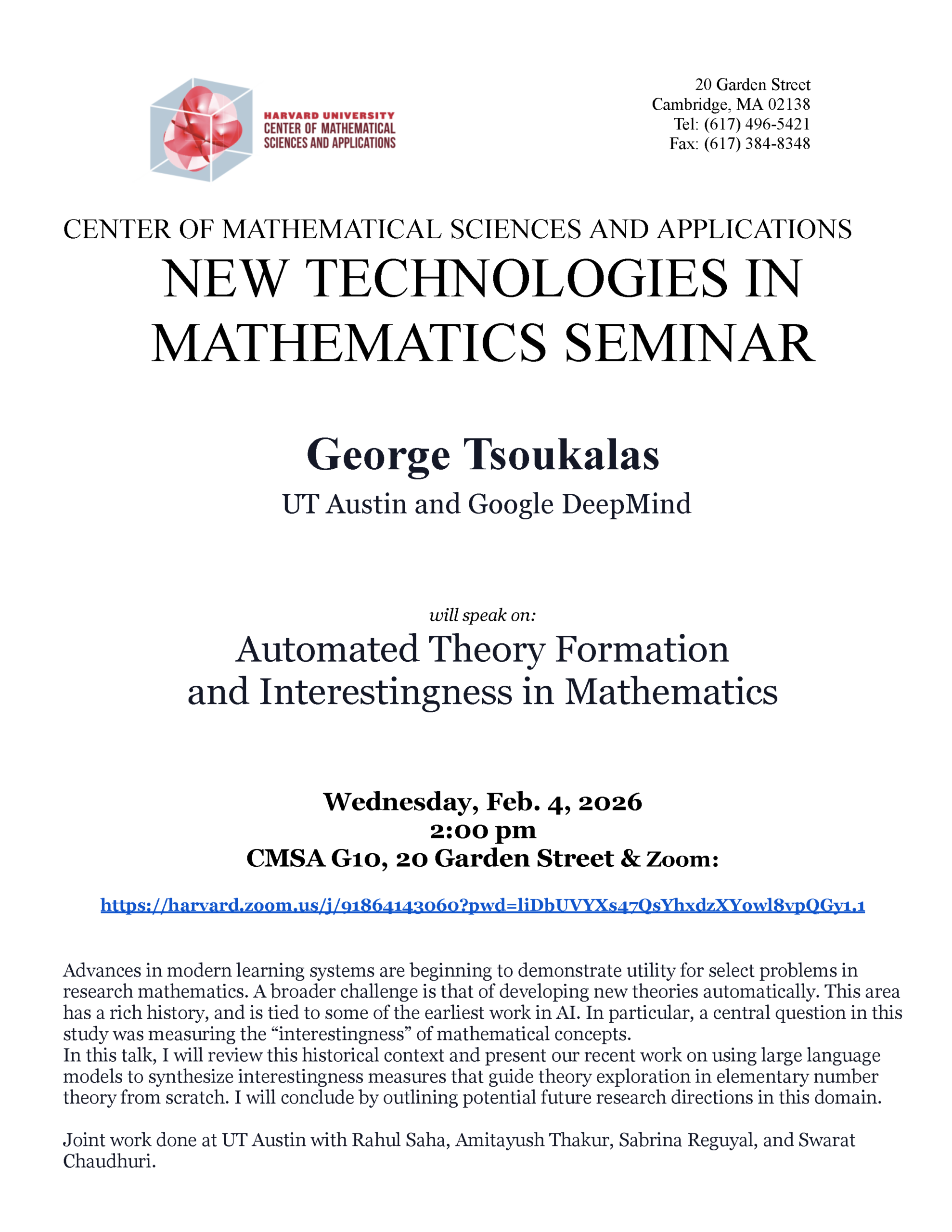
  • Automated Theory Formation and Interestingness in Mathematics

    CMSA Room G10 CMSA, 20 Garden Street, Cambridge, MA, United States

    New Technologies in Mathematics Seminar Speaker: George Tsoukalas, UT Austin Dept. of Computer Science and Google DeepMind. Title: Automated Theory Formation and Interestingness in Mathematics Abstract: Advances in modern learning systems are beginning to demonstrate utility for select problems in research mathematics. A broader challenge is that of developing new theories automatically. This area has a rich […]

  • Index from a point

    CMSA Room G10 CMSA, 20 Garden Street, Cambridge, MA, United States

    Differential Geometry and Physics Seminar Speaker: Monica Jinwoo Kang, Texas A&M University Title: Index from a point Abstract: We argue that protected data of 4d N=2 SCFTs admits a purely algebro-geometric characterization. We conjecture that both the Macdonald index (and hence the Schur index) and the Higgs branch are encoded by a bifiltered affine scheme determined by […]

  • On E7+1/2 gauge theory

    CMSA Room G10 CMSA, 20 Garden Street, Cambridge, MA, United States

    Differential Geometry and Physics Seminar Speaker: Yinan Wang, Peking University Title: On E7+1/2 gauge theory Abstract: We propose that an exotic gauge theory based on the intermediate Lie algebra E7+1/2 naturally appears in the landscape of 6d F-theory. We give strong evidence of this proposal with 6d anomaly cancellation, dual M-theory geometry and elliptic genus of the single-string […]

  • Algebra Seminar

    CMSA Room G10 CMSA, 20 Garden Street, Cambridge, MA, United States

    Algebra Seminar  

  • Member Seminar

    CMSA Room G10 CMSA, 20 Garden Street, Cambridge, MA, United States

    Member Seminar Speaker: Ahsan Khan

  • On the p-curvature of quantum connections of CY threefolds

    CMSA Room G10 CMSA, 20 Garden Street, Cambridge, MA, United States

    Quantum Field Theory and Physical Mathematics Seminar Speaker: Shaoyun Bai (MIT) Title: On the p-curvature of quantum connections of CY threefolds Abstract: The small quantum connection of Calabi-Yau varieties has integral coefficients, thus admits reduction mod a prime number p. A fundamental invariant associated with flat connections over characteristic p is the p-curvature, which lies […]

  • Phase Transition to Chaos in Complex Ecosystems with Non-reciprocal Interactions

    CMSA Room G10 CMSA, 20 Garden Street, Cambridge, MA, United States

    Colloquium Speaker: Pankaj Metha, Boston University Title: Phase Transition to Chaos in Complex Ecosystems with Non-reciprocal Interactions Abstract: Nonreciprocal interactions between microscopic constituents can profoundly shape the large-scale properties of complex systems. In this pedagogical chalk talk, I will discuss recent work from our group on phase transitions and chaos in high-dimensional ecosystems with non-reciprocal […]

  • Solitonic Symmetry: Cohomology with TFT Coefficients

    Science Center 507 1 Oxford Street, Cambridge

    Geometry and Quantum Theory Seminar Speaker: Sanjay Raman, Harvard Title: Solitonic Symmetry: Cohomology with TFT Coefficients Abstract: We review the formalism of https://arxiv.org/pdf/2307.00939, which develops the theory of solitonic symmetry in quantum field theory. The algebraic structure of solitonic symmetry is determined by the fusion of topological functionals in a given path-integral formulation of topological field theory, and […]

  • CMSA Q&A Seminar

    CMSA Q&A Seminar: James Eldred Pascoe, Drexel University

    Common Room, CMSA 20 Garden Street, Cambridge, MA, United States

    CMSA Q&A Seminar Speaker: James Eldred Pascoe, Drexel University Title: (What is) The tracial fundamental group and free universal monodromy? Abstract: We introduce the tracial fundamental group to classify the analytic continuation of functions that are locally behave like the trace of natural matrix valued functions. While globally defined natural matrix-valued functions (known as free […]

  • ReLU and Softplus neural nets as zero-sum, turn-based, stopping games

    Virtual

    New Technologies in Mathematics Seminar Speaker: Yiannis Vlassopoulos, Athena Research Center Title: ReLU and Softplus neural nets as zero-sum, turn-based, stopping games Abstract: Neural networks are for the most part treated as black boxes. In an effort to begin elucidating the mathematical structure they encode, we will explain how ReLU neural nets can be interpreted as […]