• AlphaProof: when reinforcement learning meets formal mathematics

    Virtual

    https://youtu.be/TFBzP78Jp6A New Technologies in Mathematics Seminar Speaker: Thomas Hubert (Google DeepMind) Title: AlphaProof: when reinforcement learning meets formal mathematics Abstract: Galileo, the renowned Italian astronomer, physicist, and mathematician, famously described mathematics as the language of the universe. Progress since only confirmed his intuition as the world we live in can be described with extreme precision […]

  • Learning Dynamical Transport without Data

    CMSA Room G10 CMSA, 20 Garden Street, Cambridge, MA, United States

    https://youtu.be/mwpbMSNZOh0 New Technologies in Mathematics Seminar Speaker: Michael Albergo (Harvard) Title: Learning Dynamical Transport without Data Abstract: Algorithms based on dynamical transport of measure, such as score-based diffusion models, have resulted in great progress in the field of generative modeling. However, these algorithms rely on access to an abundance of data from the target distribution. […]

  • Can Transformers Do Enumerative Geometry?

    CMSA Room G10 CMSA, 20 Garden Street, Cambridge, MA, United States

    https://youtu.be/zvvUFPOwseo New Technologies in Mathematics Seminar Speaker: Baran Hashemi, Technical University of Munich Title: Can Transformers Do Enumerative Geometry? Abstract: How can Transformers model and learn enumerative geometry? What is a systematic procedure for using Transformers in abductive knowledge discovery within a mathematician-machine collaboration? In this work, we introduce a Neural Enumerative Reasoning model for computation of ψ-class intersection numbers on the moduli space […]

  • Machine learning for analytic calculations in theoretical physics

    CMSA Room G10 CMSA, 20 Garden Street, Cambridge, MA, United States

    New Technologies in Mathematics Seminar Speaker: Matthias Wilhelm (University of Southern Denmark) Title: Machine learning for analytic calculations in theoretical physics Abstract: In this talk, we will present recent progress on applying machine-learning techniques to improve calculations in theoretical physics, in which we desire exact and analytic results. One example are so-called integration-by-parts reductions of […]

  • Big Data Conference 2025

    CMSA Room G10 CMSA, 20 Garden Street, Cambridge, MA, United States

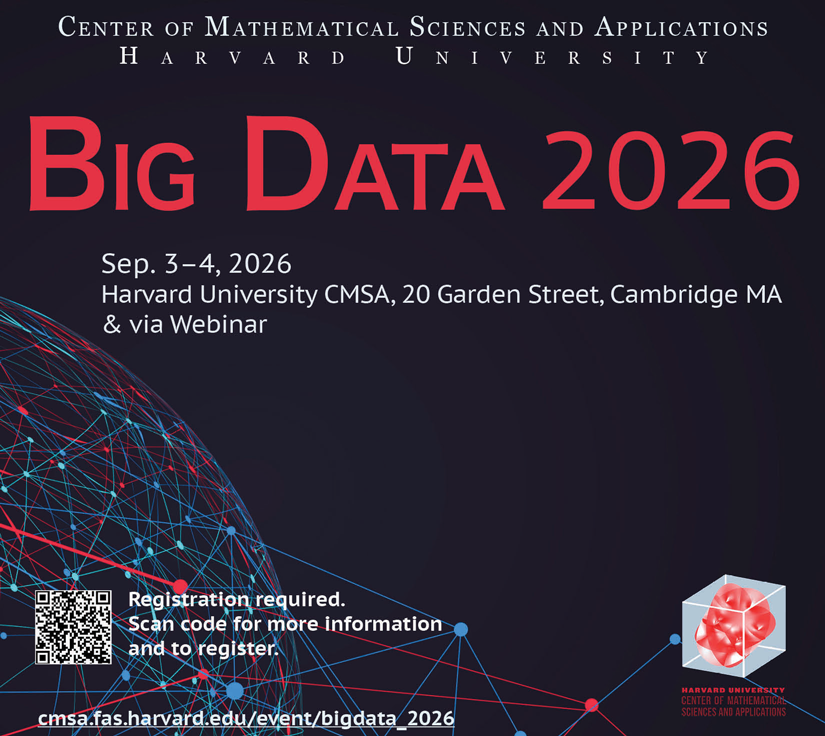
    Big Data Conference 2025 Dates: Sep. 11–12, 2025 Location: Harvard University CMSA, 20 Garden Street, Cambridge & via Zoom The Big Data Conference features speakers from the Harvard community as well as scholars from across the globe, with talks focusing on computer science, statistics, math and physics, and economics. Invited Speakers Markus J. Buehler, MIT […]

  • The Geometry of Machine Learning

    CMSA 20 Garden Street Cambridge, Massachusetts 02138 United States

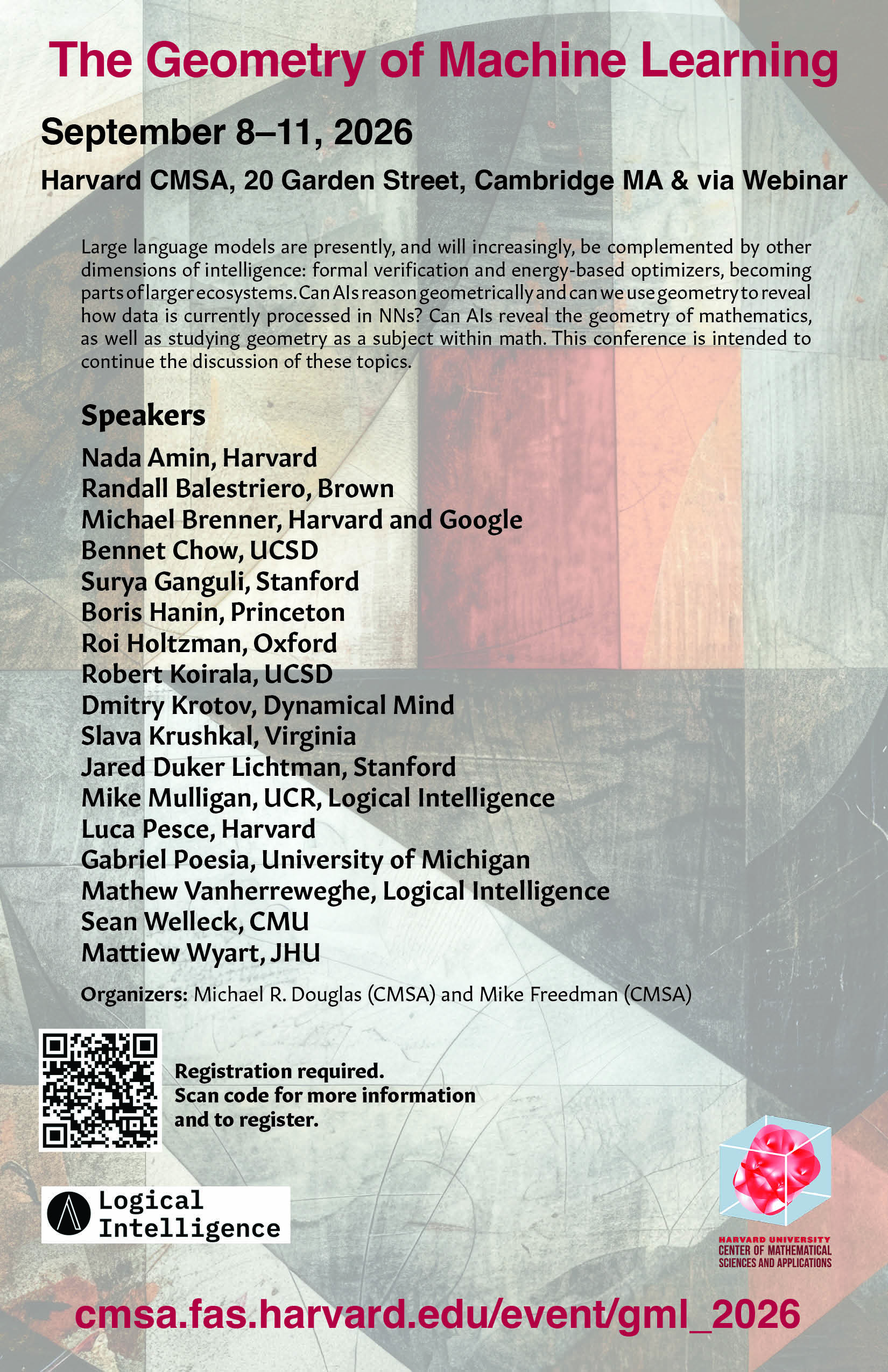
    The Geometry of Machine Learning Dates: September 15–18, 2025 Location: Harvard CMSA, Room G10, 20 Garden Street, Cambridge MA 02138 Despite the extraordinary progress in large language models, mathematicians suspect that other dimensions of intelligence must be defined and simulated to complete the picture. Geometric and symbolic reasoning are among these. In fact, there seems […]

  • Tropicalized quantum field theory

    Virtual

    https://youtu.be/0FCgpyCfb4o New Technologies in Mathematics Seminar Speaker: Michael Borinsky, Perimeter Institute  Title: Tropicalized quantum field theory Abstract: Quantum field theory (QFT) is one of the most accurate methods for making phenomenological predictions in physics, but it has a significant drawback: obtaining concrete predictions from it is computationally very demanding. The standard perturbative approach expands an […]

  • Understanding Optimization in Deep Learning with Central Flows

    Hybrid - G10

    https://youtu.be/04E8r76TetQ New Technologies in Mathematics Seminar Speaker: Alex Damian, Harvard Title: Understanding Optimization in Deep Learning with Central Flows Abstract: Traditional theories of optimization cannot describe the dynamics of optimization in deep learning, even in the simple setting of deterministic training. The challenge is that optimizers typically operate in a complex, oscillatory regime called the "edge of […]
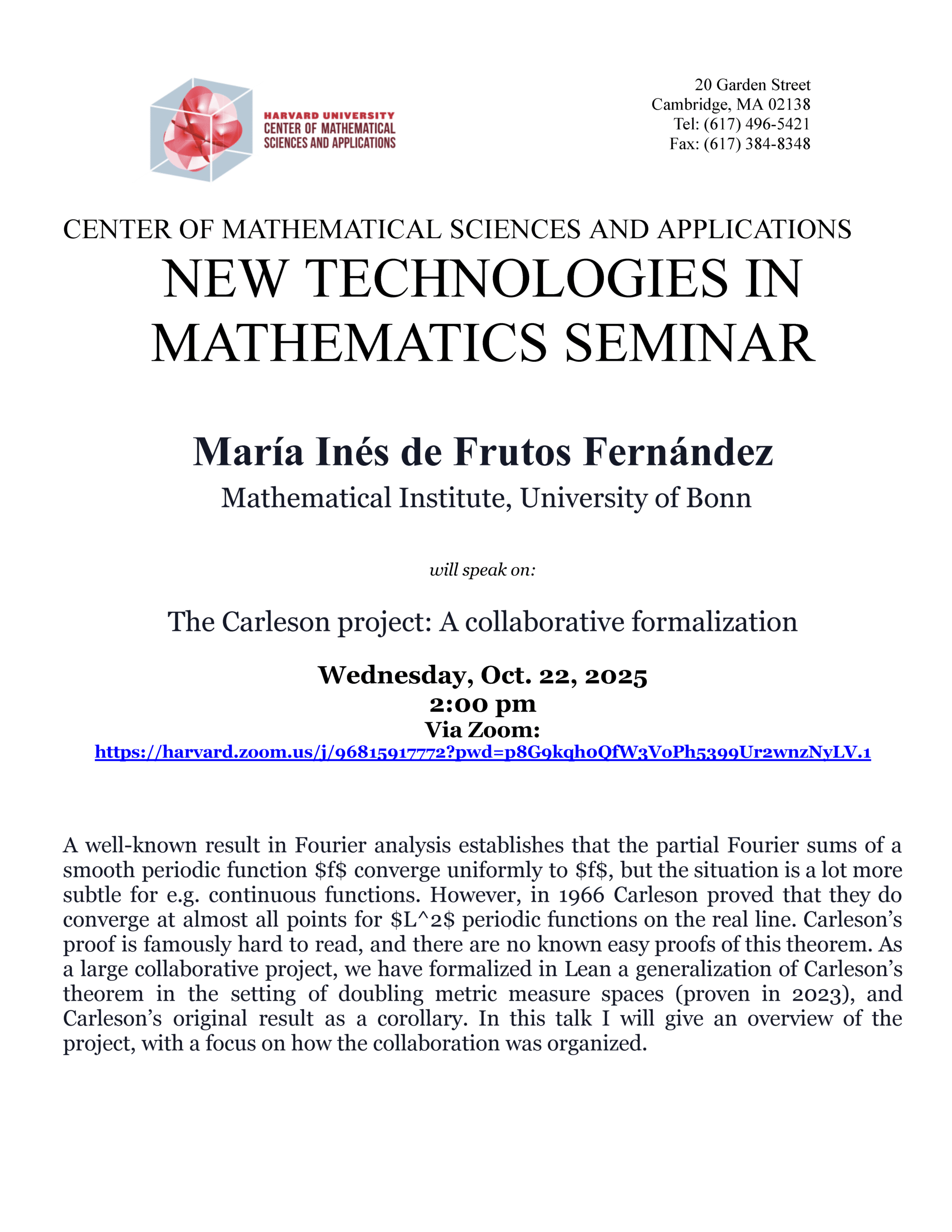
  • The Carleson project: A collaborative formalization

    Virtual

    New Technologies in Mathematics Seminar Speaker: María Inés de Frutos Fernández, Mathematical Institute, University of Bonn Title: The Carleson project: A collaborative formalization Abstract: A well-known result in Fourier analysis establishes that the partial Fourier sums of a smooth periodic function $f$ converge uniformly to $f$, but the situation is a lot more subtle for […]

  • Discovery of unstable singularity with machine precision

    CMSA 20 Garden Street Cambridge, Massachusetts 02138 United States

    New Technologies in Mathematics Seminar Speaker: Yongji Wang, NYU Courant Institute of Mathematical Sciences Title: Discovery of unstable singularity with machine precision Abstract: Whether singularities can form in fluids remains a foundational unanswered question in mathematics. This phenomenon occurs when solutions to governing equations, such as the 3D Euler equations, develop infinite gradients from smooth initial […]

  • Machine learning tools for mathematical discovery

    Virtual

    New Technologies in Mathematics Seminar Speaker: Adam Zsolt Wagner, Google DeepMind Title: Machine learning tools for mathematical discovery Abstract: I will discuss various ML tools we can use today to try to find interesting constructions to various mathematical problems. I will briefly mention simple reinforcement learning setups and PatternBoost, but the talk will mainly focus […]