• Member Seminar

    CMSA Room G10 CMSA, 20 Garden Street, Cambridge, MA, United States

    Member Seminar Speaker: Han Shao  

  • Incentives for data sharing in federated learning

    CMSA Room G10 CMSA, 20 Garden Street, Cambridge, MA, United States

    Member Seminar Speaker: Han Shao, Harvard CMSA Title: Incentives for data sharing in federated learning Abstract: Federated learning has recently emerged as a powerful approach for enabling collaboration across large populations of learning agents. However, agents may have incentives to defect from the collaboration—that is, to withdraw or contribute less data than expected—due to the […]

  • Asset pricing with heterogeneous agents

    CMSA Room G10 CMSA, 20 Garden Street, Cambridge, MA, United States

    Member Seminar Speaker: Sergiy Verstyuk, Harvard CMSA Title: Asset pricing with heterogeneous agents Abstract: This talk will introduce the basics of continuous-time finance, discuss important existing theories and models, as well as present some new asset pricing results in a setting with many heterogeneous investors. (Joint work with Puskar Mondal.)  
  • Echo Chamber: RL Post-training Amplifies Behaviors Learned in Pretraining

    CMSA Room G10 CMSA, 20 Garden Street, Cambridge, MA, United States

    Member Seminar Speaker: Samy Jelassi, CMSA Title: Echo Chamber: RL Post-training Amplifies Behaviors Learned in Pretraining Abstract: Reinforcement Learning has become a crucial step in training state-of-the-art language models such as DeepSeek-R1 for solving mathematical problems. In this talk, I will first review the mechanisms of Reinforcement Learning fine-tuning. Then, I will present a systematic end-to-end […]

  • Lie algebra cohomology and Seiberg-Witten theory

    CMSA Room G10 CMSA, 20 Garden Street, Cambridge, MA, United States

    Member Seminar Speaker: Ahsan Khan, Harvard CMSA Title: Lie algebra cohomology and Seiberg-Witten theory Abstract: I will discuss how a certain (relative) Lie algebra cochain complex categorifies the Schur index of N=2 supersymmetric gauge theory. For the special case of Seiberg-Witten theory I will provide a conjectured description of this cohomology.

  • A leisurely stroll through the theory of adjunctions

    CMSA Room G10 CMSA, 20 Garden Street, Cambridge, MA, United States

    Member Seminar Speaker: Lorenzo Riva, Harvard CMSA Title: A leisurely stroll through the theory of adjunctions Abstract: Adjoint functors (and, more generally, adjunctions in a 2-category) are ubiquitous in algebra and topology. In this talk I will give an overview of the basics of adjunctions, with the ultimate goal being understanding the statement of the […]

  • Theory of Task-Adapted Dynamics in Large Recurrent Neural Networks

    CMSA Room G10 CMSA, 20 Garden Street, Cambridge, MA, United States

    Member Seminar Speaker: Blake Bordelon, CMSA Title: Theory of Task-Adapted Dynamics in Large Recurrent Neural Networks Abstract: Recurrent neural networks (RNNs) encode expressive and flexible dynamical systems which can adapt to perform tasks by modifying the internal connections between neurons. In this work we analyze the structure of the dynamical systems encoded in RNNs after […]

  • Gauge theory, from low dimensions to higher dimensions and back

    CMSA Room G10 CMSA, 20 Garden Street, Cambridge, MA, United States

    Member Seminar Speaker: Saman Habibi Esfahani, CMSA Title: Gauge theory, from low dimensions to higher dimensions and back Abstract: Almost thirty years ago, Donaldson and Thomas proposed extending powerful ideas from gauge theory, which had transformed the study of three- and four-dimensional manifolds, to higher dimensions, with the goal of defining new invariants of special […]

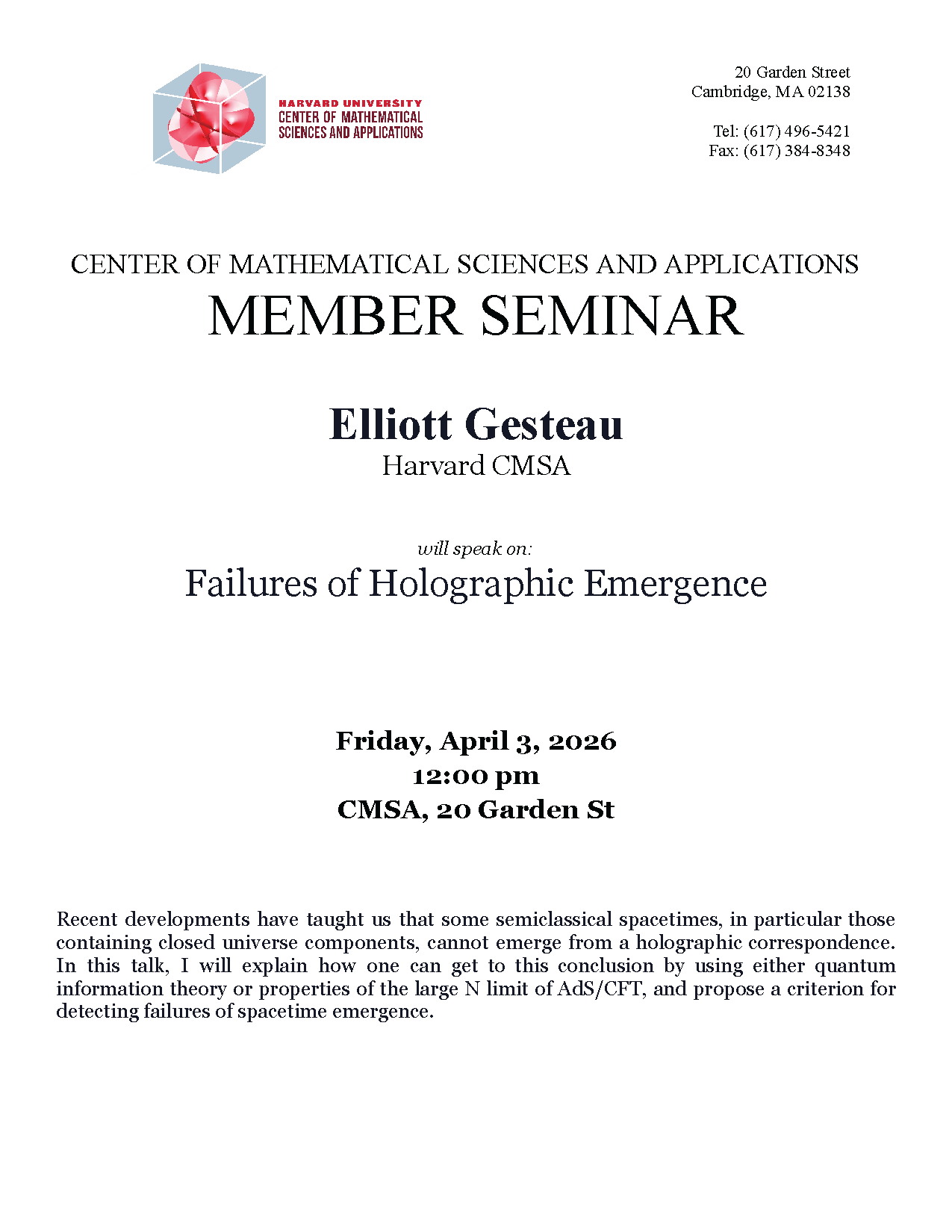
  • Failures of Holographic Emergence

    CMSA Room G10 CMSA, 20 Garden Street, Cambridge, MA, United States

    Member Seminar Speaker: Elliott Gesteau, CMSA Title: Failures of Holographic Emergence Abstract: Recent developments have taught us that some semiclassical spacetimes, in particular those containing closed universe components, cannot emerge from a holographic correspondence. In this talk, I will explain how one can get to this conclusion by using either quantum information theory or properties of the large N limit of […]

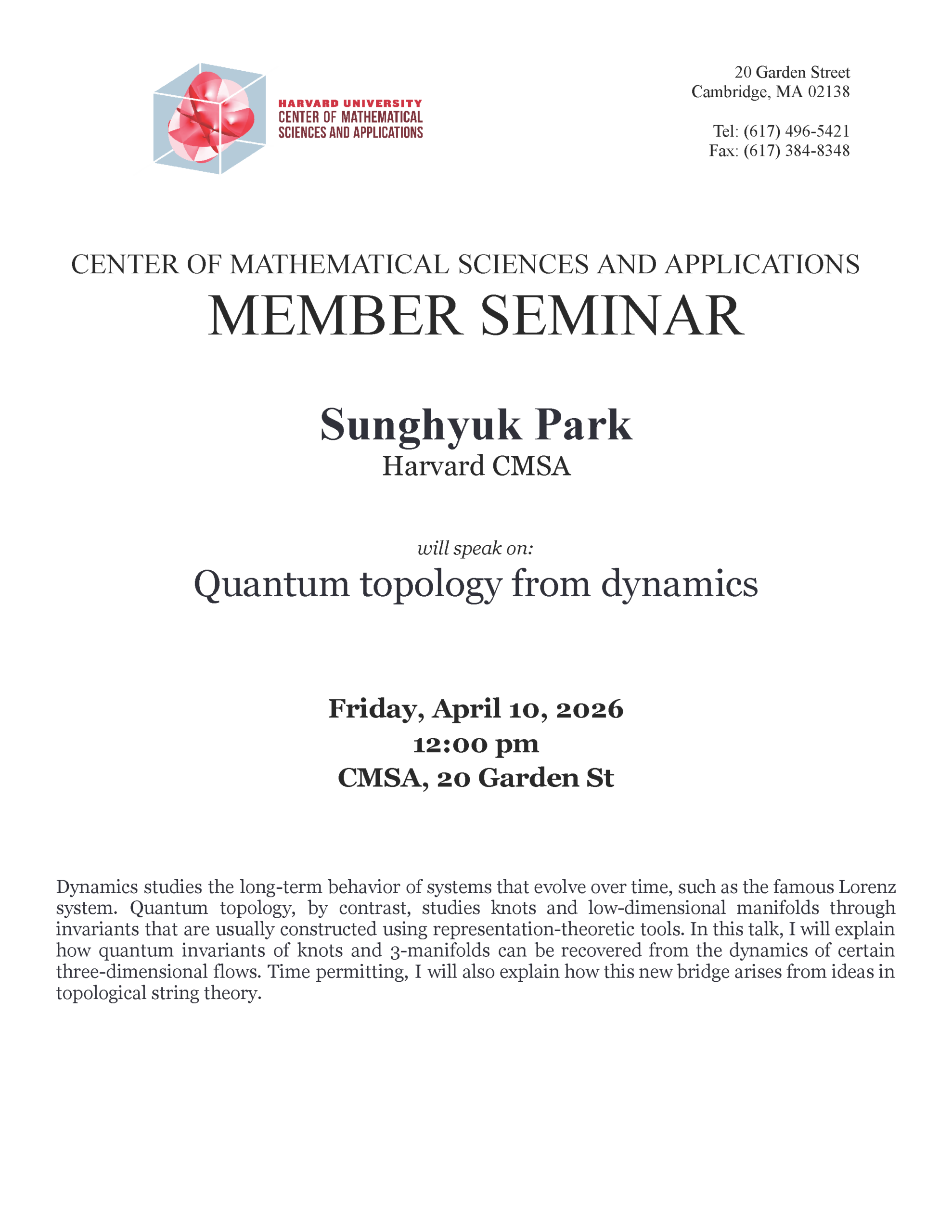
  • Quantum topology from dynamics

    CMSA Room G10 CMSA, 20 Garden Street, Cambridge, MA, United States

    Member Seminar Speaker: Sunghyuk Park, CMSA Title: Quantum topology from dynamics Abstract: Dynamics studies the long-term behavior of systems that evolve over time, such as the famous Lorenz system. Quantum topology, by contrast, studies knots and low-dimensional manifolds through invariants that are usually constructed using representation-theoretic tools. In this talk, I will explain how quantum invariants of […]

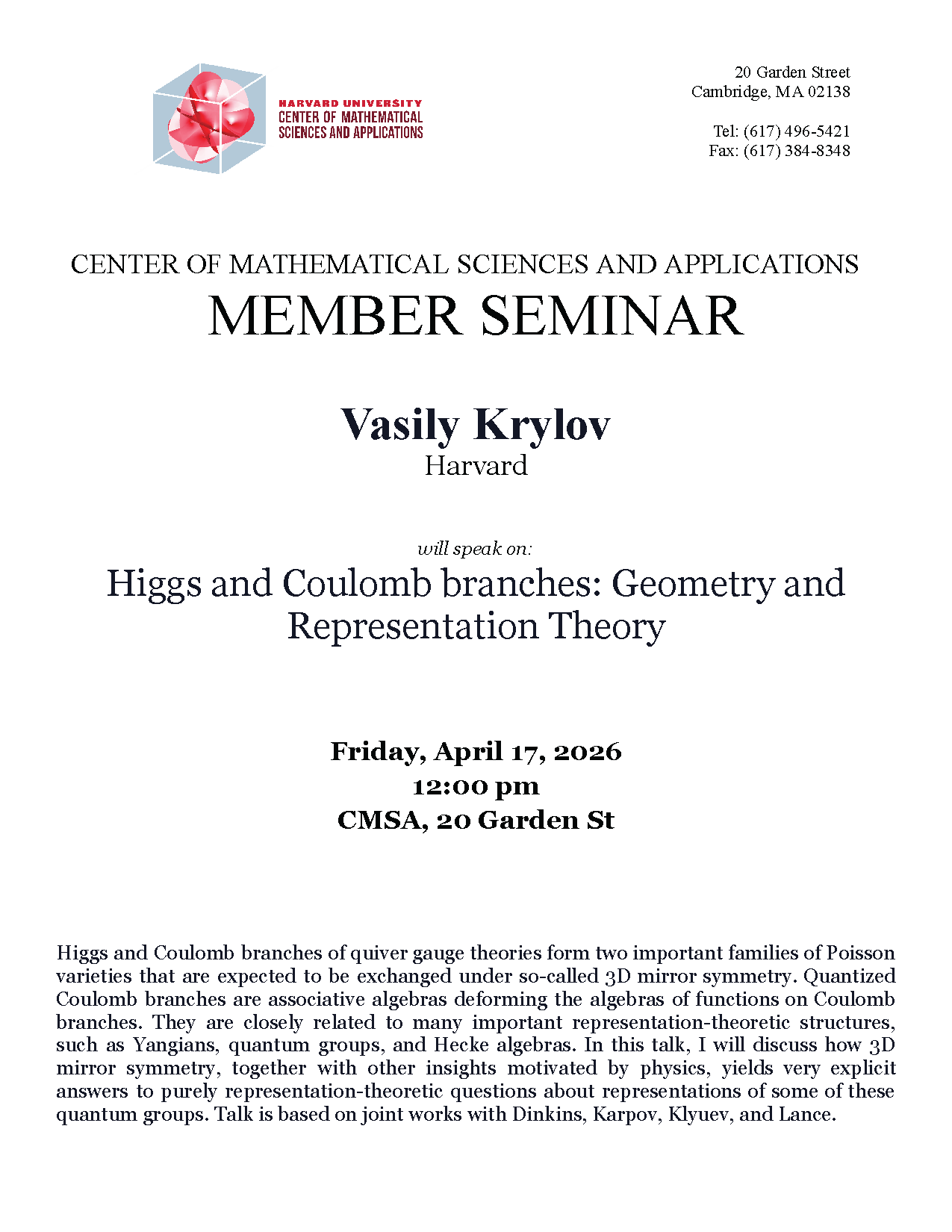
  • Higgs and Coulomb branches: Geometry and Representation Theory

    CMSA Room G10 CMSA, 20 Garden Street, Cambridge, MA, United States

    Member Seminar Speaker: Vasily Krylov Title: Higgs and Coulomb branches: Geometry and Representation Theory Abstract: Higgs and Coulomb branches of quiver gauge theories form two important families of Poisson varieties that are expected to be exchanged under so-called 3D mirror symmetry. Quantized Coulomb branches are associative algebras deforming the algebras of functions on Coulomb branches. They are […]

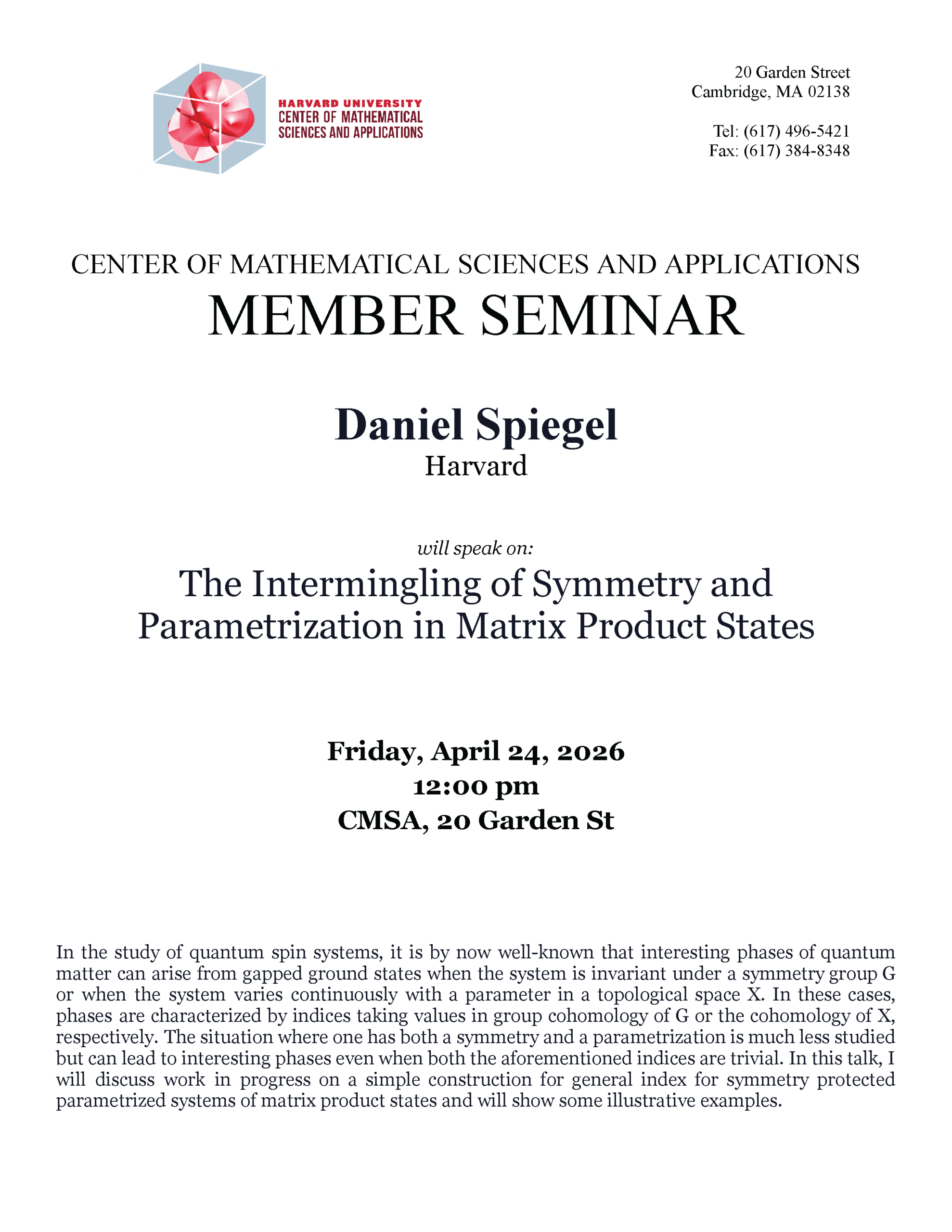
  • The Intermingling of Symmetry and Parametrization in Matrix Product States

    CMSA Room G10 CMSA, 20 Garden Street, Cambridge, MA, United States

    Member Seminar Speaker: Daniel Spiegel Title: The Intermingling of Symmetry and Parametrization in Matrix Product States Abstract: In the study of quantum spin systems, it is by now well-known that interesting phases of quantum matter can arise from gapped ground states when the system is invariant under a symmetry group G or when the system varies continuously […]