• Workshop on Morphometrics, Morphogenesis and Mathematics

    CMSA 20 Garden Street, Cambridge, MA, United States

    In Fall 2018, the CMSA will host a Program on Mathematical Biology, which aims to describe recent mathematical advances in using geometry and statistics in a biological context, while also considering a range of physical theories that can predict biological shape at scales ranging from macromolecular assemblies to whole organ systems. The plethora of natural shapes that surround […]
  • F-Theory Workshop

    CMSA 20 Garden Street, Cambridge, MA, United States

    The CMSA hosted an F-Theory workshop September 29-30, 2018. The workshop was held in room G10 of the CMSA, located at 20 Garden Street, Cambridge, MA. Youtube Playlist  Organizers: Paolo Aluffi (Florida State) Lara B. Anderson (Virginia Tech) Mboyo Esole (Northeastern) Shing-Tung Yau (Harvard) Speakers: Mirjam Cvetic, University of Pennsylvania Tommaso de Fernex, University of […]

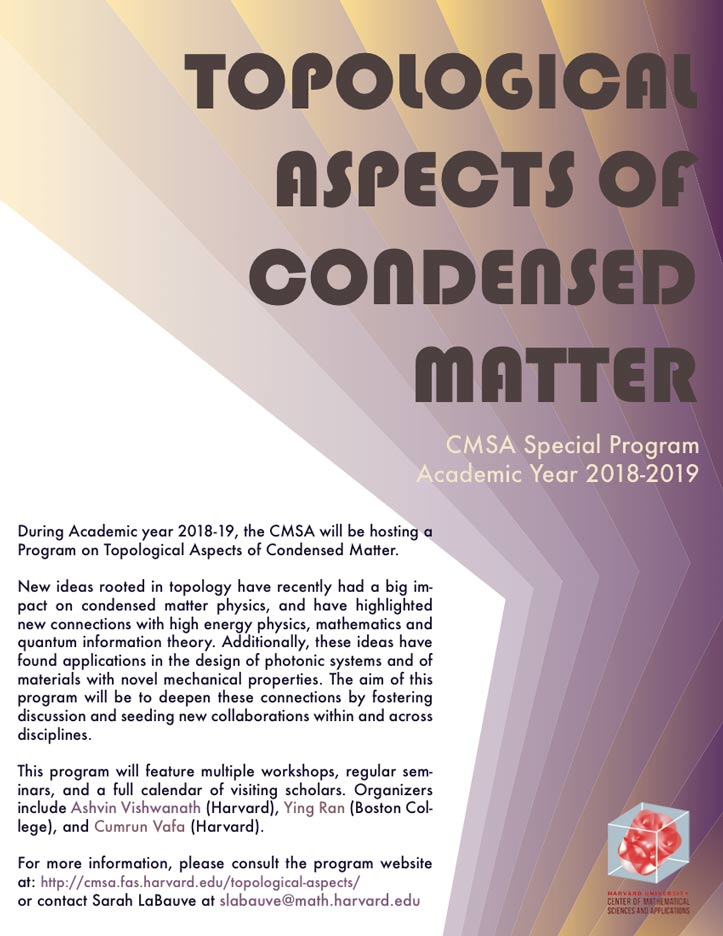
  • Kickoff Workshop on Topology and Quantum Phases of Matter

    CMSA 20 Garden Street, Cambridge, MA, United States

    On August 27-28, 2018, the CMSA will be hosting a Kickoff workshop on Topology and Quantum Phases of Matter. New ideas rooted in topology have recently had a big impact on condensed matter physics, and have highlighted new connections with high energy physics, mathematics and quantum information theory. Additionally, these ideas have found applications in the design of […]

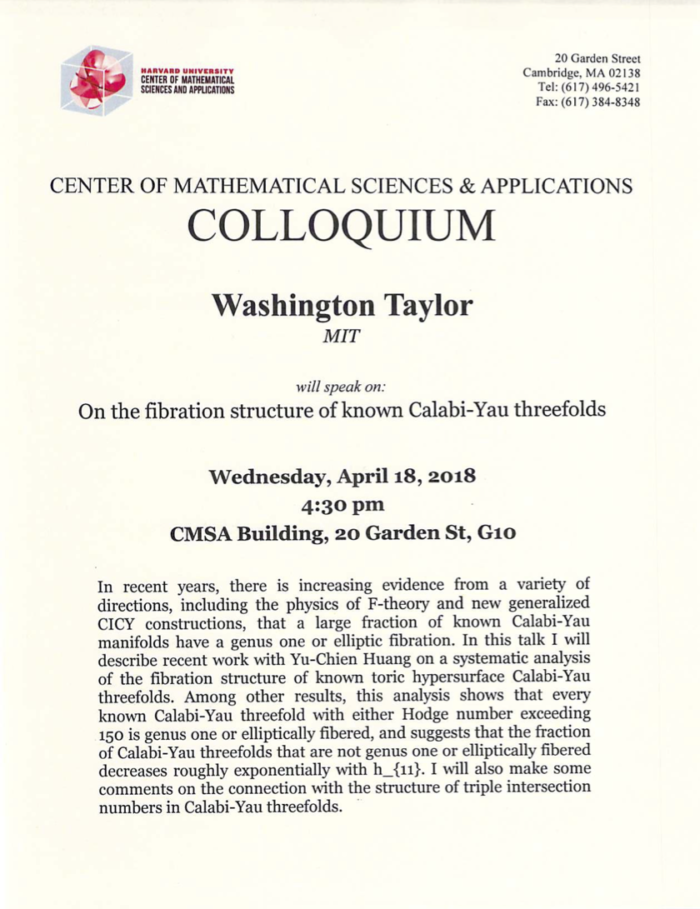
  • On the fibration structure of known Calabi-Yau threefolds

    CMSA 20 Garden Street, Cambridge, MA, United States

    Speaker: Washington Tayor (MIT) Title: On the fibration structure of known Calabi-Yau threefolds Abstract: In recent years, there is increasing evidence from a variety of directions, including the physics of F-theory and new generalized CICY constructions, that a large fraction of known Calabi-Yau manifolds have a genus one or elliptic fibration. In this talk I will describe […]

  • Graph Structure in Polynomial Systems: Chordal Networks

    CMSA 20 Garden Street, Cambridge, MA, United States

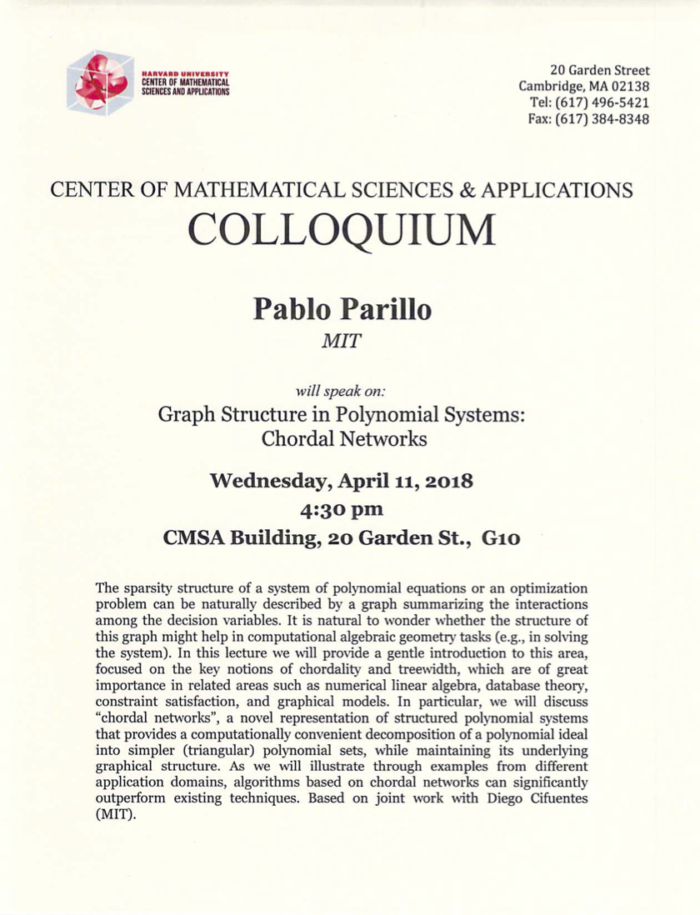
    Speaker: Pablo Parillo (MIT) Title: Graph Structure in Polynomial Systems: Chordal Networks Abstract: The sparsity structure of a system of polynomial equations or an optimization problem can be naturally described by a graph summarizing the interactions among the decision variables. It is natural to wonder whether the structure of this graph might help in computational algebraic geometry […]

  • Workshop on Coding and Information Theory

    CMSA 20 Garden Street, Cambridge, MA, United States

    The workshop on coding and information theory will take place April 9-13, 2018 at the Center of Mathematical Sciences and Applications, located at 20 Garden Street, Cambridge, MA. This workshop will focus on new developments in coding and information theory that sit at the intersection of combinatorics and complexity, and will bring together researchers from several communities — […]

  • Simons Collaboration Workshop, April 5-7, 2018

    CMSA 20 Garden Street, Cambridge, MA, United States

    The CMSA will be hosting a three-day Simons Collaboration Workshop on Homological Mirror Symmetry and Hodge Theory on April 5-7, 2018. The workshop will be held in room G10 of the CMSA, located at 20 Garden Street, Cambridge, MA. Please click here to register for this event.  We have space for up to 30 registrants on a first come, […]

  • Black Holes and Naked Singularities

    CMSA 20 Garden Street, Cambridge, MA, United States

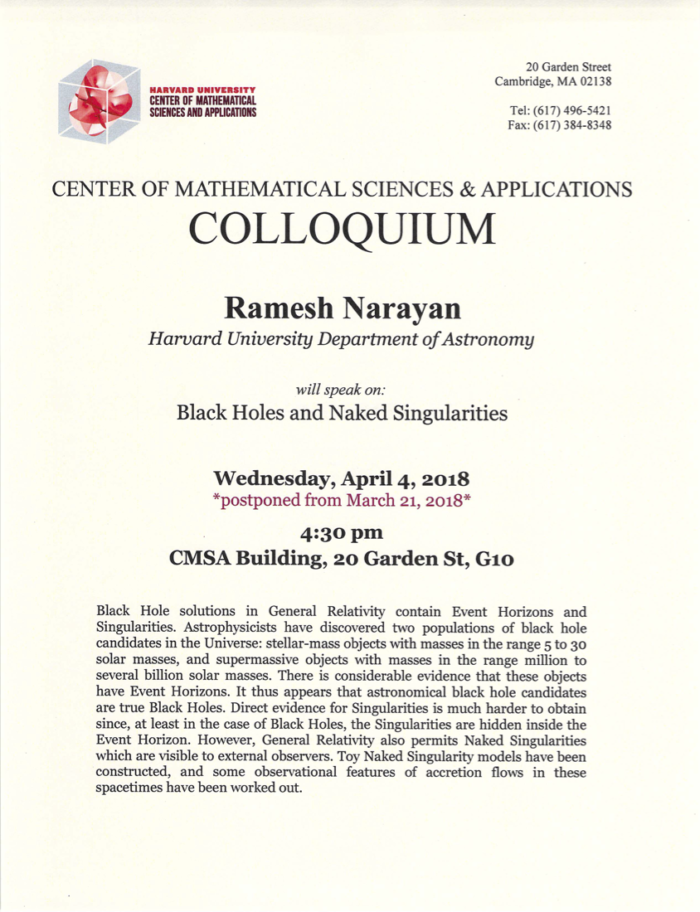
    Speaker: Ramesh Narayan, Department of Astronomy, Harvard University Title: Black Holes and Naked Singularities Abstract: Black Hole solutions in General Relativity contain Event Horizons and Singularities. Astrophysicists have discovered two populations of black hole candidates in the Universe: stellar-mass objects with masses in the range 5 to 30 solar masses, and supermassive objects with masses […]

  • A Mean Field View of the Landscape of Two-Layers Neural Networks

    CMSA 20 Garden Street, Cambridge, MA, United States

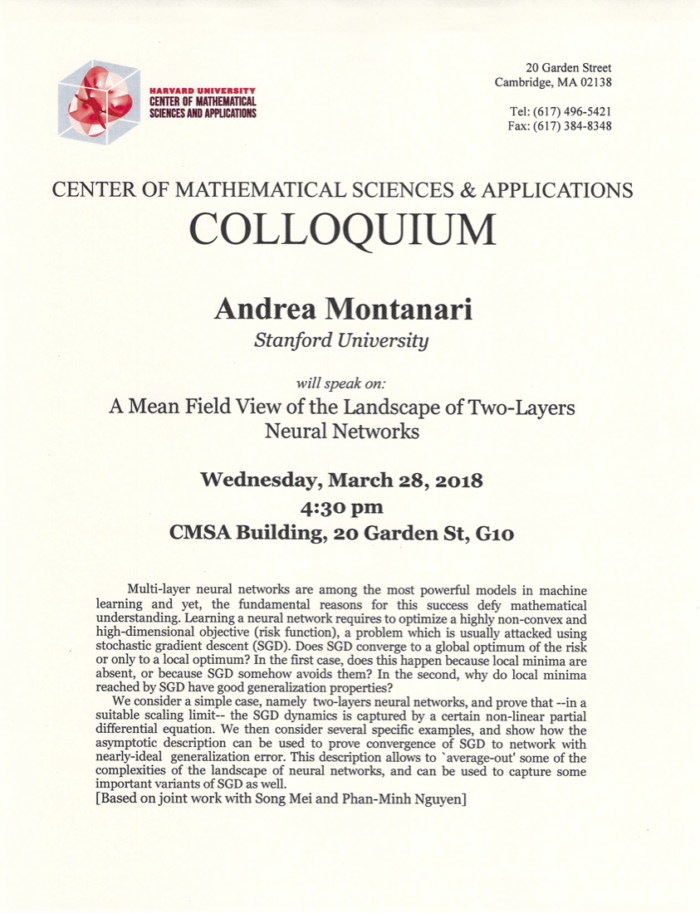
    Speaker: Andrea Montanari (Stanford) Title: A Mean Field View of the Landscape of Two-Layers Neural Networks Abstract: Multi-layer neural networks are among the most powerful models in machine learning and yet, the fundamental reasons for this success defy mathematical understanding. Learning a neural network requires to optimize a highly non-convex and high-dimensional objective (risk function), a problem which […]

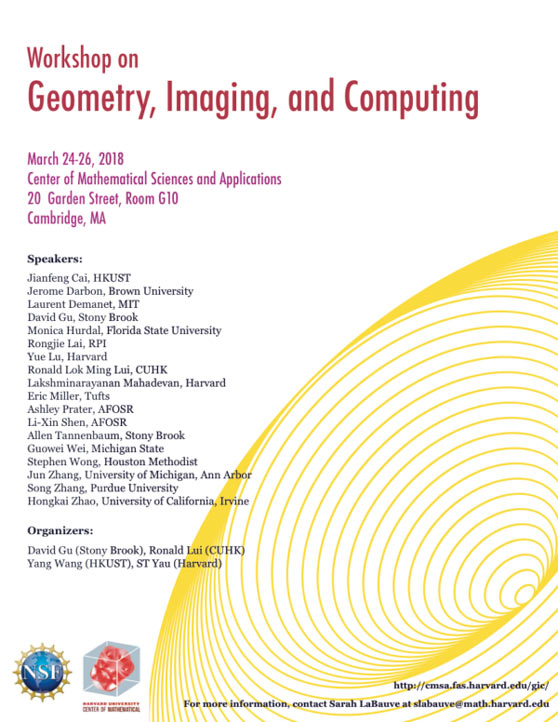
  • Workshop on Geometry, Imaging, and Computing

    CMSA 20 Garden Street, Cambridge, MA, United States

    On March 24-26, The Center of Mathematical Sciences and Applications will be hosting a workshop on Geometry, Imaging, and Computing, based off  the journal of the same name. The workshop will take place in CMSA building, G10. The organizing committee consists of Yang Wang (HKUST), Ronald Lui (CUHK), David Gu (Stony Brook), and Shing-Tung Yau (Harvard). Confirmed Speakers: Jianfeng Cai (HKUST) Shikui Chen (Stony Brook) Jerome Darbon (Brown University) Laurent Demanet (MIT) David […]

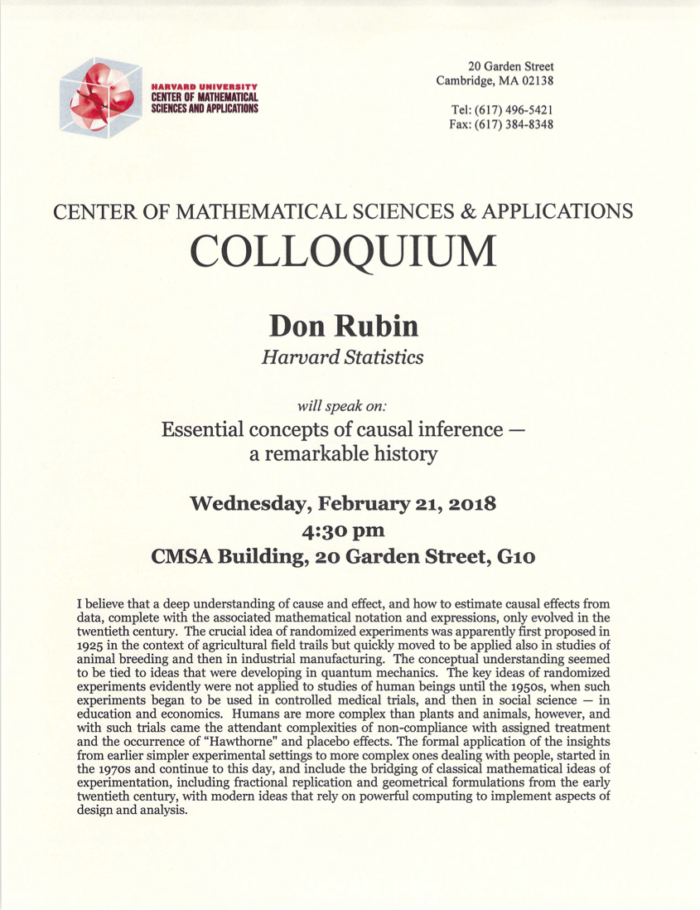
  • Essential concepts of Causal inference—a remarkable history

    CMSA 20 Garden Street, Cambridge, MA, United States

    Speaker: Don Rubin (Harvard Statistics) Title: Essential concepts of Causal inference—a remarkable history Abstract: I believe that a deep understanding of cause and effect, and how to estimate causal effects from data, complete with the associated mathematical notation and expressions, only evolved in the twentieth century.  The crucial idea of randomized experiments was apparently first proposed in 1925 in the context of […]

  • Workshop on Probabilistic and Extremal Combinatorics

    CMSA 20 Garden Street, Cambridge, MA, United States

    The workshop on Probabilistic and Extremal Combinatorics will take place February 5-9, 2018 at the Center of Mathematical Sciences and Applications, located at 20 Garden Street, Cambridge, MA. Extremal and Probabilistic Combinatorics are two of the most central branches of modern combinatorial theory. Extremal Combinatorics deals with problems of determining or estimating the maximum or minimum possible cardinality of a collection of […]