
1/28/2021 Quantum Matter Seminar
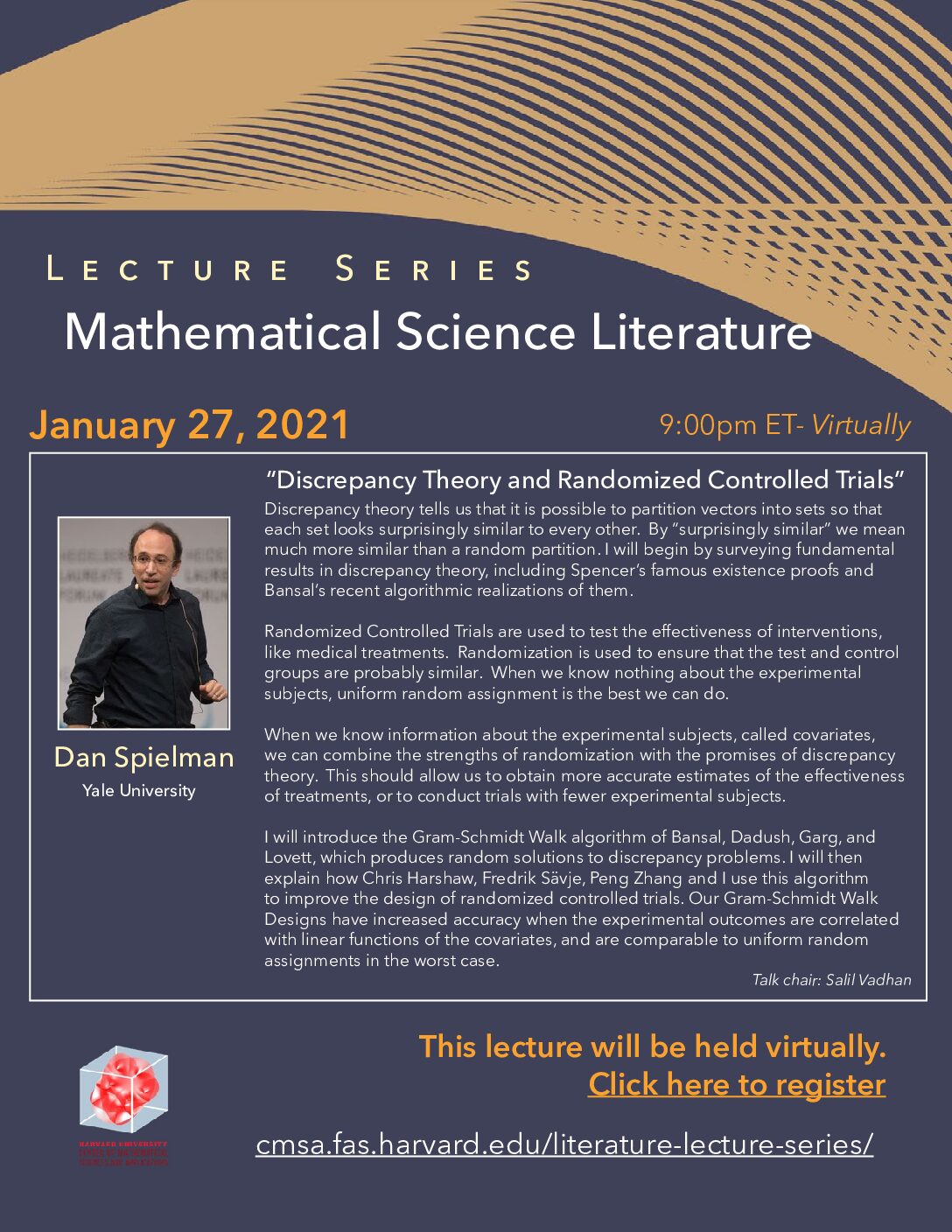
CMSA Math-Science Literature Lecture: Discrepancy Theory and Randomized Controlled Trials
Dan Spielman (Yale University) Title: Discrepancy Theory and Randomized Controlled Trials Abstract: Discrepancy theory tells us that it is possible to partition vectors into sets so that each set looks surprisingly similar to every other. By “surprisingly similar” we mean much more similar than a random partition. I will begin by surveying fundamental results in […]
Gromov-Witten/Donaldson Thomas theory and Birational/Symplectic invariants for algebraic surfaces
During the Spring 2021 Semester Artan Sheshmani (CMSA/ I.M. A.U.) will be teaching a CMSA special lecture series on Gromov-Witten/Donaldson Thomas theory and Birational/Symplectic invariants for algebraic surfaces. In order to attend this series, please fill out this form. The lectures will be held Mondays from 8:00 – 9:30 AM ET and Wednesdays from 8:00 – 9:00 AM ET beginning January 25 on […]
Language Modeling for Mathematical Reasoning
Speaker: Christian Szegedy Title: Language Modeling for Mathematical Reasoning Abstract: In this talk, I will summarize the current state of the art of transformer based language models and give examples on non-trivial reasoning task language models can solve in higher order logic reasoning. I will also discuss how to inject injective bias into transformer networks via pretraining on […]
AI and Theorem Proving
https://youtu.be/UnYrWuOzOlc Speaker: Josef Urban, Czech Technical University Title: AI and Theorem Proving Abstract: The talk will discuss the main approaches that combine machine learning with automated theorem proving and automated formalization. This includes learning to choose relevant facts for “hammer” systems, guiding the proof search of tableaux and superposition automated provers by interleaving learning and […]
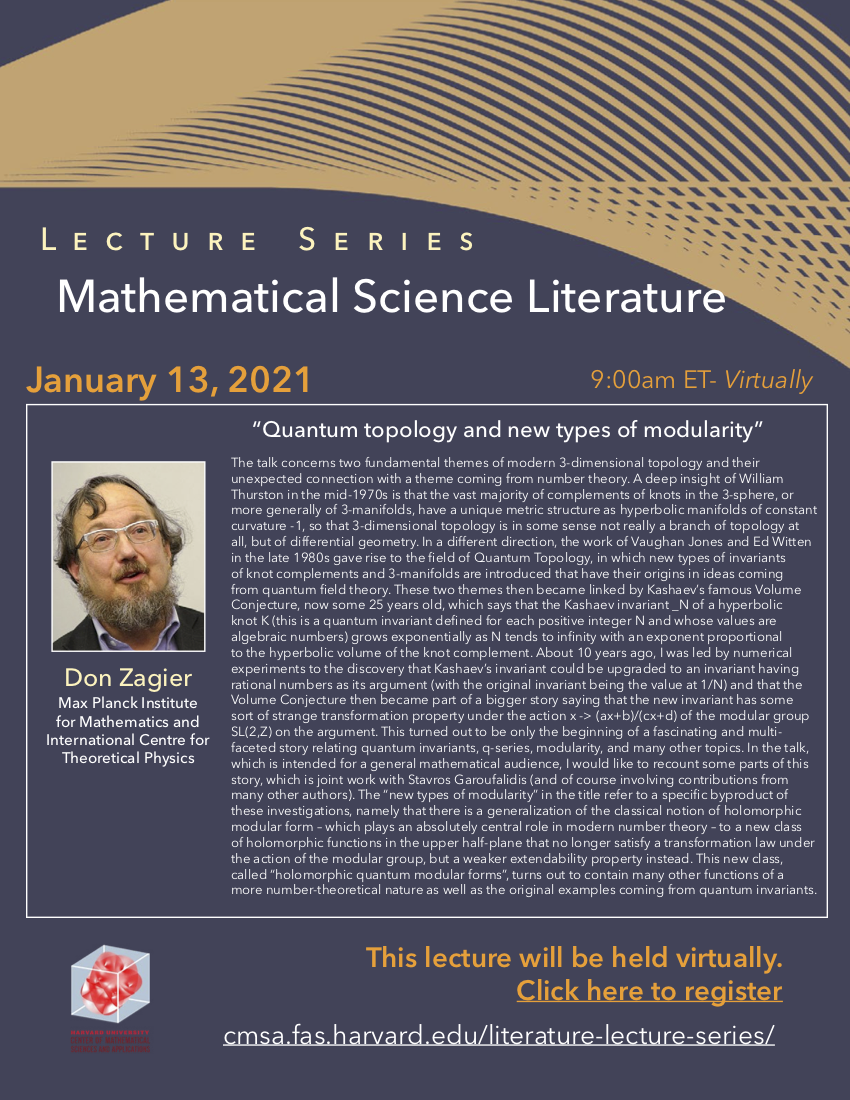
CMSA Math-Science Literature Lecture: Quantum topology and new types of modularity
Don Zagier (Max Planck Institute for Mathematics and International Centre for Theoretical Physics) Title: Quantum topology and new types of modularity Abstract: The talk concerns two fundamental themes of modern 3-dimensional topology and their unexpected connection with a theme coming from number theory. A deep insight of William Thurston in the mid-1970s is that the […]

A universal triangulation for flat tori
Speaker:Francis Lazarus, CNRS / Grenoble University Title: A universal triangulation for flat tori Abstract: A celebrated theorem of Nash completed by Kuiper implies that every smooth Riemannian surface has a C¹ isometric embedding in the Euclidean 3-space E³. An analogous result, due to Burago and Zalgaller, states that every polyhedral surface, obtained by gluing Euclidean […]
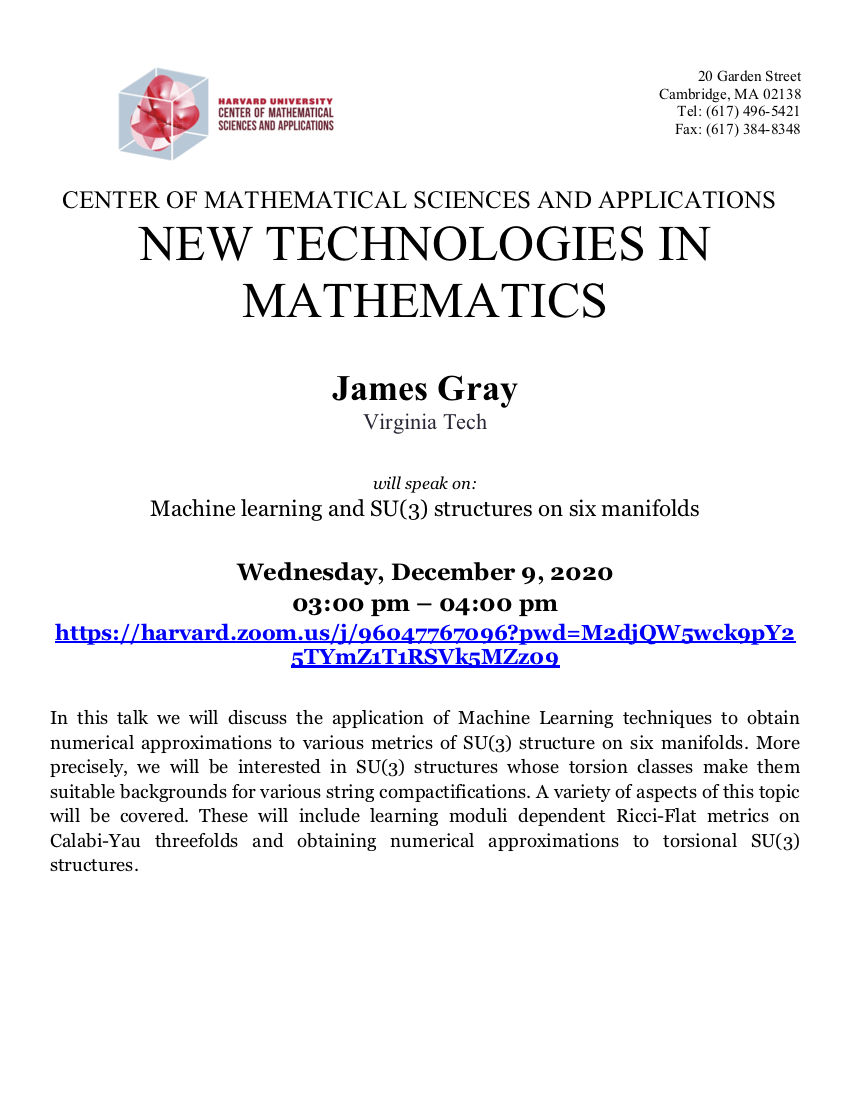
Machine learning and su(3) structures on six manifolds
Speaker: James Gray - Virginia Tech Title: Machine learning and su(3) structures on six manifolds Abstract: In this talk we will discuss the application of Machine Learning techniques to obtain numerical approximations to various metrics of SU(3) structure on six manifolds. More precisely, we will be interested in SU(3) structures whose torsion classes make them suitable […]
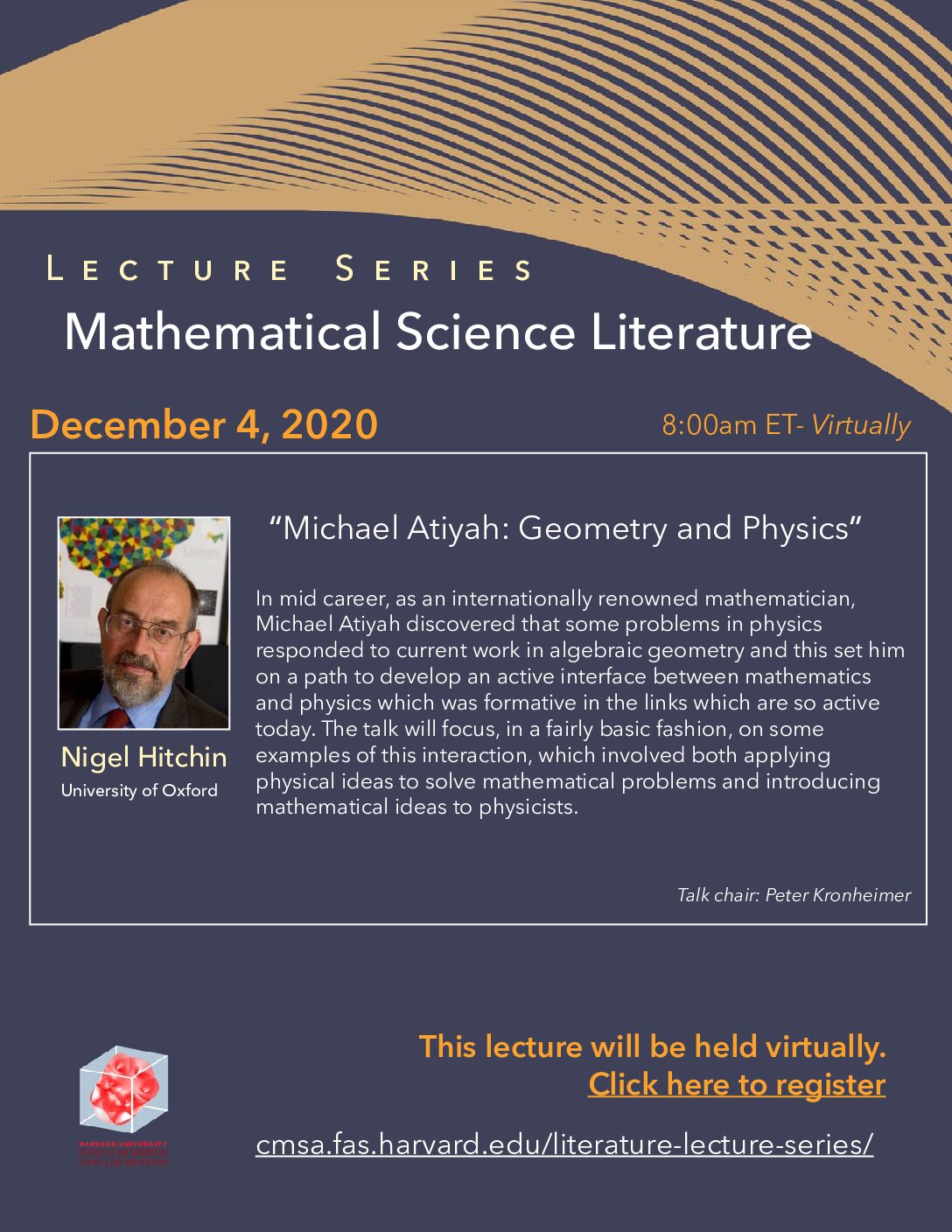
CMSA Math-Science Literature Lecture: Michael Atiyah: Geometry and Physics
Nigel Hitchin (University of Oxford) Title: Michael Atiyah: Geometry and Physics Abstract: In mid-career, as an internationally renowned mathematician, Michael Atiyah discovered that some problems in physics responded to current work in algebraic geometry and this set him on a path to develop an active interface between mathematics and physics which was formative in the links […]
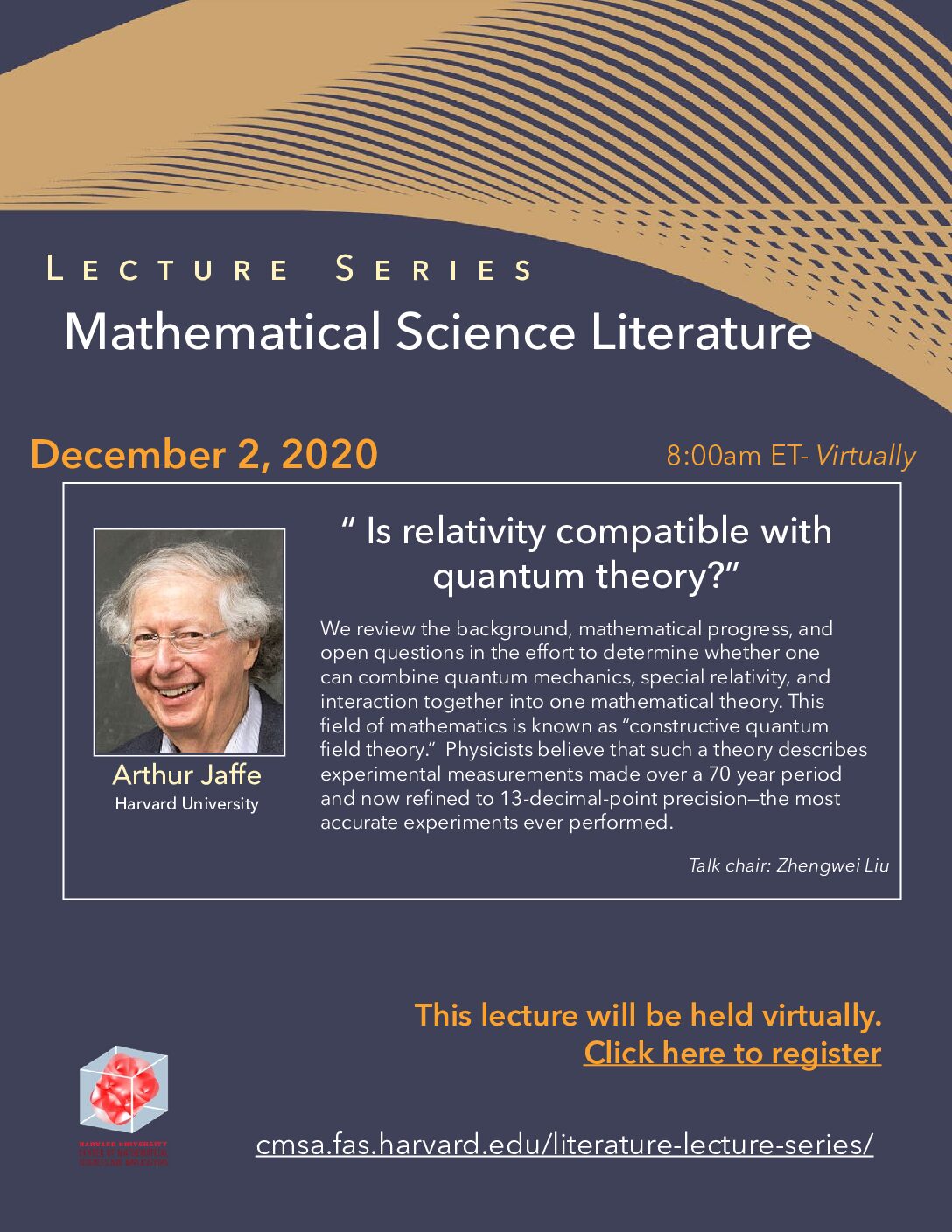
CMSA Math-Science Literature Lecture: Is relativity compatible with quantum theory?
Arthur Jaffe (Harvard University) Title: Is relativity compatible with quantum theory? Abstract: We review the background, mathematical progress, and open questions in the effort to determine whether one can combine quantum mechanics, special relativity, and interaction together into one mathematical theory. This field of mathematics is known as “constructive quantum field theory.” Physicists believe that such […]