• Memorial Conference for the founders of index theory: Atiyah, Bott, Hirzebruch, and Singer

    Virtual

    In 2021, the CMSA hosted a lecture series on the literature of the mathematical sciences. This series highlights significant accomplishments in the intersection between mathematics and the sciences. Speakers include Edward Witten, Lydia Bieri, Simon Donaldson, Michael Freedman, Dan Freed, and many more. Videos of these talks can be found in this Youtube playlist. https://youtu.be/vb_JEhUW9t4 […]

  • CMSA Math-Science Literature Lecture: Isadore Singer’s Work on Analytic Torsion

    Virtual

    Edward Witten (IAS) Title: Isadore Singer’s Work on Analytic Torsion Abstract:  I will review two famous papers of Ray and Singer on analytic torsion written approximately half a century ago. Then I will sketch the influence of analytic torsion in a variety of areas of physics including anomalies, topological field theory, and string theory. This talk is […]

  • CMSA Math-Science Literature Lecture: On the History of quantum cohomology and homological mirror symmetry

    Virtual

    Maxim Kontsevich  (IHÉS) Title: On the History of quantum cohomology and homological mirror symmetry Abstract: About 30 years ago, string theorists made remarkable discoveries of hidden structures in algebraic geometry.  First, the usual cup-product on the cohomology of a complex projective variety admits a canonical multi-parameter deformation to so-called quantum product, satisfying a nice system of differential […]

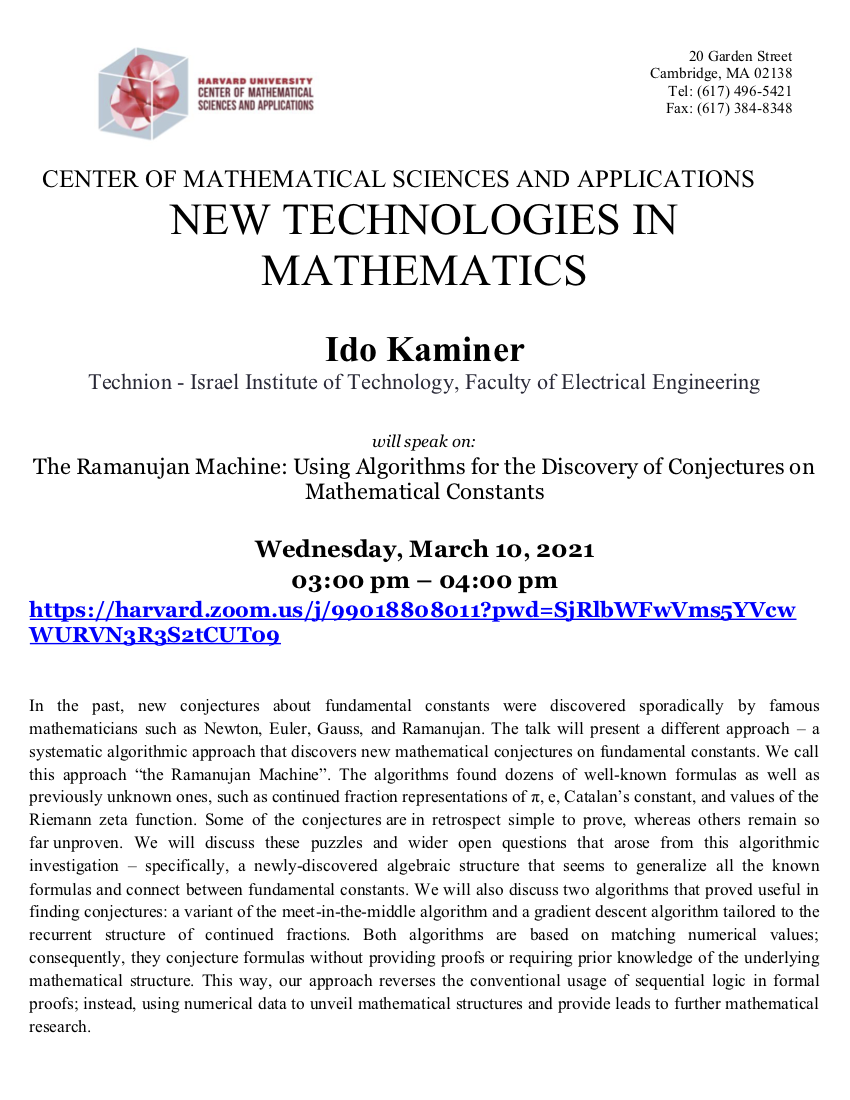
  • The Ramanujan Machine: Using Algorithms for the Discovery of Conjectures on Mathematical Constants

    Virtual

    https://youtu.be/h0FW7l7z-C4 Speaker: Ido Kaminer, Technion – Israel Institute of Technology, Faculty of Electrical Engineering Title: The Ramanujan Machine: Using Algorithms for the Discovery of Conjectures on Mathematical Constants Abstract: In the past, new conjectures about fundamental constants were discovered sporadically by famous mathematicians such as Newton, Euler, Gauss, and Ramanujan. The talk will present a […]

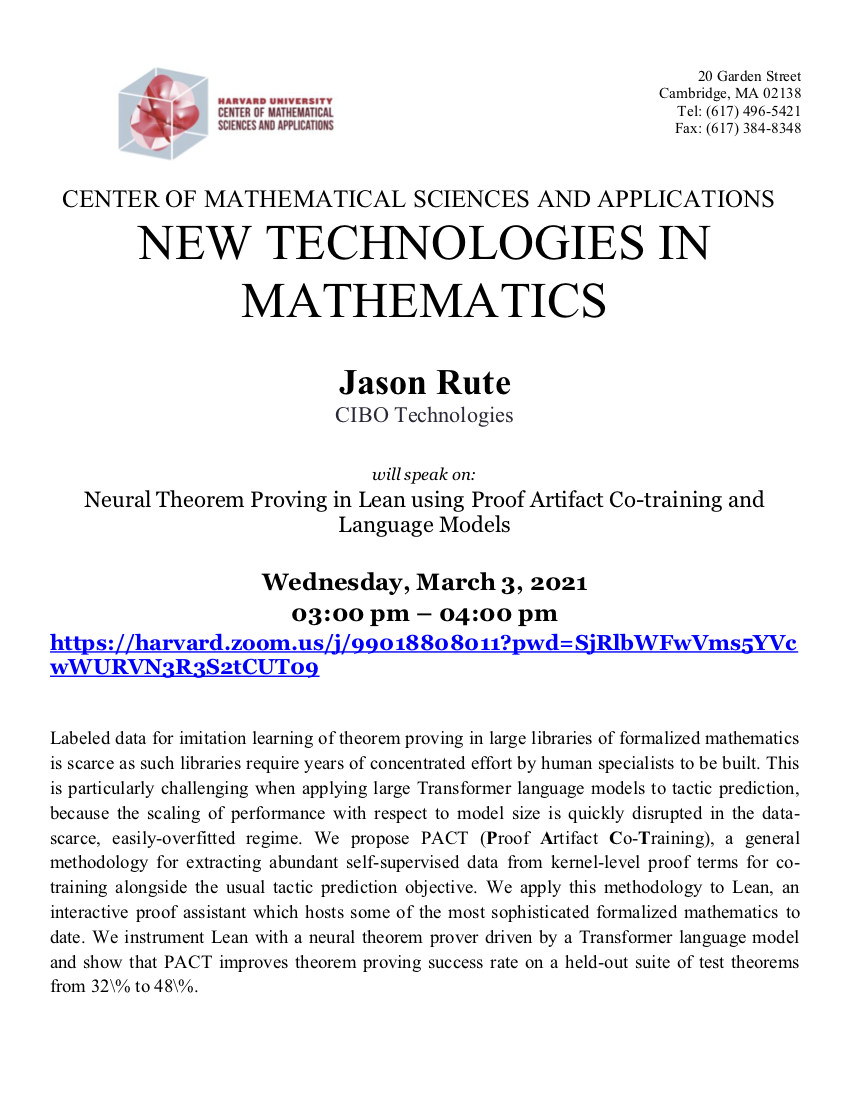
  • Neural Theorem Proving in Lean using Proof Artifact Co-training and Language Models

    Virtual

    https://youtu.be/EXpmbAfBNnw Speaker: Jason Rute, CIBO Technologies Title: Neural Theorem Proving in Lean using Proof Artifact Co-training and Language Models Abstract: Labeled data for imitation learning of theorem proving in large libraries of formalized mathematics is scarce as such libraries require years of concentrated effort by human specialists to be built. This is particularly challenging when applying […]

  • CMSA Math-Science Literature Lecture: Homological (homotopical) algebra and moduli spaces in Topological Field theories

    Virtual

    Kenji Fukaya (Simons Center for Geometry and Physics) Title: Homological (homotopical) algebra and moduli spaces in Topological Field theories Abstract: Moduli spaces of various gauge theory equations and of various versions of (pseudo) holomorphic curve equations have played important role in geometry in these 40 years. Started with Floer’s work people start to obtain more […]

  • 2/18/2021 Quantum Matter Seminar

    Virtual

    Speaker:  Xiao-Gang Wen (MIT) Title: A solution to the chiral fermion problem Abstract: Motivated by the relation between anomaly and topological/SPT order in one higher dimension, we propose a solution to the chiral fermion problem. In particular, we find several sufficient conditions, such that a chiral fermion field theory can be regularized by an interacting […]

  • Global Anomalies on the Hilbert Space

    Virtual

    Speaker:  Jaume Gomis (Perimeter PI) Title: Global Anomalies on the Hilbert Space Abstract: We will discuss an elementary way of detecting some global anomalies from the way the symmetry algebra is realized on the torus Hilbert space of the anomalous theory, give a physical description of the imprint of the “layers” that enter in the […]

  • 2/16/2021 Computer Science for Mathematicians

    Virtual

    Speaker: Michael P. Kim (UC Berkeley) Title: Outcome Indistinguishability Abstract: Prediction algorithms assign numbers to individuals that are popularly understood as individual “probabilities” — e.g., what is the probability of 5-year survival after cancer diagnosis? — and which increasingly form the basis for life-altering decisions. The understanding of individual probabilities in the context of such unrepeatable events […]