
- This event has passed.
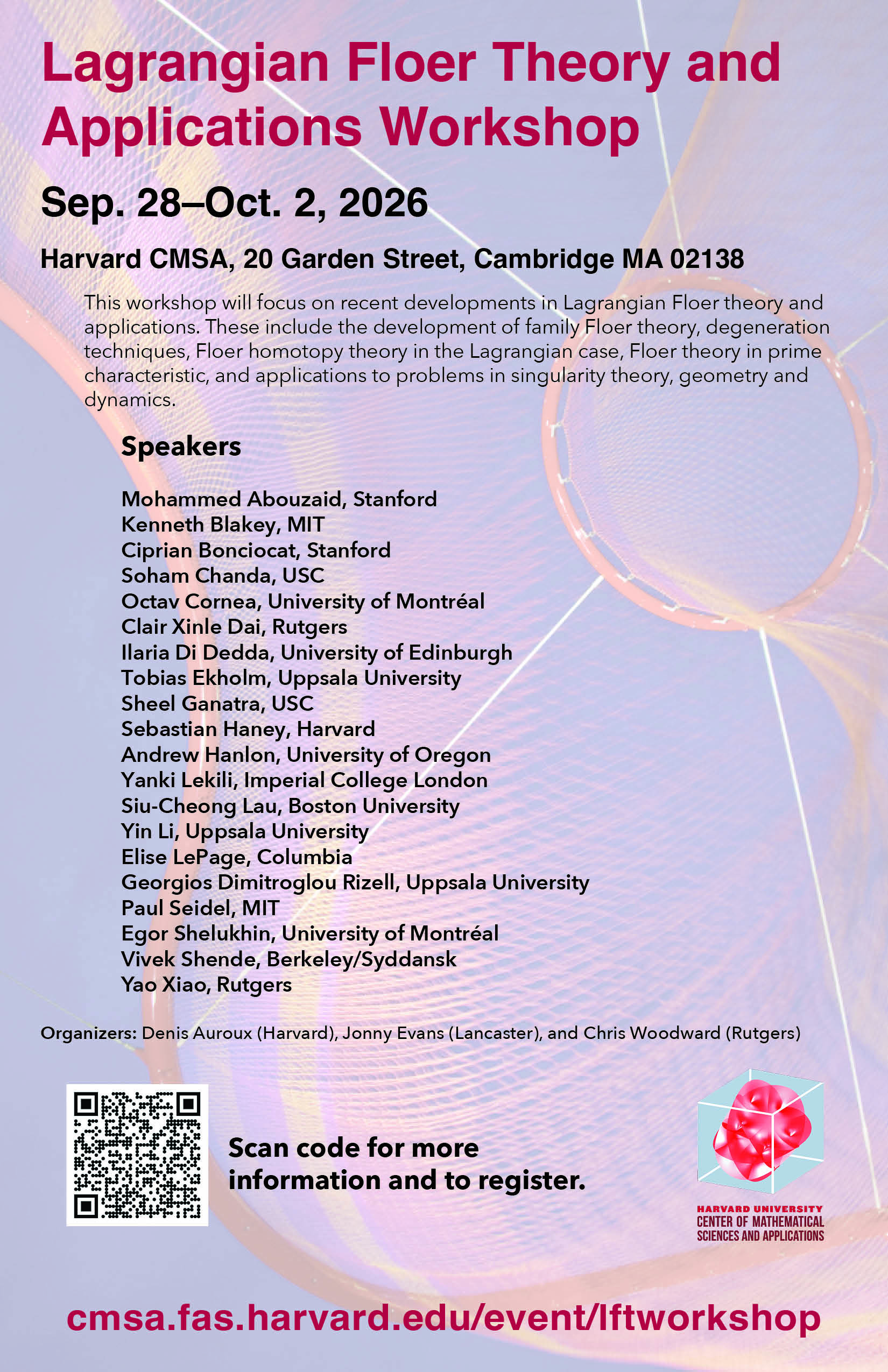
Workshop on Lagrangian Floer Theory and Applications
Workshop on Lagrangian Floer Theory and Applications
Dates: September 28 – October 2, 2026
Location: CMSA G10, 20 Garden St., Cambridge MA 02138
This workshop is part of the Lagrangian Floer Theory and Applications Program
Speakers will include:
- Mohammed Abouzaid, Stanford University
- Kenneth Blakey, MIT
- Ciprian Bonciocat, Stanford
- Soham Chanda, USC
- Octav Cornea, University of Montréal
- Clair Xinle Dai, Rutgers
- Ilaria Di Dedda, University of Edinburgh
- Tobias Ekholm, Uppsala University
- Sheel Ganatra, USC
- Sebastian Haney, Harvard
- Andrew Hanlon, University of Oregon
- Siu-Cheong Lau, Boston University
- Yanki Lekili, Imperial College London
- Elise LePage, Columbia
- Yin Li, Uppsala University
- Georgios Dimitroglou Rizell, Uppsala University
- Paul Seidel, MIT
- Egor Shelukhin, University of Montréal
- Vivek Shende, Berkeley/Syddansk
- Yao Xiao, Rutgers
Organizers: Denis Auroux (Harvard), Jonny Evans (Lancaster), and Chris Woodward (Rutgers)
Schedule
Monday 9/28/26
9:00 – 9:30 am
Breakfast
9:30 – 10:30 am
Tobias Elkholm, Uppsala University
Symplectic Field theory and skein valued curve counts.
Abstract: We show that the degree zero bare Symplectic Field Theory (SFT) of the unit cotangent bundle of an oriented closed 3-manifold is isomorphic to its skein module. We apply this result to curve counting. We also consider the corresponding relative SFT result when we include conormals of knots. This involves defining the skein module of two 3-manifolds intersecting cleanly along a knot. The talk reports on joint work with Shende and Scharitzer, and Ng.
10:30 – 11:00 am
Break
11:00 am – 12:00 pm
Sebastian Haney, Harvard
On intrinsic homological mirror symmetry for toric degenerations
Abstract: This talk reports on a joint project with Shaoyun Bai in which we implement a proposal due to Siebert for proving homological mirror symmetry for smooth projective Calabi–Yau manifolds in some special cases. I will outline a general strategy for proving a version of homological mirror symmetry between a smooth fiber of a maximally unipotent degeneration of smooth projective Calabi–Yau manifolds, on the A-side, and a mirror family that is conjecturally the Gross–Siebert intrinsic mirror family on the B-side. Our techniques work under some geometric hypotheses which we can verify for general fibers of toric degenerations of a certain type. The class of toric degenerations to which our methods currently apply include all Batyrev-Borisov degenerations, as well as certain toric degenerations or relative dimension three described via the Gross–Siebert reconstruction algorithm. The Floer-theoretic computations required for our proof are based on semistable reduction theorems in algebraic geometry, as well as the theory of regularizations of symplectic crossings divisors developed by Farajzadeh-Tehrani–McLean–Zinger, in a manner inspired by Seidel’s proof of HMS for the quartic K3 surface. During the talk, I will also discuss prospects for extending our methods beyond the case of toric degenerations, especially for Calabi–Yau threefolds
12:00 – 1:30 pm
Lunch
1:30 – 2:30 pm
Ilaria di Dedda, University of Edinburgh
Semiorthogonal decompositions in mirror symmetry
Abstract: I will explain a variation of Clarke duality, and describe a homological mirror symmetry framework which is based on work of Abouzaid–Auroux–Katzarkov. The framework I will outline describes pairs of toric Landau–Ginzburg (LG) models which are conjecturally equivalent under HMS. We use this machinery to refine the HMS conjecture for toric LG models by describing natural semiorthogonal decompositions on both sides, in a way that generalises the work of Ballard–Diemer–Favero–Katzarkov–Kerr. This generalisation allows us to define and study Fukaya—Seidel categories mirror to Kuznetsov components of Fano varieties. In order to rigorously describe the semiorthogonal decompositions on the A-side at the level of generality we propose, more foundational work on these Fukaya–Seidel-type categories is required. I will give a precise description of the necessary structural features of these categories. This is joint work in progress with Giulia Gugiatti, Danil Koževnikov and Nick Sheridan.
2:30 – 3:00 pm
Break
3:00 – 4:00 pm
Dan Pomerleano, UMass Boston
Exotic affine spaces and Floer theory
Abstract: “Exotic affine spaces” are affine varieties diffeomorphic but not algebraically isomorphic to C^n. We will discuss the Floer theoretic approach to identifying such spaces. New results come from discussions with Denis Auroux and Shaoyun Bai.
Tuesday 9/29/26
8:45 – 9:15 am
Breakfast
9:15 – 10:15 am
Johan Asplund, Stony Brook
Unit conormals of simple knots
Abstract: A simple n-knot is a codimension two embedding of a homotopy n-sphere in R^{n+2} whose complement have homotopy groups that agree with those of S^1 in degrees less than or equal to (n-1)/2. In this talk I will explain how the unit conormal of an odd-dimensional simple n-knot (for n odd and at least 3) is a complete invariant (up to mirroring). This talk is based on joint work with Yash Deshmukh.
10:15 – 11:15 am
Kenneth Blakey, MIT
Grothendieck-Riemann-Roch and Floer homotopy
Abstract: Given a graded Liouville manifold, Floer homotopy lifts its integral symplectic cohomology to a module over complex bordism referred to as “Floer complex bordism”. I will explain the relationship between the rationalization of Floer complex bordism and bulk-deformed symplectic cohomology. As a consequence of this relationship, there is an explicit cohomological obstruction for when Floer complex bordism further lifts to the sphere spectrum, and one can straightforwardly compute its non-triviality for e.g. cotangent bundles of certain complex projective spaces. Time permitting, I’ll mention implications of this non-triviality for: Floer homotopy theory more broadly, spectral Gromov-Witten theory, and spectral mirror symmetry. Various parts based on joint work with Noah Porcelli.
11:15 – 11:30 am
Break
11:30 am – 12:30 pm
Soham Chanda, USC
Bohr-Sommerfeld surgery on Lagrangians
Abstract: We introduce a surgery operation on Lagrangian submanifolds that switches between two different fillings of Bohr-Sommerfeld Legendrians. We will discuss the effect of such a surgery operation on the disk potential in the setting of monotone Lagrangians. As an application, we will prove that such surgery operations yield exotic monotone Lagrangian tori in projective spaces of dimension 3 and higher.
12:30 – 1:30 pm
Lunch
1:30 – 2:30 pm
Elise Le Page, Columbia
Categorified quantum group representations from Fukaya-Seidel categories of Zastava spaces Abstract: I will explain how 2-representations of categorified quantum groups arise from Fukaya-Seidel categories of Zastava spaces. This construction realizes categorifications of irreducible representations, Verma modules, and arbitrary tensor products of these representations. A key feature is a differential relating categorified Verma modules to categorified irreducible representations. I will show how this differential arises geometrically from a partial compactification that fills in a previously removed divisor.
2:30 – 3:00 pm
Break
3:00 – 4:00 pm
Paul Seidel, MIT
TQFT aspects of deformed symplectic cohomology
Abstract: Deformed symplectic cohomology is a version of quantum cohomology relative to a (smooth, in this case) ample divisor. I will discuss the formal aspect of operations in the theory, with emphasis on the equivariant situation.
Wednesday 9/30/26
8:45 – 9:30 am
Breakfast
9:30 – 10:30 am
Sheel Ganatra, USC
Arclike Lagrangians in Liouville sectors
Abstract: Sectorial descent, established in earlier joint work of the speaker with Pardon-Shende, gives a local-to-global formula computing the wrapped Fukaya category of a Weinstein manifold from a sectorial cover. If one has a specific fixed global Lagrangian in mind that isn’t contained in a single subsector, the resulting formula is only implicit, as it begins by appealing to the generation of this object by “local” Lagrangians. In this talk I will introduce and study the class of (global) “arclike” Lagrangian submanifolds with respect to a sectorial covering, which are allowed to run through subsector boundaries but in a controlled fashion. For arclike Lagrangians, a more explicit local-to-global analysis is possible. Based on work with Hanlon-Hicks-Pomerleano-Sheridan and work-in-progress with Hanlon-Hicks-Sheridan-Ward.
10:30 – 10:45 am
break
10:45 – 11:45 am
Andrew Hanlon, University of Oregon
Topological toric mirror monodromies
Abstract: Mirror symmetry predicts an action by the fundamental group of a stringy Kahler moduli space on the derived category of an algebraic variety. For a toric variety, a model for this space is understood, but constructing the action is a still an open problem in general. In dimension two, this action can be studied via a moduli space of Legendrians isotopic to the Fang-Liu-Treumann-Zaslow stop. The two-dimensional case of the conjecture was first exhibited by Seidel-Thomas and has been thoroughly studied, but we hope our topological approach can be generalized. This talk is based on joint work with Michela Barbieri and Jeff Hicks.
11:45 am – 12:00 pm
break
12:00 – 1:00 pm
Denis Auroux, Harvard
CMSA Q&A Seminar
This talk is not part of the workshop, but an explanation for the broader CMSA community of the workshop topic.
1:00 –1:45 pm
Lunch
1:45 – 2:45 pm
Yin Li, Uppsala University
Lagrangian capacity and rigidity of extremal Lagrangians
Abstract: We use quantitative modifications of Fukaya and Irie’s techniques of chain level string topology to study the computational questions of Lagrangian capacities and rigidity questions of extremal Lagrangian tori. In particular, we prove that the Lagrangian capacities of convex and concave tori domains are equal to their diagonals and any extremal Lagrangian torus in a convex toric domain must be contained in the boundary. These results prove (general versions) of two conjectures of Cieliebak-Mohnke, without assuming the existence of a virtual perturbation scheme for asymptotically cylindrical holomorphic curves with local tangency constraints. This is joint work with Shah Faisal.
2:45 – 3:00 pm
Break
3:00 – 4:00 pm
Octav Cornea, University of Montréal
Complexity of Lagrangians
Abstract: I will discuss a notion of complexity for Lagrangian submanifolds inspired by
classical notions in topology, such as the Lusternik-Schnirelmann category, and in homological
algebra, such as in work of Dimitrov-Haiden-Katzarkov-Kontsevich. This complexity turns
out to be intimately related to precompactness of subsets of spaces of Lagrangians relative
to the spectral metric.
Thursday 10/1/26
8:45 – 9:15 am
Breakfast
9:15 – 10:15 am
Yanki Lekili, Imperial College London
Kodaira fibers and wrapped Fukaya categories
Abstract: Kodaira’s classification describes the singular fibers of complex elliptic fibrations. What symplectic invariants are attached to these configurations of curves? A nonvanishing holomorphic two-form makes each fiber Lagrangian for its real part. I will explain how to construct and describe a Weinstein neighborhood by Legendrian surgery such that the cocores arise by completing transverse holomorphic disks.
The main result computes the wrapped Fukaya category of this neighborhood, including multiplicative bulk deformations. The key geometric observation is that wrapped Floer cohomology between the generators lies entirely in degree zero. Combined with Legendrian surgery, this identifies the category with perfect modules over explicit quiver algebras, including multiplicative preprojective algebras of affine type. I will illustrate the construction through examples and discuss its consequences for formality, noncommutative crepant resolutions, and mirror symmetry.
10:15 – 11:15 am
Siu-Cheong Lau, Boston University
Applications of Lagrangian correspondence and neck stretching
Abstract: Teleman conjectured that the mirror of a Hamiltonian action on a symplectic manifold is a holomorphic fibration. In this talk, I will explain this from the perspective of equivariant Floer theory for Lagrangian correspondence for symplectic quotients. Quantum corrections for symplectic quotients are present due to the Floer theoretical obstruction of the correspondence. We will use Charest-Woodward’s theory of Fukaya algebras under neck stretching in the rational setting and extend this to equivariant correspondence to compute the necessary quantum corrections. As an application, we will relate this with Seidel elements in the setup of Seidel spaces for loops of Hamiltonian diffeomorphisms. This is a joint work with Naichung Conan Leung and Yan-Lung Li.
11:15 – 11:30 am
Break
11:30 am – 12:30 pm
Ciprian Mircea Bonciocat, Stanford
Coherent orientations and real Heegaard Floer homology
Abstract: Upgrading Lagrangian Floer theory to integral coefficients is a thoroughly studied subject. One typically endows each individual Lagrangian with a “brane”, sometimes compatible with a fixed background data on the symplectic manifold. In Heegaard Floer theory, this is not adequate, as shown by Abouzaid-Manolescu in 2025; one needs a “brane on the pair of Lagrangians”. We develop this philosophy to give an if-and-only-if obstruction for coherent orientations in Lagrangian Floer homology, living over the pathspace joining the two Lagrangians. We illustrate it in (real) Heegaard Floer theory, where the pathspace has the homotopy type of the space of (real) Spin^c structures on the 3-manifold.
12:30 – 1:30 pm
Lunch
1:30 – 2:30 pm
Yao Xiao, Rutgers
Lagrangian Floer theory on multiplicity-free manifolds
Abstract: Symplectic toric manifolds have long served as particularly effective examples in Floer theory. In this talk, we extend existing techniques to study the symplectic topology and the Fukaya category of a family of non-toric symplectic manifolds.
2:30 – 3:00 pm
Break
3:00 – 4:00 pm
Egor Shelukhin, University of Montréal
Invariant sets and rigidity of Hamiltonian diffeomorphisms
Abstract: I will report on a new application of Lagrangian Floer theory in Hamiltonian dynamics, obtained in joint work with Habib Alizadeh. We show that the existence of suitable invariant sets of a Hamiltonian diffeomorphism, which are often Lagrangian, implies that its iterations do not accumulate at the identity in natural metrics of symplectic nature. Our main applications include a solution of Polterovich’s well-known rigidity question in Hofer’s geometry for surfaces, and a proof of its analogue for autonomous flows on symplectically hyperbolic manifolds. In fact, the arguments apply to the spectral metric and hence often to the C^0 metric. Time permitting, I will also discuss the case of autonomous flows of functions of the moment map on toric manifolds.
Friday 10/2/26
8:45 – 9:15 am
Breakfast
9:15 – 10:15 am
Vivek Shende, Berkeley/Syddansk
Topological algebra of symplectic geometry of symmetric powers
Abstract: To a noncompact orientable surface with no closed boundary, we associate the sum of Fukaya categories of (Liouville sectors associated to) its symmetric powers. We construct sectorial covers with the combinatorics of the bar resolution to show this association extends to an open 2d topological field theory—without naming a Lagrangian, let alone a holomorphic disk. In particular, we recover results of Rouquier and Manion on extending Heegaard-Floer theory down to an interval. This talk presents joint work with Peng Zhou.
10:15 – 11:15 am
Mohammed Abouzaid, Stanford University
How to get scooped by AI: the Arnold Conjecture
Abstract: On Wednesday, Hai Jiao, an undergraduate at Tsinghua, posted a counterexample to the degenerate Arnold Conjecture, using GPT to implement the main strategy. I will explain work that I have been doing with Egor Shelukhin, mostly focused on the weaker question for Lagrangian intersections. Our approach builds on an old result of Takens about minimal numbers of critical points of functions. I will end by discussing approaches to formulate the right bounds.
11:15 – 11:30 am
Break
11:30 am – 12:30 pm
Renato Vianna, Federal University of Rio de Janeiro
Open-string Quantum Lefschetz formula
Abstract: Let (Y) be a symplectic divisor in ((X,\omega)), and let (L \subset Y) be a Lagrangian. A Lagrangian (L) in (Y) can be lifted to a Lagrangian (L’) in a neighbourhood of (Y) in (X). We study the relation between the disk potentials of (L) and (L’), viewed as an open-string analogue of Quantum Lefschetz. Building on work of Biran–Khanevsky, we first obtain a formula under a monotonicity condition for the tuple ((X,L’,Y,L)), extending it to the case where the minimal Chern number of (Y) is one. We briefly discuss applications, including the construction of infinitely many Lagrangian tori in (CP^n), quadrics, cubics, and other symplectic manifolds. We wiil then focus on a new formulation inspired by the algebraic-geometric Quantum Lefschetz picture. Using Tonkonog’s work on gravitational descendants, we recover the open-string Quantum Lefschetz formula of Coates–Corti–Galkin–Kasprzyk but in a contrasting setting to the monotone tuple. We then introduce a different set of hypotheses, motivated by the algebraic geometric setting, under which a more general open-string Quantum Lefschetz formula holds. We will discuss when it is geometrically realizable. This is joint work with Luis Diogo, Dmitry Tonkonog, and Weiwei Wu.
12:30 – 1:30 pm
Lunch
1:30 – 2:30 pm
Clair Xinle Dai, Rutgers
Sectorial Decompositions of Symmetric Products and Homological Mirror Symmetry Abstract: Symmetric products of Riemann surfaces play a crucial role in symplectic geometry and low-dimensional topology. They are essential ingredients for defining Heegaard Floer homology and serve as important examples of Liouville manifolds when the surfaces are open. In this talk, I will discuss ongoing work on the symplectic topology of these spaces through Liouville sectorial methods, along with examples as applications of this decomposition construction to homological mirror symmetry.
2:30 – 3:00 pm
Break
3:00 – 4:00 pm
Georgios Dimitroglou Rizell, Uppsala University
A Floer theory for singular Lagrangians of Weinstein type
Abstract: We define a Floer homology for singular Lagrangians that admit the structure of a Weinstein skeleton. We compute the self Floer homology in the exact case (it is the resolution of the diagonal bimodule of the wrapped Fukaya category of a neighbourhood), discuss its invariance properties, and present some applications concerning dualities and Calabi-Yau structures. This is joint ongoing projects with B. Chantraine and P. Ghiggini, as well as N. Legout.