
https://youtu.be/leONsS4LiV4 Speaker: JM Landsberg, Texas A&M Title: The complexity of matrix multiplication approached via algebraic geometry and representation theory Abstract: In 1968 V. Strassen discovered the way we usually multiply matrices is not the most efficient possible, and after considerable work by many authors, it is generally conjectured by computer scientists that as the size […]
Colloquia & Seminar
Events
Calendar of Events
|
Monday
|
Tuesday
|
Wednesday
|
Thursday
|
Friday
|
Saturday
|
Sunday
|
|---|---|---|---|---|---|---|
|
0 events,
|
0 events,
|
0 events,
|
0 events,
|
0 events,
|
0 events,
|
0 events,
|
|
0 events,
|
0 events,
|
0 events,
|
1 event,
-
|
1 event,
-
Member Seminar Speaker: Michael Simkin Title: Threshold phenomena in random graphs and hypergraphs Abstract: In 1959 Paul Erdos and Alfred Renyi introduced a model of random graphs that is the cornerstone of modern probabilistic combinatorics. Now known as the “Erdos-Renyi” model of random graphs it has far-reaching applications in combinatorics, computer science, and other fields. The […] |
0 events,
|
0 events,
|
|
0 events,
|
0 events,
|
3 events,During the 2021–22 academic year, the CMSA will be hosting a Colloquium, organized by Du Pei, Changji Xu, and Michael Simkin. It will take place on Wednesdays at 9:30am – 10:30am (Boston time). The meetings will take place virtually on Zoom. All CMSA postdocs/members are required to attend the weekly CMSA Members’ Seminars, as well as the weekly CMSA […]
-
Speaker: Tian Yang (Texas A&M University) Title: Hyperbolic Geometry and Quantum Invariants Abstract: There are two very different approaches to 3-dimensional topology, the hyperbolic geometry following the work of Thurston and the quantum invariants following the work of Jones and Witten. These two approaches are related by a sequence of problems called the Volume Conjectures. In this talk, I […]
-
https://youtu.be/3Nxe7J07TQY Speaker: Francois Chollet, Google Title: Why abstraction is the key to intelligence, and what we’re still missing Abstract: This talk provides a personal perspective on the way forward towards more human-like and more intelligent artificial systems. Traditionally, symbolic and probabilistic methods have dominated the domains of concept formation, abstraction, and automated reasoning. More recently, deep […] |
2 events,
-
Member Seminar Speaker: Itamar Shamir Title: Geometry, Entanglement and Quasi Local Data Abstract: I will review some general ideas about gravity as motivation for an approach based on quasi local quantities. |
|||
2 events,
-
Member Seminar Speaker: Puskar Mondal Title: Stability and convergence issues in mathematical cosmology Abstract: The standard model of cosmology is built on the fact that while viewed on a sufficiently coarse-grained scale the portion of our universe that is accessible to observation appears to be spatially homogeneous and isotropic. Therefore this observed `homogeneity and isotropy’ of our […] |
||||||
3 events,
-
https://youtu.be/ufG0YLj_sik Speaker: Adam Wagner, Tel Aviv University Title: Constructions in combinatorics via neural networks Abstract: Recently, significant progress has been made in the area of machine learning algorithms, and they have quickly become some of the most exciting tools in a scientist’s toolbox. In particular, recent advances in the field of reinforcement learning have led […]
-
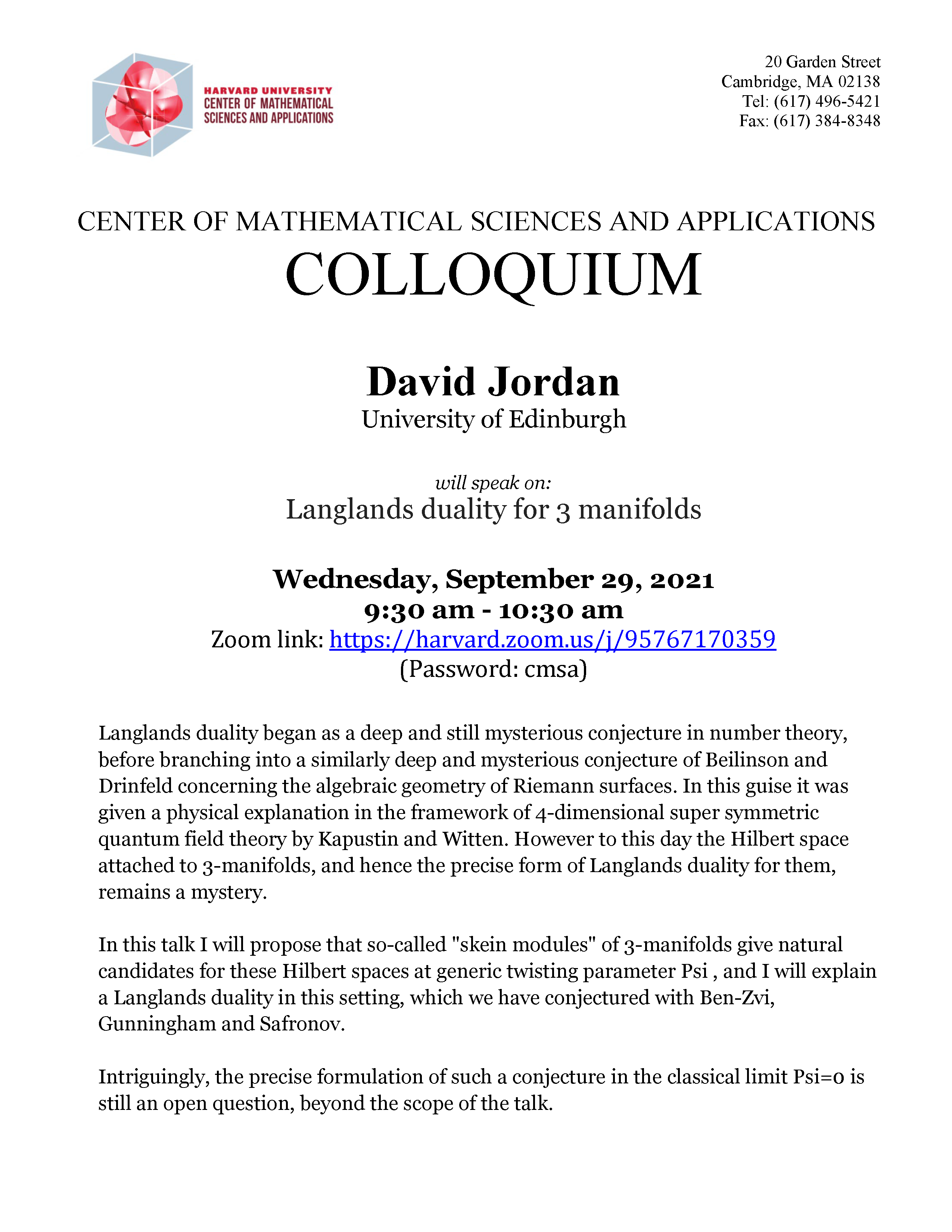
Speaker: David Jordan (U Edinburgh) Title: Langlands duality for 3 manifolds Abstract: Langlands duality began as a deep and still mysterious conjecture in number theory, before branching into a similarly deep and mysterious conjecture of Beilinson and Drinfeld concerning the algebraic geometry of Riemann surfaces. In this guise it was given a physical explanation in the framework of 4-dimensional super […] |
2 events,
-
Member Seminar Speaker: Jue Liu Title: Instability of naked singularities in general relativity Abstract: One of the fundamental problems in mathematical relativity is the weak cosmic censorship conjecture, proposed by Penrose, which roughly states that for generic physical spacetime, the singularities (if existed) must be hidden behind the black holes. Unfortunately, the singularities visible to faraway observers, […] |