During the 2025–26 academic year, the CMSA will be hosting a Colloquium series, organized by Tomer Ezra, Houcine Ben Dali, Francesco Mori, and Sunghyuk Park.

It will take place on Mondays from 4:30 – 5:30 pm (Eastern Time) in Room G10, CMSA, 20 Garden Street. All CMSA postdocs/members are required to attend the weekly CMSA Colloquium series as well as the weekly CMSA Members’ Seminars.

To subscribe to the CMSA Colloquium Mailing list, please visit this link.

The schedule will be updated as talks are confirmed.

  • Global Existence and Scattering for Einstein’s equations and related equations satisfying the weak null condition

    Speaker: Hans Lindblad (Johns Hopkins University) Title:  Global Existence and Scattering for Einstein's equations and related equations satisfying the weak null condition Abstract: Einstein's equations in harmonic or wave coordinates are a system of nonlinear wave equations for a Lorentzian metric, that in addition satisfy the preserved wave coordinate condition. Christodoulou-Klainerman proved global existence for Einstein vacuum equations for […]
  • Monogamy of entanglement and convex geometry

    CMSA 20 Garden Street, Cambridge, MA, United States

    Speaker: Aram Harrow (MIT) Title: Monogamy of entanglement and convex geometry Abstract: The SoS (sum of squares) hierarchy is a flexible algorithm that can be used to optimize polynomials and to test whether a quantum state is entangled or separable.  (Remarkably, these two problems are nearly isomorphic.)  These questions lie at the boundary of P, NP and the unique games […]

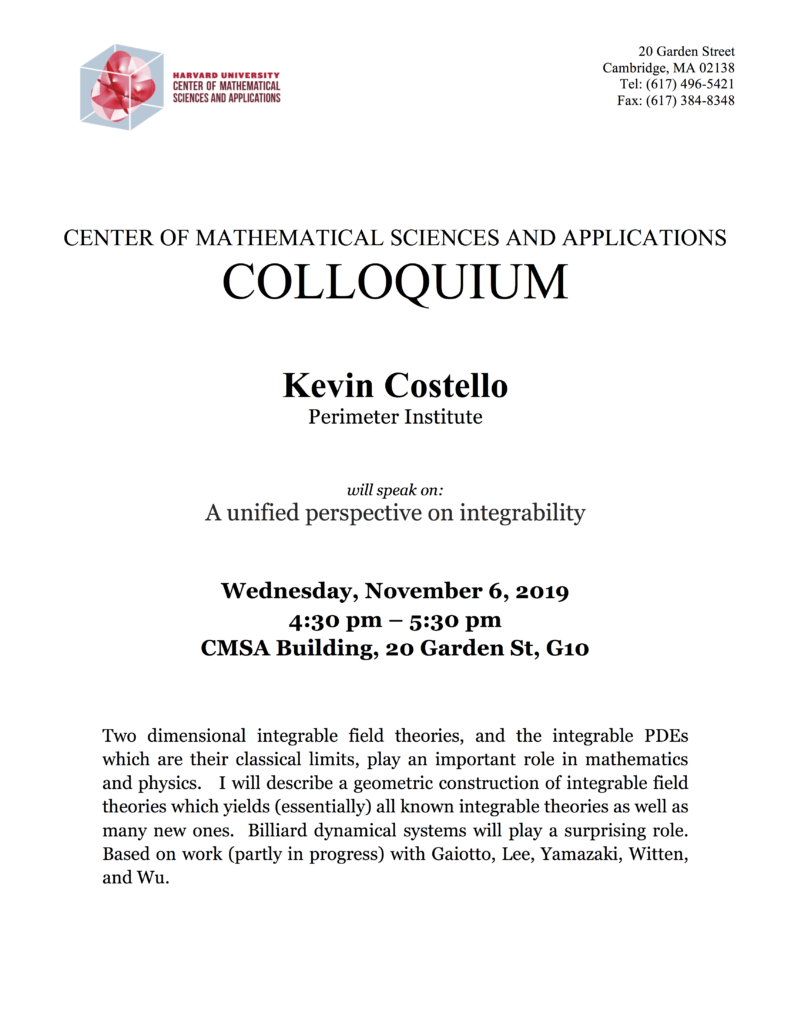
  • A unified perspective on integrability

    CMSA 20 Garden Street, Cambridge, MA, United States

    Speaker: Kevin Costello (Perimeter Institute) Title: A unified perspective on integrability Abstract: Two-dimensional integrable field theories, and the integrable PDEs which are their classical limits, play an important role in mathematics and physics.   I will describe a geometric construction of integrable field theories which yields (essentially) all known integrable theories as well as many new ones.  Billiard dynamical […]

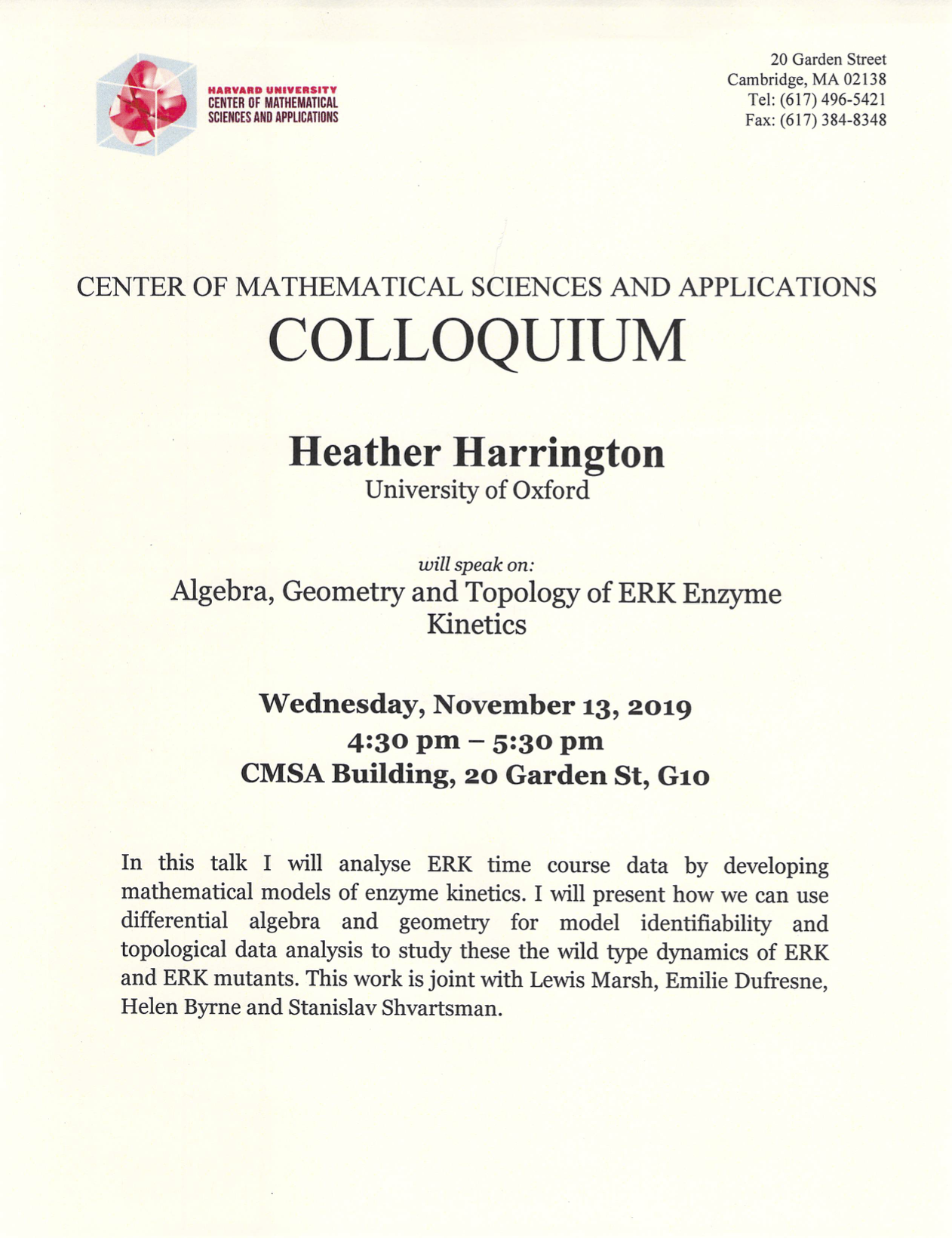
  • Algebra, Geometry and Topology of ERK Enzyme Kinetics

    CMSA 20 Garden Street, Cambridge, MA, United States

    Speaker: Heather Harrington (University of Oxford) Title: Algebra, Geometry and Topology of ERK Enzyme Kinetics Abstract: In this talk I will analyse ERK time course data by developing mathematical models of enzyme kinetics. I will present how we can use differential algebra and geometry for model identifiability and topological data analysis to study these the wild type dynamics of ERK […]

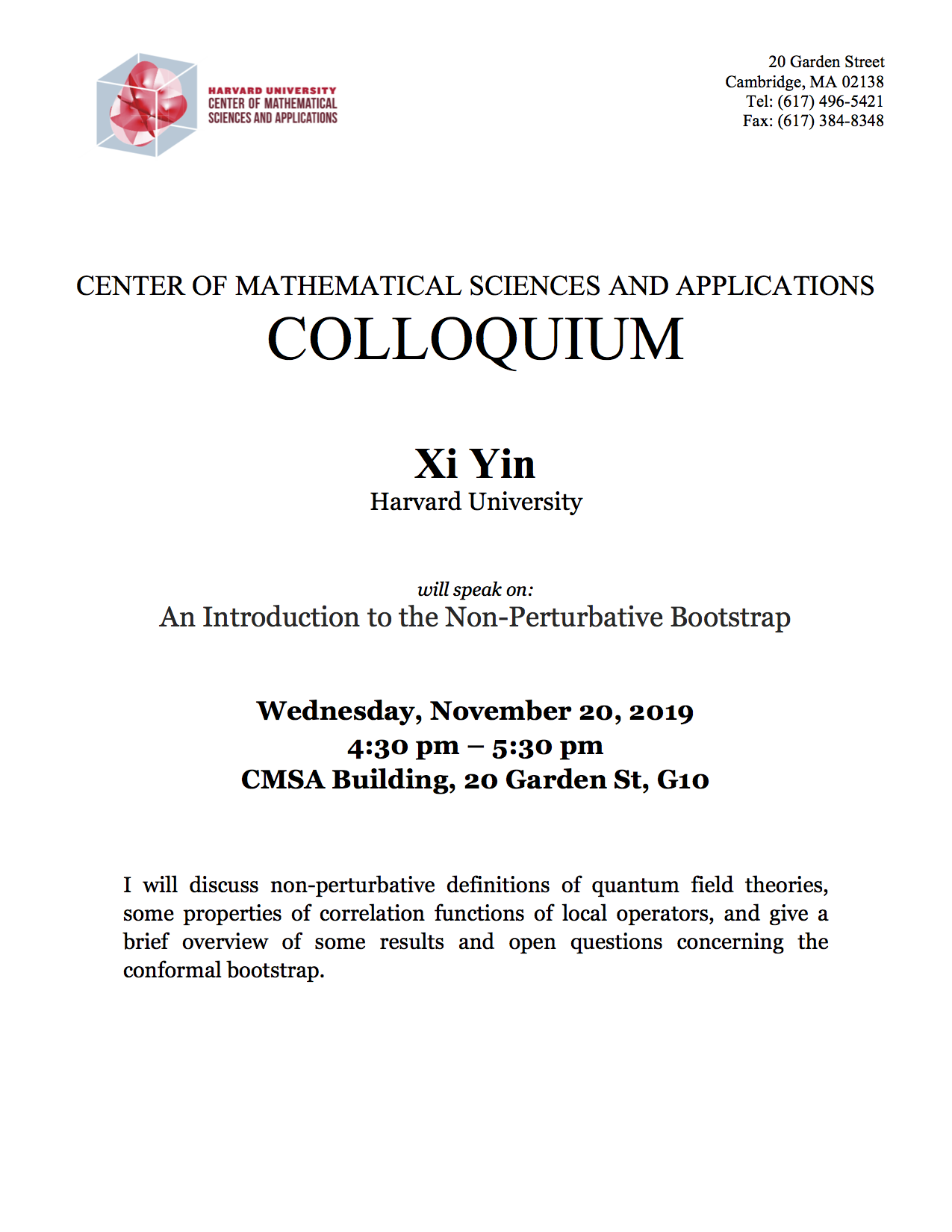
  • An Introduction to the Non-Perturbative Bootstrap

    CMSA 20 Garden Street, Cambridge, MA, United States

    Speaker: Xi Yin (Harvard) Title: An Introduction to the Non-Perturbative Bootstrap Abstract: I will discuss non-perturbative definitions of quantum field theories, some properties of correlation functions of local operators, and give a brief overview of some results and open questions concerning the conformal bootstrap

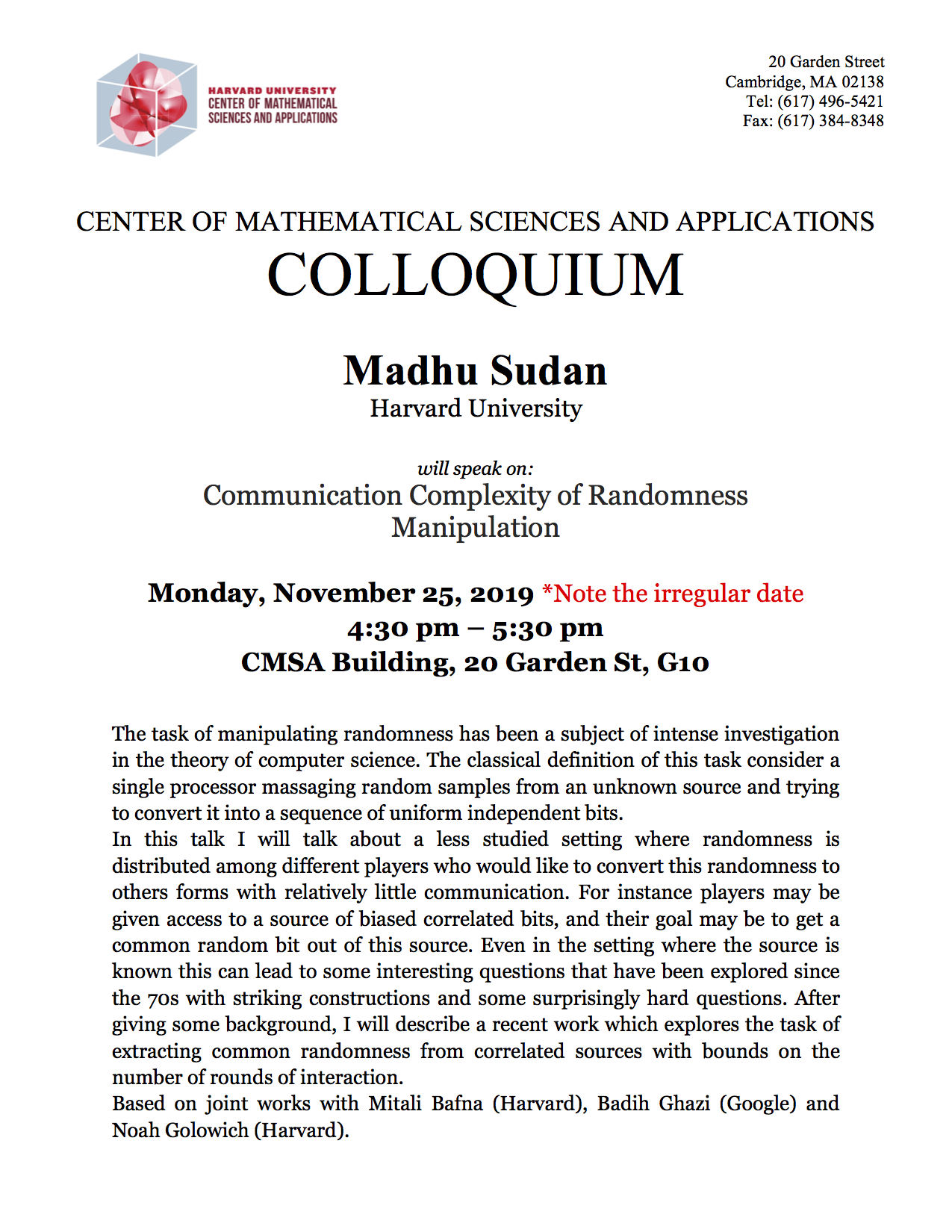
  • Communication Complexity of Randomness Manipulation

    CMSA 20 Garden Street, Cambridge, MA, United States

    Speaker: Madhu Sudan (Harvard) Title: Communication Complexity of Randomness Manipulation Abstract: The task of manipulating randomness has been a subject of intense investigation in the theory of computer science. The classical definition of this task consider a single processor massaging random samples from an unknown source and trying to convert it into a sequence of uniform independent bits.  In […]

  • Emergence of graviton-like excitations from a lattice model

    Speaker: Xiao-Gang Wen (MIT) Title: Emergence of graviton-like excitations from a lattice model Abstract: I will review some construction of lattice rotor model which give rise to emergent photons and graviton-like excitations. The appearance of vector-like charge and symmetric tensor field may be related to gapless fracton phases.

  • Data-intensive Innovation and the State: Evidence from AI Firms in China

    Speaker: David Yang (Harvard) Title: Data-intensive Innovation and the State: Evidence from AI Firms in China Abstract: Data-intensive technologies such as AI may reshape the modern world. We propose that two features of data interact to shape innovation in data-intensive economies: first, states are key collectors and repositories of data; second, data is a non-rival input in innovation. We document the importance of state-collected data for innovation using comprehensive data on Chinese facial recognition AI firms and government contracts. […]

  • Gentle Measurement of Quantum States and Differential Privacy

    CMSA 20 Garden Street, Cambridge, MA, United States

    Speaker: Scott Aaronson (University of Texas at Austin) Title: Gentle Measurement of Quantum States and Differential Privacy Abstract: I'll discuss a recent connection between two seemingly unrelated problems: how to measure a collection of quantum states without damaging them too much ("gentle measurement"), and how to provide statistical data without leaking too much about individuals ("differential privacy," an area of classical […]

  • A Compact, Logical Approach to Large-Market Analysis

    CMSA 20 Garden Street, Cambridge, MA, United States

    Speaker: Scott Duke Kominers (Harvard) Title: A Compact, Logical Approach to Large-Market Analysis Abstract: In game theory, we often use infinite models to represent "limit" settings, such as markets with a large number of agents or games with a long time horizon. Yet many game-theoretic models incorporate finiteness assumptions that, while introduced for simplicity, play a real role in the analysis. Here, we show […]

  • The Cubical Route to Understanding Groups

    Speaker: Daniel Wise (McGill University) Title: The Cubical Route to Understanding Groups Abstract: Cube complexes have come to play an increasingly central role within geometric group theory, as their connection to right-angled Artin groups provides a powerful combinatorial bridge between geometry and algebra. This talk will introduce nonpositively curved cube complexes, and then describe the developments that culminated in the resolution of the virtual […]