During the 2025–26 academic year, the CMSA will be hosting a Colloquium series, organized by Tomer Ezra, Houcine Ben Dali, Francesco Mori, and Sunghyuk Park.

It will take place on Mondays from 4:30 – 5:30 pm (Eastern Time) in Room G10, CMSA, 20 Garden Street. All CMSA postdocs/members are required to attend the weekly CMSA Colloquium series as well as the weekly CMSA Members’ Seminars.

To subscribe to the CMSA Colloquium Mailing list, please visit this link.

The schedule will be updated as talks are confirmed.

  • Stability of spacetimes with supersymmetric compactifications

    Virtual

    Speaker: Lars Andersson (Max-Planck Institute for Gravitational Physics) Title: Stability of spacetimes with supersymmetric compactifications Abstract: Spacetimes with compact directions, which have special holonomy such as Calabi-Yau spaces, play an important role in supergravity and string theory. In this talk I will discuss the global, non-linear stability for the vacuum Einstein equations on a spacetime which is a cartesian product […]

  • Statistical, mathematical, and computational aspects of noisy intermediate-scale quantum computers 

    Speaker: Gil Kalai (Hebrew University and IDC Herzliya) Title: Statistical, mathematical, and computational aspects of noisy intermediate-scale quantum computers Abstract: Noisy intermediate-scale quantum (NISQ) Computers hold the key for important theoretical and experimental questions regarding quantum computers. In the lecture I will describe some questions about mathematics, statistics and computational complexity which arose in my study of NISQ systems and […]

  • Re-pricing avalanches

    Virtual

    Speaker: Jose A. Scheinkman (Columbia) Title: Re-pricing avalanches Abstract: Monthly aggregate price changes exhibit chronic fluctuations but the aggregate shocks that drive these fluctuations are often elusive.  Macroeconomic models often add stochastic macro-level shocks such as technology shocks or monetary policy shocks to produce these aggregate fluctuations. In this paper, we show that a state-dependent  pricing model with a large but […]

  • Hyperbolic Geometry and Quantum Invariants

    Virtual

    Speaker: Tian Yang (Texas A&M University) Title: Hyperbolic Geometry and Quantum Invariants Abstract: There are two very different approaches to 3-dimensional topology, the hyperbolic geometry following the work of Thurston and the quantum invariants following the work of Jones and Witten. These two approaches are related by a sequence of problems called the Volume Conjectures. In this talk, I […]

  • CMSA Colloquium 9/15/2021 – 5/25/2022

    CMSA 20 Garden Street, Cambridge, MA, United States

    During the 2021–22 academic year, the CMSA will be hosting a Colloquium, organized by Du Pei, Changji Xu, and Michael Simkin. It will take place on Wednesdays at 9:30am – 10:30am (Boston time). The meetings will take place virtually on Zoom. All CMSA postdocs/members are required to attend the weekly CMSA Members’ Seminars, as well as the weekly CMSA […]

  • Langlands duality for 3 manifolds

    Virtual

    Speaker: David Jordan (U Edinburgh) Title: Langlands duality for 3 manifolds Abstract: Langlands duality began as a deep and still mysterious conjecture in number theory, before branching into a similarly deep and mysterious conjecture of Beilinson and Drinfeld concerning the algebraic geometry of Riemann surfaces. In this guise it was given a physical explanation in the framework of 4-dimensional super […]

  • Strings, knots and quivers

    Virtual

    Speaker: Piotr Sułkowski (University of Warsaw) Title: Strings, knots and quivers Abstract: I will discuss a recently discovered relation between quivers and knots, as well as – more generally – toric Calabi-Yau manifolds. In the context of knots this relation is referred to as the knots-quivers correspondence, and it states that various invariants of a given knot […]

  • Knot homology and sheaves on the Hilbert scheme of points on the plane

    Speaker: Alexei Oblomkov (University of Massachusetts) Title: Knot homology and sheaves on the Hilbert scheme of points on the plane Abstract: The knot homology (defined by Khovavov, Rozansky) provide us with a refinement of the knot polynomial knot invariant defined by Jones. However, the knot homology are much harder to compute compared to the polynomial […]

  • Categorification and applications

    Virtual

    Speaker: Peng Shan (Tsinghua University) Title: Categorification and applications Abstract: I will give a survey of the program of categorification for quantum groups, some of its recent development and applications to representation theory.
  • Anisotropy, biased pairing theory and applications

    Speaker: Karim Adiprasito, Hebrew University and University of Copenhagen Title: Anisotropy, biased pairing theory and applications Abstract: Not so long ago, the relations between algebraic geometry and combinatorics were strictly governed by the former party, with results like log-concavity of the coefficients of the characteristic polynomial of matroids shackled by intuitions and techniques from projective algebraic […]

  • Hitchin map as spectrum of equivariant cohomology

    Speaker: Tamás Hausel (IST Austria) Title: Hitchin map as spectrum of equivariant cohomology Abstract: We will explain how to model the Hitchin integrable system on a certain Lagrangian upward flow as the spectrum of equivariant cohomology of a Grassmannian.

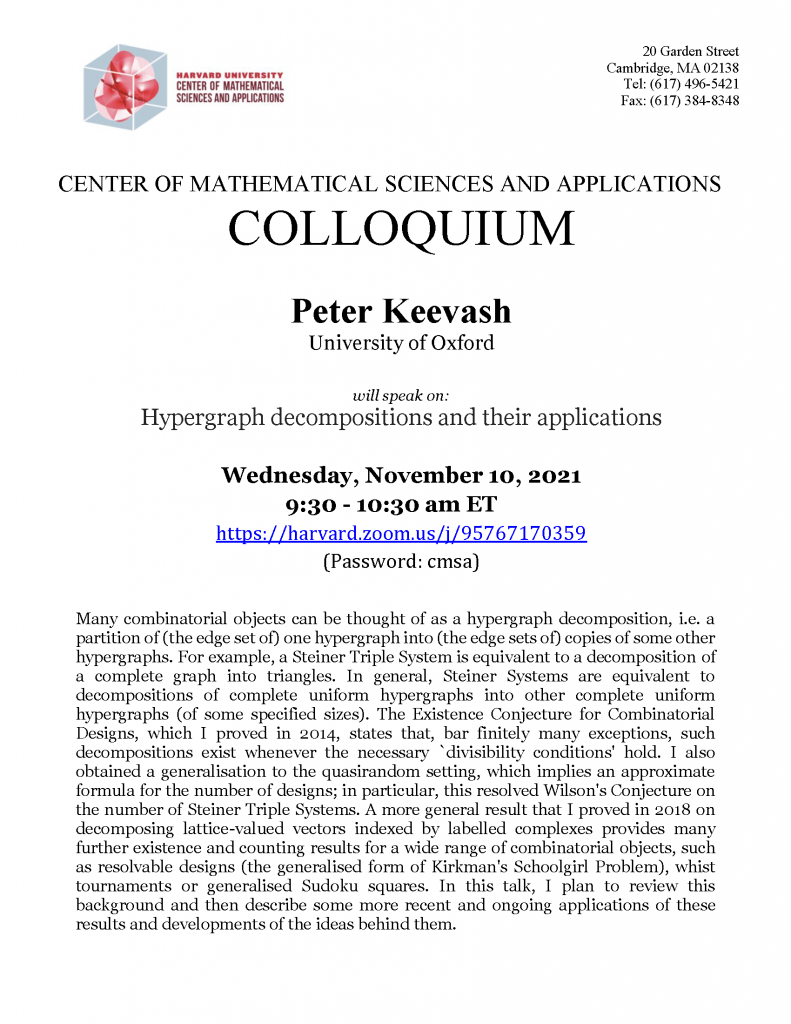
  • Hypergraph decompositions and their applications

    Speaker: Peter Keevash, Oxford Title: Hypergraph decompositions and their applications Abstract: Many combinatorial objects can be thought of as a hypergraph decomposition, i.e. a partition of (the edge set of) one hypergraph into (the edge sets of) copies of some other hypergraphs. For example, a Steiner Triple System is equivalent to a decomposition of a complete graph […]