During the 2025–26 academic year, the CMSA will be hosting a Colloquium series, organized by Tomer Ezra, Houcine Ben Dali, Francesco Mori, and Sunghyuk Park.

It will take place on Mondays from 4:30 – 5:30 pm (Eastern Time) in Room G10, CMSA, 20 Garden Street. All CMSA postdocs/members are required to attend the weekly CMSA Colloquium series as well as the weekly CMSA Members’ Seminars.

To subscribe to the CMSA Colloquium Mailing list, please visit this link.

The schedule will be updated as talks are confirmed.

  • Curve counting on surfaces and topological strings

    Speaker: Andrea Brini, U Sheffield Title: Curve counting on surfaces and topological strings Abstract: Enumerative geometry is a venerable subfield of Mathematics, with roots dating back to Greek Antiquity and a present inextricably linked with developments in other domains. Since the early 90s, in particular, the interaction with String Theory has sent shockwaves through the subject, giving […]

  • The Hitchin connection for parabolic G-bundles

    Speaker: Richard Wentworth, University of Maryland Title: The Hitchin connection for parabolic G-bundles Abstract: For a simple and simply connected complex group G, I will discuss some elements of the proof of the existence of a flat projective connection on the bundle of nonabelian theta functions on the moduli space of semistable parabolic G-bundles over families of […]

  • Induced subgraphs and tree decompositions

    Speaker: Maria Chudnovsky, Princeton Title: Induced subgraphs and tree decompositions Abstract: Tree decompositions are a powerful tool in both structural graph theory and graph algorithms. Many hard problems become tractable if the input graph is known to have a tree decomposition of bounded “width”. Exhibiting a particular kind of a tree decomposition is also a useful way […]

  • The Kapustin-Rozanski-Saulina “2-category” of a holomorphic integrable system

    Speaker: Constantin Teleman (UC Berkeley) Title: The Kapustin-Rozanski-Saulina “2-category” of a holomorphic integrable system Abstract: I will present a construction of the object in the title which, applied to the classical Toda system, controls the theory of categorical representations of compact Lie groups, along with applications (some conjectural, some rigorous) to gauged Gromov-Witten theory. Time permitting, we […]

  • Colloquium 2021–22

    During the 2021–22 academic year, the CMSA will be hosting a Colloquium, organized by Du Pei, Changji Xu, and Michael Simkin. It will take place on Wednesdays at 9:30am – 10:30am (Boston time). The meetings will take place virtually on Zoom. All CMSA postdocs/members are required to attend the weekly CMSA Members’ Seminars, as well as the weekly CMSA […]

  • CMSA Colloquium

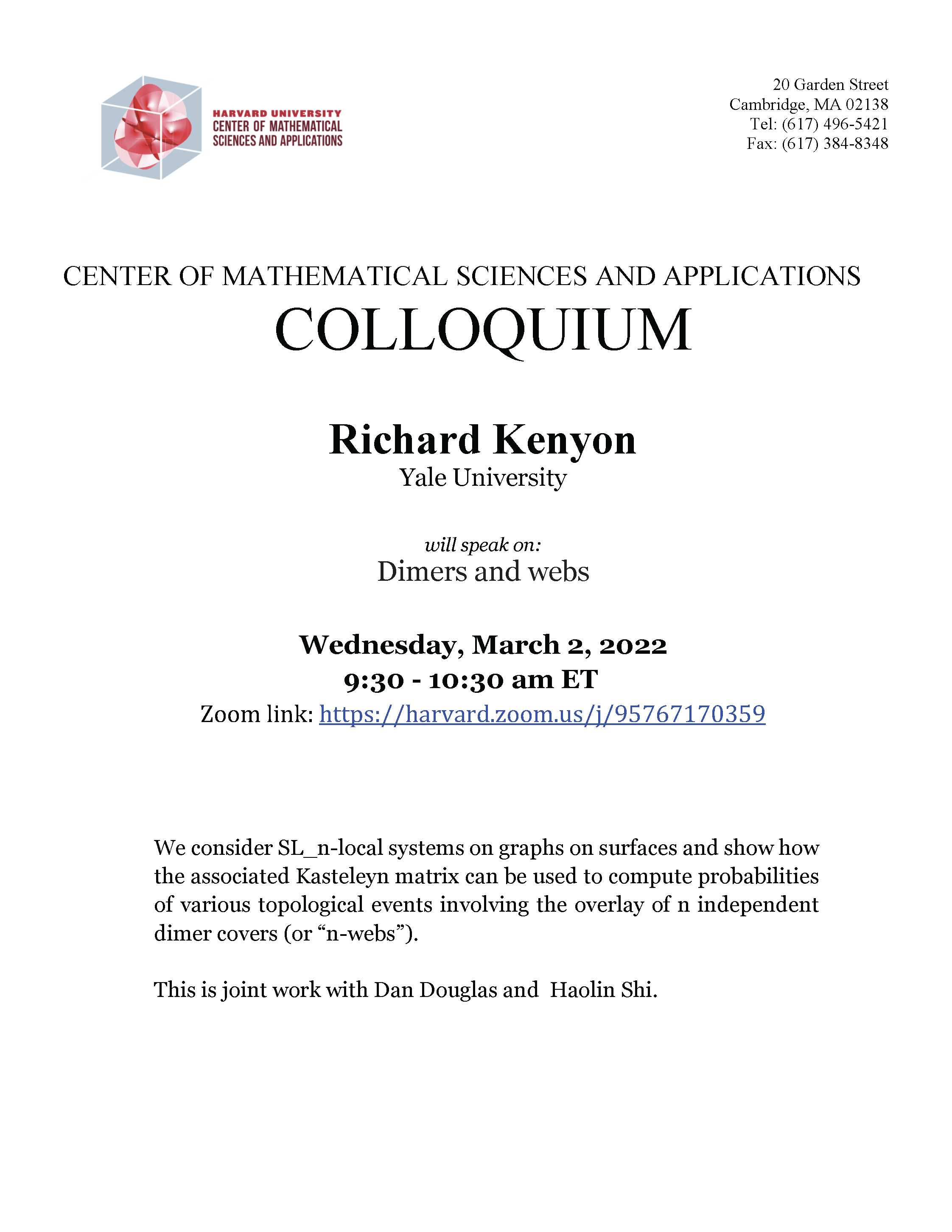
    During the 2021–22 academic year, the CMSA will be hosting a Colloquium, organized by Du Pei, Changji Xu, and Michael Simkin. It will take place on Wednesdays at 9:30am – 10:30am (Boston time). The meetings will take place virtually on Zoom. All CMSA postdocs/members are required to attend the weekly CMSA Members’ Seminars, as well as the weekly CMSA […]
  • The black hole information paradox

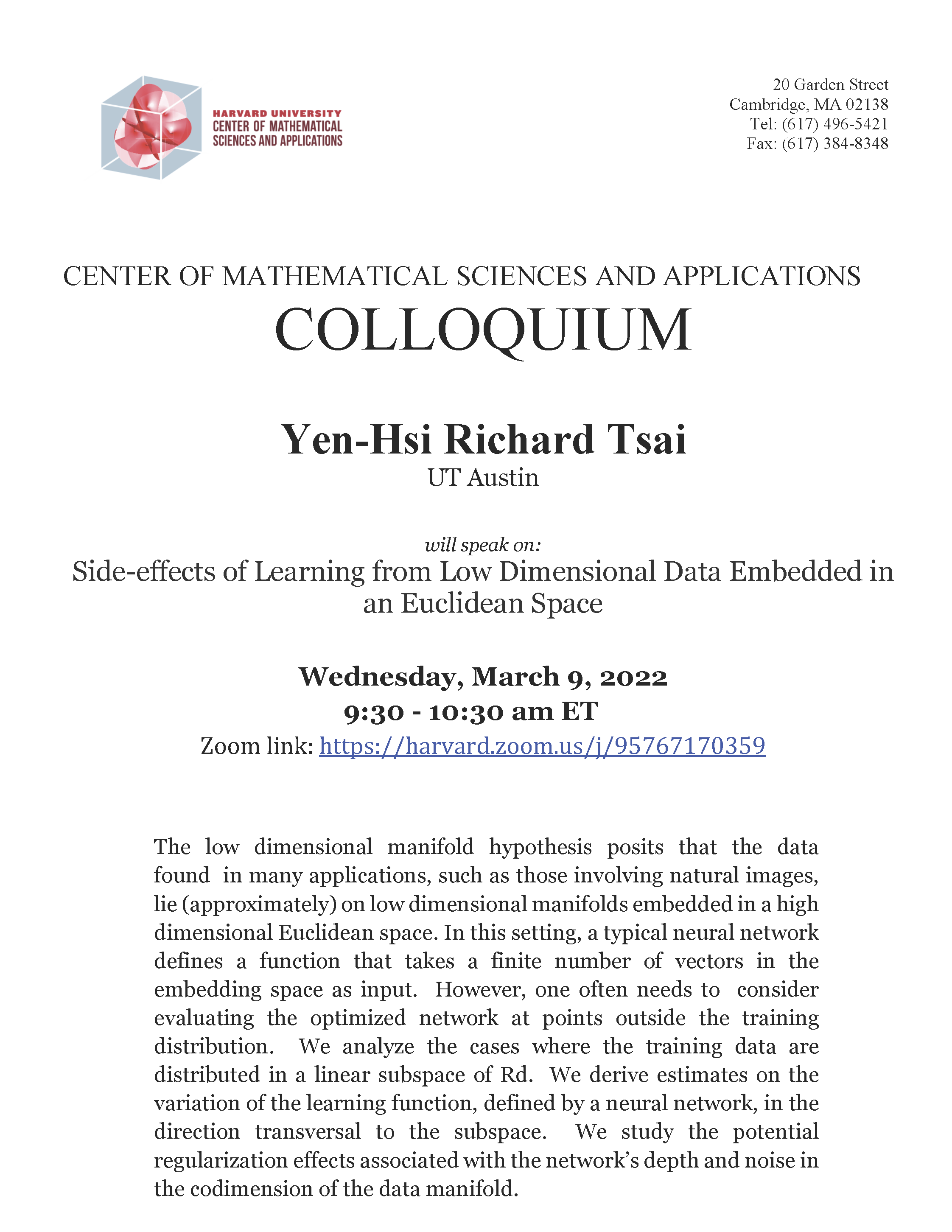
    Speaker: Samir Mathur (Ohio State University) Title: The black hole information paradox Abstract: In 1975, Stephen Hawking showed that black holes radiate away in a manner that violates quantum theory. Starting in 1997, it was observed that black holes in string theory did not have the form expected from general relativity: in place of “empty space will […]

  • Learning and inference from sensitive data

    Virtual

    Speaker: Adam Smith (Boston University) Title: Learning and inference from sensitive data Abstract: Consider an agency holding a large database of sensitive personal information—say,  medical records, census survey answers, web searches, or genetic data. The agency would like to discover and publicly release global characteristics of the data while protecting the privacy of individuals’ records. I will discuss recent (and not-so-recent) results on this problem with […]

  • CMSA Colloquium

    During the 2021–22 academic year, the CMSA will be hosting a Colloquium, organized by Du Pei, Changji Xu, and Michael Simkin. It will take place on Wednesdays at 9:30am – 10:30am (Boston time). The meetings will take place virtually on Zoom. All CMSA postdocs/members are required to attend the weekly CMSA Members’ Seminars, as well as the weekly CMSA […]

  • Tetrahedron instantons and M-theory indices

    Virtual

    Colloquium Speaker: Wenbin Yan (Tsinghua University) Title: Tetrahedron instantons and M-theory indices Abstract: We introduce and study tetrahedron instantons. Physically they capture instantons on $\mathbb{C}^{3}$ in the presence of the most general intersecting codimension-two supersymmetric defects. In this talk, we will review instanton moduli spaces, explain the construction, moduli space and partition functions of tetrahedron instantons. We […]

  • Kobayashi-Hitchin correspondences for harmonic bundles and monopoles

    Virtual

    Speaker: Takuro Mochizuki (Kyoto University) Title: Kobayashi-Hitchin correspondences for harmonic bundles and monopoles Abstract:  In 1960's, Narasimhan and Seshadri discovered the equivalence between irreducible unitary flat bundles and stable bundles of degree $0$ on compact Riemann surfaces. In 1980's, Donaldson, Uhlenbeck and Yau generalized it to the equivalence between irreducible Hermitian-Einstein bundles and stable bundles on smooth […]

  • Holographic Cone of Average Entropies and Universality of Black Holes

    Virtual

    Speaker: Bartek Czech, Tsinghua University Title: Holographic Cone of Average Entropies and Universality of Black Holes Abstract:  In the AdS/CFT correspondence, the holographic entropy cone, which identifies von Neumann entropies of CFT regions that are consistent with a semiclassical bulk dual, is currently known only up to n=5 regions. I explain that average entropies of p-partite subsystems can […]