During the 2025–26 academic year, the CMSA will be hosting a seminar organized by Mike Freedman on Fridays from 2:00–4:30 pm.

The seminar will take place in Room G10 at the CMSA, 20 Garden Street, Cambridge MA and will also be broadcast via Zoom.

To receive seminar announcements, subscribe to the mailing list.


  • Freedman CMSA Seminar

    CMSA Room G10 CMSA, 20 Garden Street, Cambridge, MA, United States

    Freedman CMSA Seminar   2:00-3:30 pm ET Speaker: Mike Freedman, Harvard CMSA Title: Detecting hidden structures in linear maps Abstract: I'll consider the problem of detecting spectral features and tensor structures within linear maps both in a quantum and classical contexts. In the quantum context there is the question of whether a Hamiltonian is local, […]

  • Freedman CMSA Seminar

    Virtual

    Freedman CMSA Seminar *Note: via Zoom only* 2:00-3:30 pm ET Speaker: Matt Hastings, Microsoft Quantum Program Title: Invertible Phases of Matter and Quantum Cellular Automata: Dimensions One to Three Abstract: A Quantum Cellular Automaton (QCA) is a *-automorphism of the algebra of local operators. While local quantum circuits provide one example of QCA, we are […]
  • Freedman CMSA Seminar

    Virtual

    Freedman CMSA Seminar *Note: via Zoom only*   2:00-3:30 pm ET Speaker: Michael Freedman, Harvard CMSA Title: Some questions and theorems about closed 3 manifolds embedded in S^4 Abstract: Much is unknown about smooth embeddings of 3-manifolds in S^4; the Schoenflies problem  (Is there only one smoothly embedded 3-sphere in S^4 up to isotopy?) is […]

  • A simple model for universal quantum computation

    Virtual

    Freedman CMSA Seminar Speaker: Michael Freedman Title: A simple model for universal quantum computation Abstract: I’ll present joint (unpublished) work with Charlie Marcus on a surprisingly simple – and potentially practical (?)– model for universal quantum computation whose only quantum primitive is the ability to measure a pair of adjacent electrons into either singlet (spin=0) […]

  • Is every knot isotopic to the unknot?

    Virtual

    Freedman CMSA Seminar *via Zoom* Speaker: Sergey Melikhov, Steklov Math Institute Title: Is every knot isotopic to the unknot? Abstract: The following problem was stated by D. Rolfsen in his 1974 paper; according to R. Daverman it was being discussed since the mid-60s. Is every knot in $S^3$ isotopic (=homotopic through embeddings) to a PL knot --- […]

  • Freedman CMSA Seminar: Michael Freedman (CMSA) & Elia Portnoy (MIT)

    Hybrid - G10

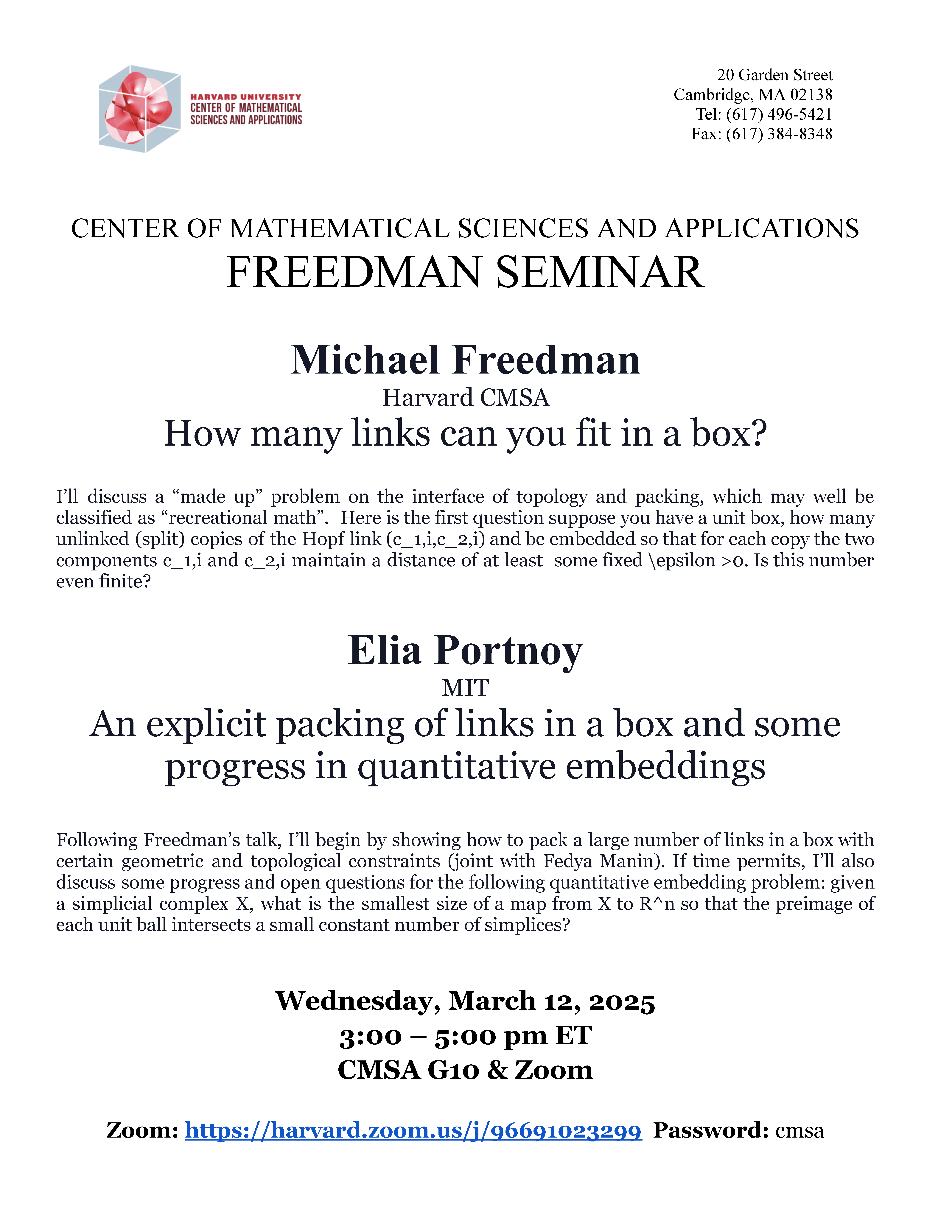
    Freedman CMSA Seminar Speaker: Michael Freedman, Harvard CMSA (3:00–4:00 pm ET) Title: How many links can you fit in a box? Abstract: I’ll discuss a “made up” problem on the interface of topology and packing, which may well be classified as “recreational math”.  Here is the first question suppose you have a unit box, how many unlinked […]

  • Adversarial KA

    Virtual

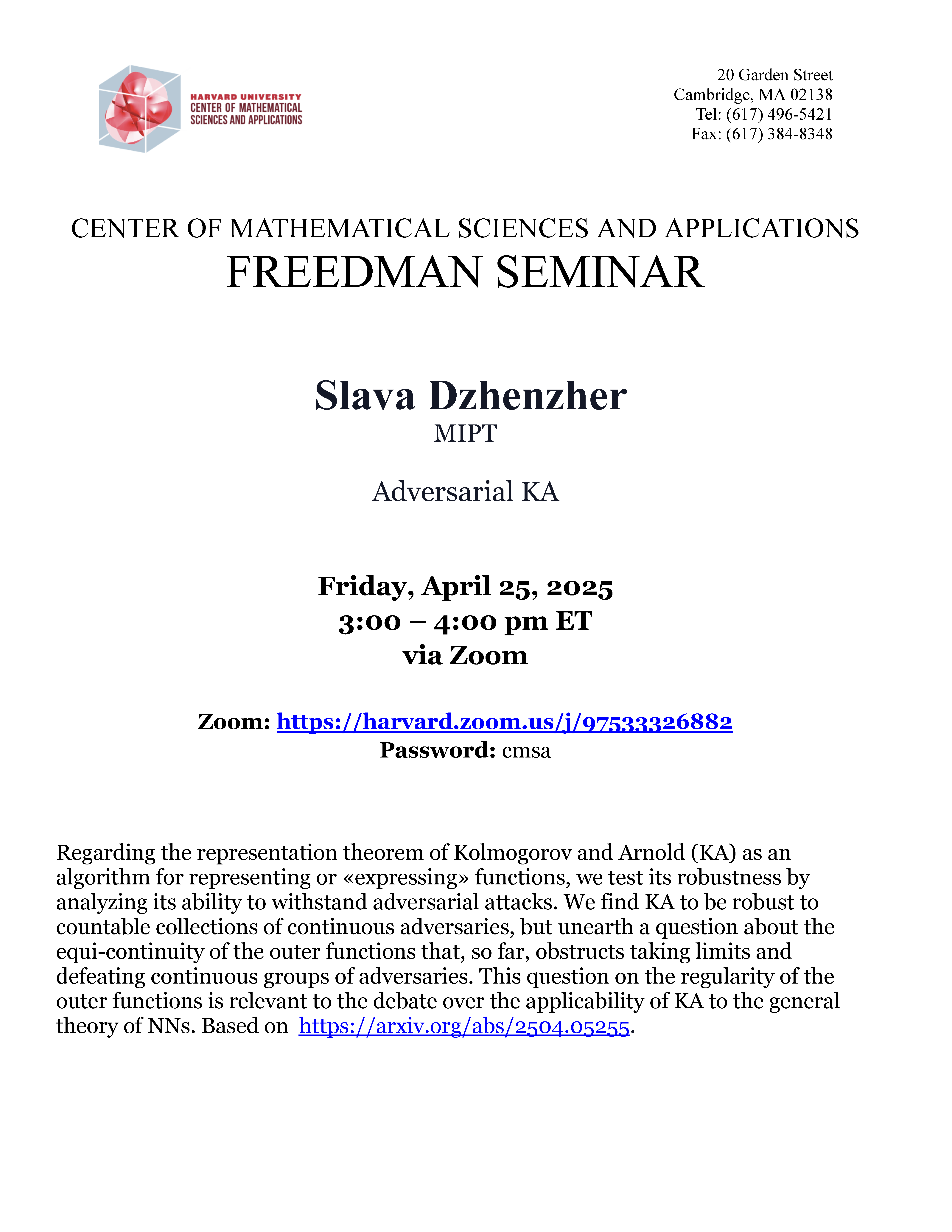
    Freedman CMSA Seminar Speaker: Slava Dzhenzher, MIPT Title: Adversarial KA Abstract: Regarding the representation theorem of Kolmogorov and Arnold (KA) as an algorithm for representing or «expressing» functions, we test its robustness by analyzing its ability to withstand adversarial attacks. We find KA to be robust to countable collections of continuous adversaries, but unearth a […]

  • Freedman Seminar: Michael Freedman, CMSA & Bowen Yang, CMSA

    Virtual

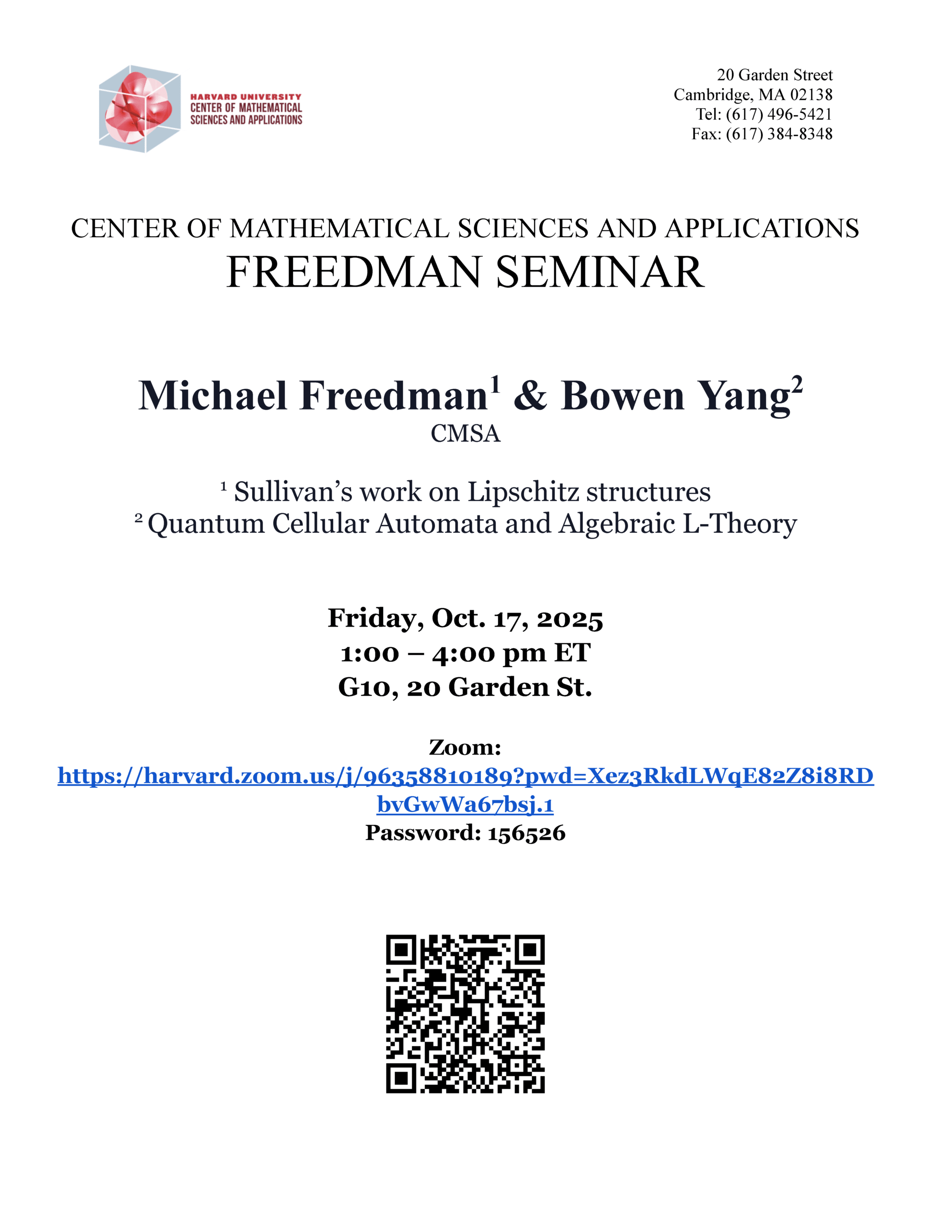
    Freedman Seminar Speaker: Michael Freedman, Harvard CMSA Title: Sullivan's work on Lipschitz structures Abstract: I'll begin with an elementary, but now little known, piece of PL topology: engulfing. John Stalling used it to give an alternative proof of the high dimensional Poincare conjecture. Then I'll explain Dennis Sullivan's enhancement of Kirby's torus trick (which relies […]

  • Freedman Seminar: Michael Freedman, CMSA & Bowen Yang, CMSA

    Virtual

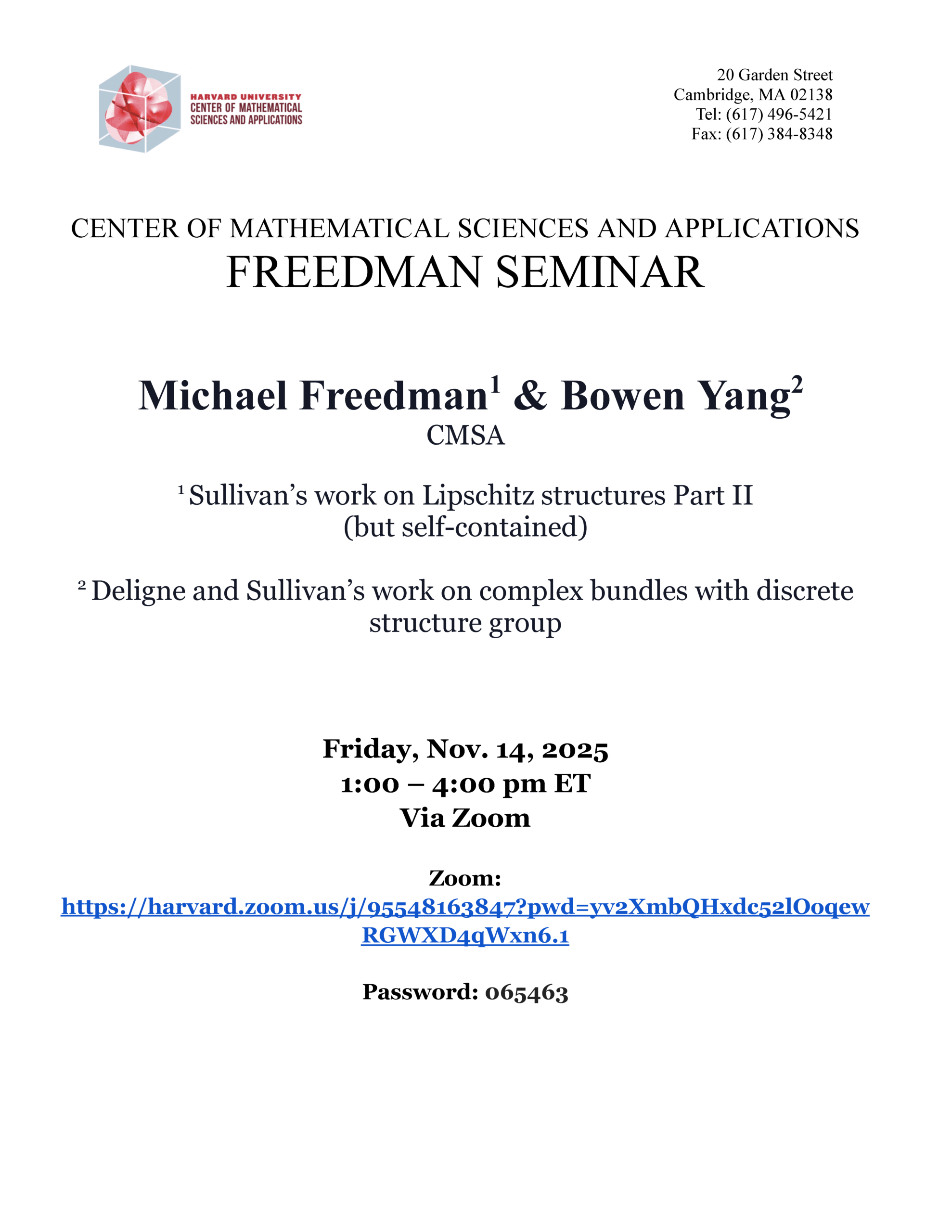
    Freedman Seminar Speaker: Michael Freedman, Harvard CMSA Title: Sullivan’s work on Lipschitz structures Part II (but self-contained)   Speaker: Bowen Yang, CMSA Title: Deligne and Sullivan's work on complex bundles with discrete structure group