• Theory of Task-Adapted Dynamics in Large Recurrent Neural Networks

    CMSA Room G10 CMSA, 20 Garden Street, Cambridge, MA, United States

    Member Seminar Speaker: Blake Bordelon, CMSA Title: Theory of Task-Adapted Dynamics in Large Recurrent Neural Networks Abstract: Recurrent neural networks (RNNs) encode expressive and flexible dynamical systems which can adapt to perform tasks by modifying the internal connections between neurons. In this work we analyze the structure of the dynamical systems encoded in RNNs after […]

  • Bi-HKT Manifolds, Sigma Models, Large N=4 and their String Constructions

    Science Center 507 1 Oxford Street, Cambridge

    Geometry and Quantum Theory Seminar Speakers: Max Hübner, CMSA Title: Bi-HKT Manifolds, Sigma Models, Large N=4 and their String Constructions Abstract: We continue our review of Witten's paper "Instantons and the Large N=4 Algebra". We discuss the realization of large N=4 supersymmetry in the context of supersymmetric sigma-models, and discuss and motivate string theoretic duals […]

  • Scaling Stochastic Momentum from Theory to LLMs

    CMSA Room G10 CMSA, 20 Garden Street, Cambridge, MA, United States

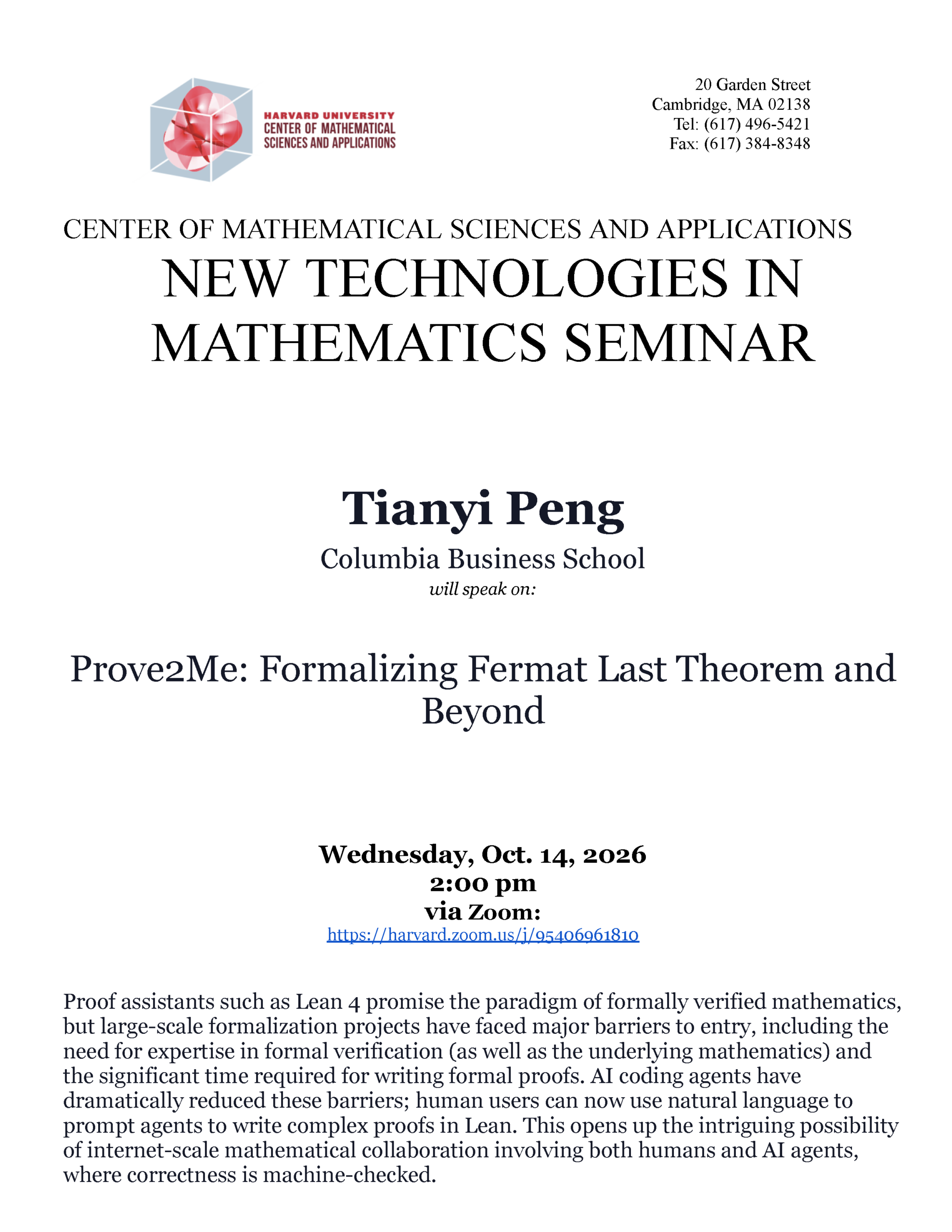
    New Technologies in Mathematics Seminar Speaker: Courtney Paquette, McGill University Title: Scaling Stochastic Momentum from Theory to LLMs Abstract: Given the massive scale of modern ML models, we now often get only a single shot to train them effectively. This limits our ability to sweep architectures and hyperparameters, making it essential to understand how learning algorithms scale […]

  • Higher Symmetries, Eta Invariants and Anomaly Theories 

    CMSA Room G10 CMSA, 20 Garden Street, Cambridge, MA, United States

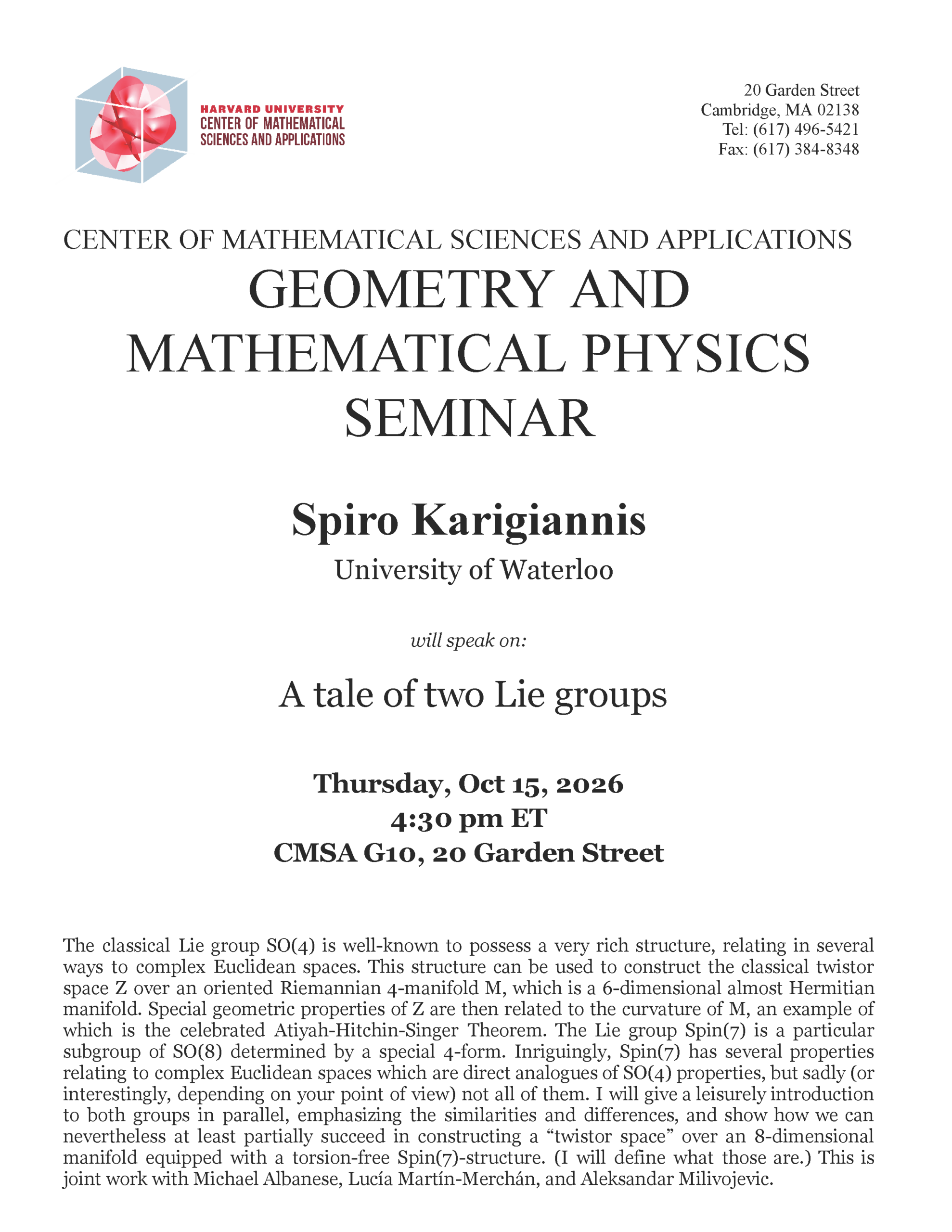
    Differential Geometry and Physics Seminar Speaker: Mirjam Cvetic, University of Pennsylvania Title: Higher Symmetries, Eta Invariants and Anomaly Theories Abstract: In recent years, much progress has been made in understanding the extra-dimensional origin of higher symmetry structures of many quantum field theories (QFTs) obtained via geometric engineering. Among others, our understanding of anomaly structures in QFTs has […]

  • Gauge theory, from low dimensions to higher dimensions and back

    CMSA Room G10 CMSA, 20 Garden Street, Cambridge, MA, United States

    Member Seminar Speaker: Saman Habibi Esfahani, CMSA Title: Gauge theory, from low dimensions to higher dimensions and back Abstract: Almost thirty years ago, Donaldson and Thomas proposed extending powerful ideas from gauge theory, which had transformed the study of three- and four-dimensional manifolds, to higher dimensions, with the goal of defining new invariants of special […]

  • Solitonic Symmetry: Cohomology with TFT Coefficients

    Science Center 507 1 Oxford Street, Cambridge

    Geometry and Quantum Theory Seminar Speaker: Sanjay Raman, Harvard Title: Solitonic Symmetry: Cohomology with TFT Coefficients Abstract: We review the formalism of https://arxiv.org/pdf/2307.00939, which develops the theory of solitonic symmetry in quantum field theory. The algebraic structure of solitonic symmetry is determined by the fusion of topological functionals in a given path-integral formulation of topological field theory, and […]

  • Fukaya categories and higher representation theory

    Harvard Science Center 1 Oxford Street, Cambridge, MA

    Differential Geometry and Physics Seminar Speaker: Vivek Shende (Syddansk Universitet & UC Berkeley) Title: Fukaya categories and higher representation theory Abstract: I will explain how Lagrangian Floer homology in certain monopole moduli spaces recovers the Khovanov homology and its relatives, by a description strikingly similar to the Oszvath-Szabo Heegard-Floer theory.  I will also explain how the […]

  • Freedman Seminar: Mattie Ji, Penn and Jeongwan Haah, Stanford

    Hybrid

    Freedman Seminar Speakers: Mattie Ji (Penn) and Jeongwan Haah (Stanford) Mattie Ji Title: Quantum Cellular Automata via Algebraic K-Theory Abstract: Algebraic K-theory, on a very high level, is the study of how to break apart and assemble objects linearly, which makes the field amenable to classification questions. In this work, we apply this methodology to study […]

  • Quantum Field Theory and Physical Mathematics

    CMSA Room G10 CMSA, 20 Garden Street, Cambridge, MA, United States

    Quantum Field Theory and Physical Mathematics Seminar Speaker: Davide Gaiotto (Perimeter Institute)