CMSA Q&A Seminar: Lauren Williams, Harvard
Common Room, CMSA 20 Garden Street, Cambridge, MA, United StatesCMSA Q&A Seminar Speaker: Lauren Williams, Harvard Topic: The First Proof Project

CMSA Q&A Seminar Speaker: Lauren Williams, Harvard Topic: The First Proof Project
Member Seminar Speaker: Elliott Gesteau, CMSA Title: Failures of Holographic Emergence Abstract: Recent developments have taught us that some semiclassical spacetimes, in particular those containing closed universe components, cannot emerge from a holographic correspondence. In this talk, I will explain how one can get to this conclusion by using either quantum information theory or properties of the large N limit of […]
Quantum Field Theory and Physical Mathematics Seminar Speaker: Seraphim Jarov, Perimeter Institute Title: Twistorial constructions of higher genus integrability Abstract: I will present a new method to engineer integrable models in 4d with higher genus spectral parameters. The method has a twistorial origin – by working on a branched covering of twistor space, I show […]
Colloquium Speaker: Mikhail Khovanov, Johns Hopkins University Title: Facets of link homology Abstract: We will review some link homology theories of algebraic origin and their connections to representation theory and geometry.
Joint Math/CMSA Geometry and Quantum Theory Seminar Speaker: Oswaldo Vázquez (Harvard) Title: A Mumford form on infinite Grassmannians Abstract: The Polyakov measure in bosonic string theory can be expressed in terms of the Mumford form, which is a trivializing section of a product of determinant line bundles over the moduli space of genus g curves. We […]

Algebra Seminar Speaker: Dale Cutkosky, University of Missouri Title: Multiplicities of graded families of ideals on Noetherian local rings Abstract: Let $R$ be an arbitrary $d$-dimensional Noetherian local ring with maximal ideal $m_R$. In this talk, we give a generalization of the multiplicity $e(I)$ of an $m_R$-primary ideal $I$ of $R$ to a multiplicity $e(\mathcal […]
Member Seminar Speaker: Sunghyuk Park, CMSA Title: Quantum topology from dynamics Abstract: Dynamics studies the long-term behavior of systems that evolve over time, such as the famous Lorenz system. Quantum topology, by contrast, studies knots and low-dimensional manifolds through invariants that are usually constructed using representation-theoretic tools. In this talk, I will explain how quantum invariants of […]
Joint Math/CMSA Geometry and Quantum Theory Seminar Speaker: Dan Freed, Harvard Math & CMSA Title: Abelian gauge fields and duality Abstract: Motivated by the new paper arXiv:2603.19161, I will give a general talk about abelian gauge fields, including duality. I will start with classical Maxwell theory, then discuss various “finite” examples, the typical p-form abelian […]
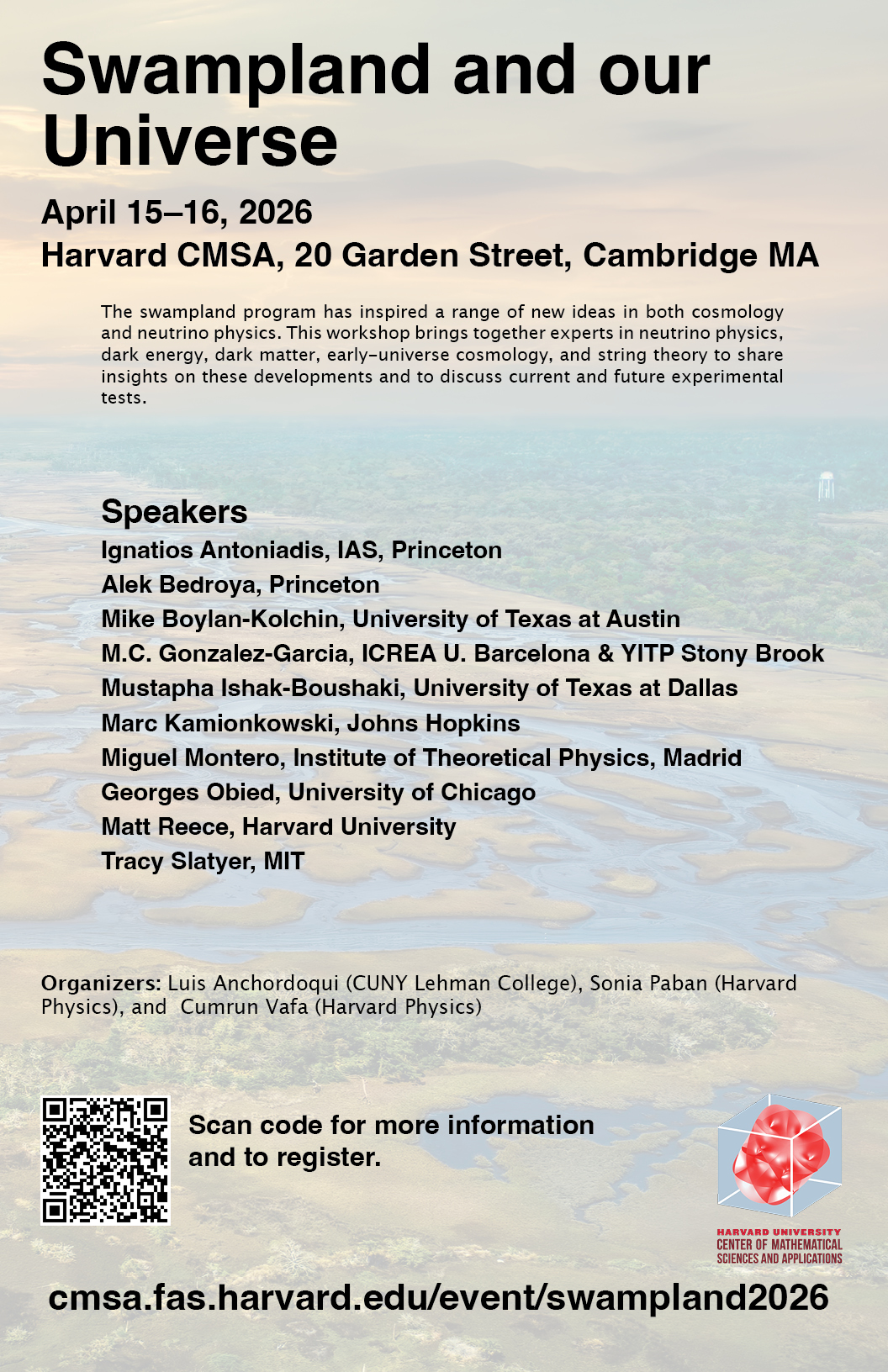
Swampland and our Universe Dates: April 15–16, 2026 Location: Harvard CMSA, Room G10, 20 Garden Street, Cambridge MA The swampland program has inspired a range of new ideas in both cosmology and neutrino physics. This workshop brings together experts in neutrino physics, dark energy, dark matter, early-universe cosmology, and string theory to share insights on […]
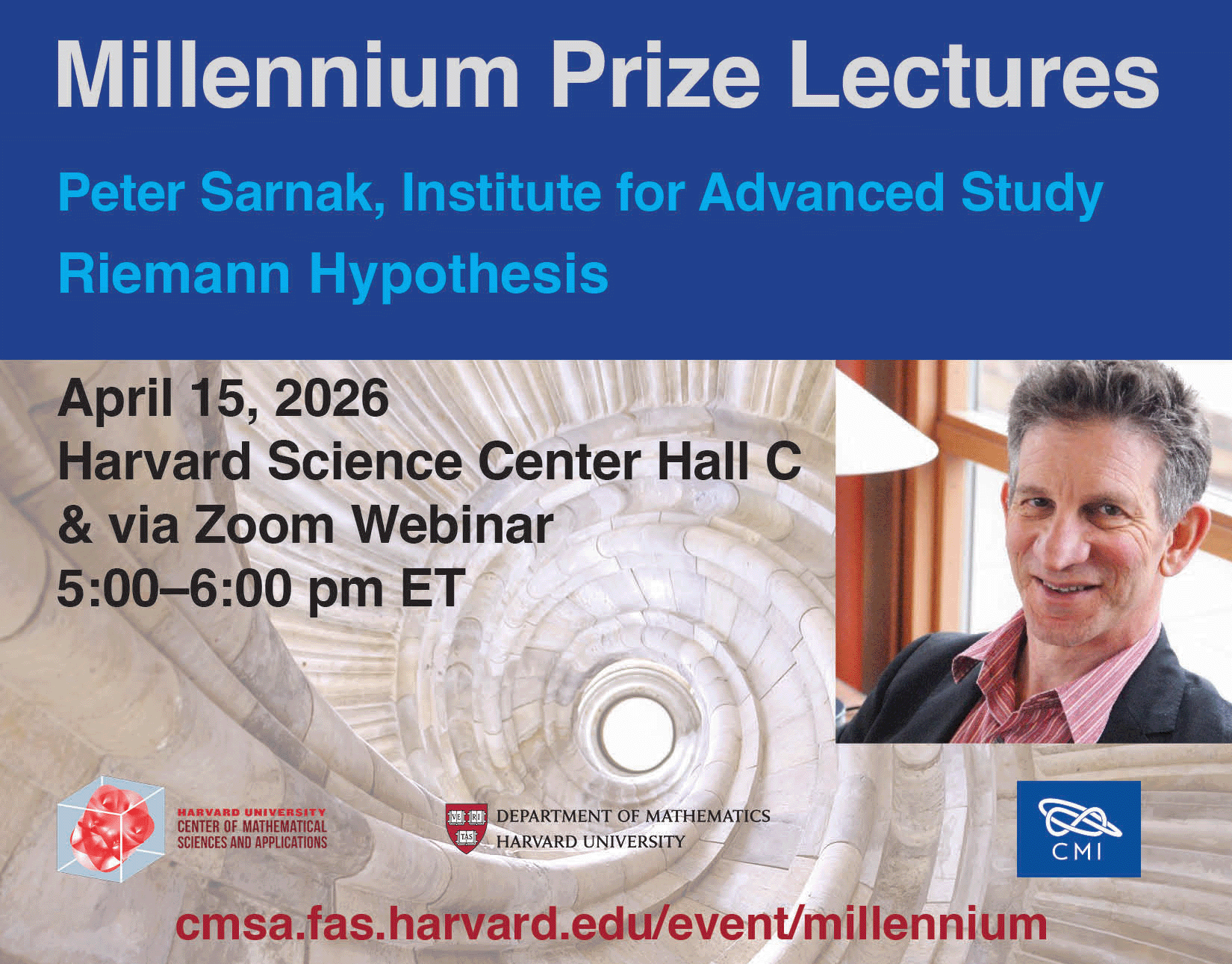
Date: April 15, 2026 Time: 5:00–6:00 pm Location: Harvard Science Center Hall C, 1 Oxford St., Cambridge MA Speaker: Peter Sarnak, Institute for Advanced Study Title: The Riemann Hypothesis Abstract: After reviewing the hypothesis as put forth by Riemann we discuss its generalizations and analogues. We highlight a few of their implications and workarounds, and […]
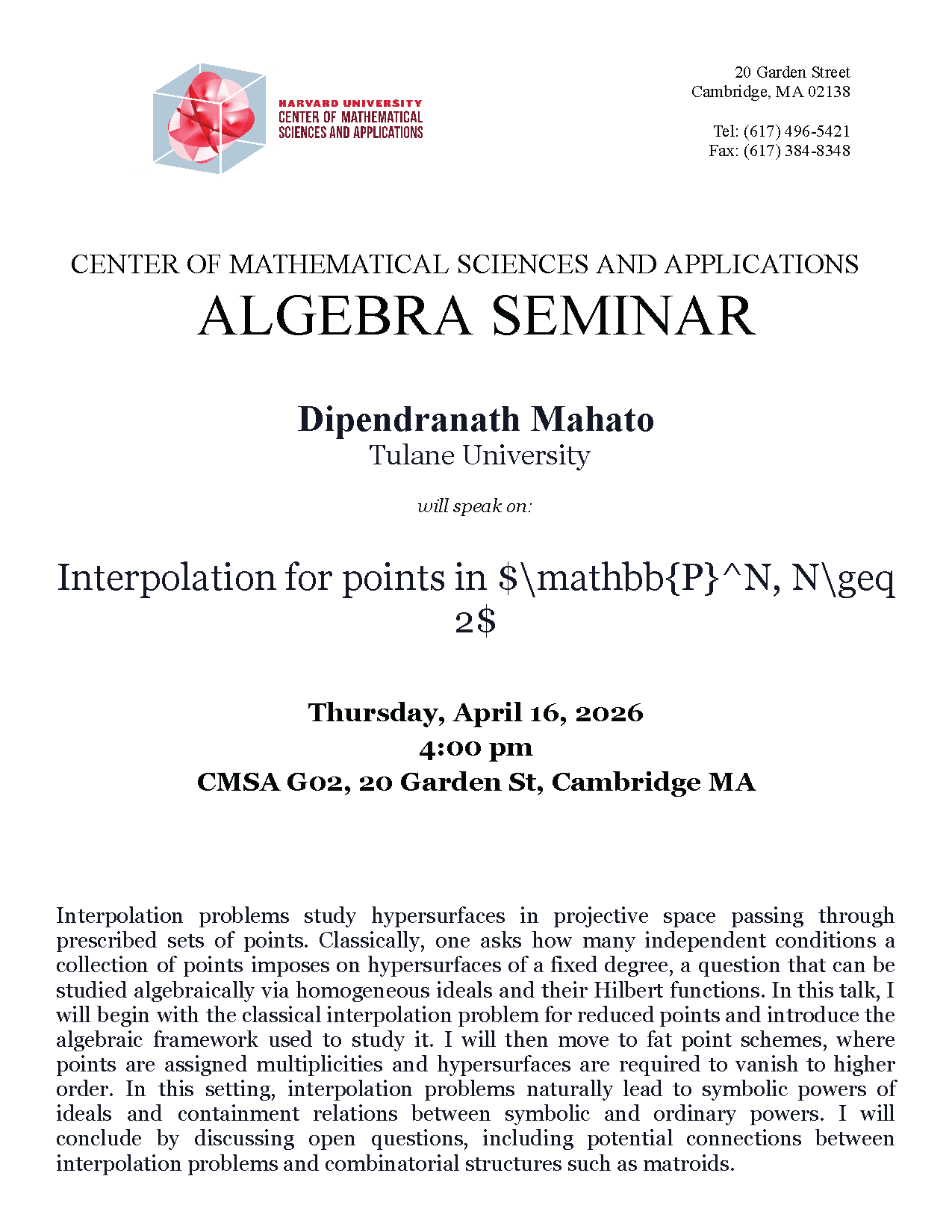
Algebra Seminar Speaker: Dipendranath Mahato, Tulane University Title: Interpolation for points in $\mathbb{P}^N, N\geq 2$ Abstract: Interpolation problems study hypersurfaces in projective space passing through prescribed sets of points. Classically, one asks how many independent conditions a collection of points imposes on hypersurfaces of a fixed degree, a question that can be studied algebraically via […]
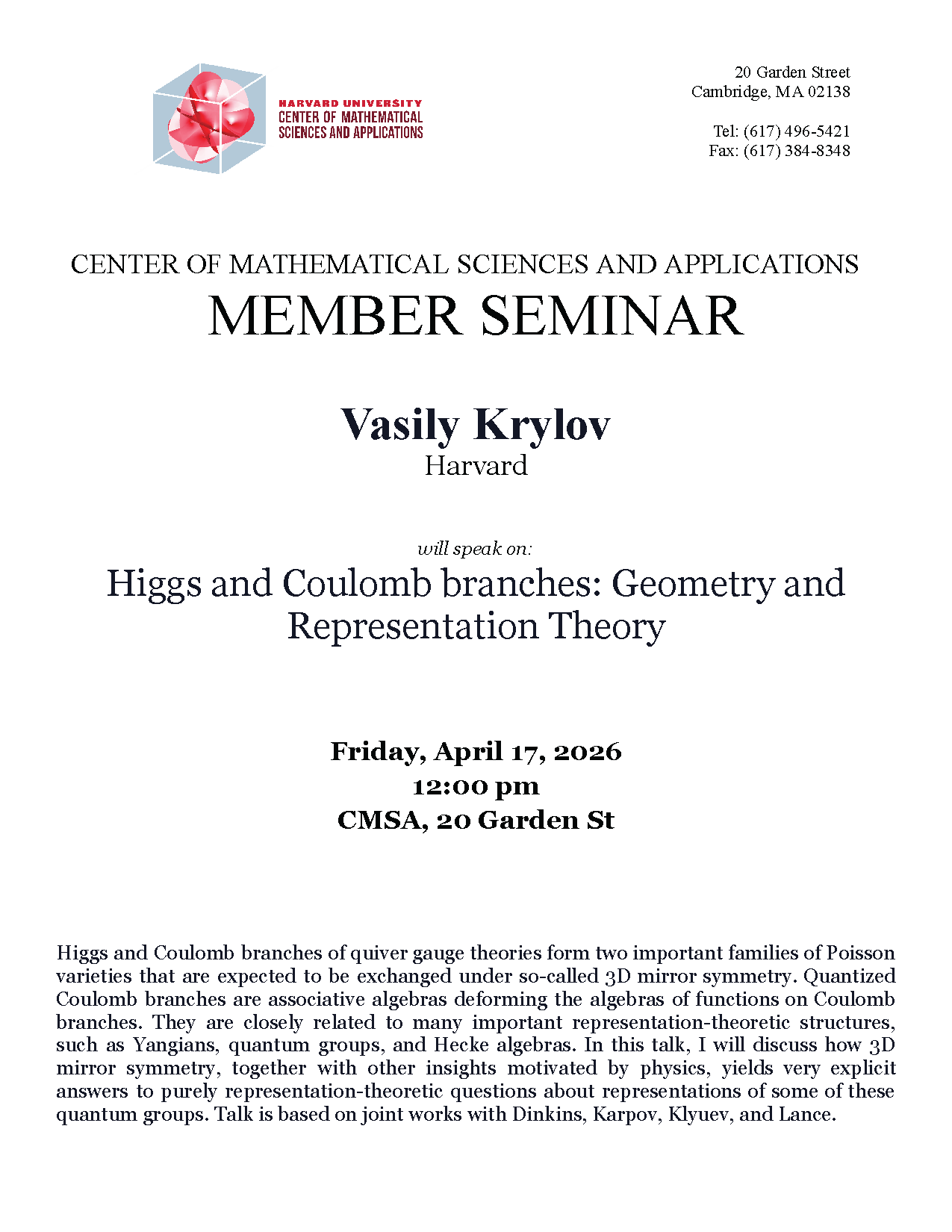
Member Seminar Speaker: Vasily Krylov Title: Higgs and Coulomb branches: Geometry and Representation Theory Abstract: Higgs and Coulomb branches of quiver gauge theories form two important families of Poisson varieties that are expected to be exchanged under so-called 3D mirror symmetry. Quantized Coulomb branches are associative algebras deforming the algebras of functions on Coulomb branches. They are […]