Math and Machine Learning Program Discussion
CMSA Room G10 CMSA, 20 Garden Street, Cambridge, MA, United StatesMath and Machine Learning Program Discussion

Math and Machine Learning Program Discussion
CMSA Q&A Seminar Speaker: Nazim Bouatta (HMS) Topic: What are AlphaFold2 and OpenFold
https://youtu.be/OYOuSAAE7QQ New Technologies in Mathematics Seminar Speaker: Anirudh Goyal (University of Montreal) Title: From Word Prediction to Complex Skills: Data Flywheels for Mathematical Reasoning Abstract: This talk examines how large language models (LLMs) evolve from simple word prediction to complex skills, with a focus on mathematical problem solving. A major driver of AI products today is the […]
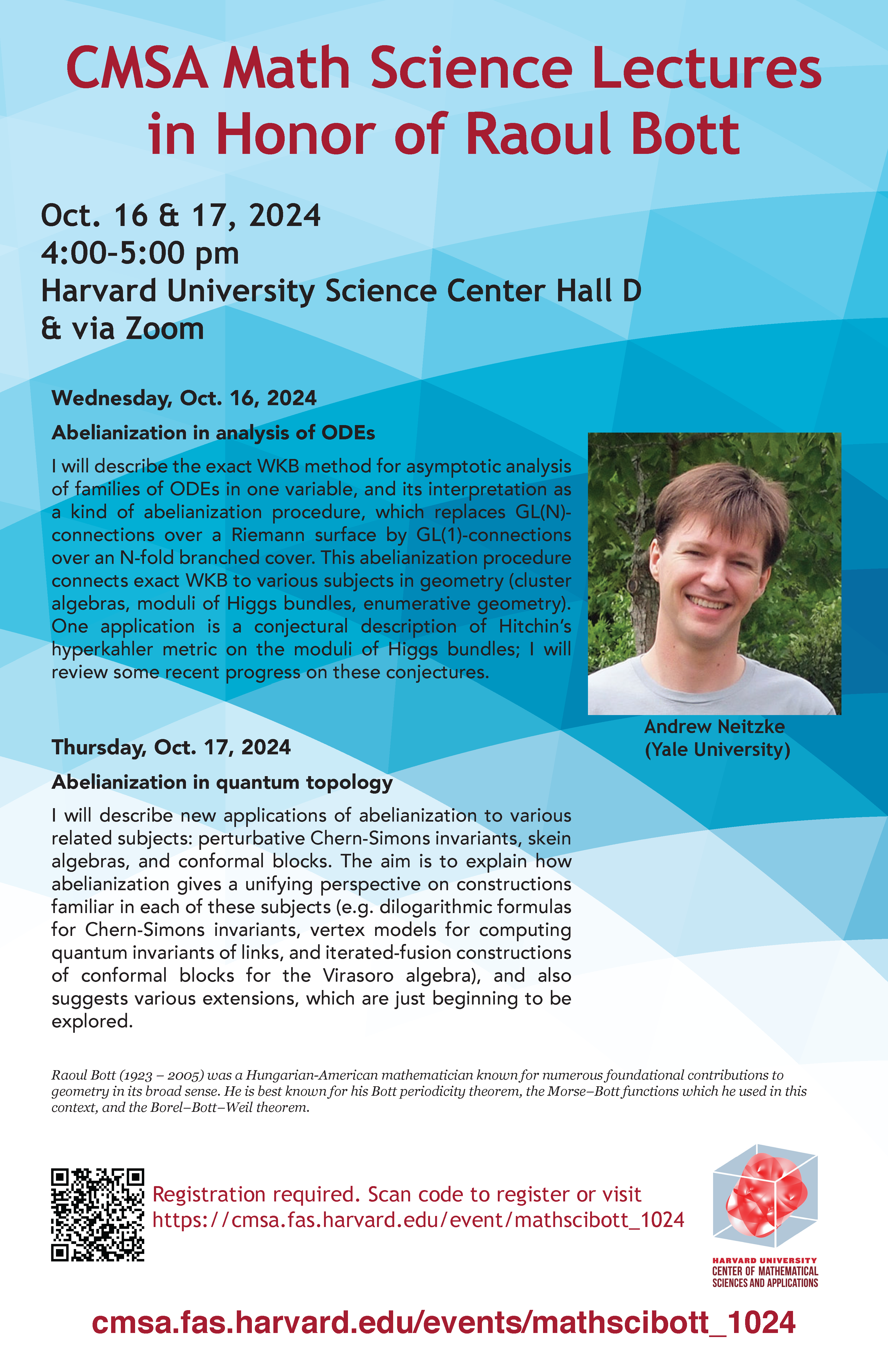
Speaker: Andrew Neitzke, Yale University Location: Harvard University Science Center Hall D & via Zoom webinar Dates: October 16 & 17, 2024 Time: 4:00 pm https://youtu.be/1SyGyeMmWoM Wednesday, Oct. 16, 2024 Title: Abelianization in analysis of ODEs Abstract: I will describe the exact WKB method for asymptotic analysis of families of ODEs in one […]
Topics in Deep Learning Theory Eli Grigsby
Speaker: Andrew Neitzke, Yale University Location: Harvard University Science Center Hall D & via Zoom webinar Dates: October 16 & 17, 2024 Time: 4:00 pm https://youtu.be/1SyGyeMmWoM Wednesday, Oct. 16, 2024 Title: Abelianization in analysis of ODEs Abstract: I will describe the exact WKB method for asymptotic analysis of families of ODEs in one variable, […]

Quantum Field Theory and Physical Mathematics Seminar *via Zoom only* Speaker: Rajath Radhakrishnan (ICTP, Trieste) Title: Bosonic and fermionic 1-form symmetries and anomaly matching Abstract: In this talk, I will consider bosonic and fermionic (non-invertible) 1-form symmetries in 2+1d QFTs. These are 1-form symmetries implemented by topological line operators with real spins. I will present a classification […]
Math and Machine Learning Program Discussion
Member Seminar Speaker: Puskar Mondal Title: Positive mass and rigidity theorems in Riemannian geometry Abstract: Positive mass theorem proved by Schoen-Yau, Witten, Taubes-Parker is one of the most important results in scalar curvature geometry in asymptotically flat settings. Since then several versions have been proven and generalized to other geometries such as asymptotically hyperbolic manifolds. The analogous […]

Foundation Seminar (Joint Seminar with BHI) Location: BHI Title: Singularity Theorems, Part I Journal Club Discussion
Math and Machine Learning Program Discussion
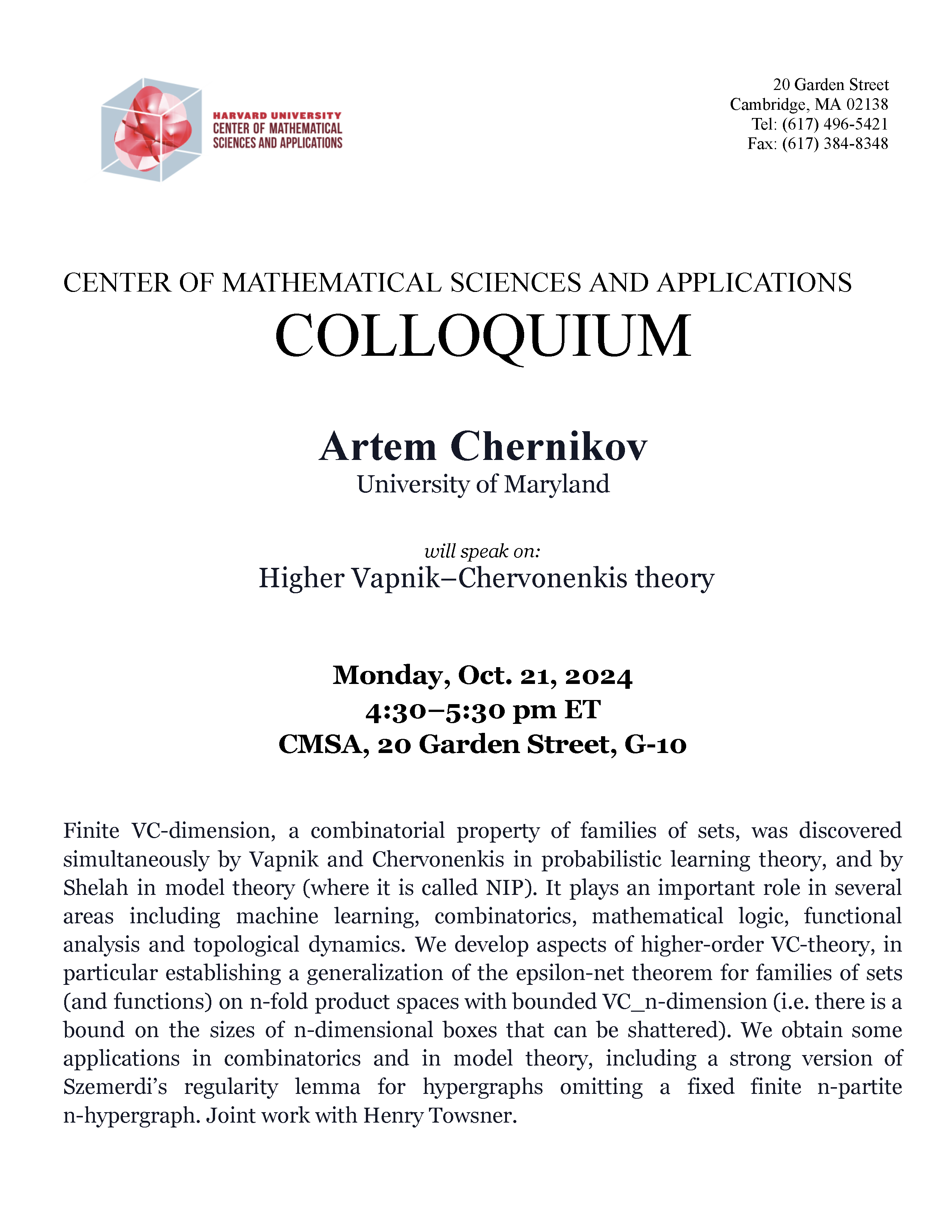
Colloquium Speaker: Artem Chernikov, University of Maryland Title: Higher Vapnik–Chervonenkis theory Abstract: Finite VC-dimension, a combinatorial property of families of sets, was discovered simultaneously by Vapnik and Chervonenkis in probabilistic learning theory, and by Shelah in model theory (where it is called NIP). It plays an important role in several areas including machine learning, combinatorics, mathematical […]