
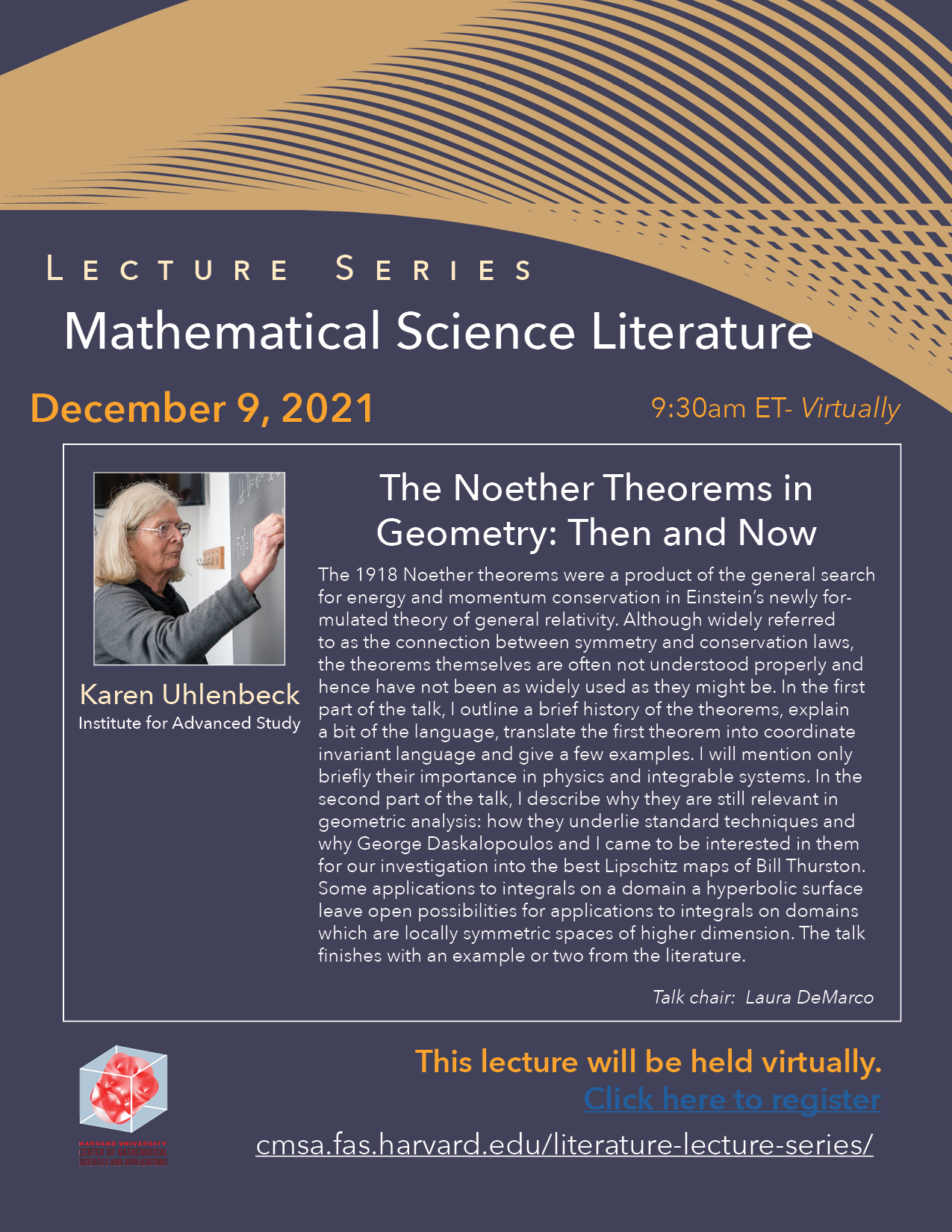
• CMSA Math-Science Literature Lecture – Karen Uhlenbeck

    Virtual

    Karen Uhlenbeck (Institute for Advanced Study) Title: The Noether Theorems in Geometry: Then and Now Abstract: The 1918 Noether theorems were a product of the general search for energy and momentum conservation in Einstein’s newly formulated theory of general relativity. Although widely referred to as the connection between symmetry and conservation laws, the theorems themselves […]
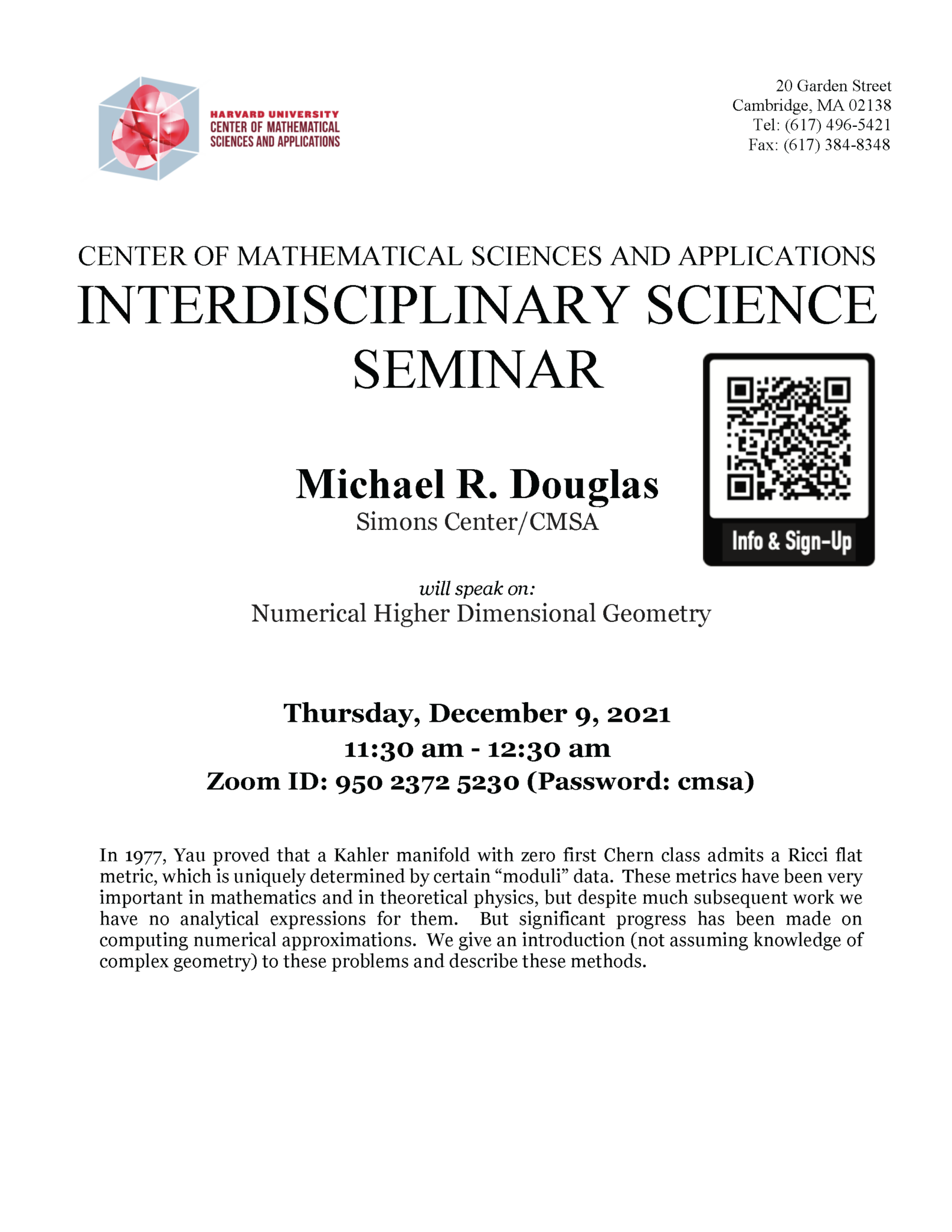
  • 12/9/21 Interdisciplinary Science Seminar

    Title: Numerical Higher Dimensional Geometry Abstract: In 1977, Yau proved that a Kahler manifold with zero first Chern class admits a Ricci flat metric, which is uniquely determined by certain “moduli” data. These metrics have been very important in mathematics and in theoretical physics, but despite much subsequent work we have no analytical expressions for them. But […]

  • On the solution space of the Ising perceptron model

    Member Seminar Speaker: Changji Xu Title: On the solution space of the Ising perceptron model Abstract:  Consider the discrete cube $\{-1,1\}^N$ and a random collection of half spaces which includes each half space $H(x) := \{y \in \{-1,1\}^N: x \cdot y \geq \kappa \sqrt{N}\}$ for $x \in \{-1,1\}^N$ independently with probability $p$. The solution space is […]

  • Gravitational anomaly of 3 + 1 dimensional Z2 toric code with fermionic charges and ferionic loop self-statistics

    Speaker: Lukasz Fidkowski (U Washington) Title: Gravitational anomaly of 3 + 1 dimensional Z2 toric code with fermionic charges and ferionic loop self-statistics Abstract: Quasiparticle excitations in 3 + 1 dimensions can be either bosons or fermions. In this work, we introduce the notion of fermionic loop excitations in 3 + 1 dimensional topological phases. Specifically, we […]

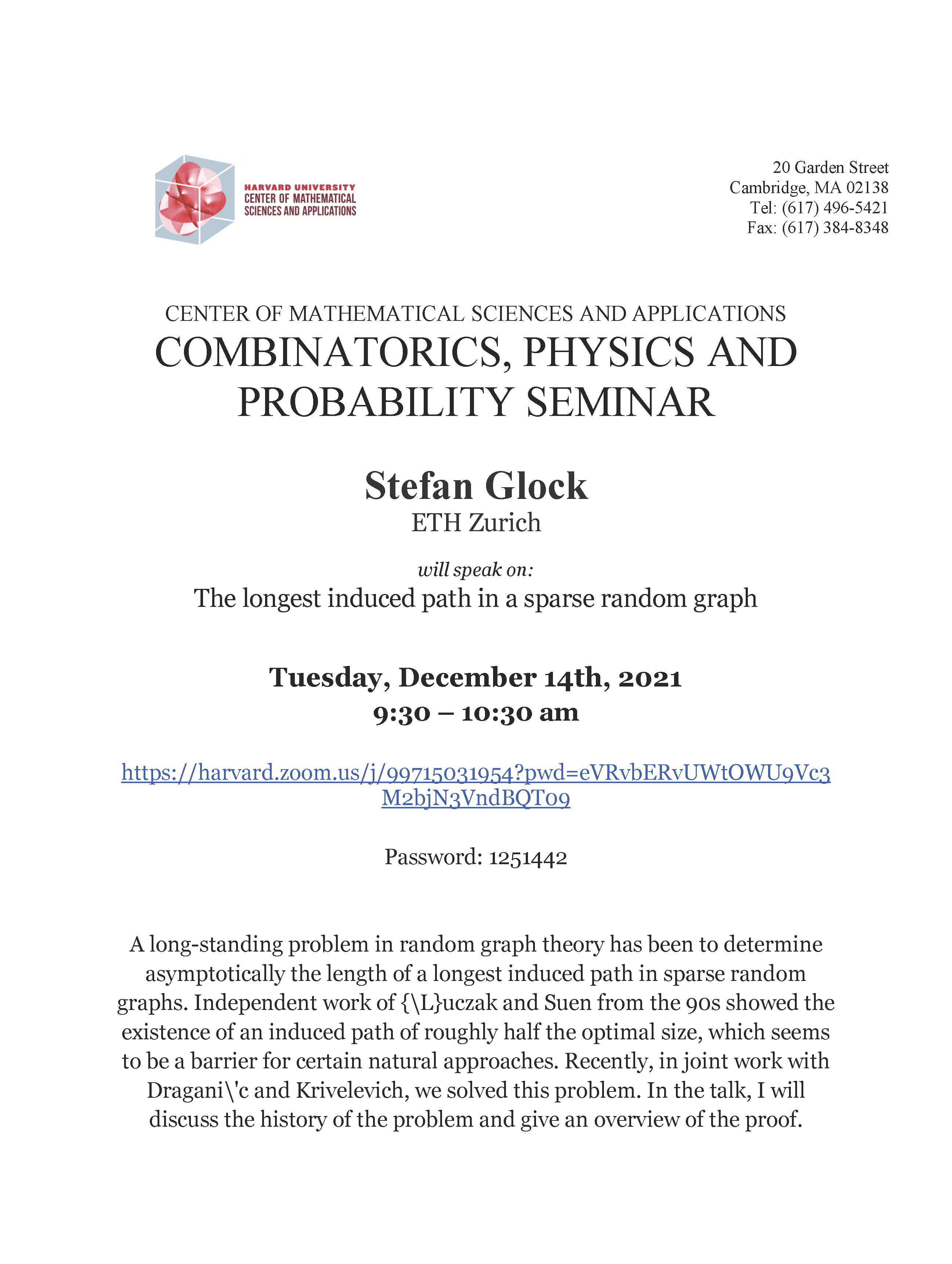
  • The longest induced path in a sparse random graph

    Abstract: A long-standing problem in random graph theory has been to determine asymptotically the length of a longest induced path in sparse random graphs. Independent work of Luczak and Suen from the 90s showed the existence of an induced path of roughly half the optimal size, which seems to be a barrier for certain natural approaches. […]

  • The Kapustin-Rozanski-Saulina “2-category” of a holomorphic integrable system

    Speaker: Constantin Teleman (UC Berkeley) Title: The Kapustin-Rozanski-Saulina “2-category” of a holomorphic integrable system Abstract: I will present a construction of the object in the title which, applied to the classical Toda system, controls the theory of categorical representations of compact Lie groups, along with applications (some conjectural, some rigorous) to gauged Gromov-Witten theory. Time permitting, we […]

  • Unreasonable effectiveness of the quantum complexity view on quantum many-body physics

    Virtual

    https://youtu.be/wKCgR3aFpnc Speaker: Anurag Anshu, Department of EECS & Challenge Institute for Quantum Computation, UC Berkeley Title: Unreasonable effectiveness of the quantum complexity view on quantum many-body physics Abstract: A central challenge in quantum many-body physics is to estimate the properties of natural quantum states, such as the quantum ground states and Gibbs states. Quantum Hamiltonian complexity […]

  • Low regularity ill-posedness for 3D elastic waves and for 3D ideal compressible MHD driven by shock formation

    Abstract: We construct counterexamples to the local existence of low-regularity solutions to elastic wave equations and to the ideal compressible magnetohydrodynamics (MHD) system in three spatial dimensions (3D). Inspired by the recent works of Christodoulou, we generalize Lindblad’s classic results on the scalar wave equation by showing that the Cauchy problems for 3D elastic waves and […]

  • 12/16/2021 Interdisciplinary Science Seminar

    Title: Quadratic reciprocity from a family of adelic conformal field theories Abstract: We consider a deformation of the 2d free scalar field action by raising the Laplacian to a positive real power. It turns out that the resulting non-local generalized free action is invariant under two commuting actions of the global conformal symmetry algebra, although it’s no […]

  • CONDENSED MATTER PROGRAM

    The methods of topology have been applied to condensed matter physics in the study of topological phases of matter. Topological states of matter are new quantum states that can be characterized by their topological properties. For example, the first topological states of matter discovered were the integer quantum Hall states. The two dimensional integer quantum […]

  • Colloquium 2021–22

    During the 2021–22 academic year, the CMSA will be hosting a Colloquium, organized by Du Pei, Changji Xu, and Michael Simkin. It will take place on Wednesdays at 9:30am – 10:30am (Boston time). The meetings will take place virtually on Zoom. All CMSA postdocs/members are required to attend the weekly CMSA Members’ Seminars, as well as the weekly CMSA […]

  • The smooth closing lemma for area-preserving surface diffeomorphisms

    Virtual

    Speaker: Boyu Zhang, Princeton University Title: The smooth closing lemma for area-preserving surface diffeomorphisms Abstract: In this talk, I will introduce the smooth closing lemma for area-preserving diffeomorphisms on surfaces. The proof is based on a Weyl formula for PFH spectral invariants and a non-vanishing result of twisted Seiberg- Witten Floer homology. This is joint work […]