• SIMPLEs: a single-cell RNA sequencing imputation strategy preserving gene modules and cell clusters variation

    Abstract: A main challenge in analyzing single-cell RNA sequencing (scRNA-seq) data is to reduce technical variations yet retain cell heterogeneity. Due to low mRNAs content per cell and molecule losses during the experiment (called ‘dropout’), the gene expression matrix has a substantial amount of zero read counts. Existing imputation methods treat either each cell or each […]
  • Global existence and stability of de Sitter-like solutions to the Einstein-Yang-Mills equations in spacetime dimensions n≥4

    Virtual

    Abstract: In this talk, we briefly introduce our recent work on establishing the global existence and stability to the future of non-linear perturbation of de Sitter-like solutions to the Einstein-Yang-Mills system in n≥4 spacetime dimension. This generalizes Friedrich’s (1991) Einstein-Yang-Mills stability results in dimension n=4 to all higher dimensions. This is a joint work with […]

  • Cancellation of the vacuum energy and Weyl anomaly in the standard model, and a two-sheeted, CPT-symmetric universe

    Virtual

    Youtube video   Abstract: I will explain a mechanism to cancel the vacuum energy and both terms in the Weyl anomaly in the standard model of particle physics, using conformally-coupled dimension-zero scalar fields.  Remarkably, given the standard model gauge group SU(3)xSU(2)xU(1), the cancellation requires precisely 48 Weyl spinors — i.e. three generations of standard model fermions, […]

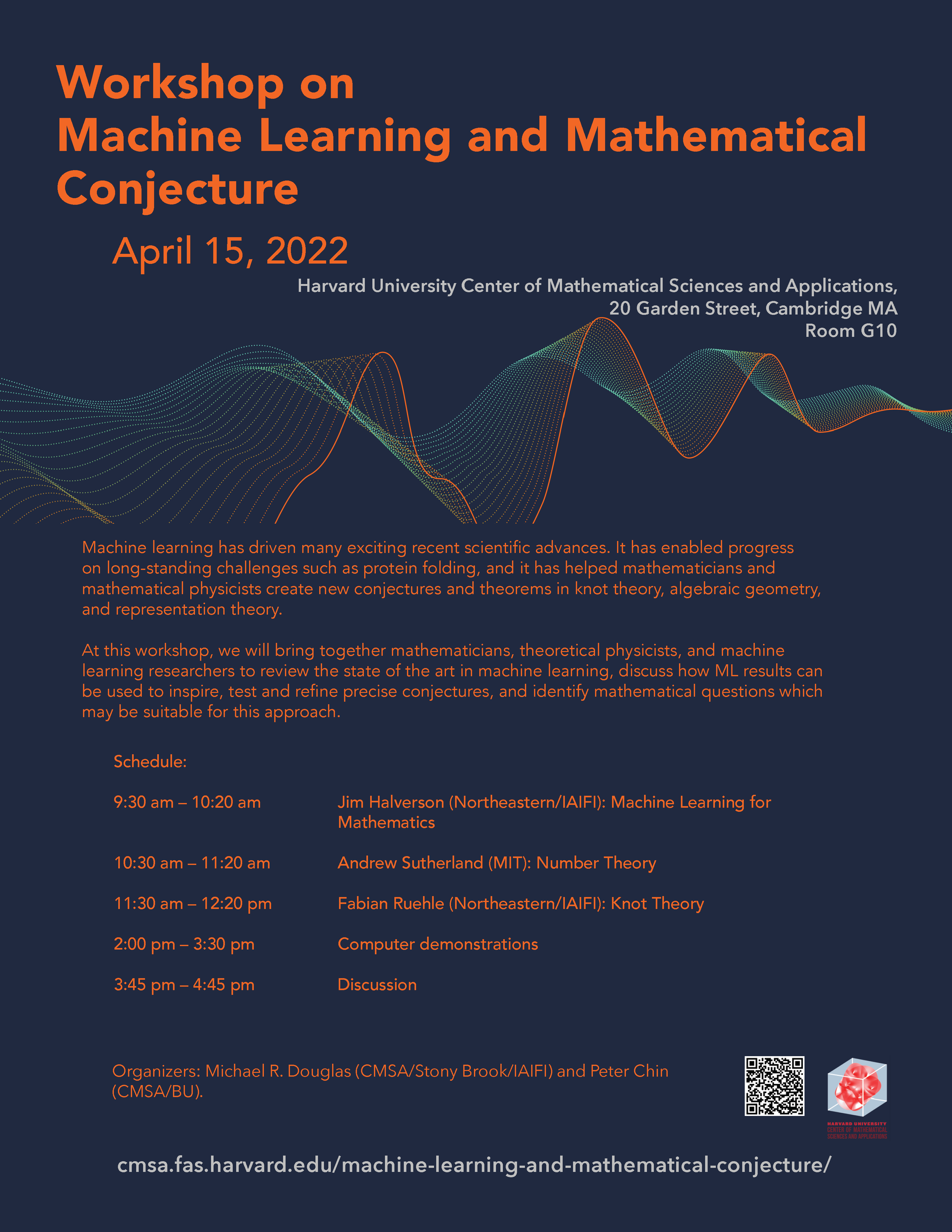
  • Workshop on Machine Learning and Mathematical Conjecture

    CMSA Room G10 CMSA, 20 Garden Street, Cambridge, MA, United States

    On April 15, 2022, the CMSA will hold a one-day workshop, Machine Learning and Mathematical Conjecture, related to the New Technologies in Mathematics Seminar Series. Location: Room G10, 20 Garden Street, Cambridge, MA 02138. Organizers: Michael R. Douglas (CMSA/Stony Brook/IAIFI) and Peter Chin (CMSA/BU). Machine learning has driven many exciting recent scientific advances. It has enabled […]

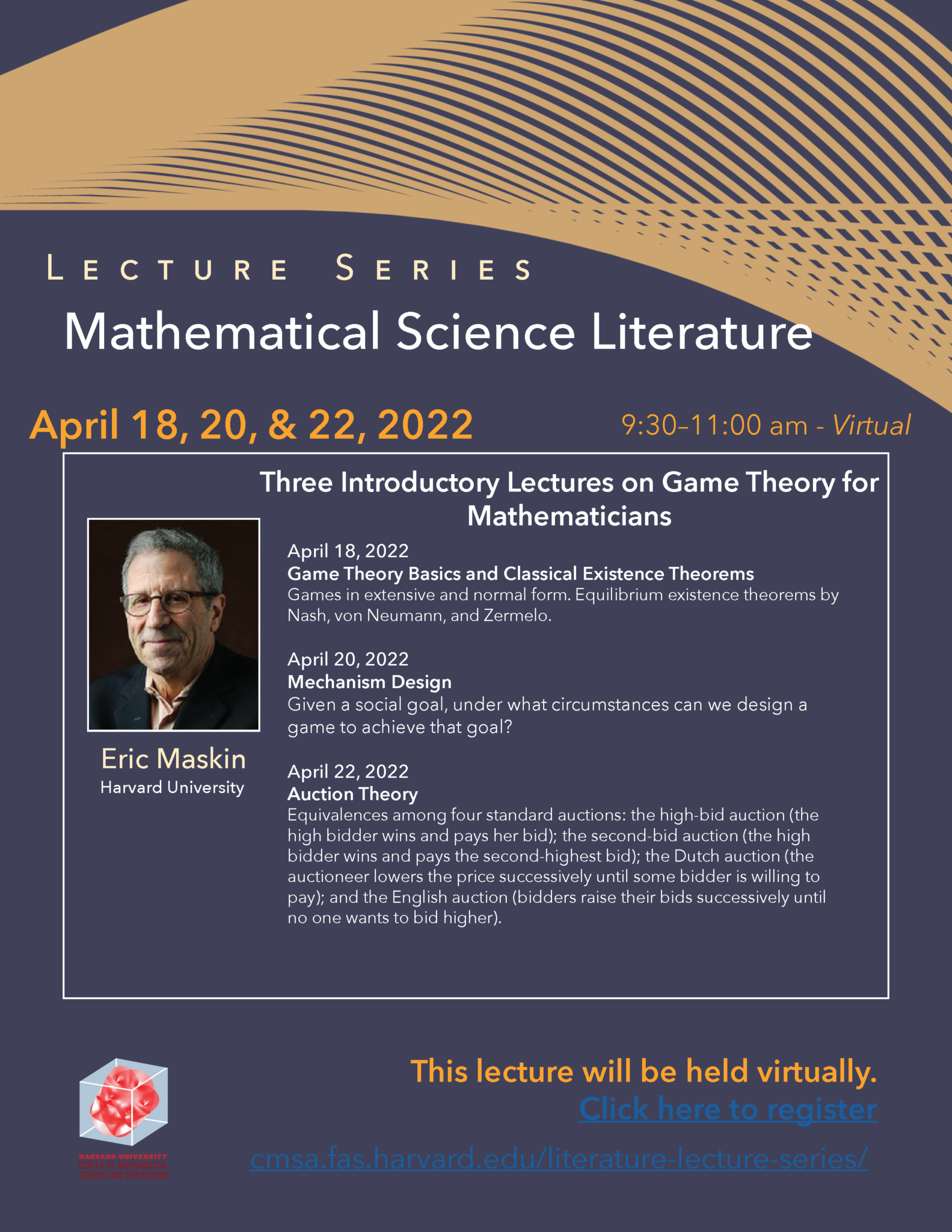
  • CMSA/Tsinghua Math-Science Literature Lecture: Three Introductory Lectures on Game Theory for Mathematicians: Game Theory Basics and Classical Existence Theorems

    Virtual

    Eric Maskin (Harvard University) Three Introductory Lectures on Game Theory for Mathematicians April 18, 2022 | 9:30 – 11:00 am ET Title: Game Theory Basics and Classical Existence Theorems Abstract: Games in extensive and normal form. Equilibrium existence theorems by Nash, von Neumann, and Zermelo Talk chairs: Scott Kominers, Sergiy Verstyuk SLIDES | VIDEO  

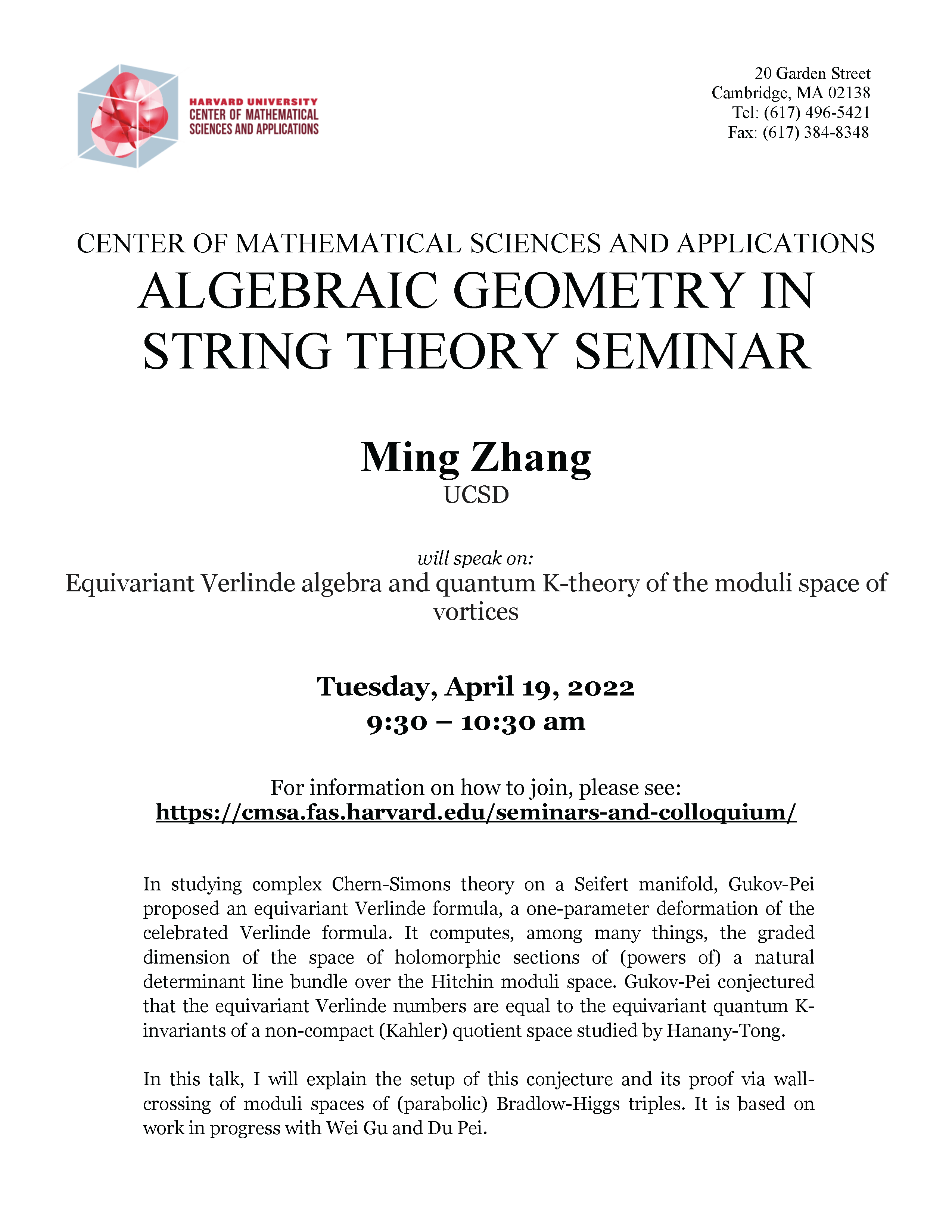
  • Equivariant Verlinde algebra and quantum K-theory of the moduli space of vortices

    Virtual

    Abstract:  In studying complex Chern-Simons theory on a Seifert manifold, Gukov-Pei proposed an equivariant Verlinde formula, a one-parameter deformation of the celebrated Verlinde formula. It computes, among many things, the graded dimension of the space of holomorphic sections of (powers of) a natural determinant line bundle over the Hitchin moduli space. Gukov-Pei conjectured that the equivariant Verlinde numbers are equal to the equivariant quantum K-invariants […]

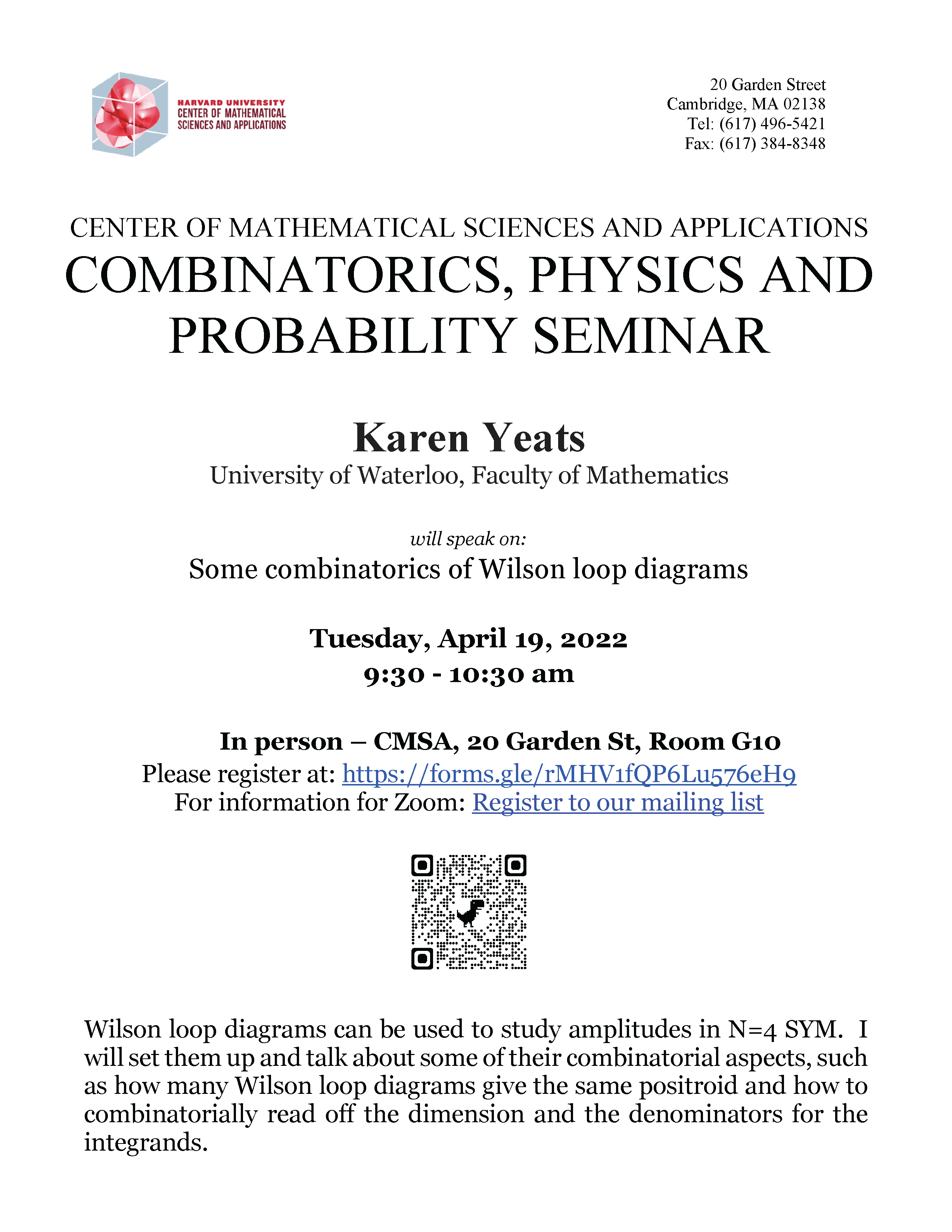
  • Some combinatorics of Wilson loop diagrams

    Hybrid

    Abstract: Wilson loop diagrams can be used to study amplitudes in N=4 SYM.  I will set them up and talk about some of their combinatorial aspects, such as how many Wilson loop diagrams give the same positroid and how to combinatorially read off the dimension and the denominators for the integrands. **This talk will be […]

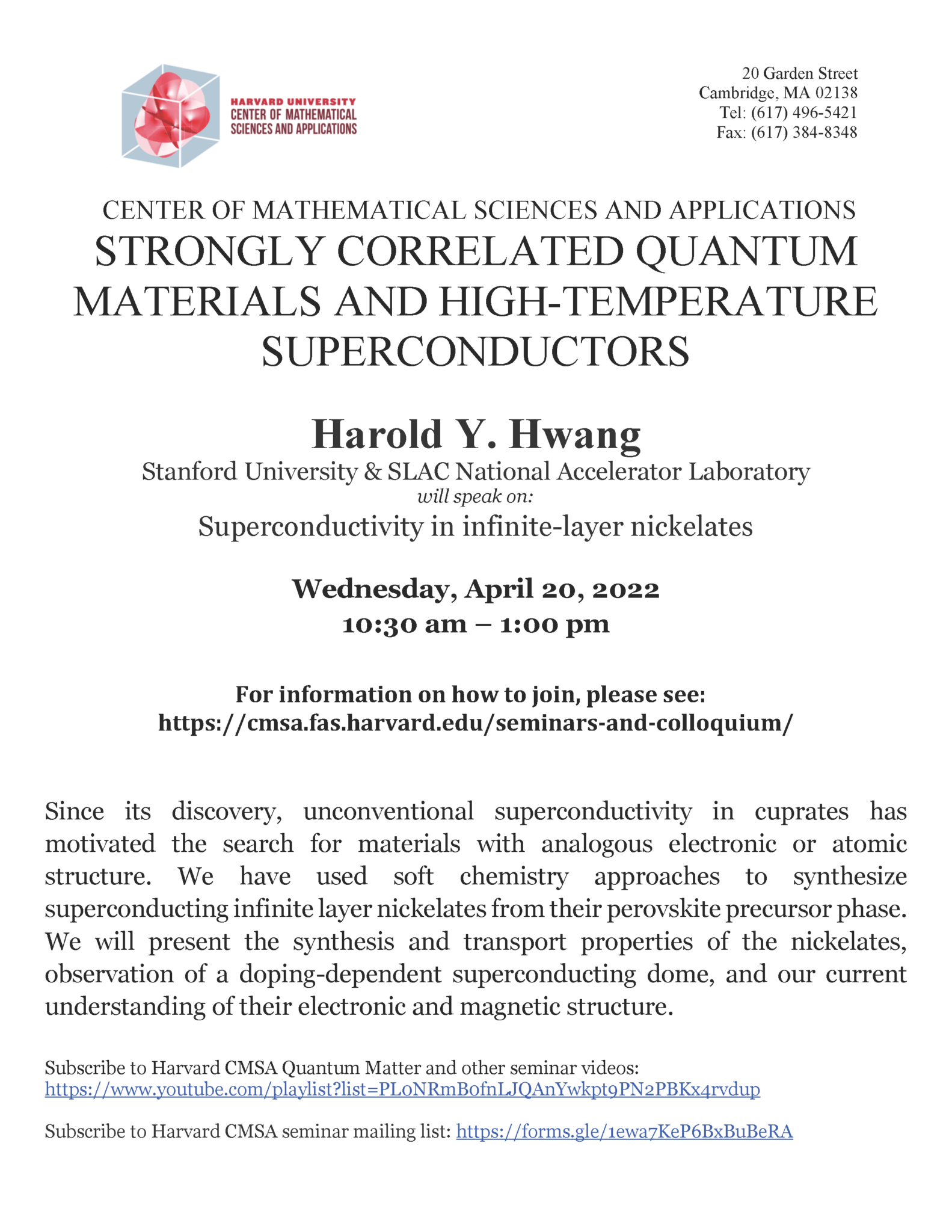
  • Superconductivity in infinite-layer nickelates

    Abstract: Since its discovery, unconventional superconductivity in cuprates has motivated the search for materials with analogous electronic or atomic structure. We have used soft chemistry approaches to synthesize superconducting infinite layer nickelates from their perovskite precursor phase. We will present the synthesis and transport properties of the nickelates, observation of a doping-dependent superconducting dome, and […]

  • Secure Multi-Party Computation: from Theory to Practice

    Abstract: Encryption is the backbone of cybersecurity. While encryption can secure data both in transit and at rest, in the new era of ubiquitous computing, modern cryptography also aims to protect data during computation. Secure multi-party computation (MPC) is a powerful technology to tackle this problem, which enables distrustful parties to jointly perform computation over […]

  • Future stability of the $1+3$ Milne model for the Einstein-Klein-Gordon system

    Abstract: We study the small perturbations of the $1+3$-dimensional Milne model for the Einstein-Klein-Gordon (EKG) system. We prove the nonlinear future stability, and show that the perturbed spacetimes are future causally geodesically complete.  For the proof, we work within the constant mean curvature (CMC) gauge and focus on the $1+3$ splitting of the Bianchi-Klein-Gordon equations. […]