• First Proof Batch 3: Mathematicians putting AI to the test

    CMSA Room G10 CMSA, 20 Garden Street, Cambridge, MA, United States

    AI for the Working Mathematician Speaker: Lauren Williams, Harvard Title: First Proof Batch 3: Mathematicians putting AI to the test Abstract: First Proof is an initiative that aims to obtain a nuanced, objective assessment about the capabilities of large language models to prove specified mathematical statements. I will report on the results of First Proof's third […]
  • A tale of two Lie groups

    CMSA Room G10 CMSA, 20 Garden Street, Cambridge, MA, United States

    Geometry and Mathematical Physics Seminar Speaker: Spiro Karigiannis, University of Waterloo Title: A tale of two Lie groups Abstract: The classical Lie group SO(4) is well-known to possess a very rich structure, relating in several ways to complex Euclidean spaces. This structure can be used to construct the classical twistor space Z over an oriented […]

  • An Introduction to Statistical Inference for Partially Identified Models

    CMSA Room G10 CMSA, 20 Garden Street, Cambridge, MA, United States

    Member Seminar Speaker: Yiqi Liu Title: An Introduction to Statistical Inference for Partially Identified Models Abstract: Classical statistical inference often relies on asymptotic approximations that are valid for each fixed data-generating process but may fail to hold uniformly over a class of relevant distributions. Starting with the familiar t-test, I will illustrate why this distinction […]

  • Geometry and Quantum Theory Seminar

    Science Center 507 1 Oxford Street, Cambridge

    Joint Math/CMSA Geometry and Quantum Theory Seminar Speaker: Kason Kunkelmann

  • What is a self-concordant barrier function?, and what is an accelerated first-order algorithm?  (ICM Series: On the work of Yurii Nesterov)

    CMSA Q&A Seminar
    Common Room, CMSA 20 Garden Street, Cambridge, MA, United States

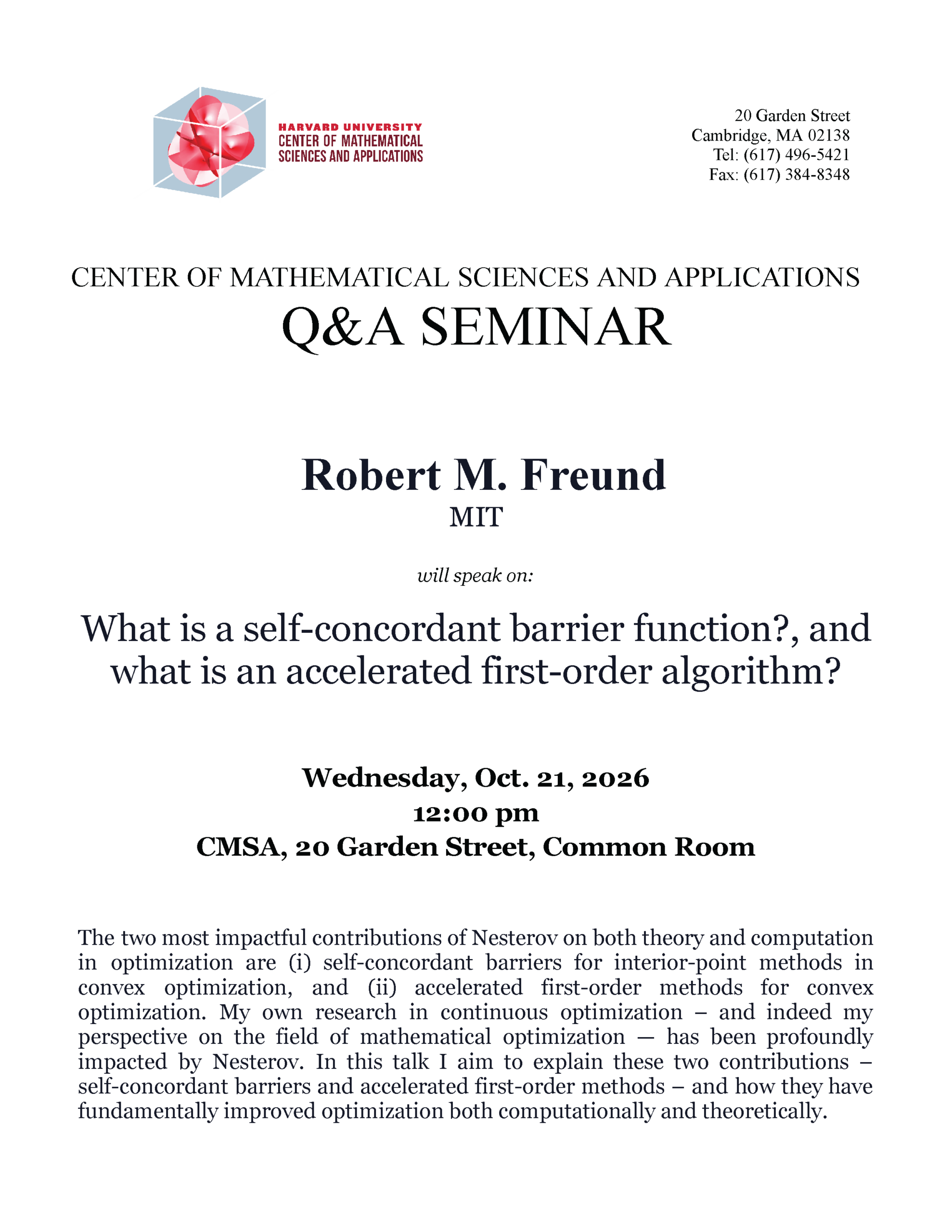
    CMSA Q&A Seminar Speaker: Robert M. Freund, MIT Title: What is a self-concordant barrier function?, and what is an accelerated first-order algorithm?  (ICM Series: On the work of Yurii Nesterov) Abstract: The two most impactful contributions of Nesterov on both theory and computation in optimization are (i) self-concordant barriers for interior-point methods in convex optimization, and (ii) […]

  • Local learning needs dendrites

    CMSA Room G10 CMSA, 20 Garden Street, Cambridge, MA, United States

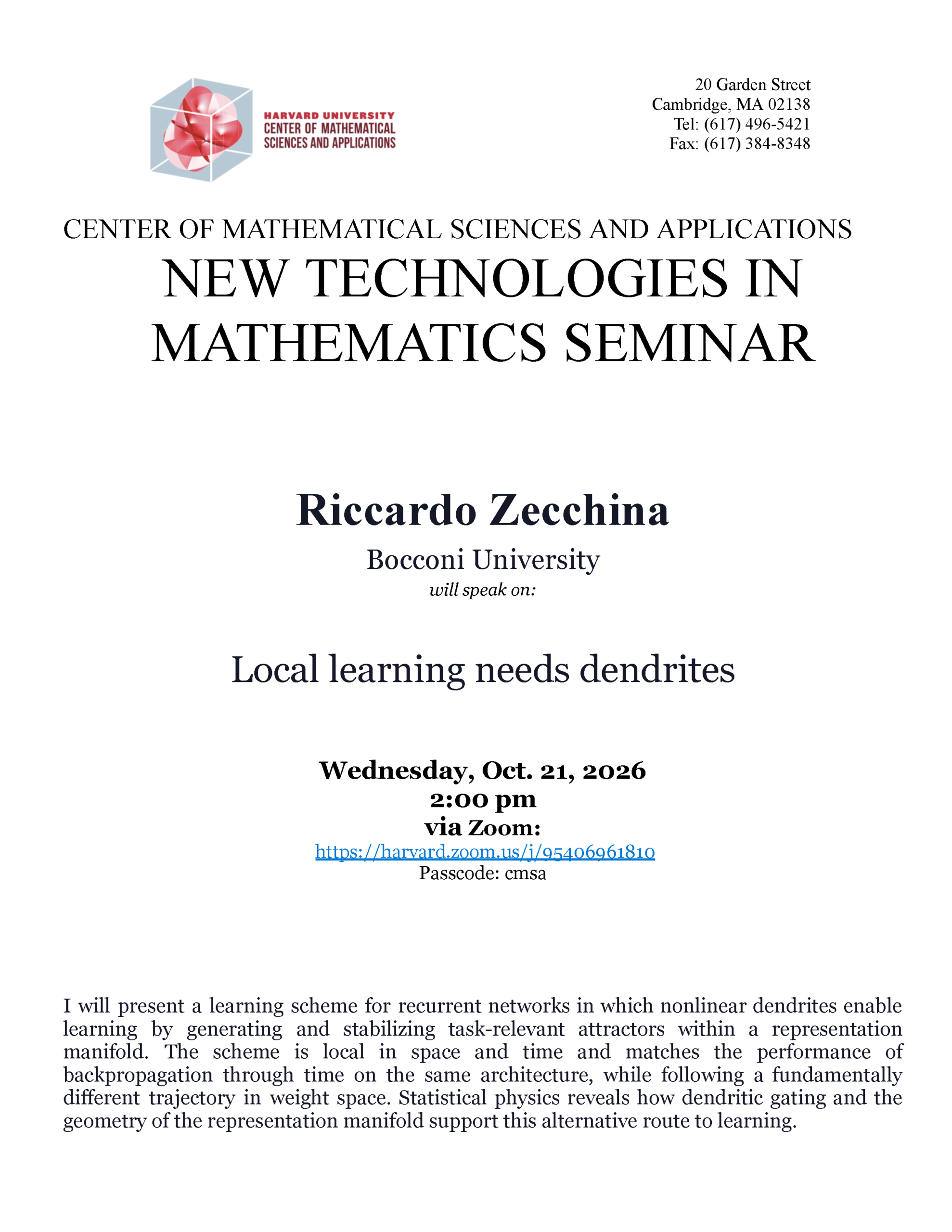
    New Technologies in Mathematics Seminar Speaker: Riccardo Zecchina (Bocconi University) Title: Local learning needs dendrites Abstract: I will present a learning scheme for recurrent networks in which nonlinear dendrites enable learning by generating and stabilizing task-relevant attractors within a representation manifold. The scheme is local in space and time and matches the performance of backpropagation […]

  • Member Seminar

    CMSA Room G10 CMSA, 20 Garden Street, Cambridge, MA, United States

    Member Seminar Speaker: David Ritzwoller  

  • The Geography of Symplectic 4-Manifolds

    CMSA Room G10 CMSA, 20 Garden Street, Cambridge, MA, United States

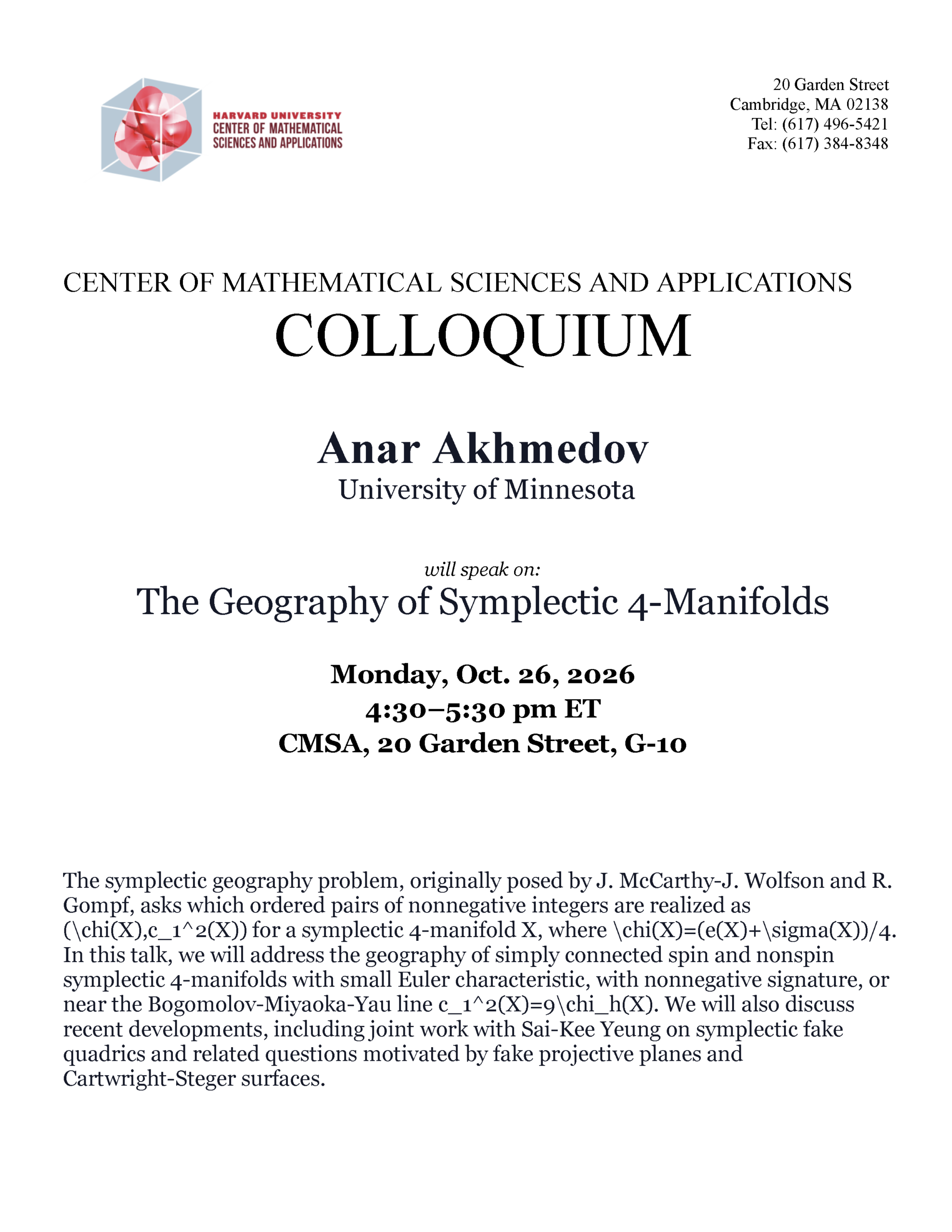
    Colloquium Speaker: Anar Akhmedov, University of Minnesota Title: The Geography of Symplectic 4-Manifolds Abstract: The symplectic geography problem, originally posed by J. McCarthy-J. Wolfson and R. Gompf, asks which ordered pairs of nonnegative integers are realized as (\chi(X),c_1^2(X)) for a symplectic 4-manifold X, where \chi(X)=(e(X)+\sigma(X))/4. In this talk, we will address the geography of simply […]