Lagrangian Floer theory and Applications Program Dates: September 15–November 21, 2026 Location: CMSA G10, 20 Garden St., Cambridge MA 02138 This thematic program will focus on recent developments in Lagrangian Floer theory and applications. These include the development of family Floer theory, degeneration techniques, Floer homotopy theory in the Lagrangian case, Floer theory in prime […]
Colloquium Speaker: Anar Akhmedov, University of Minnesota Title: The Geography of Symplectic 4-Manifolds Abstract: The symplectic geography problem, originally posed by J. McCarthy-J. Wolfson and R. Gompf, asks which ordered pairs of nonnegative integers are realized as (\chi(X),c_1^2(X)) for a symplectic 4-manifold X, where \chi(X)=(e(X)+\sigma(X))/4. In this talk, we will address the geography of simply […]
Joint Math/CMSA Geometry and Quantum Theory Seminar Speaker: Kason Kunkelmann, Harvard Title: A Rigorous Construction of the Free Quantum Field Abstract: In this talk we will build on last week’s discrete intuition and rigorously construct our first continuum quantum field theory: the free field. Following Chapter three of Chatterjee’s notes, we will realize it as a Gaussian […]
New Technologies in Mathematics Seminar Speaker: Xinjie He, UCLA Title: The IEANTN Project: Automation and Mathematical Understanding Abstract: Explicit analytic number theory combines conceptual arguments with extensive bookkeeping and numerical computation, often drawing on long chains of results across many papers. The Integrated Explicit Analytic Number Theory Network (IEANTN) aims to organize this literature into […]
AI for the Working Mathematician Speaker: Tristan Buckmaster, NYU Title: A 'Deep Blue-Kasparov moment for mathematics' Abstract: In this talk I will describe recent work with Levent Alpöge proving the blow-up for smooth solutions to the incompressible Euler equations and the broader implications that such results have of the study of mathematics.
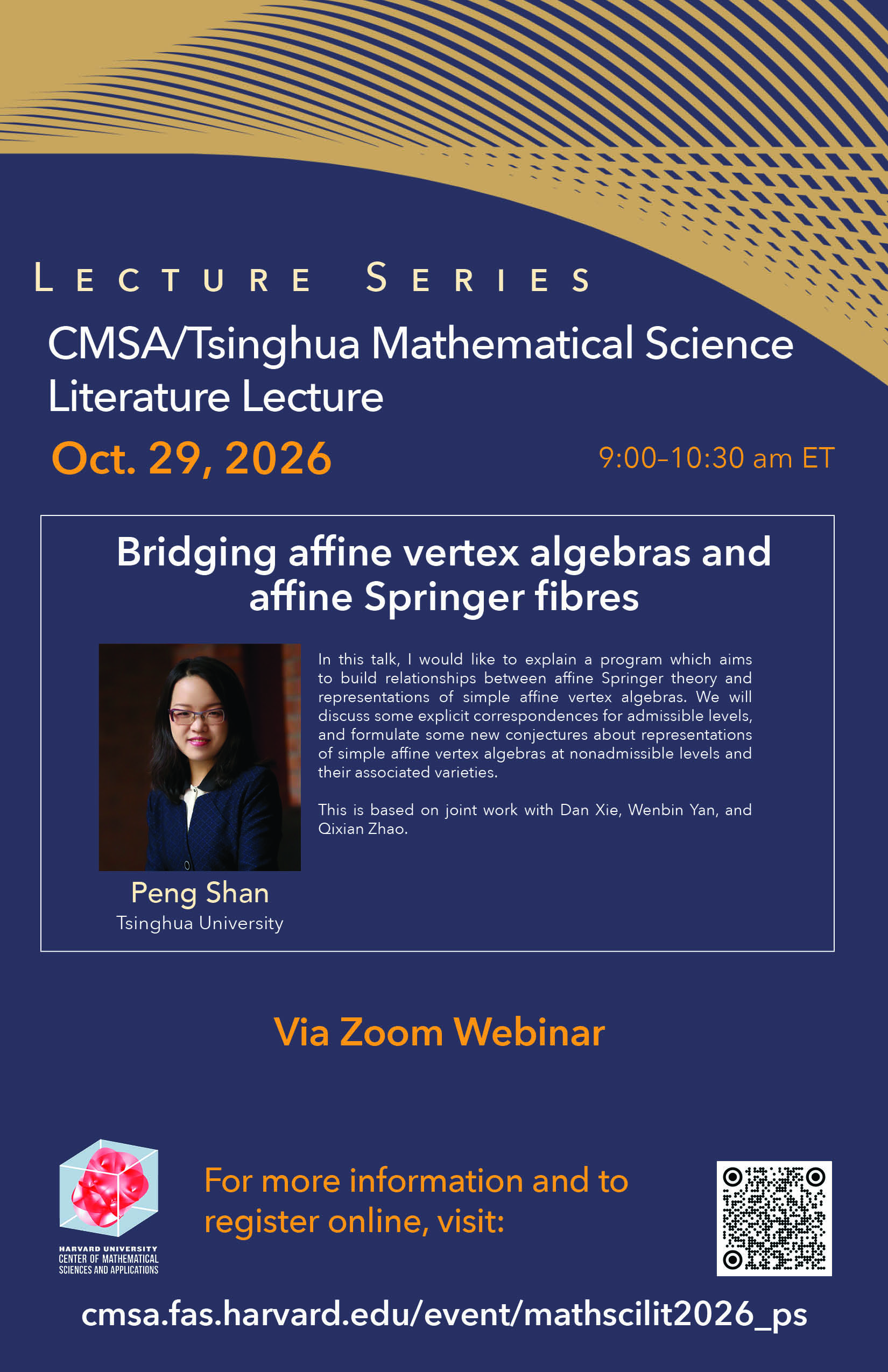
CMSA/Tsinghua Math-Science Literature Lecture Date: Thursday, October 29, 2026 Time: 9:00 - 10:30 am ET Location: online via Zoom Webinar Video (Youtube) Speaker: Peng Shan, Tsinghua University Title: Bridging affine vertex algebras and affine Springer fibres Abstract: In this talk, I would like to explain a program which aims to build relationships between affine Springer […]
Geometry and Mathematical Physics Seminar Speaker: Elliott Gesteau (MIT & CMSA) Title: Worldsheets, baby universes, and asymptotic representation theory Abstract: The string worldsheet can be reinterpreted as a baby universe field theory, a formalism first introduced by Coleman, Giddings and Strominger and more recently revived by Marolf and Maxfield to deal with third quantization in […]
Member Seminar Speaker: Bowen Yang Title: Poincaré Duality in Quantum Error-Correcting Codes Abstract: Quantum information is fragile, and one of the main tools for protecting it is a family of error-correcting codes called stabilizer codes. These codes have a second life as exactly solvable models of quantum matter: the code space is the vacuum state […]
Freedman Seminar Speaker: Michael Freedman, Harvard CMSA Title: The geometry of the Bing Involution Abstract: I’ll discuss a new sharper proof, joint with Mike Starbird that precisely quantifies the stretching necessary for Bing’s wild involution on S^3.
Doing Mathematics with AI Agents Date: Saturday, October 31, 2026 Time: 9:00–5:00 pm ET Location: Zimmer Hall (Science Center), 1 Oxford Street, Cambridge MA This is a one day workshop for Boston-area mathematics faculty to work with AI agents in a collaborative environment (designed by Andrew Sutherland) supported by computational infrastructure and formalization tools. This […]
Joint Math/CMSA Geometry and Quantum Theory Seminar Speaker: Tobias Schmidt, Harvard CMSA Title: The free field and the Fock space Abstract: Last time we defined a stochastic process on tempered distributions corresponding to the euclidean action of the free field. In this talk, we begin with verifying the Markov property. Next, we will show a […]
CMSA Q&A Seminar Speaker: Wes Cain, Harvard Title: Can Math Mend a Broken Heart? Abstract: I will discuss an abnormal cardiac rhythm known as T-wave alternans, and a simple feedback control method (time-delay autosynchronization, TDAS) that has been used successfully to suppress alternans experimentally. Variants of TDAS have been used for chaos control and prevention […]
New Technologies in Mathematics Seminar Speaker: Yasaman Bahri (Google DeepMind) Title: On the emergence of representational geometry from the statistics of natural language Abstract: Large language models organize their internal representations into rich geometric structures that mirror the concepts of natural language. For example, categorical concepts often map to linear directions, while words and phrases […]
AI for the Working Mathematician Speaker: Andrew Sutherland, MIT Title: Doing mathematics with AI agents: A case study Abstract: I will describe a project with four human collaborators and a varying cast of AI agents that ran from summer 2025 to summer 2026, what we learned about working with AI agents in the process, and what I have learned since […]
Geometry and Mathematical Physics Seminar Speaker: Ron Donagi, University of Pennsylvania Title: Recent developments in super geometry Abstract: String theory leads naturally to consideration of Super Riemann surfaces and their super moduli spaces. Much of the classical theory of curves and their moduli, e.g. existence of a Deligne-Mumford compactification, has natural super-analogues. But a number […]
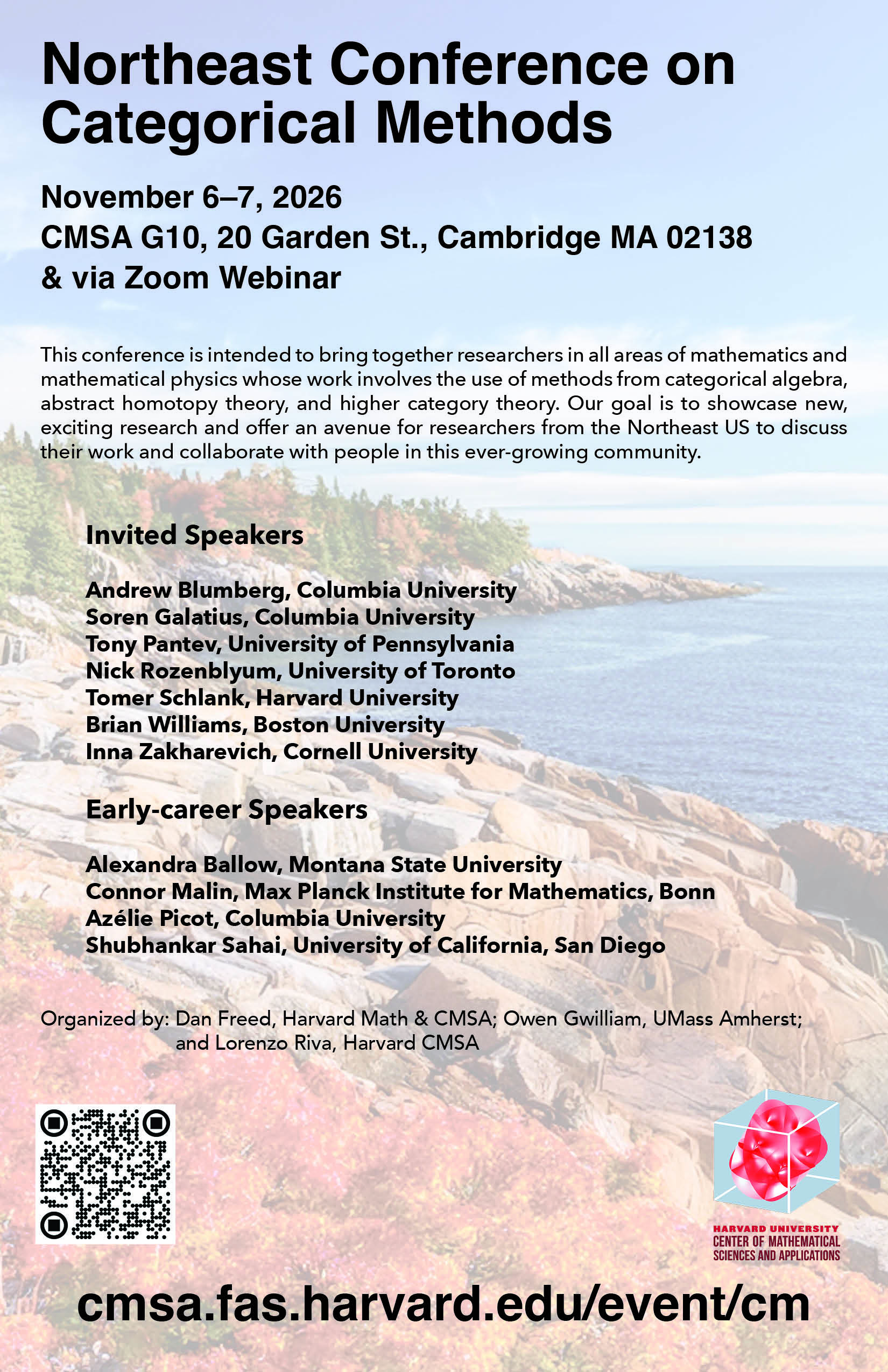
Northeast Conference on Categorical Methods Dates: November 6–7, 2026 Location: CMSA G10, 20 Garden St., Cambridge MA 02138 This conference is intended to bring together researchers in all areas of mathematics and mathematical physics whose work involves the use of methods from categorical algebra, abstract homotopy theory, and higher category theory. Our goal is to […]
Colloquium Speaker: Lukas Müller (LMU Munich) Title: Unitary extended topological field theories and higher Hermitian objects Abstract: Mathematically, topological field theories study the representation theory of manifolds undercutting and gluing. Extended topological field theories take this idea a step further by allowing one to cut manifolds in multiple directions, leading to a formulation in terms […]
Joint Math/CMSA Geometry and Quantum Theory Seminar Speaker: Nikita Sopenko (CMSA) Title: Perturbative renormalization Abstract: I will discuss the idea of perturbative renormalization in the simplest case of \phi^4 theory following Chapter 5 and Chapter 6 of the book.
New Technologies in Mathematics Seminar Speaker: Johannes von Oswald (Google) Title: Retrieval-Centric Deep Learning: Replacing Weight Matrices with Vector Databases Abstract: The deep learning models powering our current AI revolution are built on parameter matrices that form linear layers. These essential components dictate a learning system’s capacity, as well as its computational and memory requirements during […]
Geometry and Mathematical Physics Seminar Speaker: Roland Bittleston (Harvard University) Title: Nonlinear Schrödinger and Korteweg–de Vries from 4d Chern–Simons theory Abstract: Over the past decade, four-dimensional Chern–Simons theory has emerged as a powerful organising principle for two-dimensional integrability. In this talk, I will directly recover the Lax formulations and variational principles of two archetypal integrable […]
Member Seminar Speaker: Saman Habibi Esfahani, CMSA Title: How complex is S^6? Abstract: A longstanding problem posed by Hopf in 1948 asks which even-dimensional spheres can be equipped with complex structures. Classical results show that only S^2 and S^6 can admit a complex structure. Since S^2 has its own standard complex structure, the question was […]
Speaker: Christopher Harshaw, Columbia University Title: Design-Based Minimax Theory for Network Experiments Abstract: Network experiments are used throughout the social and medical sciences to investigate causal effects under the presence of interference. While a large body of work has developed improved statistical procedures, the fundamental limits of statistical estimation in these settings is less well understood. […]
CMSA Q&A Seminar Speaker: Aaron Landesman (Harvard CMSA) Title: The work of Jacob Tsimerman (ICM series) Abstract: I will discuss some basics of the Fields Medal work of Jacob Tsimerman. Some of his key contributions come toward the André-Oort conjecture, algebraicity of period maps, and arithmetic statistics.
AI for the Working Mathematician Speaker: Ken Ono, Axiom Math and University of Virginia Title: Mathematics in the Age of AI: Discovery, Verification and the Future of Proof Abstract: How is artificial intelligence changing mathematics? Drawing on my mathematical journey and recent work at Axiom Math, I will discuss the discovery of new theorems and the […]
Doing Mathematics with AI Agents Date: Saturday, November 21, 2026 Time: 9:00–5:00 pm ET Location: Zimmer Hall (Science Center), 1 Oxford Street, Cambridge MA This is a one day workshop for Boston-area mathematics postdocs to work with AI agents in a collaborative environment (designed by Andrew Sutherland) supported by computational infrastructure and formalization tools. […]
Colloquium Speaker: Ewain Gwynne, University of Chicago Title: Liouville quantum gravity and distances in random planar maps Abstract: I will give an introduction to Liouville quantum gravity, a theory of random surfaces. Such random surfaces describe the large-scale behavior of random planar maps (e.g., uniformly sampled triangulations of the sphere), equipped with the graph distance, in the […]
Colloquium Speaker: James Propp (UMass Lowell) Title: Snake graphs and q-deformed real numbers Abstract: I'll present a statistical-mechanical construction of q-deformed real numbers ]_q, inspired by the q-deformed rational numbers _q of Morier-Genoud and Ovsienko. The new construction admits two equivalent formulations: one in terms of random filters in snake posets and the other in terms of […]