• A Classifying Space for Phases of Matrix Product States

    Science Center 507 1 Oxford Street, Cambridge

    Geometry and Quantum Theory Seminar Speakers: Daniel Spiegel, Harvard Math Title: A Classifying Space for Phases of Matrix Product States Abstract: Alexei Kitaev has conjectured that there should be a loop spectrum consisting of spaces of gapped invertible quantum spin systems, indexed by spatial dimension d of the lattice. Motivated by Kitaev’s conjecture, I will […]

  • Geometry and Quantum Theory Seminar

    Science Center 507 1 Oxford Street, Cambridge

    Geometry and Quantum Theory Seminar Speaker: Dylan Galt, Harvard (60 minute talk) Title: What is a "nonlinear" near-symplectic form? Abstract: In this talk, I will explain how one might understand this question and why a possible answer can be found in the geometry of coassociative 4-folds, a special class of minimal submanifolds discovered by Harvey and Lawson.   […]

  • CMSA Q&A Seminar

    CMSA Q&A Seminar: Thomas Grimm

    Common Room, CMSA 20 Garden Street, Cambridge, MA, United States

    CMSA Q&A Seminar Speaker: Thomas Grimm, Utrecht & CMSA Topic: What is o-minimality and what is it good for?

  • Geometry and Quantum Theory Seminar

    Science Center 507 1 Oxford Street, Cambridge

    Geometry and Quantum Theory Seminar Speakers: (1) Elliott Gesteau, CMSA (60 min) and  (2) Sanjay Raman, Harvard (30 min) (1) Title: Holography for closed universes Abstract: Recent advances in holography and black hole physics have prompted a number of new puzzles related to the physics of closed universes, which can be argued to have a one-dimensional […]

  • A fully local extension of Chern-Simons theory

    Science Center 507 1 Oxford Street, Cambridge

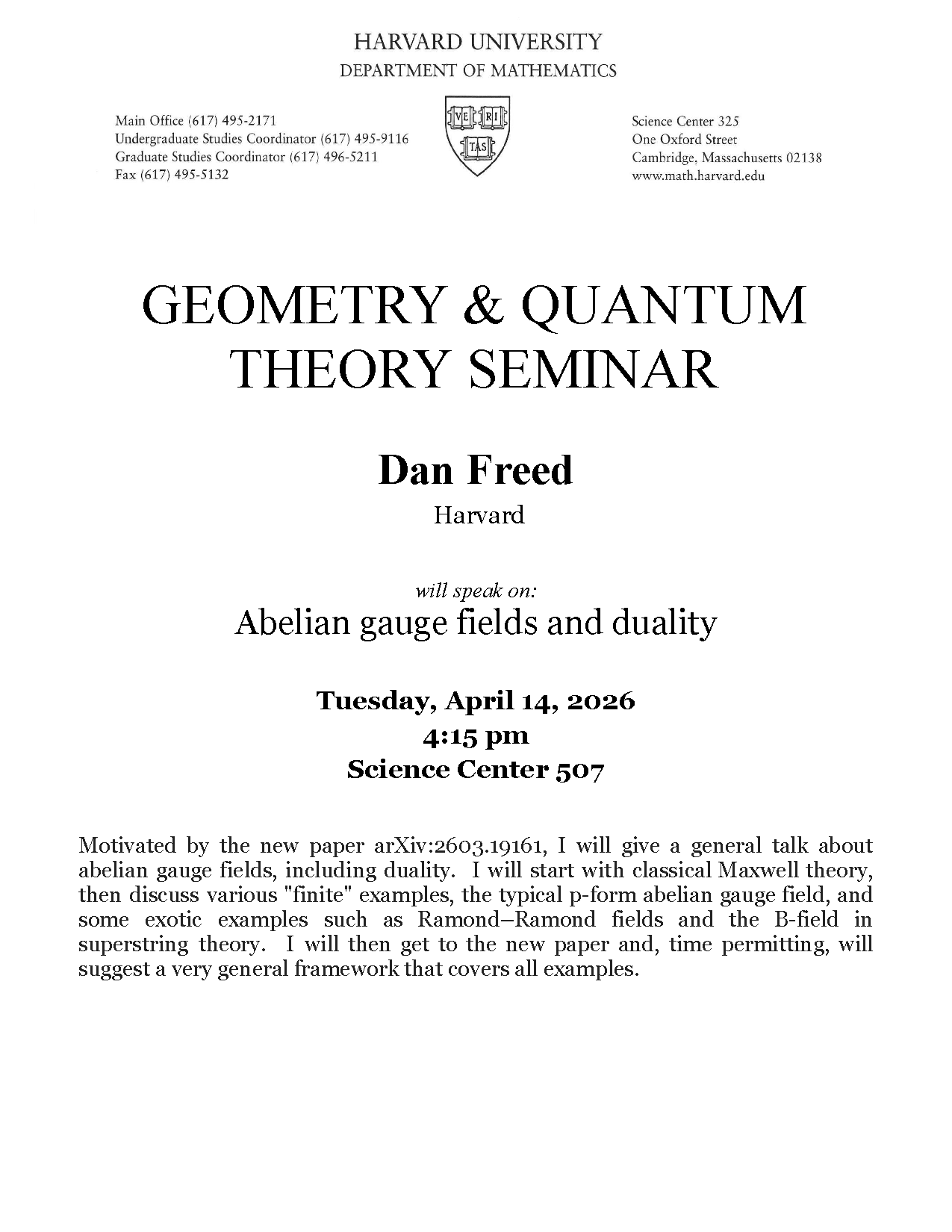
    Geometry and Quantum Theory Seminar Speaker: Dan Freed Title: A fully local extension of Chern-Simons theory Abstract: The Reshetikhin-Turaev-Witten invariants of 3-manifolds fit into a 3-dimensional topological field theory that also attaches invariants to 2-manifolds and 1-manifolds. It has long been asked to extend to invariants of 0-manifolds as well, a question that often takes […]

  • Khovanov homology from KLRW algebras

    Science Center 507 1 Oxford Street, Cambridge

    Geometry and Quantum Theory Seminar Speaker: Sunghyuk Park, CMSA Title: Khovanov homology from KLRW algebras Abstract: This is the first in a four-part series, organized together with Vasily Krylov, Sebastian Haney, and Lorenzo Riva, aimed at understanding Aganagic's categorification of quantum link invariants through Coulomb branches and homological mirror symmetry. In this first talk, I will lay […]

  • Coulomb branches and KLRW algebras

    Science Center 507 1 Oxford Street, Cambridge

    Geometry and Quantum Theory Seminar Speaker:Vasily Krylov, CMSA Title: Coulomb branches and KLRW algebras Abstract: I will introduce Coulomb branches associated to a pair of a reductive group G and its complex representation N. We will discuss their main geometric properties and examine explicit examples. I will also highlight the connection to the moduli space of monopoles. […]

  • Homological mirror symmetry for Coulomb branches

    Science Center 507 1 Oxford Street, Cambridge

    Geometry and Quantum Theory Seminar Speaker: Sebastian Haney, Harvard Title: Homological mirror symmetry for Coulomb branches Abstract: I will describe a result of Aganagic, Danilenko, Li, Shende, and Zhou which constructs a embeddings of certain cylindrical KLRW categories into Fukaya-Seidel categories of multiplicative Coulomb branches. This can be thought of as a homological mirror symmetry statement relating the […]

  • Geometry and Quantum Theory Seminar

    Science Center 507 1 Oxford Street, Cambridge

    Geometry and Quantum Theory Seminar Speaker: Lorenzo Riva, CMSA Title: Aganagic’s invariant is Khovanov homology Abstract: Webster computed the Khovanov homology of (the closure of) a braid in terms of the action of that braid on a certain KLRW category. Aganagic proposed that the same computation could be done in the Fukaya-Seidel category of the multiplicative Coulomb […]