• Neural Optimal Stopping Boundary

    CMSA Room G10 CMSA, 20 Garden Street, Cambridge, MA, United States

    Speaker: Max Reppen (Boston University) Title: Neural Optimal Stopping Boundary Abstract:  A method based on deep artificial neural networks and empirical risk minimization is developed to calculate the boundary separating the stopping and continuation regions in optimal stopping. The algorithm parameterizes the stopping boundary as the graph of a function and introduces relaxed stopping rules based on fuzzy […]
  • Unexpected Uses of Neural Networks: Field Theory and Metric Flows  

    CMSA Room G10 CMSA, 20 Garden Street, Cambridge, MA, United States

    Speaker: James Halverson (Northeastern University)   Title: Unexpected Uses of Neural Networks: Field Theory and Metric Flows Abstract:  We are now quite used to the idea that deep neural networks may be trained in a variety of ways to tackle cutting-edge problems in physics and mathematics, sometimes leading to rigorous results. In this talk, however, I will argue […]

  • Colloquium

    Factorization algebras in quite a lot of generality

    CMSA Room G10 CMSA, 20 Garden Street, Cambridge, MA, United States

    Colloquium Speaker: Clark Barwick, University of Edinburgh Title: Factorization algebras in quite a lot of generality Abstract: The objects of arithmetic geometry are not manifolds. Some concepts from differential geometry admit analogues in arithmetic, but they are not straightforward. How then can we hope to make precise sense of quantum field theories on these objects? […]

  • Colloquium

    Strong bounds for arithmetic progressions

    CMSA Room G10 CMSA, 20 Garden Street, Cambridge, MA, United States

    Colloquium Speaker: Raghu Meka (UCLA) Title: Strong bounds for arithmetic progressions Abstract: Suppose you have a set S of integers from {1,2,...,N} that contains at least N / C elements. Then for large enough N, must S contain three equally spaced numbers (i.e., a 3-term arithmetic progression)? In 1953, Roth showed this is the case […]

  • Colloquium

    Koszul duality & twisted holography for asymptotically flat spacetimes

    CMSA Room G10 CMSA, 20 Garden Street, Cambridge, MA, United States

    Colloquium Speaker: Natalie Paquette, University of Washington Title: Koszul duality & twisted holography for asymptotically flat spacetimes Abstract: Koszul duality has been understood in recent years to characterize order-type defects in twists of supersymmetric field theories. This notion has been generalized, from a physical point of view, by studying couplings between D-branes and closed string […]

  • Colloquium

    The DNA of Particle Scattering

    CMSA Room G10 CMSA, 20 Garden Street, Cambridge, MA, United States

    Colloquium Speaker: Lance Dixon (SLAC, Stanford University) Title: The DNA of Particle Scattering Abstract: At the Large Hadron Collider, the copious scattering of quarks and gluons in quantum chromodynamics (QCD) produces Higgs bosons and many backgrounds to searches for new physics.  At short distances, scattering in QCD can be evaluated in perturbation theory and leads to highly […]

  • Colloquium

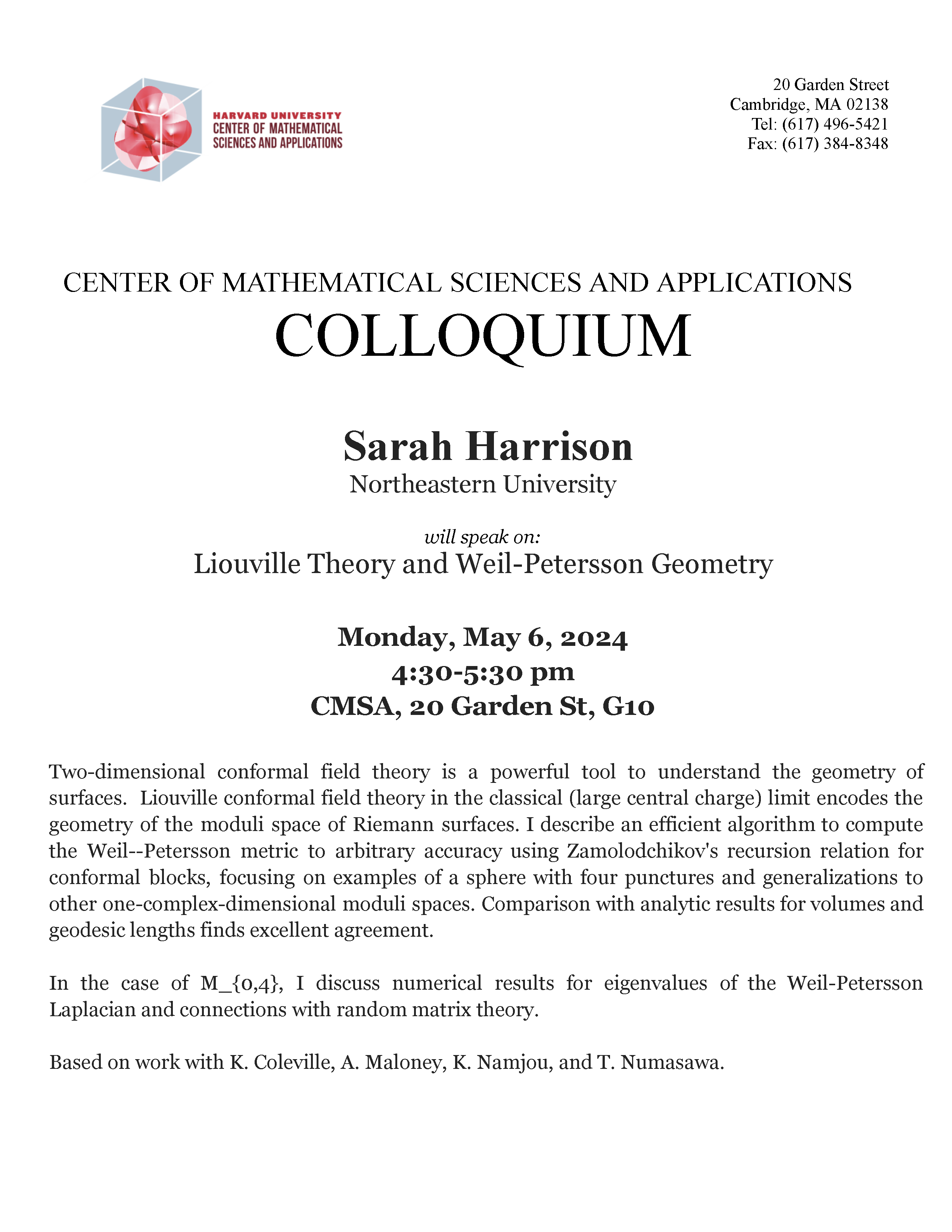
    Liouville Theory and Weil-Petersson Geometry

    CMSA Room G10 CMSA, 20 Garden Street, Cambridge, MA, United States

    Colloquium Speaker: Sarah Harrison (Northeastern University) Title: Liouville Theory and Weil-Petersson Geometry Abstract: Two-dimensional conformal field theory is a powerful tool to understand the geometry of surfaces. Liouville conformal field theory in the classical (large central charge) limit encodes the geometry of the moduli space of Riemann surfaces. I describe an efficient algorithm to compute […]

  • Colloquium

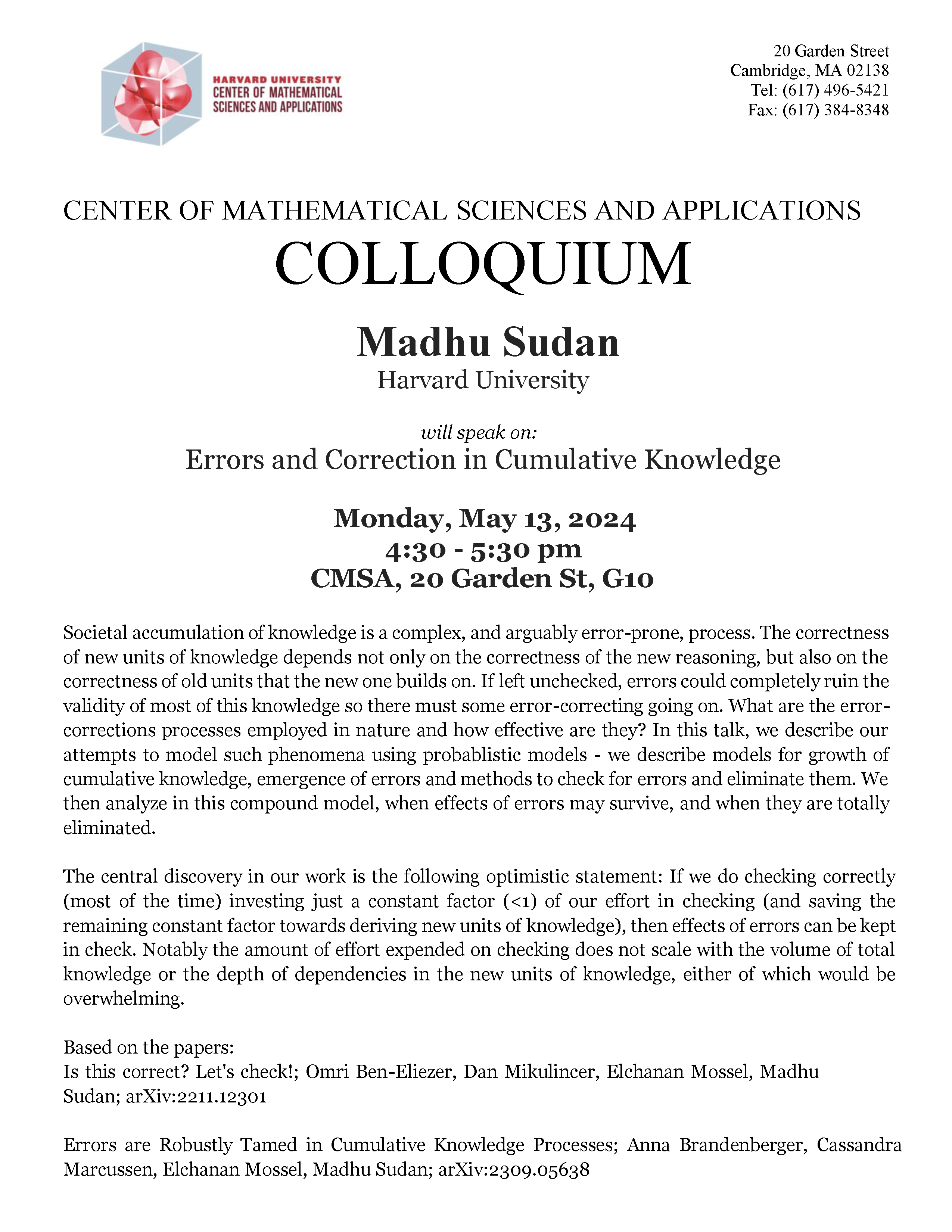
    Errors and Correction in Cumulative Knowledge

    CMSA Room G10 CMSA, 20 Garden Street, Cambridge, MA, United States

    Colloquium Speaker: Madhu Sudan, Harvard University Title: Errors and Correction in Cumulative Knowledge Abstract: Societal accumulation of knowledge is a complex, and arguably error-prone, process. The correctness of new units of knowledge depends not only on the correctness of the new reasoning, but also on the correctness of old units that the new one builds […]

  • Foundation Seminar

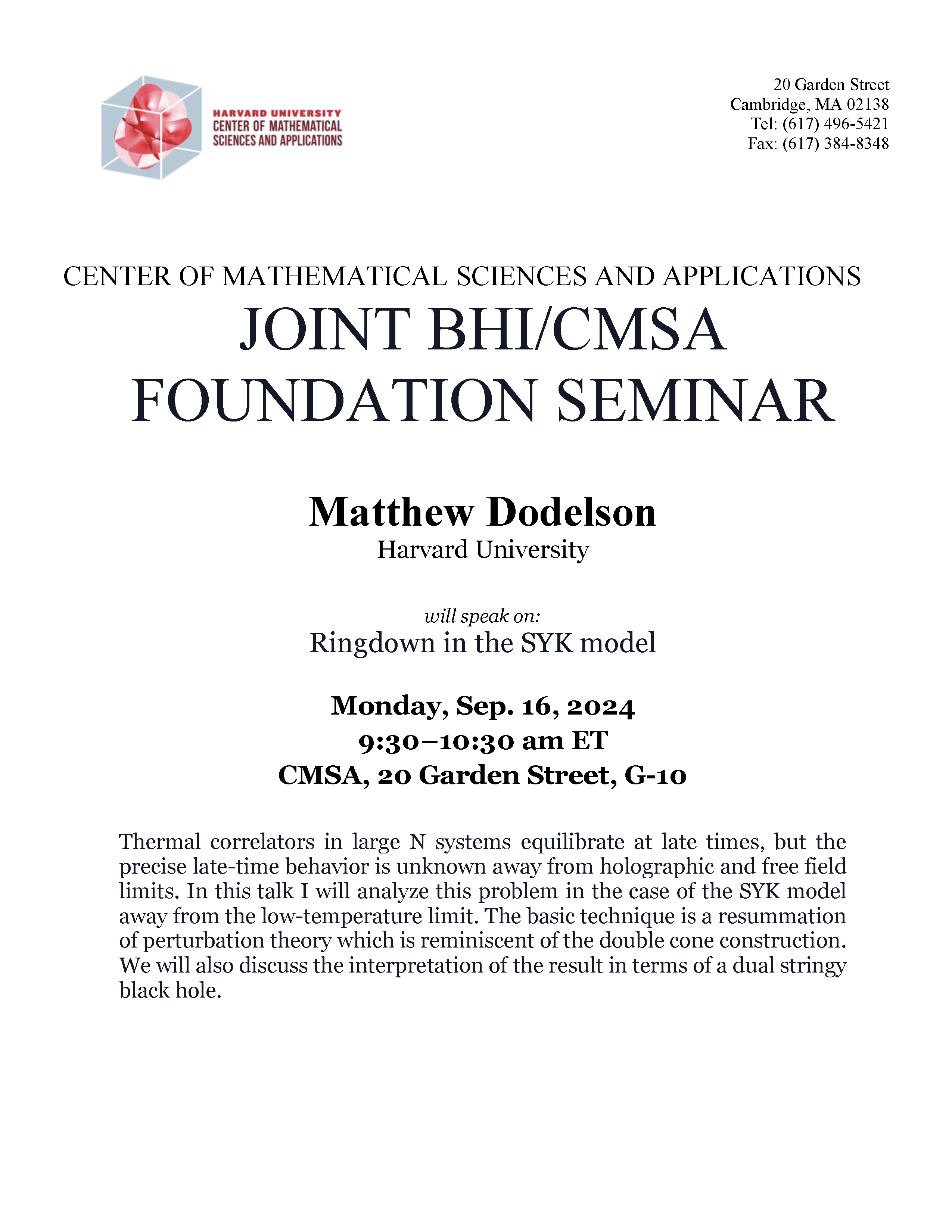
    Ringdown in the SYK model

    CMSA Room G10 CMSA, 20 Garden Street, Cambridge, MA, United States

    Joint BHI/CMSA Foundation Seminar Speaker: Matthew Dodelson (Harvard) Title: Ringdown in the SYK model Abstract: Thermal correlators in large N systems equilibrate at late times, but the precise late-time behavior is unknown away from holographic and free field limits. In this talk I will analyze this problem in the case of the SYK model away from […]

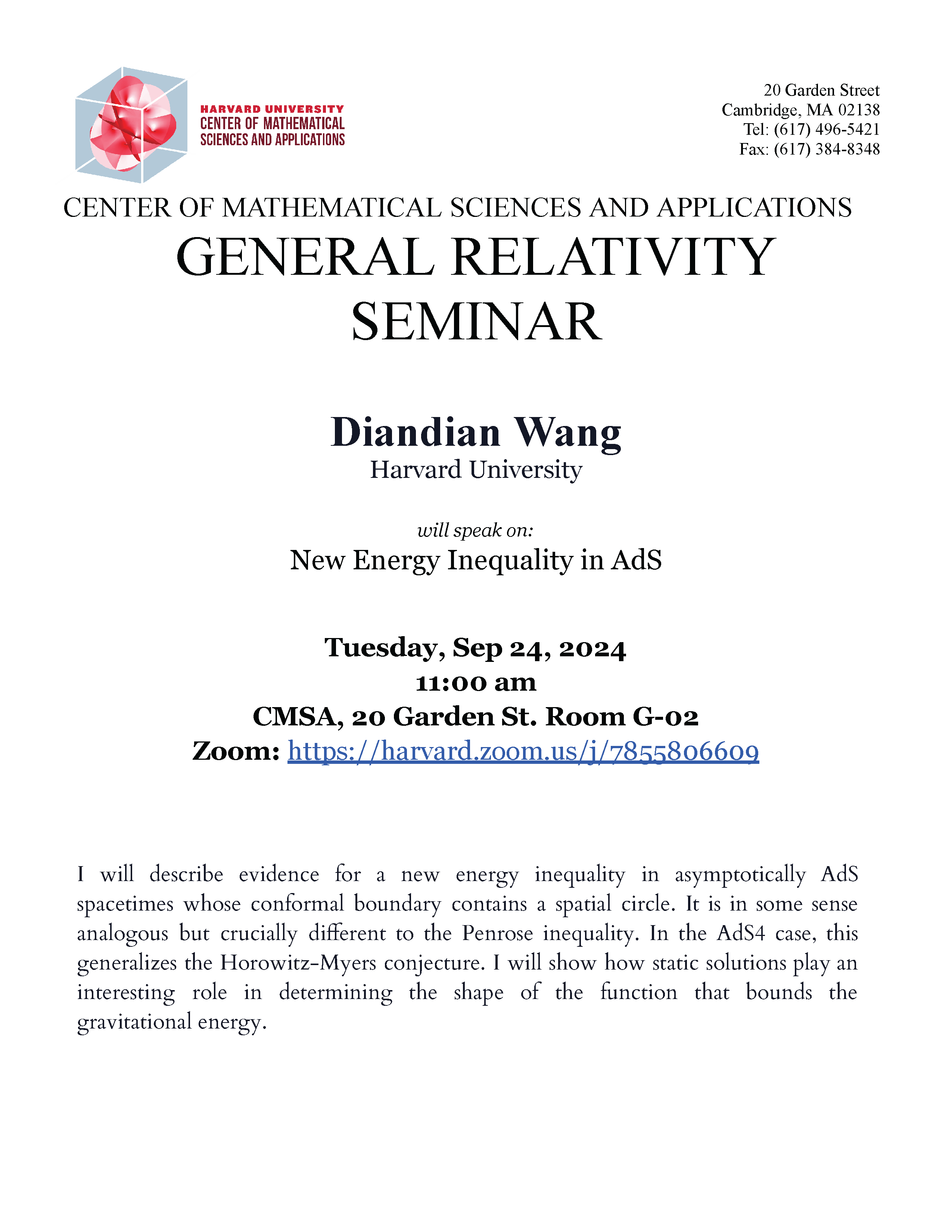
  • New Energy Inequality in AdS

    CMSA Room G10 CMSA, 20 Garden Street, Cambridge, MA, United States

    General Relativity Seminar Speaker: Diandian Wang, Harvard University Title: New Energy Inequality in AdS Abstract: I will describe evidence for a new energy inequality in asymptotically AdS spacetimes whose conformal boundary contains a spatial circle. It is in some sense analogous but crucially different to the Penrose inequality. In the AdS4 case, this generalizes the […]

  • Quasinormal Corrections to Near-Extremal Black Hole Thermodynamics

    CMSA Room G10 CMSA, 20 Garden Street, Cambridge, MA, United States

    General Relativity Seminar Speaker: Daniel Kapec, Harvard Title: Quasinormal Corrections to Near-Extremal Black Hole Thermodynamics Abstract: Recent work on the quantum mechanics of near-extremal non-supersymmetric black holes has identified a characteristic  scaling of the low temperature black hole partition function. This result has only been derived using the path integral in the near-horizon region and relies […]