

Swampland and our Universe
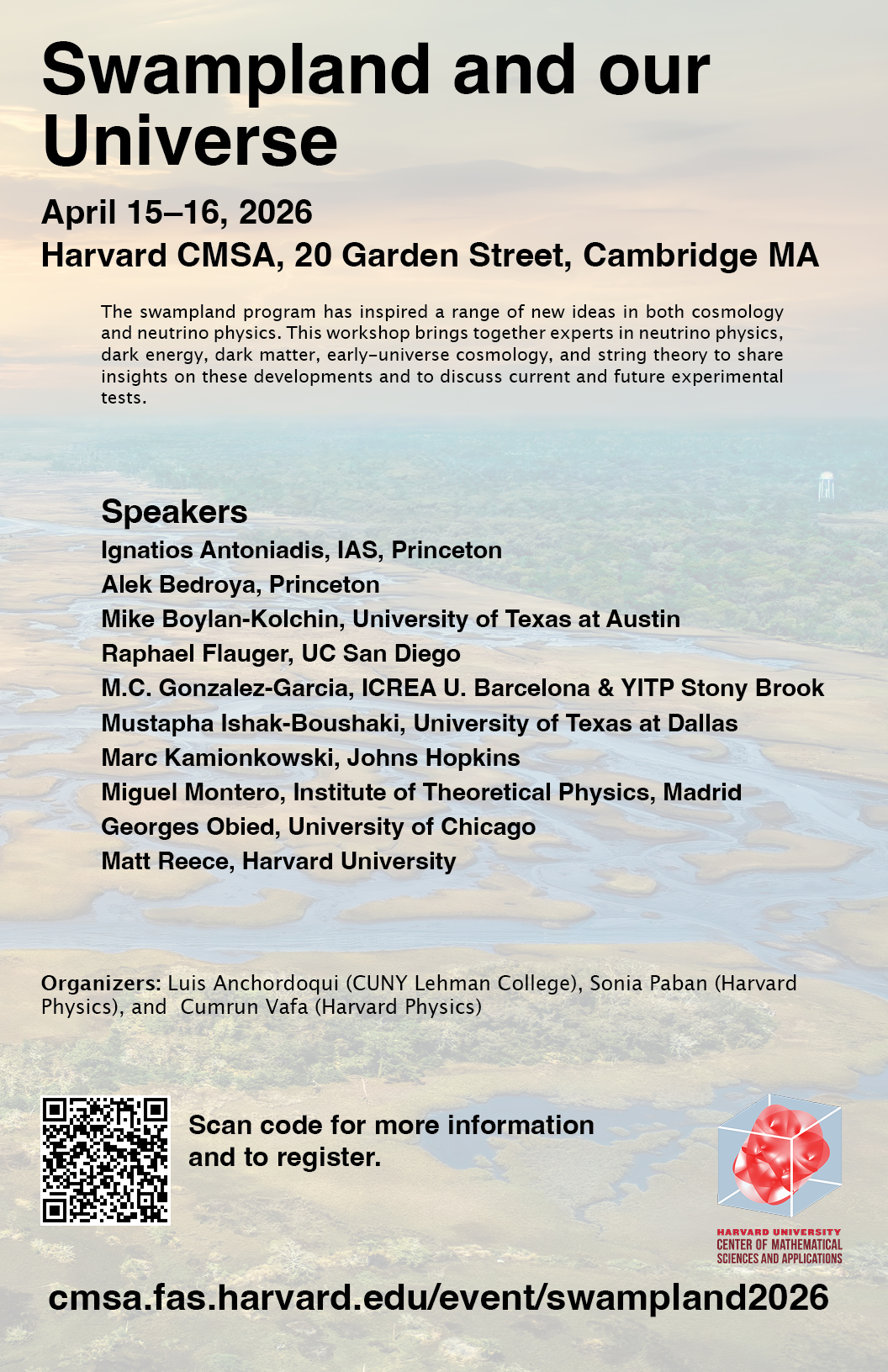
Swampland and our Universe
Dates: April 15–16, 2026
Location: Harvard CMSA, Room G10, 20 Garden Street, Cambridge MA
The swampland program has inspired a range of new ideas in both cosmology and neutrino physics. This workshop brings together experts in neutrino physics, dark energy, dark matter, early-universe cosmology, and string theory to share insights on these developments and to discuss current and future experimental tests.
Speakers
- Ignatios Antoniadis, IAS, Princeton
- Alek Bedroya, Princeton
- Mike Boylan-Kolchin, UT Austin
- Raphael Flauger, UC San Diego
- M.C. Gonzalez-Garcia, ICREA U. Barcelona & YITP Stony Brook
- Mustapha Ishak-Boushaki, UT Dallas
- Marc Kamionkowski, Johns Hopkins
- Miguel Montero, Institute of Theoretical Physics, Madrid
- Georges Obied, U Chicago
- Matt Reece, Harvard
Organizers: Luis Anchordoqui (CUNY Lehman College), Sonia Paban (Harvard Physics), and Cumrun Vafa (Harvard Physics)
Schedule
Wednesday, Apr. 15, 2026
8:00–9:00 am
Breakfast
9:00–10:00 am
Mark Kamionkowski, Johns Hopkins –Dark-matter dynamics and new physics
Abstract: Galactic halos that are spherical, stationary, and composed of collisionless dark matter are easy to describe mathematically. If dark matter decays or interacts or there is some departure from equilibrium or time evolution of the system, all bets are off. In this case costly N-body simulations are required. If, however, one retains the assumption of spherical symmetry, these systems can be evolved numerically with a far simpler algorithm that is easily coded run in a matter of minutes on a laptop, rather than a day on a supercomputer. I will describe this approach and illustrate with simulations of self-interacting dark matter, decaying dark matter (with and without anisotropic velocity distributions, supermassive-black-hole growth, tidal stripping, mixed SIDM/CDM models. Come prepared with your own non-standard dark-matter model; we’ll see if we can simulate it during the talk!
10:00–10:30 am
Coffee Break
10:30–11:30 am
Raphael Flauger, UC San Diego
11:30 am–1:00 pm
Lunch Break (catered)
1:00–2:00 pm
Alek Bedroya, Princeton
2:00–2:30 pm
Coffee Break
2:30–3:30 pm
Mustapha Ishak-Boushaki, UT Dallas
3:30–4:00 pm
Coffee Break
4:00–5:00 pm
George Obied, U Chicago
Thursday, Apr. 16, 2026
8:00–8:30 am
Breakfast
8:30–9:30 am
MC Gonzalez-Garcia, ICREA U. Barcelona, YITP Stony Brook
9:30–10:00 am
Coffee Break
10:00–11:00 am
Miguel Montero, IFT, Madrid
11:00–11:30 am
Coffee Break
11:30 am–12:30 pm
Ignatios Antoniadis, IAS, Princeton – Searching for the dark dimension in neutrino experiments
Abstract: Micron size extra dimensions offer a possibility to explain the smallness of neutrino masses if the right-handed neutrino propagates in the higher dimensional bulk. I will discuss the theoretical framework and the experimental signatures of this proposal in present and future experiments of KATRIN prototype, aiming to measure the magnitude of neutrino masses and to search for extra sterile-type species.
12:30–1:30 pm
Lunch Break (catered)
1:30–2:30 pm
Mike Boylan-Kolchin, UT Austin – Galaxies as Tracers of the Matter Density Field
2:30–3:00 pm
Coffee Break
3:00–4:00 pm
Matt Reece, Harvard