

Swampland and our Universe
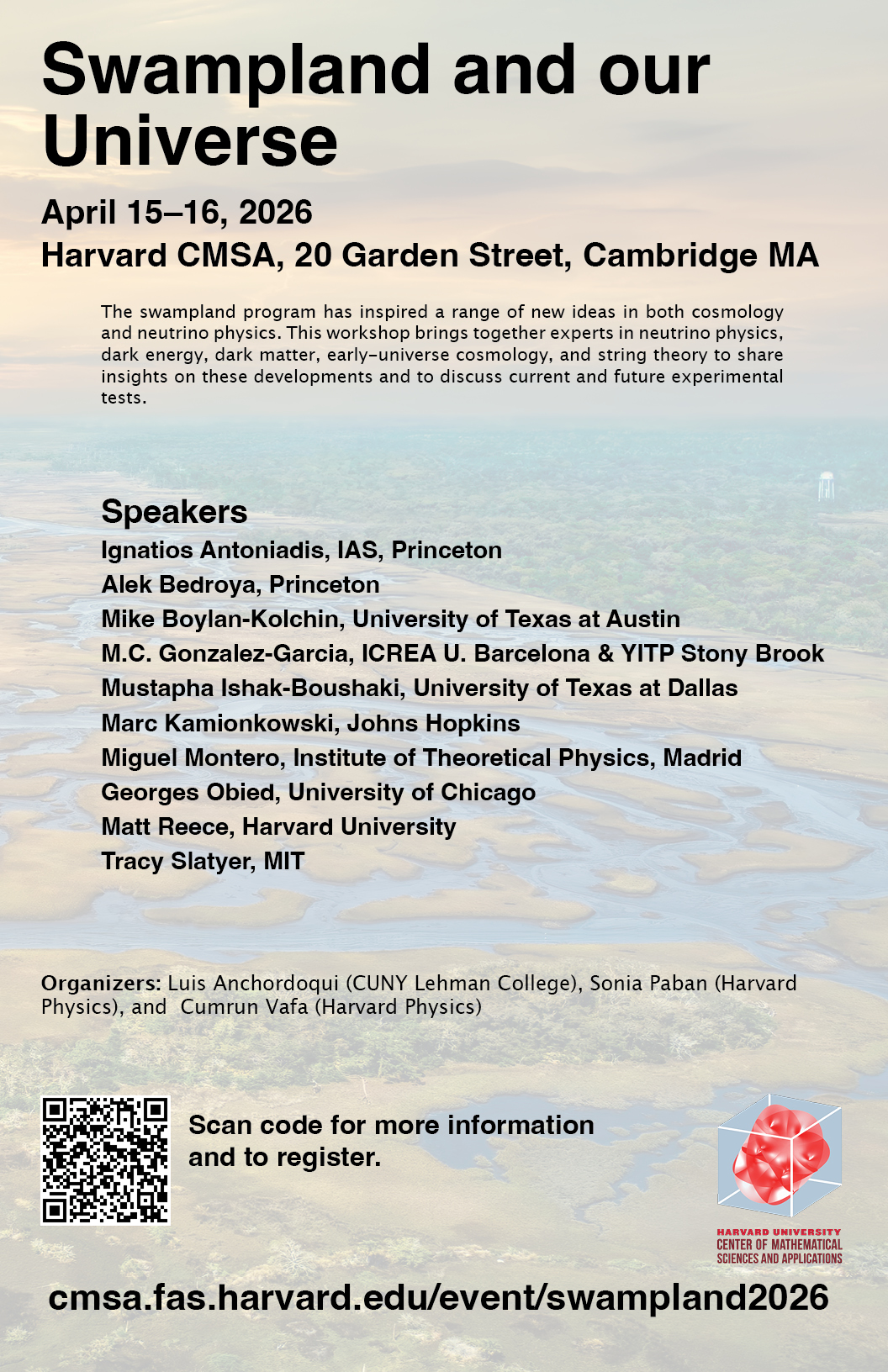
Swampland and our Universe
Dates: April 15–16, 2026
Location: Harvard CMSA, Room G10, 20 Garden Street, Cambridge MA
The swampland program has inspired a range of new ideas in both cosmology and neutrino physics. This workshop brings together experts in neutrino physics, dark energy, dark matter, early-universe cosmology, and string theory to share insights on these developments and to discuss current and future experimental tests.
Speakers
- Ignatios Antoniadis, IAS, Princeton
- Alek Bedroya, Princeton
- Mike Boylan-Kolchin, UT Austin
- M.C. Gonzalez-Garcia, ICREA U. Barcelona & YITP Stony Brook
- Mustapha Ishak-Boushaki, UT Dallas
- Marc Kamionkowski, Johns Hopkins
- Miguel Montero, Institute of Theoretical Physics, Madrid
- Georges Obied, U Chicago
- Matt Reece, Harvard
- Tracy Slatyer, MIT
Organizers: Luis Anchordoqui (CUNY Lehman College), Sonia Paban (Harvard Physics), and Cumrun Vafa (Harvard Physics)
Schedule
Wednesday, Apr. 15, 2026
8:00–9:00 am
Breakfast
9:00–10:00 am
Marc Kamionkowski, Johns Hopkins –Dark-matter dynamics and new physics
Abstract: Galactic halos that are spherical, stationary, and composed of collisionless dark matter are easy to describe mathematically. If dark matter decays or interacts or there is some departure from equilibrium or time evolution of the system, all bets are off. In this case costly N-body simulations are required. If, however, one retains the assumption of spherical symmetry, these systems can be evolved numerically with a far simpler algorithm that is easily coded run in a matter of minutes on a laptop, rather than a day on a supercomputer. I will describe this approach and illustrate with simulations of self-interacting dark matter, decaying dark matter (with and without anisotropic velocity distributions, supermassive-black-hole growth, tidal stripping, mixed SIDM/CDM models. Come prepared with your own non-standard dark-matter model; we’ll see if we can simulate it during the talk!
10:00–10:30 am
Coffee Break
10:30–11:30 am
Tracy Slatyer, MIT
11:30 am–1:00 pm
Lunch Break (catered)
1:00–2:00 pm
Alek Bedroya, Princeton
2:00–2:30 pm
Coffee Break
2:30–3:30 pm
Mustapha Ishak-Boushaki, UT Dallas: Persistent and serious challenge to the ΛCDM throne: Evidence for dynamical dark energy rising from combinations of different types of datasets
Abstract: We derive multiple constraints on dark energy and compare dynamical dark energy models with a time-varying equation of state (w0waCDM) versus a cosmological constant model (LCDM). We use Baryon Acoustic Oscillation (BAO) from DESI and DES, Cosmic Microwave Background from Planck with and without lensing from Planck and ACT (noted CMBL and CMB, respectively), supernovae(SN), and cross-correlations between galaxy positions and galaxy lensing from DES. We use pairs or triplets of datasets where we exclude one type of dataset each time and categorize them as “NO SN”, “NO CMB” and “NO BAO” combinations. In all cases, we find that the combinations favor the w0waCDM model over LCDM, with significance ranging from 2.0 to 3.0-sigma. The persistence of this pattern across various dataset combinations even when any of the datasets is excluded supports an overall validation of this trending result regardless of any specific dataset. Next, we use larger combinations of these datasets after verifying their mutual consistency within the w0waCDM model. We find combinations that give robust significance levels, with DESI+DESY6BAO+CMBL+SN giving 3.4-sigma. In sum, while we need to remain cautious, the trend and pattern of these results beyond any single type of dataset and their associated systematics presents a compelling overall portrait not in favor of the LCDM and constitutes a serious challenge to the model’s reign. A few other cosmological results will be provided.
3:30–4:00 pm
Coffee Break
4:00–5:00 pm
Georges Obied, U Chicago
Thursday, Apr. 16, 2026
8:00–8:30 am
Breakfast
8:30–9:30 am
MC Gonzalez-Garcia, ICREA U. Barcelona, YITP Stony Brook: Massive Neutrinos in 2026: What we know, what we do not know (yet?), and what we do not understand
Abstract: In this talk I will present an update of the current understanding (and some not understanding) of the neutrino masses and the lepton mixing and some other minimal SM extensions as derived from direct scrutiny of the results of neutrino flavour oscillation experiments, some other laboratory probes, and the cosmos.
9:30–10:00 am
Coffee Break
10:00–11:00 am
Miguel Montero, IFT, Madrid – Neutrinos and B-L symmetry in the Dark Dimension scenario
Abstract: The Dark Dimension proposes the existe of a micrometer-sized large extra dimension, whose size is tied to the observed small vacuum energy. I will review the scenario, and then discuss how to embed the B-L global symmetry of the SM, focusing on one possibility which leads to an explanation of the observed coincidence between neutrino mass scale and the vacuum energy scale, while leading to 3 light species of right-handed neutrinos. I will also briefly discuss potential opportunities for detection of the resulting neutrino oscillations.
11:00–11:30 am
Coffee Break
11:30 am–12:30 pm
Ignatios Antoniadis, IAS, Princeton – Searching for the dark dimension in neutrino experiments
Abstract: Micron size extra dimensions offer a possibility to explain the smallness of neutrino masses if the right-handed neutrino propagates in the higher dimensional bulk. I will discuss the theoretical framework and the experimental signatures of this proposal in present and future experiments of KATRIN prototype, aiming to measure the magnitude of neutrino masses and to search for extra sterile-type species.
12:30–1:30 pm
Lunch Break (catered)
1:30–2:30 pm
Mike Boylan-Kolchin, UT Austin – Galaxies as Tracers of the Matter Density Field
2:30–3:00 pm
Coffee Break
3:00–4:00 pm
Matt Reece, Harvard – Axions from String Theory, and String Theory from Axions
Abstract: String theory compactifications contain the right ingredients to produce axion fields that might solve the Strong CP problem or contribute to dark matter or dynamical dark energy in our universe. After briefly reviewing some of these ingredients, I will frame the inverse question: suppose that an axion is discovered, and its decay constant is measured in an experiment. Could this help us to locate ourselves in the string landscape? In particular, I will discuss how an axion could give us clues about the fundamental string scale and the scale of supersymmetry breaking.