During the 2026–27 academic year, the CMSA will be hosting a Colloquium series, organized by Tobias Schmidt, Houcine Ben Dali, Francesco Mori, and Michal Shavit.

It will take place on Mondays from 4:30 – 5:30 pm (Eastern Time) in Room G10, CMSA, 20 Garden Street. All CMSA postdocs/members are required to attend the weekly CMSA Colloquium series as well as the weekly CMSA Members’ Seminars.

To subscribe to the CMSA Colloquium Mailing list, please visit this link.

The schedule will be updated as talks are confirmed.

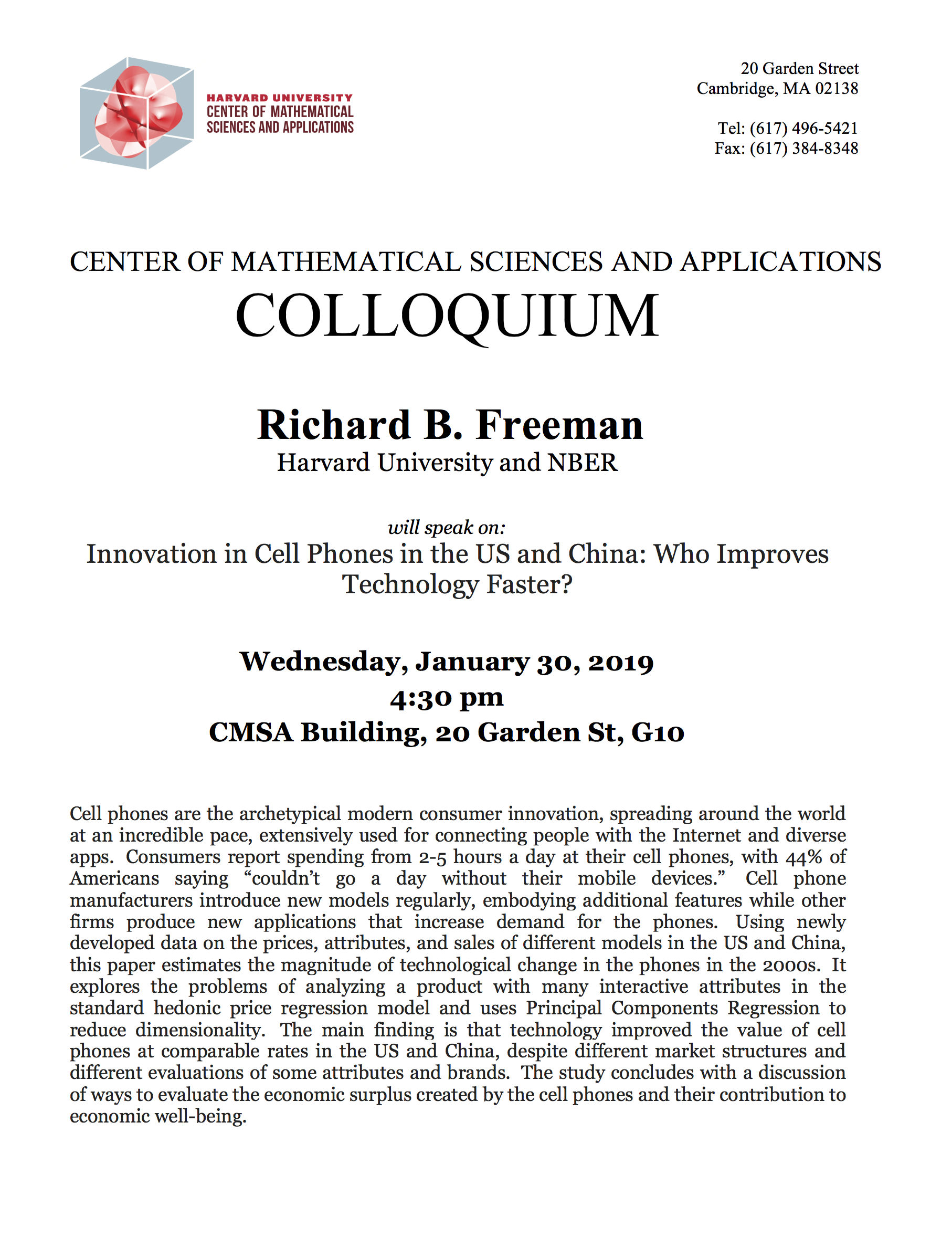
  • Innovation in Cell Phones in the US and China: Who Improves Technology Faster?

    CMSA 20 Garden Street, Cambridge, MA, United States

    Speaker: Richard B. Freeman (Harvard University and NBER) Title: Innovation in Cell Phones in the US and China: Who Improves Technology Faster? Abstract: Cell phones are the archetypical modern consumer innovation, spreading around […]
  • Inference for the Mean

    CMSA 20 Garden Street, Cambridge, MA, United States

    Speaker: Ulrich Mueller (Princeton) Title: Inference for the Mean Abstract: Consider inference about the mean of a population with finite variance, based on an i.i.d. sample. The usual t-statistic yields correct inference in large samples, […]

  • Optimally Imprecise Memory and Biased Forecasts

    CMSA 20 Garden Street, Cambridge, MA, United States

    Speaker: Michael Woodford (Columbia) Title: Optimally Imprecise Memory and Biased Forecasts Abstract: We propose a model of optimal decision making subject to a memory constraint. The constraint is a limit on the complexity of memory […]

  • Sentiment and Speculation in a Market with Heterogeneous Beliefs

    CMSA 20 Garden Street, Cambridge, MA, United States

    Speaker: Ian Martin (LSE) Title: Sentiment and Speculation in a Market with Heterogeneous Beliefs Abstract: We present a dynamic model featuring risk-averse investors with heterogeneous beliefs. Individual investors have stable beliefs and risk aversion, but […]

  • On the geometry and topology of initial data sets in General Relativity

    CMSA 20 Garden Street, Cambridge, MA, United States

    Speaker: Greg Galloway (University of Miami) Title: On the geometry and topology of initial data sets in General Relativity Abstract: A theme of long standing interest (to the speaker!) concerns the relationship […]

  • Quality Externalities on Platforms: The Case of Airbnb

    CMSA 20 Garden Street, Cambridge, MA, United States

    Speaker:  Sonia Jaffe  (Microsoft) Title: Quality Externalities on Platforms: The Case of Airbnb Abstract:  We explore quality externalities on platforms: when buyers have limited information, a seller's quality affects whether her buyers return […]

  • Hyperbolic geometry of the olfactory space

    CMSA 20 Garden Street, Cambridge, MA, United States

    Speaker: Tatyana Sharpee (Salk Institute for Biological Studies) Title: Hyperbolic geometry of the olfactory space Abstract: The sense of smell can be used to avoid poisons or estimate a food’s nutrition content because biochemical reactions […]

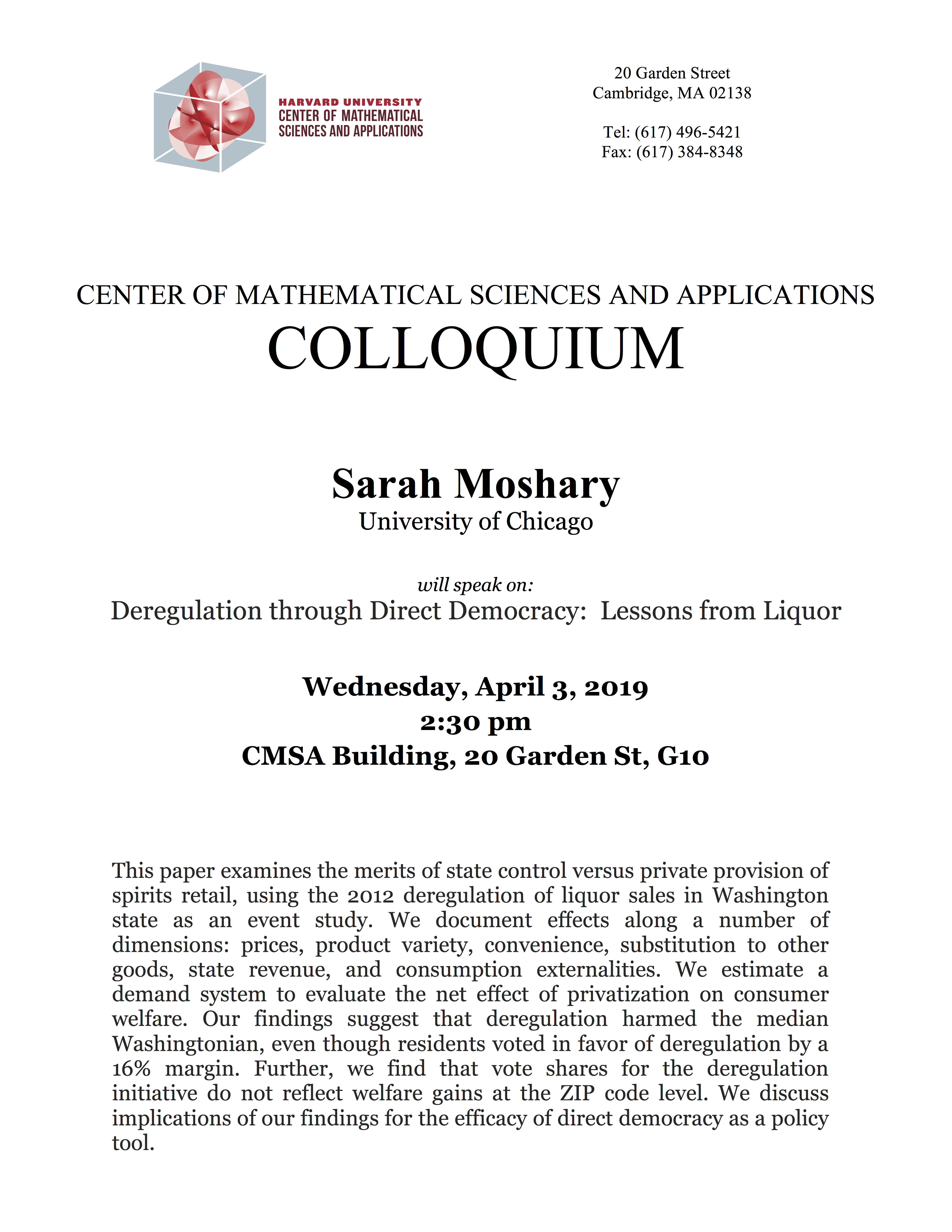
  • Deregulation through Direct Democracy: Lessons from Liquor

    CMSA 20 Garden Street, Cambridge, MA, United States

    Speaker:  Sarah Moshary (University of Chicago) Title:  Deregulation through Direct Democracy: Lessons from Liquor Abstract:  This paper examines the merits of state control versus private provision of spirits retail, using the 2012 deregulation of […]

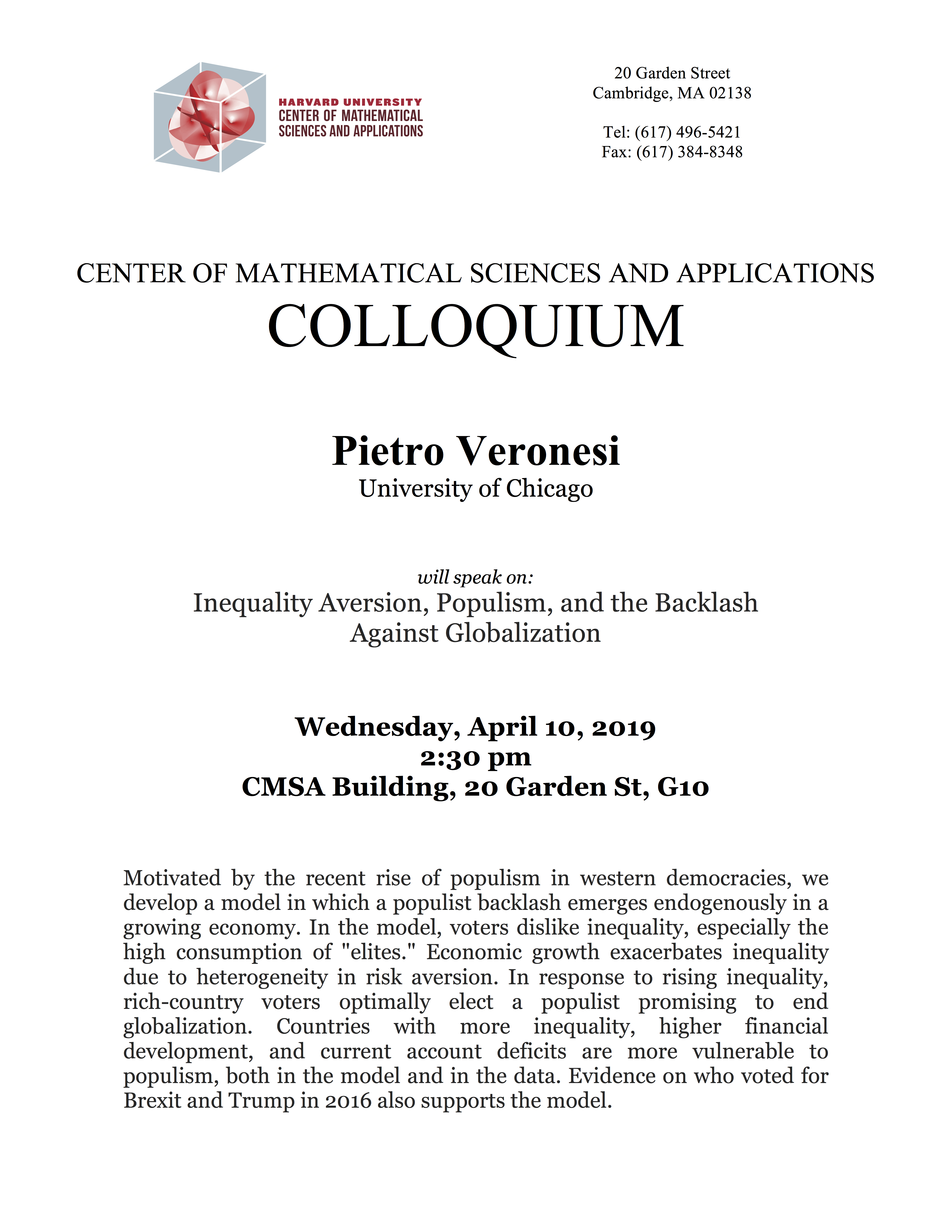
  • Inequality Aversion, Populism, and the Backlash Against Globalization

    CMSA 20 Garden Street, Cambridge, MA, United States

    Speaker: Pietro Veronesi (University of Chicago) Title: Inequality Aversion, Populism, and the Backlash Against Globalization Abstract: Motivated by the recent rise of populism in western democracies, we develop a model in which a populist […]

  • Machine Learning Physics: From Quantum Mechanics to Holographic Geometry

    Speaker: Yi-Zhuang You (UCSD) Title: Machine Learning Physics: From Quantum Mechanics to Holographic Geometry Abstract: Inspired by the "third wave" of artificial intelligence (AI), machine learning has found rapid applications in various topics of physics research. Perhaps one of the most […]

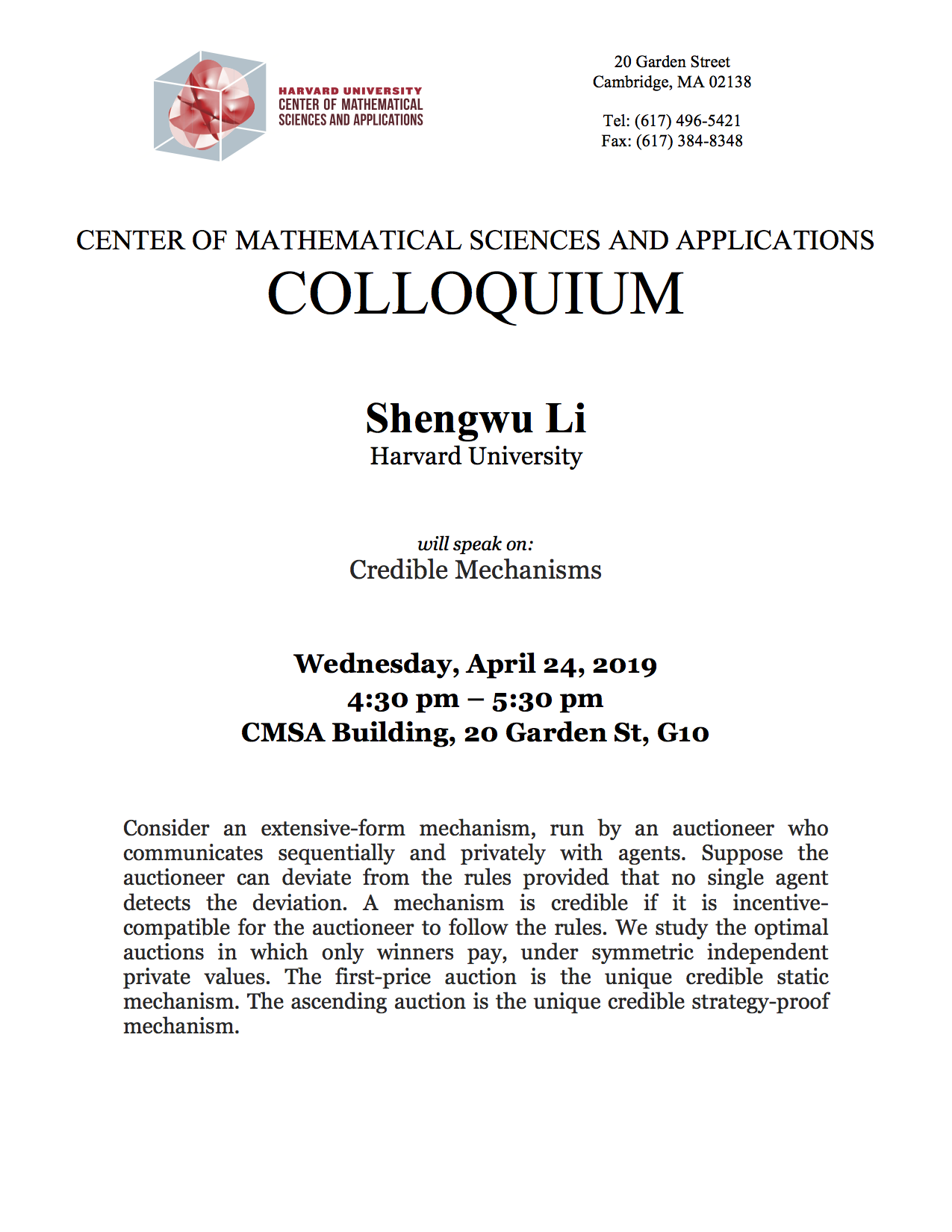
  • Credible Mechanisms

    Speaker: Shengwu Li (Harvard) Title: Credible Mechanisms Abstract: Consider an extensive-form mechanism, run by an auctioneer who communicates sequentially and privately with agents. Suppose the auctioneer can deviate from the rules provided that no single agent […]