During the 2025–26 academic year, the CMSA will be hosting a Colloquium series, organized by Tobias Schmidt, Houcine Ben Dali, Francesco Mori, and Michal Shavit.

It will take place on Mondays from 4:30 – 5:30 pm (Eastern Time) in Room G10, CMSA, 20 Garden Street. All CMSA postdocs/members are required to attend the weekly CMSA Colloquium series as well as the weekly CMSA Members’ Seminars.

To subscribe to the CMSA Colloquium Mailing list, please visit this link.

The schedule will be updated as talks are confirmed.

  • Impossibility results in classical dynamical systems

    CMSA Room G10 CMSA, 20 Garden Street, Cambridge, MA, United States

    Speaker: Matthew Foreman (UC Irvine) Title: Impossibility results in classical dynamical systems Abstract: In 1932, motivated by questions in statistical and celestial mechanics, von Neumann proposed classifying the statistical behavior of dynamical systems. In […]
  • Koszul duality in QFT

    CMSA Room G10 CMSA, 20 Garden Street, Cambridge, MA, United States

    Speaker: Brian Williams (Boston University) Title: Koszul duality in QFT Abstract: We will describe appearances of the algebraic phenomena of Koszul duality in the context of boundary conditions and defects […]

  • The analytical challenges of connectomics

    CMSA Room G10 CMSA, 20 Garden Street, Cambridge, MA, United States

    Speaker: Jeff W. Lichtman (Harvard University) Title: The analytical challenges of connectomics Abstract: Recent progress in generating synapse-level maps of brains, a field known as connectomics, brings both opportunities and challenges. The […]

  • What do topological dynamics, combinatorics, and model theory have in common?

    CMSA Room G10 CMSA, 20 Garden Street, Cambridge, MA, United States

    Speaker: Dana Bartosova (University of Florida) Title: What do topological dynamics, combinatorics, and model theory have in common? Abstract: A striking correspondence between dynamics of automorphism groups of countable first order structures […]

  • Analysis of ALH* gravitational instantons

    CMSA Room G10 CMSA, 20 Garden Street, Cambridge, MA, United States

    Speaker: Xuwen Zhu (Northeastern) Title: Analysis of ALH* gravitational instantons Abstract: Gravitational instantons are non-compact Calabi-Yau metrics with L^2 bounded curvature and are categorized into six types. We will discuss one […]

  • Homology, higher derived limits, and set theory

    CMSA Room G10 CMSA, 20 Garden Street, Cambridge, MA, United States

    Colloquium Speaker: Justin Moore (Cornell University) Title: Homology, higher derived limits, and set theory Abstract: Singular homology has a number of well-known defects when used to study spaces such as […]

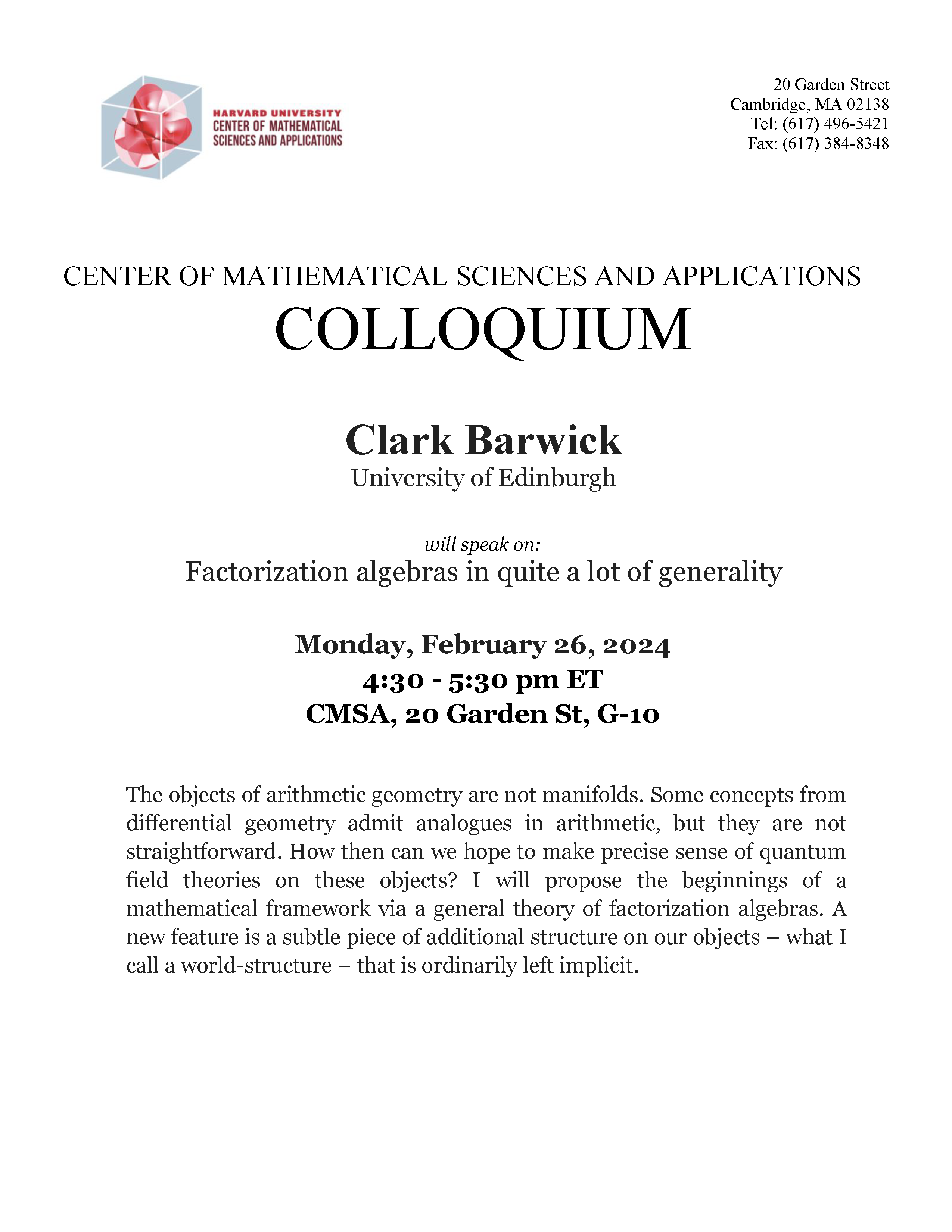
  • Factorization algebras in quite a lot of generality

    Colloquium
    CMSA Room G10 CMSA, 20 Garden Street, Cambridge, MA, United States

    Colloquium Speaker: Clark Barwick, University of Edinburgh Title: Factorization algebras in quite a lot of generality Abstract: The objects of arithmetic geometry are not manifolds. Some concepts from differential geometry […]

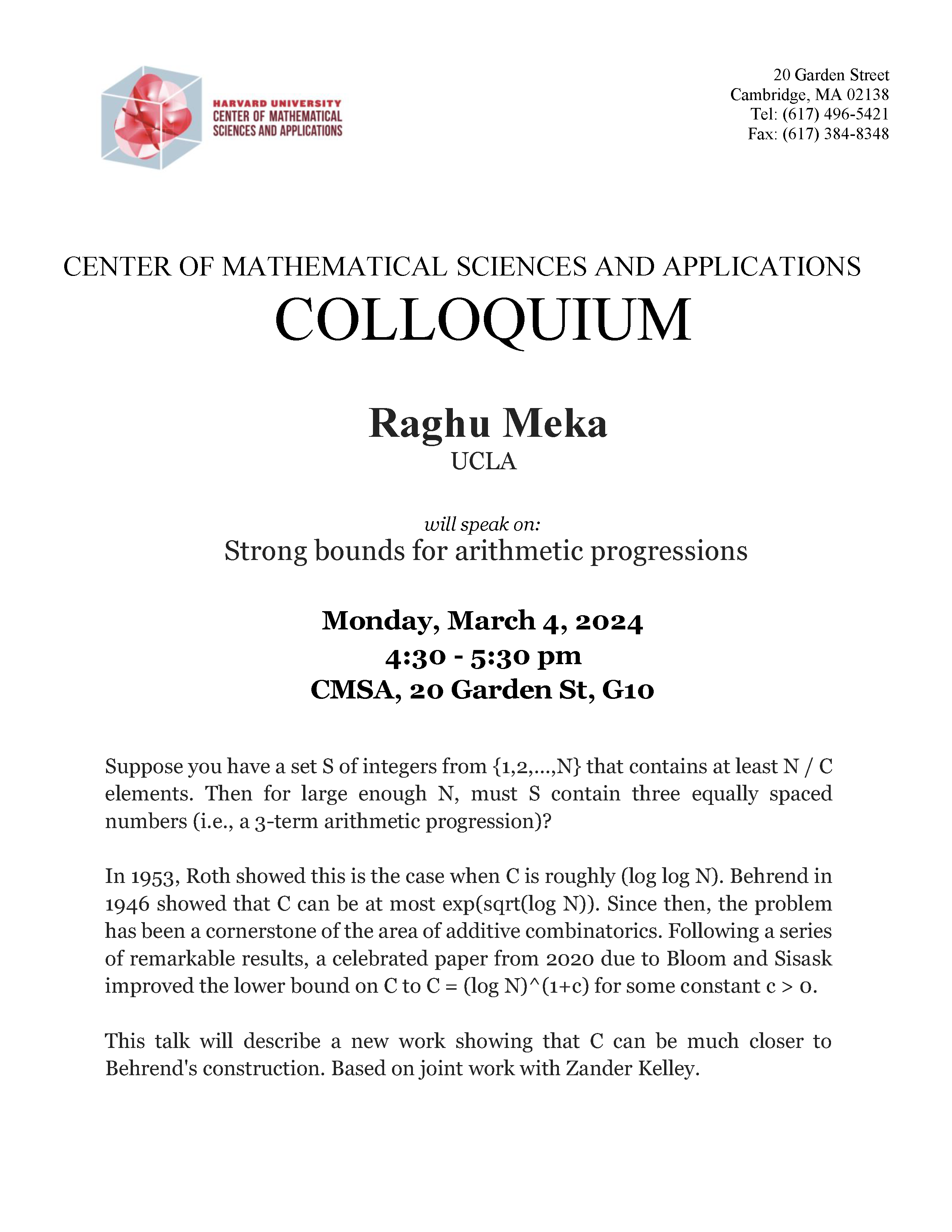
  • Strong bounds for arithmetic progressions

    Colloquium
    CMSA Room G10 CMSA, 20 Garden Street, Cambridge, MA, United States

    Colloquium Speaker: Raghu Meka (UCLA) Title: Strong bounds for arithmetic progressions Abstract: Suppose you have a set S of integers from {1,2,...,N} that contains at least N / C elements. […]

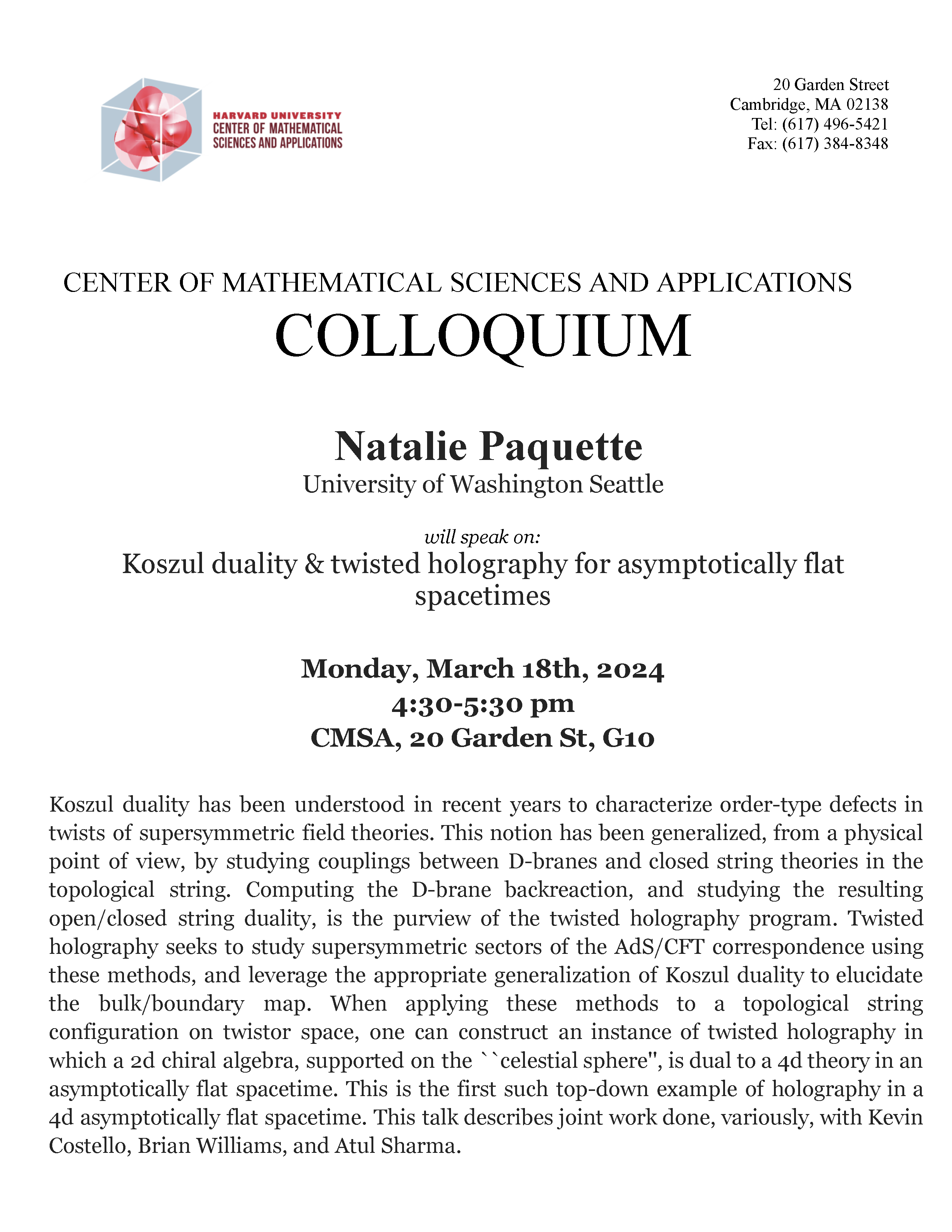
  • Koszul duality & twisted holography for asymptotically flat spacetimes

    Colloquium
    CMSA Room G10 CMSA, 20 Garden Street, Cambridge, MA, United States

    Colloquium Speaker: Natalie Paquette, University of Washington Title: Koszul duality & twisted holography for asymptotically flat spacetimes Abstract: Koszul duality has been understood in recent years to characterize order-type defects […]

  • The DNA of Particle Scattering

    Colloquium
    CMSA Room G10 CMSA, 20 Garden Street, Cambridge, MA, United States

    Colloquium Speaker: Lance Dixon (SLAC, Stanford University) Title: The DNA of Particle Scattering Abstract: At the Large Hadron Collider, the copious scattering of quarks and gluons in quantum chromodynamics (QCD) produces Higgs […]

  • Liouville Theory and Weil-Petersson Geometry

    Colloquium
    CMSA Room G10 CMSA, 20 Garden Street, Cambridge, MA, United States

    Colloquium Speaker: Sarah Harrison (Northeastern University) Title: Liouville Theory and Weil-Petersson Geometry Abstract: Two-dimensional conformal field theory is a powerful tool to understand the geometry of surfaces. Liouville conformal field […]