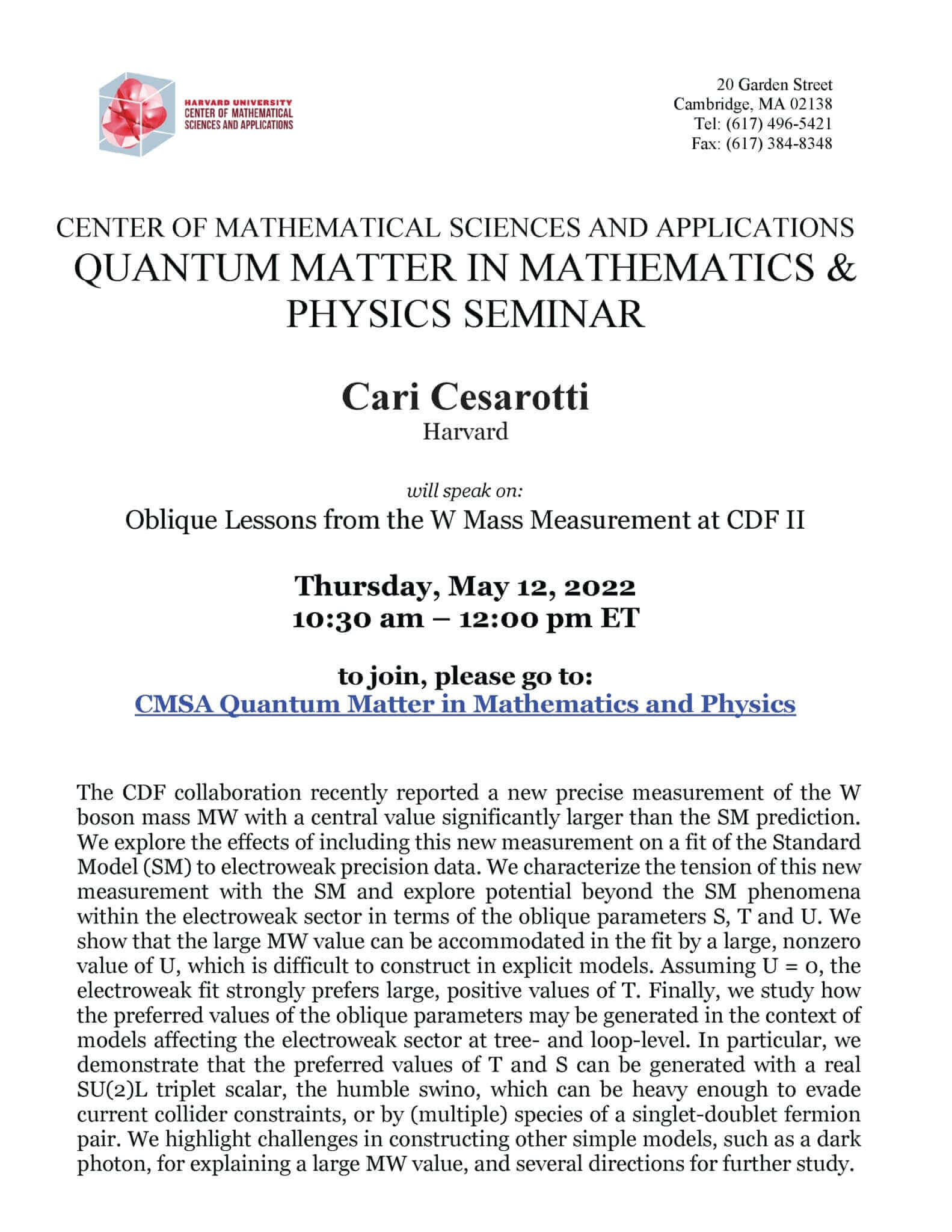
• Oblique Lessons from the W Mass Measurement at CDF II

    https://www.youtube.com/watch?v=jnWI9sCfAi0&list=PL0NRmB0fnLJQAnYwkpt9PN2PBKx4rvdup&index=11&t=2s Abstract: The CDF collaboration recently reported a new precise measurement of the W boson mass MW with a central value significantly larger than the SM prediction. We explore the effects of including this new measurement on a fit of the Standard Model (SM) to electroweak precision data. We characterize the tension of this new measurement […]
  • Geometric Models for Sets of Probability Measures

    Abstract: Many statistical and computational tasks boil down to comparing probability measures expressed as density functions, clouds of data points, or generative models.  In this setting, we often are unable to match individual data points but rather need to deduce relationships between entire weighted and unweighted point sets. In this talk, I will summarize our team’s […]

  • Cobordism and Deformation Class of the Standard Model and Beyond: Proton Stability and Neutrino Mass

    Member Seminar Speaker: Juven Wang Title: Cobordism and Deformation Class of the Standard Model and Beyond: Proton Stability and Neutrino Mass Abstract: ‘t Hooft anomalies of quantum field theories (QFTs) with an invertible global symmetry G (including spacetime and internal symmetries) in a d-dim spacetime are known to be classified by a d+1-dim cobordism group TPd+1(G), […]

  • SMaSH: Symposium for Mathematical Sciences at Harvard

    Science and Engineering Complex (SEC) 150 Western Ave, Allston, MA 02134, MA

    SMaSH: Symposium for Mathematical Sciences at Harvard On Tuesday, May 17, 2022, from 9:00 am – 5:30 pm, the Harvard John A Paulson School of Engineering and Applied Sciences (SEAS) and the Harvard Center of Mathematical Sciences and Applications (CMSA) held a Symposium for Mathematical Sciences for the mathematical sciences community at Harvard. Organizing Committee […]

  • Hypergraph Matchings Avoiding Forbidden Submatchings

    Abstract:  In 1973, Erdős conjectured the existence of high girth (n,3,2)-Steiner systems. Recently, Glock, Kühn, Lo, and Osthus and independently Bohman and Warnke proved the approximate version of Erdős’ conjecture. Just this year, Kwan, Sah, Sawhney, and Simkin proved Erdős’ conjecture. As for Steiner systems with more general parameters, Glock, Kühn, Lo, and Osthus conjectured the […]

  • Statistical Mechanics of Mutilated Sheets and Shells

    Speaker: David Nelson, Harvard University Title: Statistical Mechanics of Mutilated Sheets and Shells Abstract:  Understanding deformations of macroscopic thin plates and shells has a long and rich history, culminating with the Foeppl-von Karman equations in 1904, a precursor of general relativity characterized by a dimensionless coupling constant (the “Foeppl-von Karman number”) that can easily reach  vK […]

  • The Generalized Landau Paradigm (a review of generalized symmetries in condensed matter)

    Virtual

    https://www.youtube.com/watch?v=orT7vWJiCeo&list=PL0NRmB0fnLJQAnYwkpt9PN2PBKx4rvdup&index=10&t=15s Abstract: Recent advances in our understanding of symmetry in quantum many-body systems offer the possibility of a generalized Landau paradigm that encompasses all equilibrium phases of matter. This talk will be an elementary review of some of these developments, based on: https://arxiv.org/abs/2204.03045

  • Boundary conditions and LSM anomalies of conformal field theories in 1+1 dimensions

    Virtual

    Speaker: Linhao Li (ISSP, U Tokyo) Title: Boundary conditions and LSM anomalies of conformal field theories in 1+1 dimensions Abstract: In this talk, we will study a relationship between conformally invariant boundary conditions and anomalies of conformal field theories (CFTs) in 1+1 dimensions. For a given CFT with a global symmetry, we consider symmetric gapping […]

  • The geometry of conditional independence models with hidden variables

    Abstract: Conditional independence (CI) is an important tool instatistical modeling, as, for example, it gives a statistical interpretation to graphical models. In general, given a list of dependencies among random variables, it is difficult to say which constraints are implied by them. Moreover, it is important to know what constraints on the random variables are caused […]

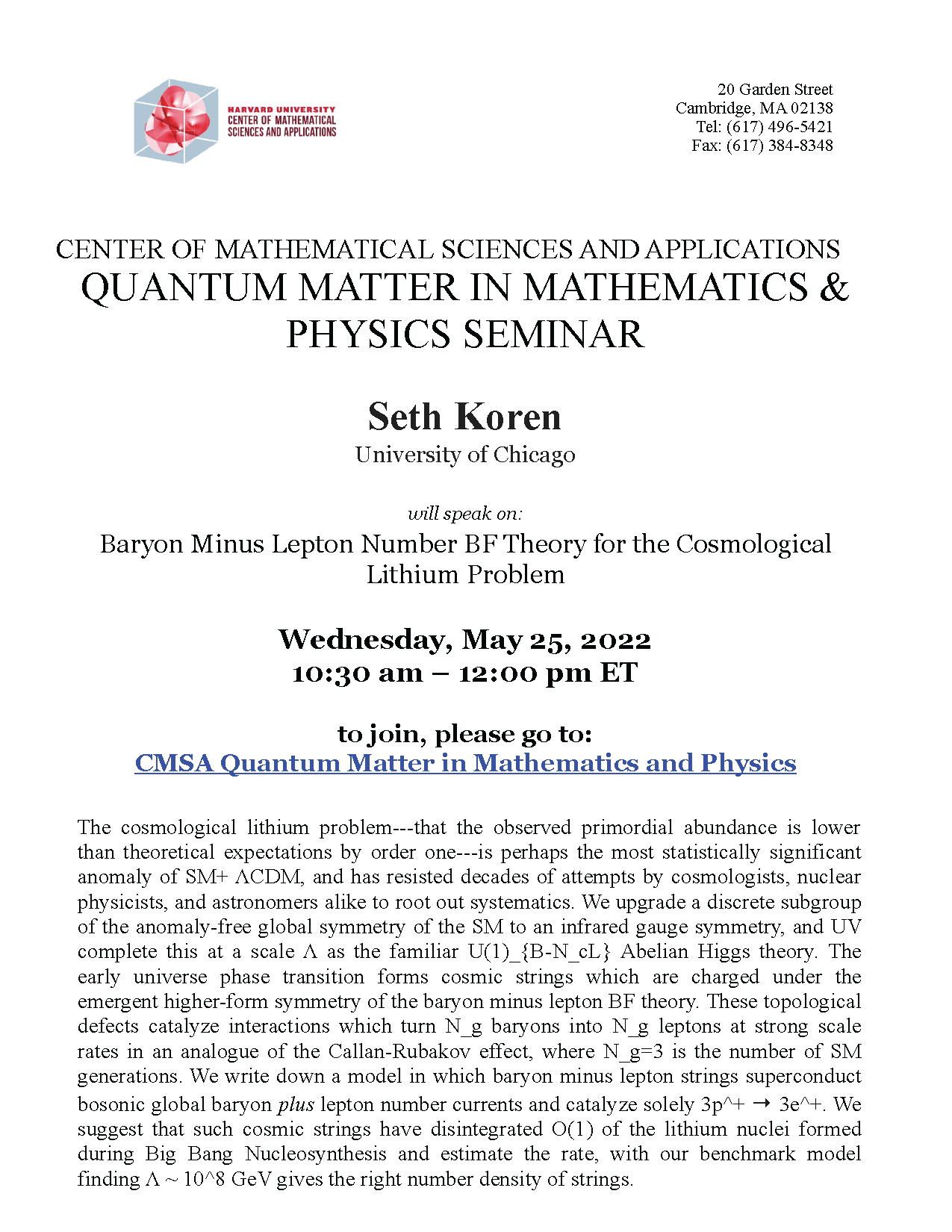
  • Oblique Lessons from the W Mass Measurement at CDF II

    Hybrid

    Speaker: Seth Koren (University of Chicago) Title: Baryon Minus Lepton Number BF Theory for the Cosmological Lithium Problem Abstract: The cosmological lithium problem—that the observed primordial abundance is lower than theoretical expectations by order one—is perhaps the most statistically significant anomaly of SM+ ΛCDM, and has resisted decades of attempts by cosmologists, nuclear physicists, and […]

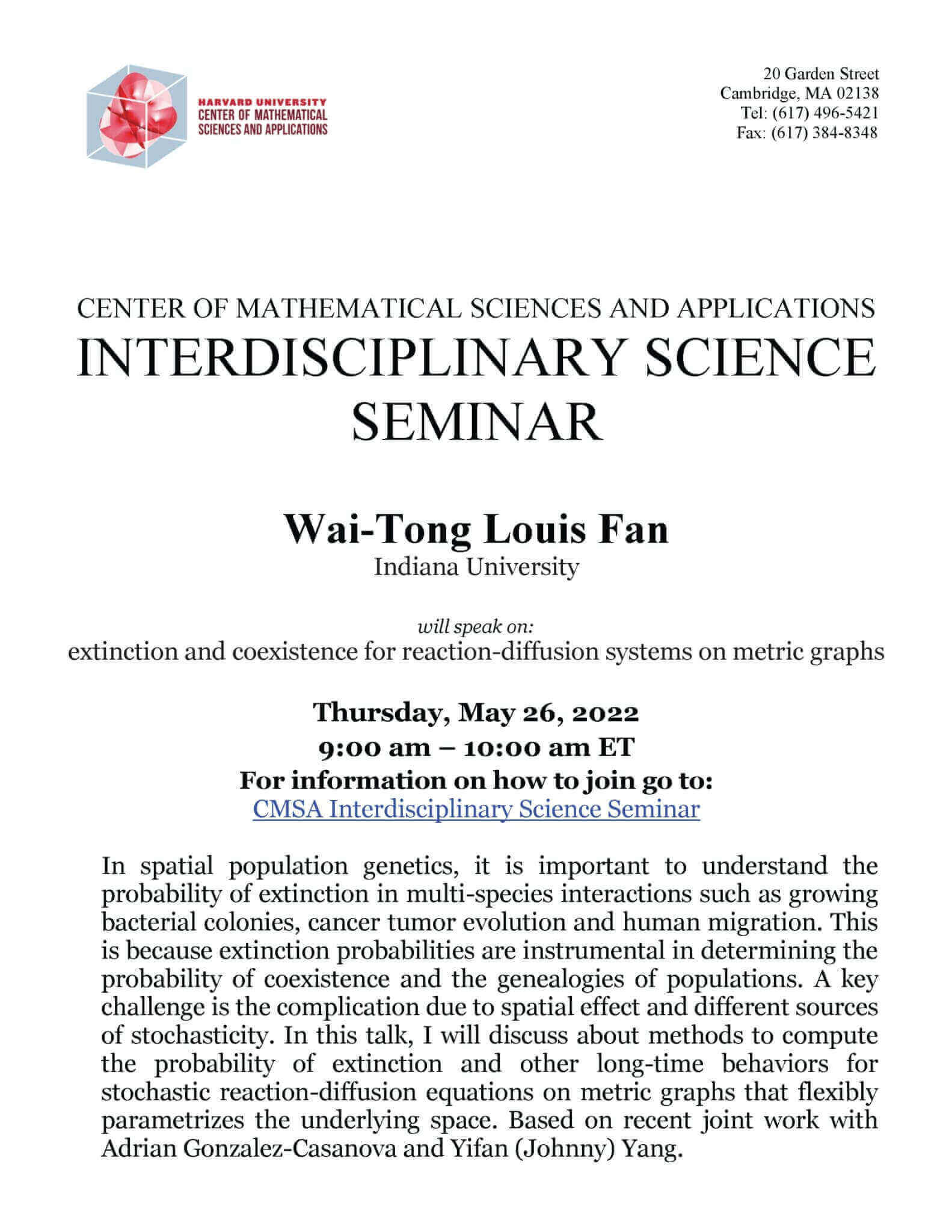
  • Extinction and coexistence for reaction-diffusion systems on metric graphs

    Abstract: In spatial population genetics, it is important to understand the probability of extinction in multi-species interactions such as growing bacterial colonies, cancer tumor evolution and human migration. This is because extinction probabilities are instrumental in determining the probability of coexistence and the genealogies of populations. A key challenge is the complication due to spatial effect […]

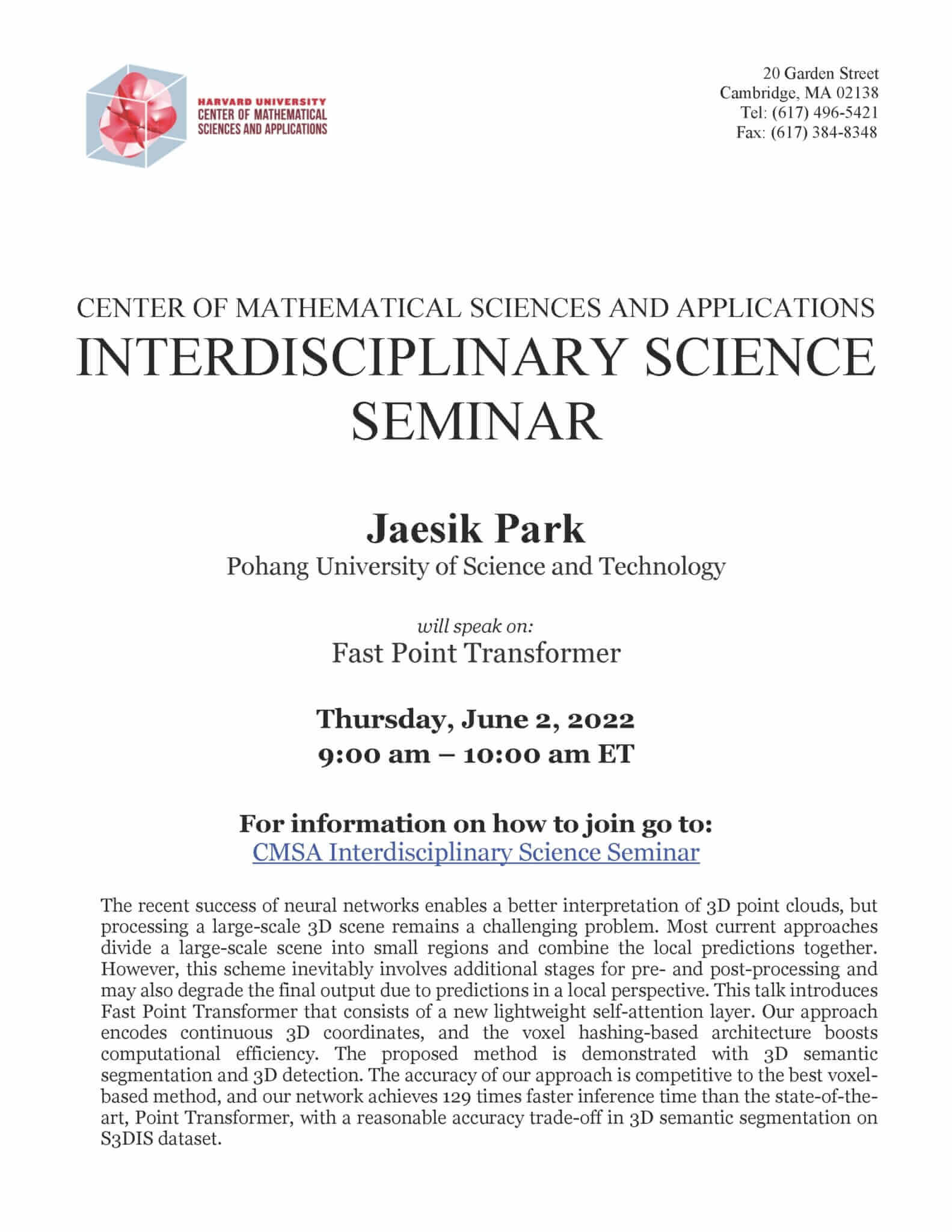
  • Fast Point Transformer

    Abstract: The recent success of neural networks enables a better interpretation of 3D point clouds, but processing a large-scale 3D scene remains a challenging problem. Most current approaches divide a large-scale scene into small regions and combine the local predictions together. However, this scheme inevitably involves additional stages for pre- and post-processing and may also degrade […]